Saturday, July 11, 2026
Home Blog Page 1404

Juneau ponders its priorities

6

MORE CHILD CARE SUPPORT OR STREET CLEANING?

By WIN GRUENING

In what has historically been a rather lackluster and tedious process, this year’s City and Borough of Juneau’s budget cycle has raised a keen level of interest in its outcome.  With further cuts at the state level expected next year and an unsustainable imbalance of expenses and revenues at the local level, our elected officials face tough choices.

It’s not clear where they are headed.

Recognizing the fiscal challenges and the newness of recently elected assembly members, city staff began tackling budget issues by developing a Fiscal Sustainability Process. The goal of the process is for the Finance Committee to provide direction to the city manager in advance of the FY21/22 budget. 

Some major issues at hand include school repairs and debt reimbursement, adding childcare as a significant ongoing expense, and Centennial Hall funding.

So far, the Finance Committee has reviewed the city’s revenue sources and debt capacity, and operating/capital expenditures, program by program – labelling each as mandatory, essential, or discretionary.

At the Nov. 2 meeting, the Finance Committee examined each of the members’ rankings of 80 different programs and projects. (Mandatory, Full Cost Recovery, and Internal Support/Service Programs were not ranked).

Results were mostly what you might expect. Discussion centered around so-called low-priority discretionary expenditures aggregated at the bottom of the list.

Public safety (JPD Patrol) was the highest-rated essential service at #1.  School CIP/Maintenance was the highest-rated CIP project at #10. Transit services were the most valued “discretionary” program at #30.  Ranked in the bottom half were discretionary programs such as those under Parks and Recreation, Eaglecrest Ski Area, and all three public libraries.

A couple surprises were the current $630,000 support for childcare programs at #34 and proposed $1 million in childcare support at #36 – both discretionary – a ranking placing them ahead of essential services like Street Cleaning at #46 and Downtown Parking at #73. 

At least one member commented that after a $400,000 hike in childcare support this year that a $1 million escalation next year was too much and should be scaled back.

Another interesting discussion focused on 23 different “revenue concepts” provided by committee members.  If at least five members favored continuing discussion on an item, it was added to a “Revenue List” for further review. This winnowed the list down to eight ideas (with estimated potential tax revenue).

  1. Additional 1% seasonal sales tax ($6.1 million)
  2. Taxing sales by/to nonprofit organizations ($2.6 million)
  3. Taxing on-board cruise ship sales ($636,000)
  4. Raising property tax by .1 mil ($500,000)
  5. Sales tax holiday – last Sunday in February
  6. Eliminating sales tax on food – offset by 1% seasonal sales tax
  7. Raising sales tax purchase cap/single service cap
  8. Collecting online sales tax ($1.5 – $5.0 million) 

The collection of sales taxes for online purchases may be controversial, but I believe this should be pursued.  Aside from the potential revenue, it helps level the playing field for local businesses that must compete with Internet retail giants.

To this list, I would only add consideration of tribal entities such as Tlingit-Haida Central Council. Currently exempt from collecting sales taxes, their recent new business activity (coffee shops and tourism venues) in Juneau compete directly with local businesses.

Another decision confronting Juneau is what to do about Centennial Hall.  In last month’s election, voters authorized a $7 million bond issue and a 2% hike in bed tax to benefit Centennial Hall. Another $4.5 million in sales taxes had previously been approved.  Together, these funds will pay for the major portion of a recommended $18 million in repairs and upgrades.   This should provide Centennial Hall revenue opportunities and reduce their existing subsidy. The Assembly would be wise to fully utilize these funds as intended.

While actual budget decisions won’t be made until later in the process, this is when ideas and concepts are being formulated.

Assembly members must balance reliance on revenue measures with serious efforts at controlling expenditures. That means not just limiting discussions to cutting low priority items but also delivering services more efficiently and monitoring whether results are being achieved.  This is particularly true with spending on schools and social services like childcare.

These issues raise tough questions – and even tougher choices to make.

Win Gruening retired as the senior vice president in charge of business banking for Key Bank in 2012. He was born and raised in Juneau and graduated from the U.S. Air Force Academy in 1970. He is active in community affairs as a 30-plus year member of Juneau Downtown Rotary Club and has been involved in various local and statewide organizations.

A governor under seige

19

By JIM DEMINT

In 2018, Alaska elected conservative state Sen. Michael Dunleavy as the state’s 12th governor. Dunleavy’s story is pretty straightforward: He legislated as a conservative, campaigned as a conservative, and for the last year has governed as a conservative.

In Alaska in 2019, “governing” has meant fiscal seriousness. Everyone knows the story. As the price of oil has fallen, so have tax revenues derived from oil leases.

The state’s larger-than-expected budget shortfall is not anyone’s fault, but it is elected officials’ responsibility to deal with it. Like most legislatures — very much including the U.S. Congress — the Alaska Legislature was reluctant to restore fiscal discipline if it meant spending cuts, even though the state’s damaged credit rating demanded it.

And so, Gov. Dunleavy did exactly what he promised to do and exactly what Alaska’s governor — empowered with a line-item veto for this very purpose — is supposed to do: He led. He first worked with the Legislature to find savings. But in politics, no one wants to be proverbial skunk at the garden party. And so, when legislators refused to deal with the budget crisis, Gov. Dunleavy used his line-item veto power to cut spending himself.

Alaska partisans, who launched a campaign to recall Gov. Dunleavy within months of his being sworn into office, used the budget reductions to inflame and co-opt public opinion in support of their politically motivated attempt to nullify the results of the 2018 election.

On Nov. 4, the Division of Elections rejected the recall petition because it failed to meet even the most basic standards required under the law. The recall process is designed to protect the state from corrupt or unfit officials; there is no such case against Gov. Dunleavy. The recall petition does not accuse Dunleavy of malfeasance, just fiscal discipline. Improving the state’s economic climate and plummeting credit rating are not crimes.

As John F. Kennedy famously said, “To govern is to choose.” Too many politicians — in Washington, in Juneau and every elected government around the world — prefer not to choose. They prefer to avoid difficult decisions. They prefer to talk rather than act. They prefer to be like pundits on TV, criticizing other people’s decisions rather than making their own. I served in Congress for 15 years, and I know. With responsibility comes accountability — angry phone calls, rowdy town halls, difficult re-election campaigns.

The Founders understood this was a fatal temptation of democracy. That’s why the Constitution they wrote requires the men and women who win elections to take an oath — a solemn promise — to fulfill the duties of their new job.

Gov. Dunleavy used his line-item veto not simply to cut the state’s budget, but to finally draw state legislators toward bipartisan compromise on overdue reforms. His efforts resulted in a significant cut in the state’s budget deficit in one year.

Fiscal discipline, like physical therapy after a necessary surgery, can hurt. But it pays manifold dividends in the long run. In response to Gov. Dunleavy’s budget leadership, the Alaska economy has added jobs, family income is rising quickly and the state’s unemployment rate is falling to historic lows.

The budget crisis presents Alaska with a challenge. Gov. Dunleavy met that challenge with transparency and honesty. While his critics sought to exploit the situation, he worked to solve it. That kind of leadership deserves respect, not recall.

Jim DeMint is a national conservative leader who is the Chairman of the Conservative Partnership Institute. DeMint represented South Carolina in the U.S. House (1999-2005) and U.S. Senate (2005-2013).

Louisiana lesson for Alaska: Jungle primaries lead to this

10

A liberal Outside group wants Alaska to model its primary system in part after Louisiana’s jungle primary, an election design that has all candidates on the same ballot regardless of party, and all voters, regardless of party affiliation, having access to the entire ballot. Political parties can’t close their primaries to those registered with the party, something that Republicans do in Alaska to prevent Democrats from crossing over and voting for false-flag Republicans.

The jungle primary is why the current gubernatorial election in Louisiana is dragging on — today is a runoff election because neither  incumbent Democratic Gov. John Bel Edwards or leading Republican Eddie Rispone won 51 percent of the vote on Oct. 12. The two were the top finishers, with Edwards winning 47 percent of the vote, and Rispone having to fight for a runoff spot with other Republicans in the race.

The challenge for candidates is to get their supporters to go to the polls twice within a few weeks is just one of the unfortunate consequences of jungle primaries. Runoffs are expensive.

The group trying to force jungle primaries into Alaska would solve that problem by having an “instant runoff,” where people rank their choices on the ballot, and a computer calculates and recalculates the winner by reassigning votes depending on the rankings. If the first choice of the most voters doesn’t reach a majority, the computer retabulates the second, third, and fourth choices until one candidate reaches more than 50 percent.

One of the biggest complaints with ranked voting is that it’s confusing for voters. It also depends on the computer program that does the counting and recalculating. Critics say it’s trying to fix something that isn’t broken.

Paid professionals are now gathering the signatures across the state to force onto Alaska’s ballot the transition to jungle primaries combined with instant-run-off ranked voting — a combination of voting changes never tried in any other state.

The initiative is heavily funded by liberals trying to turn the state blue, because Alaska is a cheap and easy state to take advantage of with the initiative process that gives Outside groups an oversized influence. To date, no Alaska group has formed to explain to voters the motives and methods of the Outside group that calls itself “Better Elections,” although it’s clear the Alaska Republican Party has the most to lose.

Here’s how the reasoning is explained in the Daily Kos, a far-left political news site:

“A top two primary system is supposed to theoretically elect more moderate candidates, as winning could require appealing to voters of both parties.  It also supposedly makes the general election more competitive.  As an example, suppose you are a Democrat living in a very Republican district where the Democrat has no chance of winning a general election.  In the primary, you now can still vote for the Democrat like you normally would in the primary, but in the general election when the top two Republicans are the choice, you can vote for the more moderate Republican and have an influence on the election.”

This would work very well for Democrats in Alaska, who could vote for the more moderate Republicans, ones who would create bipartisan coalitions such as the one operating the Alaska House of Representatives today.

The gubernatorial runoff in Louisiana today is considered a razor-thin race, with Edwards having the advantage of incumbency. Alaskans interested in the upcoming possible changes to Alaska’s election system may want to pay close attention.

Resigning, but optimistic

12

By BRUCE TANGEMAN

I know this message may be getting old for some, but many Alaskans have lost perspective on the positive position we find ourselves in. Yes, we’ve suffered through some serious “political paralysis” over the past year, but the message is worth repeating.

Alaska truly is blessed with amazing resources and a healthy balance sheet. Our permanent fund is approaching $70 billion and spins off annual revenue supporting 50% of government spending as well as a cash dividend to every Alaskan who qualifies.

We are expecting final investment decisions in the near future on two projects that will add 250,000 to 300,000 barrels per day to the pipeline. We are the envy of most states and many small countries for that matter. The frantic, sometimes unhinged debate that has taken place over the past year would lead outsiders to think our economy is on par with many of the bankrupt states in the Lower 48. Nothing could be further from the truth.

While painful, this healthy debate over the past year is necessary and was a long time coming. Like it or not, Governor Dunleavy did exactly what he campaigned on: reduce the massive size of government, fight for a full PFD, and not take hard-earned cash from your pocket through new tax schemes. Governor Dunleavy still believes in these principles. Over the past several decades we have been blessed with the ability — and cash — to be all things to all people.

Many have come to realize that we had one helluva run, but things must change. Many others think this gravy train can just keep on chugging. However, Alaska can no longer afford the budgets that were constructed and funded through one revenue stream over the past 30-plus years.

The discussion is turning more and more toward taxes. I’ll admit that I’m on the record stating that someday Alaska will have a broad-based tax. However, I always followed up that opinion by stating this decision should be years if not decades down the road, well past my tenure as commissioner of revenue.

Step one must continue to be fiscal discipline in order to get our spending habits adjusted. That must be accomplished well before we implement any sort of tax. My concern is that once a tax is on the books, the budget in place at that time will be the new base going forward. Cutting below that will be nearly impossible and the budget will only go up from there.

I believe our population and workforce is far too small to provide the level of revenue we would need to extract from working Alaskans in order to continue a “business as usual” approach to budgeting that includes the PFD. We’ve all heard the many angles and perspectives on the PFD: It’s a God-given right; it’s a welfare check; it’s free money; reducing it is a “tax”; it’s our birthright.

Regardless of where you stand on the PFD issue or government spending in general, it all comes down to math. The math is simple but unfortunately does not balance despite the governor’s best efforts: Government spending and services + PFD does not equal currently available revenue. I give Governor Dunleavy tremendous kudos for tackling the government spending issue and trust he will keep up the battle he has undertaken.

As the commissioner of revenue, I look at any potential tax implementation and its interaction with the current revenue streams and budget expenditures as a fairly simple exercise. The politics and policy are extremely difficult but the math is simple: A new tax means the department I’m responsible for will have to stand up a bureaucracy in order to extract revenue from the private sector. Or in the case of an oil tax change, take more money from the companies that are willing to invest the billions we as a state do not have yet is required to monetize our resources. Any new tax will be used to sustain this unsustainable budget, as well as provide the revenue to distribute PFD checks every October as the Department of Revenue has done for 38 years.

When I accepted the job of revenue commissioner I did so based on a path forward in which the math equation allowed for the available revenues to be split between a healthy but reduced government and provide net-positive revenue to Alaskans through the PFD. It is apparent that many have not accepted the realization that our three decades of spending patterns cannot continue.

I have loved serving the state of Alaska and Governor Dunleavy as commissioner of revenue. I’ll never forget the very sage advice Governor Dunleavy gave to his commissioners at one of our first Cabinet meetings. To paraphrase, he said, just run our departments. Don’t let the policy/politics swirling around get in the way of us doing our most important job… serving Alaskans.

I have been blessed with the best department in the entire state and really wish it was that simple. But my department will be at the heart of all discussions this session as it usually is, and I want the governor to have someone who is 100% aligned with his vision. I have therefore notified the governor that I will be resigning from his Cabinet.

I will continue in my position for as long as he needs so a smooth transition can take place. I will remain optimistic about Alaska’s future but we must agree to start walking down this path together not for our own perceived immediate needs but for the tremendous future that I believe Alaska will continue to have.

Bruce Tangeman was appointed commissioner of the Department of Revenue in late November 2018. He previously served as policy director for the Alaska Senate majority, vice president and chief financial officer of the Alaska Gasline Development Corp., and deputy commissioner in the Department of Revenue during the administration of Gov. Sean Parnell.

Breaking: Revenue commissioner resigns

10

Department of Revenue Commissioner Bruce Tangeman has resigned. 

“Bruce has dedicated a significant portion of his life to public service and I thank him for the outstanding work he has done within my administration. His leadership and oversight of the Department of Revenue enabled many lasting changes and efficiencies. His character and strong work ethic have been a valuable asset to our team,” said Governor Dunleavy. “I wish him all the best for his future endeavors.”

Commissioner Tangeman will oversee the rollout of the upcoming Fall Revenue Forecast and the FY2021 Budget, and continue in his role until a replacement is found to ensure a smooth transition.

Tangeman joined the Administration last year after serving as policy director for theAlaska Senate majority, and vice president and chief financial officer of the Alaska Gasline Development Corp. He was deputy commissioner in the Department of Revenue in the Parnell administration.

Data point: Crooked Creek homicides equal 2% of residents in 90 days

2

Alaska State Troopers arrested a 30-year-old Crooked Creek man on Saturday, charging him with first degree murder in the death of a 26-year-old family member.

Troopers say Ronald Waskey and Evan Waskey were involved in an altercation, during which Evan died. Ronald was arraigned Monday and is now in custody at the Yukon Kuskokwim Correctional Center.

On Sept. 23, Troopers arrested 29-year-old Harold M. Gregory, after a woman’s body was found at a residence in Crooked Creek six weeks earlier. Gregory is being held on a Murder II charge in the Yukon Kuskokwim Correctional Center.

Crooked Creek has been losing population. A decade ago, it was home to more than 135 people. This year it has — or had — a population of about 94, according to the State Division of Community and Regional Affairs, which means the village has lost two percent of its population to murder in the past 90 days.

To compare, if Anchorage had seen a 2 percent murder rate, that would be more than 5,800 murders in the last 90 days.

Statewide, it would be as if 14,200 Alaskans had been knocked off since August.

Instead, Anchorage is aghast because the murders this year have totaled 26 known homicides so far. That’s closing in on last year’s total of 28 in the municipality.

[Read: 11th murder puts Anchorage ahead of pace from 2018]

Two murders in 90 days, is a relatively small number for those on the road system worried about the triple homicide this month in Wasilla. Anchorage is averaging more than two per month.

But for rural Alaska villages like Crooked Creek, the isolation, close family relationships, and lack of law enforcement make it especially troubling when two people end up dead, and another two end up in jail. Between the two, and the two accused in their deaths, four percent of the village was somehow directly involved in a murder since August, not counting the parents, siblings, cousins, and extended family of the victims, who suffer the grief and sorrow. There are very few last names in a rural Alaska village, and only 31 families altogether.

Crooked Creek, 120 miles up the Kuskokwim River from Bethel, is served by the Village Public Safety Officer program through the Association of Village Council Presidents. But the village tribal government has no public safety facilities of any kind, according to AVCP’s assessment of public safety.

Camarena turns himself in

1

Juan Camarena, wanted in connection with a Nov. 2 triple homicide in Wasilla, called the Alaska State Troopers and arranged to meet at a Wasilla location, where he was taken into custody Thursday at 11:30 am. He was brought in on an unrelated warrant relating to federal charges.

Troopers had put out a notice asking the public’s help in locating the 51-year-old Californian, after three bodies were found off of KGB and Knik Knack Mud Shack Road.

[Read: Who is this Juan Camarena? Sought in connection with triple murder]

Do state deadlines matter? Cannabis chocolatier wants to know if regulator cares

11

TAKES COMPLAINT TO OMBUDSMAN

Dave Lanning co-owns a small cannabis manufacturing business in Fairbanks. Among the product lines at Arctic Bakery are dark chocolates infused with cannabis.

Lanning wants to branch out. In addition to plain dark chocolate, for which he has a permit from the Alaska Marijuana Control Office, he wants to sell orange-flavored and raspberry flavored cannabis chocolates.

He sent his application in to the AMCO two days before the Oct. 25 deadline so his product could be considered during this week’s board meeting, which started Wednesday.

The small-business owner was surprised, then, to find his application had not been included on the agenda. “Why?” he asked the staff. Because they didn’t have time to get to it, he was told.

His application to allow him to add a drop of orange flavoring to a piece of chocolate would not be heard until 2020.

That means that even though Lanning complied with a state deadline, he’ll miss the Christmas holidays for his confections. It’s not catastrophic, he said, but it’s also not an insignificant financial setback to have to delay this product until next year.

“I was stunned to pick up the agenda and see that only two of the 32 applications were on it,” he said.

Lanning took his complaint to the board on Wednesday, only to be told by Board Chairman Mark Springer that Lanning should have gotten his application in “earlier.”

Lanning has no idea what defines “earlier.” Two weeks? A month before the deadline? Why even have a deadline? he wondered.

The staff is working hard, Springer said, defending the executive director (who was fired later in the meeting).

[Read: Marijuana board votes out agency director]

Lanning was unsatisfied with that answer and filed a 45-page complaint with the State Ombudsman documenting his application and communications between himself and AMCO staff.

From the perspective of a business owner, if there’s a published deadline, the regulated industry has the right to expect the agency to do its job, he said.

Must Read Alaska has learned that there are multiple positions at AMCO that are funded but unfilled under the leadership of the former executive director Erika McConnell. Additionally, the office is supposed to be funded through fees and taxes on industry — an industry that can’t get permits in a timely way.

Lanning’s story was one of several brought up this week to describe the disappointment that the marijuana industry has with the AMCO level of service to the fledgling industry. Business owners also fear retaliation, especially from the previous director, who was described to Must Read Alaska by some as vindictive.

McConnell was replaced with Glen Klinkhart on Thursday.

[Read: Marijuana agency hits restart button with new chief: Glen ‘Fix It’ Klinkhart]

Lacy Wilcox, the president of the Alaska Marijuana Industry Association, spoke to the board this week about the rapidly growing industry and its need for an effective and responsive regulatory agency.

“We perhaps more than anything, hope for recognition that the industry is comprised of hard-working Alaskans, with few exceptions, who perhaps more then any other sector are ‘all-in’ and stand ready to work with regulators to create a sustainable and fair business environment. In that vein, those dedicated entrepreneurs are asking for respect and courtesy from our regulators and wish that the days of being treated like a criminal can finally end,” she said.

The association published a statement on Thursday acknowledging the right of the Marijuana Control Board to change the leadership at the
Alcohol and Marijuana Control Office, but called out Chairman Springer and Vice Chair Loren Jones for claiming the industry seeks less regulation.

“We have in fact never asked for that. We seek consultation. Industry professionals are experts on how the cannabis plant is grown, processed, sold, and consumed. We have submitted public comment on several occasions asking AMCO to conduct meaningful consultation with the industry. Blatant disregard for industry input will only result in regulations and guidelines that hinder commerce and fail to protect public health and safety.”

Wilcox has asked the board to help improve communication to licensees — more transparency with board meetings, timely meeting minutes, audio archives, guidance documents, efficient teleconference providers, clearly written AMCO advisories, and an archive of regulatory bulletins.

“When communication is lacking, and when guidance isn’t easily available, mistakes happen. When mistakes happen, a trusting industry to regulator relationship could benefit from self-reporting. This has proven to be a bad idea for licensees fearful of heavy-handed enforcement. We ask that reasonable judgement be used to guide and assist business into compliance rather then push licensees back under the rock they invested their livelihoods to come out from under. We look forward to a future when this industry is treated as it should be, as a vibrant new player in the fabric of Alaska’s economy,” she said.

As for Lanning’s complaint to the Ombudsman, he had three main points:

  • The AMCO agency fails to honor published deadlines and perhaps fails to understand the common definition of a deadline.
  • This is typical of the way AMCO has been operating, and demonstrates bad faith and a habitual disregard for published notices.
  • AMCO staff knows it has an effect on the family businesses they regulate, but their actions demonstrate an uncaring attitude.

Not so fast: No speedy court date for recall group

7

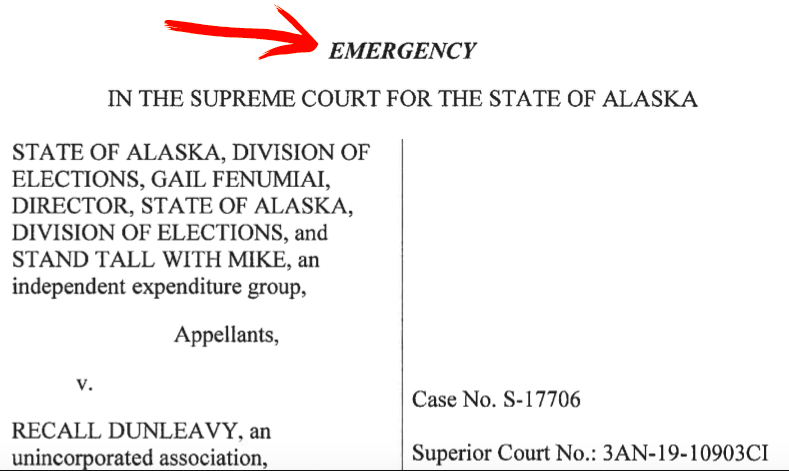
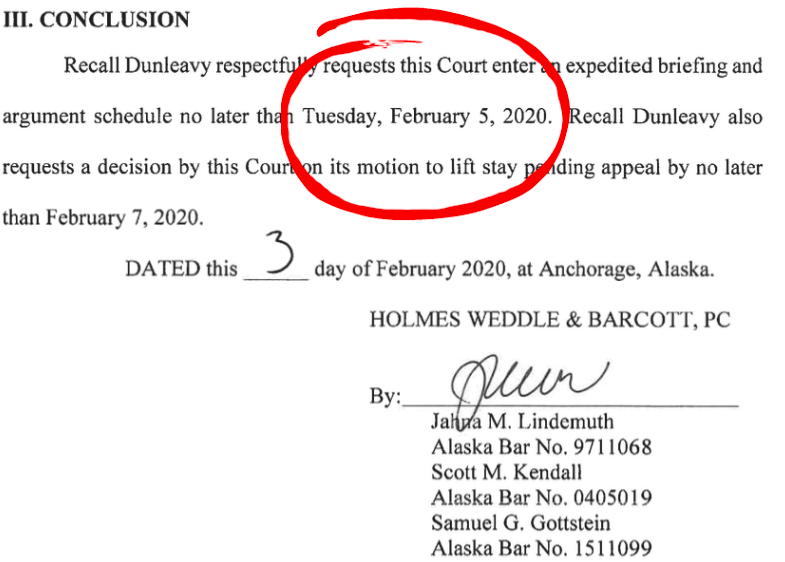
The Recall Dunleavy group was out of luck today in front of Superior Court Justice Eric Aarseth, who set the court date 10 am on Jan. 10 to hear the merits of the recall petition application, which was denied this month by the Division of Elections.

The pro-recall lawyers argued that with an expedited schedule, they would be able to get enough signatures to force a recall election by spring, before the next state budget is issued. The FY 2021 state budget seems to be the group’s main argument for asking for the court date for December.

To ask for an expedited schedule, the petitioners have to show actual harm, so the recall group did its best, but the real harm they were trying to avoid is having their base of support fizzle. Also, they want a special election, rather than having a recall put onto the General Election ballot next November. A court case dragging out is a bad thing for their strategy.

The judge today seemed to have understood the difference between real harm and contrived harm.

Arguing on behalf of the Division of Elections was Assistant Attorney General Margaret Paton-Walsh and the Stand Tall With Mike attorney, Brewster Jamieson. The newly formed STWM group has joined the case officially and hired former Gov. Bill Walker Attorney General Craig Richards as counsel in addition to Jamieson.

The State argued that a case as important as a precedence-setter like this one shouldn’t be decided in haste.

Appearing on behalf of the pro-recall group was former Gov. Bill Walker Chief of Staff Scott Kendall and former Walker’s Attorney General Jahna Lindemuth, two ambitious political attorneys who are relaunching their legal careers after Alaskans voted them and their governor out of office one year ago.

The January hearing will determine if the Attorney General and Division of Elections acted properly by denying the application on the basis of it lacking any legitimate cause for recalling the governor.

Oral arguments on Jan. 10 are scheduled for two hours. Meanwhile, briefings will take place over the next two months, with motions and cross motions for summary judgments, agreements made ahead of time that address basic legal issues that don’t involve disputes about facts.

A decision can be expected toward the end of January, and a date with the Alaska Supreme Court could come in March, at the court’s discretion. The final decision by the Alaska Supremes will determine if the recall advocates can proceed to collect the 79,000+ signatures they need to force the matter into a special recall election.

Alaska Statute says that if the court decides they can collect the signatures, and if they actually do collect them, the Division of Elections then has 30 days to verify those signatures. The division would then set an election no sooner than 60 days and no later than 90 days after notifying the petitioners of the certification of the signatures.

The pro-recall group is hoping to get a special election set before the August primary; it would work to their benefit to not be lumped with other items on a regularly scheduled election, but to only attract a highly motivated and angry voter.

[Read: New judge named for recall hearing]