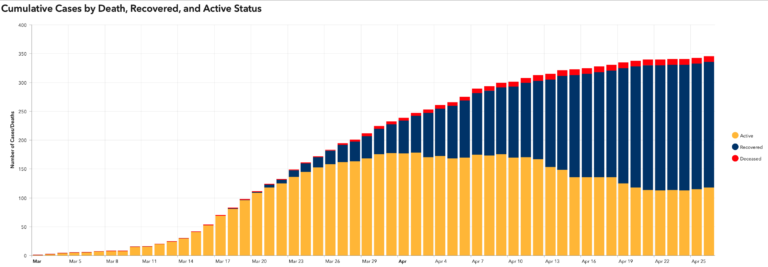
Six new Alaska cases of COVID-19 coronavirus were diagnosed in the 24-hour period that ended at midnight on Monday.
There were no new hospitalizations or deaths reported; those still stand at 37 and 9 respectively of the 351 cases that have been diagnosed among Alaskans. There are currently 16 people hospitalized in Alaska with the illness.
The six new cases were in Anchorage (4), Petersburg (1), and Fairbanks (1)
To date, 228 Alaskans have recovered from the coronavirus that started human-to-human transmission in Wuhan, China and made its way across the world, infecting Americans in January.
17,089 Alaskans have undergone swab testing for the Wuhan coronavirus, which works out to more than one in every 50 Alaskans.
The total count of all cases that were ever diagnosed among Alaskans is as follows:
When the chairman of Tyson Food tells America “the food supply chain in breaking” after multiple meat processing plants across the country are shuttered because of the coronavirus pandemic, it is time to pay attention.
Alaskans should be paying even more attention than most during the ongoing crisis. We find ourselves at the end of a very, very long supply chain.
At one point, some time ago, food security in Alaska was a big deal. Former Gov. Sean Parnell in 2013 set up the Alaska Food Resource Working Group, composed of eight state agency commissioners. It was to recommend policies to increase the purchase and consumption of local wild seafood and farm products and encourage collaboration among fisheries, consumers, Alaska farmers, state and tribal entities, and consumers.
Parnell’s goal was to make Alaska more self-reliant when it comes to food, and more prepared for a major earthquake or other disaster. He wanted to build warehouses to hold enough emergency food in Anchorage and Fairbanks to feed 40,000 people for up to a week after an earthquake or other disaster.
There was a statewide assessment – “Building Food Security in Alaska” – town halls and much talk in some circles. All that has gotten less attention in the years since, and, worse, Alaska has become even less self-reliant. Over the years it has lost its state-run dairy, its meat packing plant and much of its agricultural base. We are ever more dependent on that very long supply chain for our food.
Nowadays, the Alaska Food Policy Council is working toward a “more secure, more self-reliant” food system in the state. State government, despite its economic woes, should step up, too, and make the food system a top priority.
Agriculture should be encouraged with the end goal of having Alaska able to stand on its own for crucial food supplies.
In the Parnell administration, the governor’s Food Resource Working Group was nearly a Cabinet-level effort, giving it the visibility and clout needed to accomplish something.
The effort in the administration of Gov. Mike Dunleavy should be at least that important – especially now. A hungry Alaskan, after all, is a grumpy Alaskan.
Those of us who know anything of Weimar Germany know it from the play and movie, “Cabaret.” Some who know a bit about music know that the 1950s hit, “Mack the Knife” was originally German and from the Weimar period. Both are a pretty good look at the cultural nihilism the rest of the West perceived in Weimar Germany. But there is more to the story.
Early 20th century Germany was the most technologically and culturally advanced nation in the world. German was the language of science and technology.
In contrast, the British were crass merchants and we Americans were crude tradesmen and farmers. At least that is the way the Germans saw it, and you can’t say they were totally wrong.
Art Chance
Socialism wasn’t invented by Bernie Sanders supporters in the 2000s; it was alive and well in Europe and America in the late 19th Century. The Kaiser’s Germany had a social welfare system that much of the world would envy today.
After Germany’s surrender in WWI and the Kaiser’s abdication, a constitutional republic was established, which today we call the Weimar Republic, the Germany of the 1920s and early ’30s; the time of “Cabaret.”
Germany was not decisively militarily defeated in the First World War, but it was decisively economically defeated, primarily by the British blockade of Germany. After the war’s end, Germany turned sharply to socialism and it had a major communist presence that thought the socialism wasn’t enough.
The policies that the U.S. Left was orgasmic about in the early days of Obama quickly became the legal and social regime in Weimar Germany:
German industry was mandated to become unionized.
Labor disputes were decided by arbitration not by the economic combat of strikes and lockouts.
Medical care was state-funded and universal.
Education was compulsory and state-funded.
German law was positivist written law, not the common law judgment of often elected judges.
It was the “workers’ paradise” of which the Left dreamed.
But hanging over the head of the Weimar Republic was the immense burden of the war reparations imposed by the treaty ending WWI.
Germany resolved to inflate their way out of the reparations. Those of us old enough to have had a History course remember the pictures of Germans taking money to the market in a wheelbarrow. But, the Germans made it work for most of a decade. Their scheme of state-mandated interest arbitration of labor agreements made them able to keep labor rates equal to the inflation.
We saw this in much of the Alaska economy in the pipeline construction era; the cost of living skyrocketed, but the wages skyrocketed with it.
It all came crashing down in Germany with the Great Depression, and the end of that wasn’t happy for maybe 60 million people.
We aren’t there yet, and we should really try not to get there.
At the federal level we’re doing exactly what the Weimar Republic did; we’re inflating our way out of the defeat. Whether Red China did it by accident or design, they took the U.S. out of the lead in the competition for world economic leadership. Now we’re inflating our economy to try to win an economic war with the Chinese.
What we have to balance is the measures necessary to protect us from the virus or from the propaganda about the virus, and the measures that will produce serious civil unrest. After all, civil unrest is what brought on the collapse of the Weimar Republic.
In 1928, Germany could have remained a democratic republic, accepted the national socialism of the NSDAP, the Nazis, or become communist and allied with the newly formed USSR. The Nazis defeated the communists in the streets and the social democrats simply didn’t have it in them to resist; a lot of people died.
We are a lot more economically powerful in the world than was Germany in the early 20th Century, but it is an open question whether we can just muscle our way through this.
Right now, our civil unrest is peaceful, but as we get further into people having no livelihood, that peace isn’t assured. We have to get back to work.
I’m sorry if the Democrats can’t keep this going long enough to have a mail-in-only ballot election that they can steal, but I really don’t want a revolution. I have more than a few limbs chopped off my family tree over the last almost 400 years because of revolutions.
Western civilization survived the Bubonic Plague that killed as much as 50 percent of the European population. America survived cholera, smallpox, yellow fever and many other epidemics. People voted in person during the Spanish Flu. I remember the terror of polio before the Salk vaccine.
Life went on. We need to get on with it.
To respond to what is mostly a Democrat/media gaslighting operation, we have printed trillions of dollars and completely strangled the once-booming U.S. economy. The Democrats have accomplished their political objective of taking away President Trump’s economic accomplishments restoring the economy from the Obama malaise. Our great-grandchildren will be paying for the debt and all of us will suffer from the loss of purchasing power from the inflation. If gold reaches $2,000/oz. next year, it won’t be because gold got more valuable, it will be because the dollar became less valuable.
It may be necessary to continue the traditional practice of quarantining those afflicted and those most vulnerable, but the healthy need to be released from house arrest and America needs to go back to work or there won’t be any work to go back to for decades. The New Deal and federal spending didn’t end the Great Depression, but the bombing of Pearl Harbor by Imperial Japan did. There are people out there who would like another Pearl Harbor-like attack on the U.S.; China isn’t building assault carriers and Iran isn’t building ICBMs for no reason.
To the extent that federal deficit spending is a remedy at all, it is a very temporary remedy that must be paid for over generations.
Here in Alaska, we have the luxury of having substantial reserves. The State government has money in mattresses and coffee cans that they call “designated general funds.”
They also have all sorts of “trust’ funds and investments in unexpended Capital funds, though those may be dwindling. Our primary asset is the earnings reserve of the Permanent Fund.
Some people who’ve been elected to represent us should turn their brains on and forget what their owners/contributors are demanding. Some of them should wear jackets like NASCAR drivers that have the logos of all their sponsors on them.
We have money to get Alaska through this, a luxury most states don’t have. Now all we need are elected and appointed officials with the IQ and the integrity to serve the people of Alaska rather than just serve their sponsors.
Art Chance is a retired Director of Labor Relations for the State of Alaska, formerly of Juneau and now living in Anchorage. He is the author of the book, “Red on Blue, Establishing a Republican Governance,” available at Amazon.
When and how was it that American journalists became so contumelious toward the U.S. working class?
On second thought, let me rephrase that to head off the comments from conservative critics of the media who imagine a long history of bias.
When and how was it that American journalists judged it publicly cool to badmouth blue-collar America?
Case in point: “Watching the videotape of the Matanuska-Susitna Borough school board meeting on April 22, you can actually see America’s IQ points circle the drain and slip away.”
These are the words of Washington Post book writer Ron Charles pontificating on something he imagined was done by the ignorant, country bumkins of “The Valley,” as other residents of the Anchorage metro area know the land the city’s upper class considers the home of the “trailer trash”.
From reading Twitter – where you can daily find the well-researched and always accurate reporting of one Donald Trump, president of the United States (POTUS) – Charles concluded “the Mat-Su Borough District School Board voted 5-2 to ban five books from MSBSD schools.”
Only it didn’t.
The books in question weren’t banned from schools, and there is no plan to do so.
Charles either failed to watch the videotape he linked or he didn’t watch it closely, because in that recording one of the members of the Board leading the push to remove books from a class curriculum very clearly states that “I don’t want the books to disappear. I think (students) should have a right to go read these books.”
What the Board did do was remove the books from the “High School English Election Curriculum.” That might have been a bad decision – public entities make bad decisions all the time – but nobody was planning a pyre in Palmer, a bonfire in Big Lake, or a war on literature in Wasilla.
The American Nazi party had not succeeded in filling Mat-Su School Board seats with card-carrying party members.
When this was pointed out to the local newspaper – the Mat-Su Valley Frontiersman which first tweeted the inherently inflammatory words “book ban” – it corrected its reporting to accurately describe what happened, and later wrote another story headlined “Not a full ban.”
Whatever a “not full ban” might be.
VIRUSES
By then, of course, it didn’t matter. The book ban version of reality was off and running unchecked like a new coronavirus:
The kicker came when Alaska reporter Dermot Cole, a former columnist for the Anchorage Daily News, lambasted the Frontiersman for correcting its original story.
“The newspaper was wrong to post a correction on its story saying, ‘The original version of this story included the word ban. The books were not banned, but rather removed from the curriculum,'” he wrote.
“The books were banned from the curriculum.”
And what curriculum would that be? Well, according to the teachers who explained things to the Board, it would be the curriculum for an English elective for juniors and seniors that would only be offered if there were enough juniors and seniors interested in the class.
An aged journalist, Cole was playing the favorite word game of old-school journalists called “it might be wrong but it’s not really wrong.” Historically, this was done to avoid the need to write “corrections,” which many thought made their newspapers (if you remember those) look bad because everyone knew how accurately processing huge volumes of information and condensing it into a story in a brief period of time was a task so simple any idiot could do it.
With the internet today revealing just how difficult the job is, the myth of flawless reporting is dead. But it has been replaced by the need of partisans to paint black and white the big, American world of greys.
So Cole pulled up his partisan pants, zipped them shut, and took the defense of a journalistic mistake to a whole new level.
You can only feel sorry for someone who can’t tell the difference between books being banned from schools and books being removed from a reading list for a class that might or might not happen.
Let’s take a look at the magnitude of the amount of oil wealth we have spent–not invested–since the advent of oil production.
As I stated in an op-ed of April 9, 2020, Gov. Hammond frequently said, “it was easy to be governor at that time because there was enough money to give everybody everything they wanted!”
Unfortunately, that attitude was held by a majority of Alaskans and their representatives. It was “Katie-bar-the-door,” but there just were not enough Katies in office. Over the next 40 years we received and spent approximately $160 billion, with very little sustainability to show for it.
Just how much cash is that?
One billion dollars equals $1,000 – thousand – million; $160 billion is 160 times that amount. Keep in mind that the population of Alaska in the 1970s was around 500,000 and is now only about 730,000. What’s the per capita amount? Go ahead and do the math.
What have we done with this vast, almost unfathomable amount of wealth, which was collectively owned by Alaskans and appropriated by their representatives? The often-stated premise, “easy come easy go” applies to Alaska’s budgetary history in spades.
A few examples I have used over the years illustrate just the tip of the iceberg of this irresponsible spending and the minimizing of the negative effects on future generations.
First, and probably most significant, has been the buildup of a huge, wasteful and unsustainable bureaucracy at all levels of government: State, Borough, City, and Village.
Second is a massive and unsustainable per-capita subsidization of many small villages with housing, make-work jobs, transportation, communication, education, infrastructure and more.
Other examples include the ill-advised and hugely expensive, now mostly defunct agricultural projects at Delta Junction and Point McKenzie; the empty grain elevators in Valdez and Seward; and mega projects like the electric plant built decades ago at Healy.
State government has also provided billions of dollars to build infrastructure in our cities, some of which was appropriate such as roads and other necessary utilities.
However, much of it was more like unnecessary superstructure, which now has to be used and maintained; adding significantly to our current budgetary problems.
In spite of this ”kid in the candy store” spending mentality, Alaska is still the richest state in the nation. No other state has a $50-$70 billion savings account, and neither will we for long if we don’t make some very wise and critical choices very soon.
Our choices are few and painful. We can impose taxes on Alaskans. We can cut the state budget to a sustainable level.
We can keep on doing what we have been doing and in the course of a few years deplete the corpus of the Permanent Fund. Or, of course, there’s a combination thereof.
Thank God and previous generations for enshrining the Permanent Fund in the Constitution. The current legislators cannot spend a dime of it without an affirmative vote, which requires a 2\3 vote of each the House and Senate and then a majority vote of the people. It’s a pretty substantial firewall but don’t count that possibility out. The Permanent Fund earnings plus other income can provide billions of dollars a year to adequately fund a rational level of government.
Thankfully, we did not spend all of the $160 billion, but collectively much of our decision-making was based not on current needs, but mostly on current wants.
Again, as my friends Rick Halford and Clem Tillion stated in their recent article promoting the Permanent Fund dividend,” we clearly spent too much and saved too little.”
We could have grown a nest egg of possibly $100 billion instead of the current $50 – 70 billion. Just the earnings on $100 billion could have provided him a more buoyant life preserver in times like these.
We have had a couple of pretty remarkable achievements that have served the individual Alaskan citizen very well. The dividend, over the last 40 years, has provided $23,973,499,973.43 directly to the citizens of Alaska, which has greatly enhanced our lives and communities.
In addition, we repealed the state income tax in 1980, which left another roughly $25 billion in all of our bank accounts to spend or invest as we saw fit.
Clearly and for variety of reasons we Alaskans are at a critical juncture and the decisions we make going forward will dictate ours and our children’s future.
Dick Randolph is a longtime insurance agency owner in Fairbanks, who was the first person to ever be elected to a partisan office under the Libertarian Party banner when he won in 1978 and joined the Alaska House of Representatives. He was re-elected in 1980. Randolph successfully advocated for the repeal of the state income tax and since 1982 Alaska has remained the only state where residents pay neither an income nor a state sales tax.
New State health mandates will require much of Alaska’s fishing fleet to have a quarantine flag handy this season.
The “Lima flag” is not something most of them have probably ever seen in person. And the requirement is only if they or their crew members are coming from out of state.
If they have a crew member who needs to self-quarantine on board for any reason, that yellow and black flag (or maybe a Pittsburgh Steeler’s sweatshirt, if no quarantine flag is to be found) has to go up the mast to warn people to stay away for 14 days.
Could this substitute for a quarantine flag?
The details of how independent fishing vessels will have to protect coastal communities from incoming coronavirus contamination are laid out in Health Mandate 17:
“The time spent in transit from the final out-of-state port to Alaska on a vessel, demonstrated through a ship’s log or equivalent record, will count towards the in-state quarantine requirement state, 14-day mandatory self-quarantine period if all protective measures are followed.
“The vessel must report that it is undergoing self-quarantine, or has a self- quarantined crewmember on board, if it has any contact with another vessel, a processor, or a harbormaster.
“Vessels are required to fly a “Lima” flag or similar yellow and black pennant if they have any crew on board still under self- quarantine.
“Once the initial self-quarantine period after arriving in the State has been observed, there is no requirement to repeat the self-quarantine period when moving between Alaskan communities,” the health mandate states.
The mandate, which comes with other specific provisions besides the new requirement for a quarantine flag, will be reviewed on May 20, according to the State Department of Health and Social Services. The rule applies to “independent commercial fishing vessels,” which are defined as catcher and tender vessels that have not agreed to operate under a fleet-“wide plan submitted by a company, association, or entity that represents a fleet of vessels.” It does not apply to skiffs operating from shore, which have their own guidance documents. The mandate alleviates the requirement for independent commercial fishing vessels to submit a cumbersome plan to protect communities they visit.
A rule change released by the Treasury Department will allow Alaska’s hundreds of seasonal businesses to choose a different 12-week expense period when applying for a Paycheck Protection Program loan — a period that more accurately reflects their operating payroll.
The Alaska congressional delegation has pressed the Trump administration for weeks and has had multiple conversations with President Donald Trump and Treasury Secretary Steven Mnuchin, asking the federal government to issue guidance that accommodates seasonal employers devastated by the coronavirus pandemic. They finally got through to the bureaucrats that the PPP program was failing many Alaska businesses that only staff-up in the summer months.
“In Alaska, the summer tourism season doesn’t get going until late-Spring, and many seasonal businesses have few, if any, employees during the covered period to base payroll on for a PPP loan,” the Alaska delegation said in a statement. “These great local businesses, already hit with extreme disruptions to travel and tourism this year, were functionally shut out of the Paycheck Protection Program, even though they had employees that they were responsible for paying in May, as well as rent and utility payments due.
“We were not going to allow this vital sector of Alaska’s economy to slip through the cracks. We thank President Trump and Secretary Mnuchin for working with us to implement this commonsense fix that offers the flexibility seasonal employers need to fairly calculate their expenses, keep their businesses afloat, and their employees on the payroll.”
The PPP is a temporary program operated by the Small Business Administration and established by the CARES Act. It offers small businesses struggling from the economic down-turn access to low-interest loans to cover payroll and other expenses over an eight-week period.
But the way it was designed, the business’s loan amount was calculated based on a 12-week period beginning on Feb. 15 or March 1, 2019.
As a result, many businesses with little or no operations or expenses during that time of year found themselves eligible for only minimal PPP loan relief.
Under Treasury’s interim final rule, seasonal employers, such as tourism companies or guides, can choose any consecutive 12-week base payroll period between May 1 and Sept. 15, 2019 to determine their PPP loan amount.
Due to the urgency of the challenges facing seasonal employers, the Treasury Department has made the interim final rule effective immediately. The rule authorizes all lenders to use the alternate criterion when originating loans for seasonal employers.
The final day to apply for and receive a PPP loan remains June 30, 2020.
Four more cases of COVID-19 coronavirus cases were diagnosed in the daily count ending midnight Sunday.
The total number of cases statewide has been 345. One person was hospitalized, bringing the total to 37. And 218 Alaskans have recovered from the Wuhan coronavirus.
Three of the new cases are in the municipality of Anchorage, and one is in the Mat-Su.
Anchorage: 171
Kenai Peninsula: 19
Fairbanks/North Star Borough: 80
Southeast Fairbanks Census Area: 1
Yukon-Koyukuk Census Area: 1
Kodiak: 1
Mat-Su Borough: 21
Nome Area 1
Juneau: 27
Ketchikan: 16
Petersburg: 3
Craig: 2
Bethel: 1
Sitka: 1
Nationwide, there have been 978,514 cases of COVID-19 and over 55,261 deaths attributed to the virus, although critics are now saying that anyone who died while infected with the coronavirus is counted as a related death, even if they die of another condition, due to hospitals being incentivized to state COVID-19 as the cause of death.
TERMS OF DEAL HAVE CHANGEDDUE TO MARKET VOLATILITY
On Sunday evening, BP issued a press release confirming its commitment to complete the sale of its Alaska business to Hilcorp, a deal first announced in August 2019. Subject to regulatory approvals, the parties expect to complete the transaction in June 2020.
Because of the recent oil price volatility, BP and Hilcorp have renegotiated the financial terms of the deal, BP said in the press release.
Under the revised agreement, the total amount of the sale remains unchanged at $5.6 billion, subject to customary closing adjustments. However, the structure and phasing of payments has been modified.
The original agreement provided for Hilcorp to pay BP $4 billion near-term and $1.6 billion through an “earnout” thereafter. Hilcorp paid BP a $500 million deposit on signing of the transaction in 2019.
The revised agreement “adjusts the structure and phasing of the remaining consideration to include lower completion payments in 2020, new cash flow sharing arrangements over the near-term, interest-bearing vendor financing and, potentially, an increase in the proportion of the consideration subject to earnout arrangements,” BP said.
The revised agreement is expected to maintain the majority of the value of the transaction. It is also structured with flexibility to phase and manage payments to accommodate current and potential future volatility in oil prices.
“We have worked closely with Hilcorp to reconfirm our commitment to completing this deal. The agreed revisions respond to market conditions while retaining the overall consideration. We look forward to progressing swiftly to completion and for Hilcorp to take over the operation of this important business. We are confident that completion of this sale is the right thing for both parties, for the business and for Alaska,” said William Lin, BP chief operating officer of upstream regions.
BP and Hilcorp have developed detailed transition plans to deliver a smooth handover of operations upon completion to allow Hilcorp to focus on embedding planned operating efficiencies as rapidly as possible.
The transaction is part of BP’s divestment programm to deliver $15 billion of announced divestments by mid-2021. Information about the transaction will be included in BP’s first quarter 2020 results, to be released on April 28.