The Alaska Department of Health and Social Services today announced six new cases of COVID-19 in three Alaska communities – Anchorage (4), Wasilla (1) and Juneau (1). This brings the total case count in Alaska to 335.
No new hospitalizations for deaths occurred from the illness in the 24-hour reporting period. There have been a total of 36 hospitalizations and nine deaths.
Recovered cases now total 196, including 28 new recovered cases recorded yesterday. That means there are 139 known cases of COVID-19 in Alaska.
The total case count, including both those recovered and those who died:
There may have been hundreds or there may have been over 1,000 people who took part in an Anchorage act of civil disobedience, as citizens in their private and business vehicles rolled from the Loussac Library in midtown, through downtown Anchorage to protest the extended business closures mandated by the government.
It was hard to count because some vehicles had one person, while others had a whole family, plus the dog. But this writer counted more than 300 vehicles leaving the Loussac Library for a roll by City Hall and it’s our guesstimate that the crowd was close to 900.
Organizers of “Open Alaska” said the social media group grew from just a handful of concerned Alaskans to more than 3,300 on Facebook in less than a week.
Today’s protest started out with a welcome by Bernadette Wilson, owner of Denali Disposal, who used a bullhorn to thank attendees and remind them to obey all traffic laws. A prayer and the Pledge of Allegiance were observed, and then Wilson announced, “Start your engines!” Her garbage truck, polished to perfection, was the lead vehicle.
By the time the procession reached 7th street downtown, there were still dozens of cars streaming into the parking lot at Loussac, making it about a 2.6-mile long parade.
As the cars drove by City Hall, drivers leaned on their horns and waved flags. They rolled through downtown for about two hours, only encountering one reckless counter-protester who started weaving his car dangerously through traffic. That man was pulled over by police. The Open Alaska drivers remained lawful and many wore face coverings as a precaution.
Police were assigned to the area and about a half dozen were observed, but took no action against what was technically, an illegal outing. Anchorage Police were simply there to keep the peace.
Meanwhile, Mayor Ethan Berkowitz was hosting a Facebook Live event to discuss when he will allow people to go back to work.
“I want to reiterate what we are doing is driven by data,” Berkowitz said, clarifying that he feels the city is in a solid enough place to allow easing of some restrictions by Monday. “None of the metrics that we are looking at are in a red zone,” he said. “They are in a green and yellow zones.”
In a previous press conference this week, the mayor had indicated that Anchorage could stay locked down for as long as 42 days.
Today, Berkowitz went to great length to clarify that he intends to move more quickly, although he said because Anchorage has to medically welcome patients from all over the state, he wanted to “move more deliberately than the state is in terms of opening things up.”
Folks at the Juneau Parks and Recreation Department wants you to lighten up, so they’ve installed a Joke-a-Day phone line.
People who need to be cheered up about their businesses having been destroyed, their jobs lost, not being able to pay their mortgages and rent, their children missing important school work, their health being compromised, or their loved ones dying from COVID-19, are invited to call Juneau’s Joke Hotline.
There’s a punchline around here somewhere. Readers, feel free to help.
Today marks the fifth anniversary of Must Read Alaska, which started as a Monday political newsletter to about 200 Alaska conservatives, and now is a three-times-weekly newsletter with over 11,800 subscribers, and a daily news website that receives more than 10,000 visits a day.
This project was built originally to keep the mainstream media in Alaska on its toes. That is still one of its purposes, but it also is here to inform people about politics and current events in Alaska.
Readers will recall that five years ago, the Anchorage Daily News was owned by wealthy East Coaster Alice Rogoff, who had helped install Gov. Bill Walker. She had renamed it the Alaska Dispatch. Her connection to the governor was tight, and she was operating the newspaper like a branch of the Alaska Democratic Party. The ADN has always been a liberal newspaper, but now it was over the top.
The public walked with their dollars and their feet. Many conservative Alaskans were clambering for another newspaper, like the old Anchorage Times. Discussions were underway among business leaders for how to finance such an enterprise.
This editor, who comes from a newspaper background, said “no.” The path forward is different in today’s world. Print is not viable as a business model and newspapers, as a rule, are a poor investment. Must Read Alaska would start a news website to punch back at the liberal-dominated media.
By 2017, Must Read Alaska was three years and counting, with the website up and running, and the newsletter expanded to three days a week.
Meanwhile, the ADN was in bankruptcy court in 2017. Rogoff wasn’t paying her bills and stiffed many small Alaska businesses. The Binkley family bought new newspaper for pennies on the dollar and have tried to keep it afloat for the past two and a half years.
Must Read Alaska documented the decline of the Rogoff and Walker empires during those years.
(Interestingly, the ADN has recently moved to a donation model. In a recent series of notes from the editor, readers are directed to donate money to a nonprofit 501(c)(3), and the money they donate there will be funneled back to the ADN.)
Other news organizations in Alaska have shrunk as well — the NewsMiner is a shadow of its former self and is owned by a charitable foundation, and the Juneau Empire has a shaky future, with its parent company downsizing.
Must Read Alaska is still one person, with help from columnists like Art Chance, Win Gruening, and occasional others, and some content creators who help from time to time build ads for advertisers and graphics for stories. MRAK runs very lean, and counts on the help of hundreds of readers who chip in financially every week, and who send in tips and comments. Recently, MRAK owes a debt of gratitude to Alaskan John Quick, who has been working on developing the business end of the MRAK project, to keep it afloat.
DATA POINTS – THE BIG REVEAL
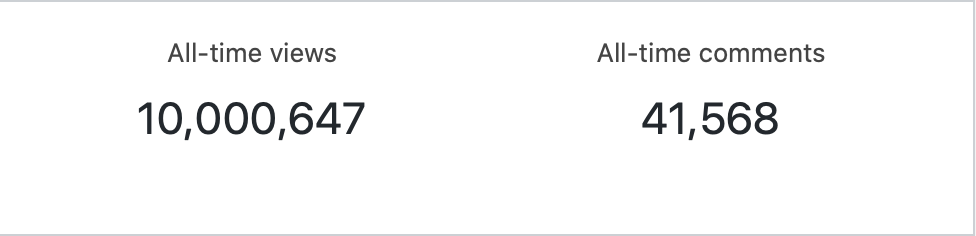
Must Read Alaska website reached over 9 million views this month, and is on track for 10 million views next month. The editor has approved and posted more than 35,000 reader comments (those that take too much editing just get round-filed at this point).
Here are some of the stats for the site as compared to mainstream media outlets in Alaska:
TOP STORIES OF ALL TIME
The winner for all-time views is the column that editor Suzanne Downing wrote in January, 2020, titled: “New decade: The Next Roaring Twenties?” Little did we know that the Roaring Twenties would come to an abrupt end before it even started, and that the world would start circling the drain by February.
HOW YOU CAN HELP
This news project has always been about Alaskans and Alaska, our future as a state, and keeping the media honest. We can’t backslide or be deluded into thinking the media will ever be fair to conservatives in Alaska. And the damage done to our state during the Rogoff-Walker years will be with us for a long time.
You can help MRAK with your donations, with your news tips, and by letting advertisers know that Must Read Alaska is a great value. The truth is, MRAK depends upon people who decide this project needs to continue.
Your donations help pay for outside contracted help that keeps the website functional, and fixes it when it breaks. They help pay for the web tools needed to publish the newsletter, and the research and travel to cover the state from Fairbanks to Ketchikan.
Today, to celebrate the fifth anniversary, MRAK launched a new feature on the front page that we’re calling “Featured Videos.” Scroll on over there after you’re finished here, and see the video clips. Keep an eye on that spot as MRAK rolls out some new features in the next few weeks.
Finally, thank you to all who have contributed their time and treasure to making MRAK a valuable resource for our future. Here’s to the next five years of keeping the mainstream media on its toes!
ANCHORAGE CHAMBER CITY-WIDE CLEANUP MOVED TO MAY 4-31
The Anchorage Department of Solid Waste Services will not host free dump days in 2020. Instead, the department will distribute free summer disposal passes to all Municipality of Anchorage residents, good for disposing of one load of garbage.
Residents can register at www.muni.org/sws for a pass that allows them disposal of one free load of garbage. Registration opens at 8 a.m. Monday, May 4 and closes at midnight Monday, May 18. Passes will be valid through Sept. 5, 2020.
All free drop-offs must go to the Anchorage Regional Landfill in Eagle River. Passes will not be accepted at the Central Transfer Station in Midtown Anchorage. Girdwood residents may use passes at the Girdwood Transfer Station.
Only current residents of the Municipality of Anchorage may register for a free pass. Passes are limited to one per resident.
Loads are limited to less than 1,000 pounds and may not exceed the size of a standard pick-up truck bed. No U-Hauls or Double Axel trailers will be eligible for free disposal.
Additional fees will still apply for any item containing Freon (refrigerators, freezers) or to disposal of more than 40 pounds of household hazardous waste.
The Anchorage Chamber of Commerce Citywide Cleanup will move to May 4-31.
According to the latest statistics, 40,000 unemployment cases were opened in a three-week period with the State of Alaska. The number is sure to grow, perhaps approaching 50,000 within a week or two.
In the last few days, Alaska North Slope oil prices have sunk to below zero per barrel, a staggering drop from $26 last week.
Last week, ConocoPhillips announced it would be pulling back $200 million that it planned to invest in Alaska. This news came on top of the crushing announcement the previous week that it was demobilizing its entire rig fleet on the North Slope.
Hundreds of Alaska’s direct-producing energy families, along with unknown numbers of support contractors have had their jobs impacted in the past few months. But they’re not the only ones affected by the economic crash in Alaska.
Last Wednesday, Holland America and Princess canceled their summer’s Gulf of Alaska cruise schedule in its entirety. For communities such as Seward, Whittier, and Talkeetna, this removes a large portion of their revenue base, and puts small business and entrepreneurial ventures at risk of permanent closure and/or bankruptcy.
A total of 3,500 jobs will not be hired for the summer, and $375 million in tourism-related spending will not enter the Alaskan economy.
But all of these goings-on – the curtailed demand for fossil fuels, the seemingly cleaner air across major cities in America, the decreased industrial machine that makes America great, and the inability to proceed with responsible development opportunities because of the near-shutdown of daily and business life – are exactly what eco-extremists have been calling for.
Just look at some quotes from their ilk, with regard to Alaska’s energy future – one they see benefitting from “leave-it-in-the-ground” actions:
“The stakes have never been higher…Scientists have already warned that all of the Arctic’s untapped oil must remain in the ground if we are going to avoid an extremely dangerous climate scenario.” – Erik Grafe, Earthjustice attorney
“Combined with the volatility of oil prices, it is increasingly clear to many across the social and political spectrum: Alaska must aggressively pursue economically and environmentally sustainable options.” – Erica Watson, Northern Alaska Environmental Center and Mary Sweeters, Greenpeace
“Regardless of where you fall in the debate over opening the (ANWR) refuge, oil-and-gas reliance is not the path to making America energy-dominant…As demonstrated by China, Germany, France, the path to energy dominance lies with the clean-energy economy.” – Kate Troll, Juneau, former Executive Director of Alaska Conservation Voters
These radicals are trumpeting the “positive” impacts of what is currently happening across America: a nearly-shut-down society. The San Francisco Chronicle calls it “an environmental boon that decades of green activism could not achieve.” The Wall Street Journal reports that the environmental movement plans to leverage the COVID-19 pandemic to affect change, with the hopes of increasing “green” technologies and decreasing fossil fuel use when the pandemic is over.
For decades, the eco-Left has called for Alaskan resource development opportunities to be denied, because Alaska is one of the last great wildernesses on Earth. You see it in the barrage of attacks by California Congressman Jared Huffman or his former employer, NRDC, on the Pebble Mine.
You hear cries of “ANWR’s Coastal Plain is a sacred place, except for when we approve of non-Natives going there and then writing a puff-piece story supporting us” and the associated hypocrisy from the Gwich’in Steering Committee.
You see extremists from all of Alaska’s “just transition” groups testifying against any development opportunities, and even against Hilcorp’s purchase of BP’s assets in Alaska.
Those groups, ideologues and their (mostly) Lower-48-based funding sources are getting their way right now, at the expense of shattered lives across our state. Alaska is even more scarcely explored than normal. Businesses have shut down. Outside visitors are minimal. The animals are protected, though, right? The fish won’t have as many hooks to dart around, and that’s good, right? Economic progress is stymied, but wildlife can go to their ‘safe spaces’ without human interference.
We hope the extremists are happy with the results.
Power The Future – and the vast majority of Alaskans who reject the “we need to place wildlife above human life” mantra of the extremists – certainly aren’t.
Alaska needs jobs. Alaska needs opportunities. The vast majority of Alaskans are worried, frustrated, angry and long for good news.
Yet the extremists rejoice. That is shameful.
Rick Whitbeck is the Alaska State Director for Power The Future, a national non-profit advocating for energy workers, while fighting back against environmental extremism and the ideologues who fund radicalized efforts to thwart American energy dominance.
“It is time! It is time to start the process of opening our economy back up.” This is a common theme I am hearing every day as I’m talking to constituents and people from all over the state.
Let’s be clear: The sacrifices we have made were absolutely necessary to ensure that our medical infrastructure could handle an influx of cases and ultimately save lives. The governor, our mayors and their teams took early action and we have seen the positive results of that action.
Our hospitals have increased capacity, our personal protective equipment stockpiles have grown, we are increasing our ability to test, and most everyone has taken appropriate social-distancing precautions. Our frontline workers deserve all of the praise we can give them for their efforts and work to get us to this point.
It is time, however, to start communicating our next stages; it’s time for a measured reopening of our economy. There are many different opinions on what is the best approach. Some want everything opened up immediately, quickly, the sooner the better. Others have said we should just stay “hunkered down” indefinitely, or for extended periods. Neither is the solution.
An economy is not just about wealth or money in people’s pockets. An economy is about goods and services that help us live. As meat plants in the Lower 48 close, the prospect of food shortages in Alaska increases. Failure to open our fisheries will add to that prospective shortage.
You might think I am being overly dramatic, but think about it: Alaska’s fish could actually be the difference between life and death for people around the world this year. Failure to move to the next stage of opening our economy could essentially put lives at risk.
It is time to establish guidelines – guidelines that outline how service, construction, landscaping, retail, sporting-goods stores, hairdressers and our many various industries can return to operation. Guidelines for businesses across the spectrum, that clearly articulate and define what they need to do to keep their customers and employees safe. Guidelines that pave a path to show how we can get people back to work.
It is not the time for political spin. People are looking for clarity. They are looking for structure, and clear plans delineated publicly will ease anxiety and the stress of what the future may hold. Politicians struggle to make clear statements, because they live in a world of spin. They are worried that someone will bring up a statement they made today and use it against them later. So to give them cover, let’s make it clear up front: certain aspects of any plan are subject to change due to changing circumstances. There can and will be starts, stops, and reversals. It also may include difficult requirements such as restrictions on the most vulnerable populations until we have concrete treatment options.
I’m calling on our leaders, myself included, across the board, to start the process and outline a plan to re-open Alaska’s economy. It’s time to communicate a clear outlined plan. Communication is paramount in this time, and vague and opaque plans will not work. We need a clearly defined process, built on the understanding that there will be starts and stops as things evolve.
It is time to give people the hope they so desperately desire. Let’s bring that light at the end of the tunnel a little bit closer.
Rep. Lance Pruitt is the House Minority Leader in the Alaska Legislature.
As of Friday, some restaurants, retail centers, and personal service businesses will be able to be open up in Alaska, the Dunleavy Administration announced today.
Details on the easing of the regulations will be announced later this week, but generally speaking, restaurants and retail centers must be at no more than 25 percent capacity and people need to be spaced 10 feet apart. For restaurants, they can seat people together when they are in the same household.
Retail establishments will need to limit their customers to one person per household at a time. There will likely be universal face coverings ordered for public-facing employees and the shopping public will also be asked to continue to wear face coverings as much as possible when in public places.
Bars will not be opening on Friday, but salons, day spas, tattoo shops and other personal service shops will open, with certain social distancing and mask rules to be observed.
Fishing charters will begin to operate on Friday. If there are parties from separate families, the charters need to operate at 25 percent capacity.
Churches, weddings, and funerals will be able to provide services, with crowd limits now extended from 10 people to 20 people, and with six feet of social distance between people.
Anchorage, however, will not implement these mandates until Monday, according to Health and Social Services Commissioner Adam Crum. The State and the Municipality have coordinated and come to an agreement about the delayed reopening for Anchorage.
Commissioner Crum addressed revisions to various health mandates:
Health Mandate 10: The 14-day quarantine for incoming travelers to Alaska will be extended to May 19, and this will be evaluated on a weekly basis for cases coming into state.
Health Mandate 11: Social distancing of six feet between people who are not part of the same household is extended until further notice.
Health Mandate 12: Intrastate travel is extended until further notice. This means no casual travel between communities in Alaska. For those traveling for fishing or hunting, they are not do engage in commerce in communities outside their hometowns.
Alaska had eight new cases of COVID-19 reported in the latest update by the State, for a total of 329 cases.
More than half — 168 — have recovered, leaving 161 active cases of the coronavirus in Alaska at this time. There were no new hospitalizations reported and no new deaths.
Total case count by community to date:
Anchorage: 160
Kenai Peninsula: 19
Fairbanks/North Star Borough: 79
Southeast Fairbanks Census Area: 1
Yukon-Koyukuk Census Area: 1
Kodiak: 1
Mat-Su Borough: 19
Nome Area 1
Juneau: 26
Ketchikan: 16
Petersburg: 3
Craig: 2
Bethel: 1
11,119 Alaskans have been tested for COVID-19.
Globally, more than 2.5 million people have been diagnosed with the Wuhan coronavirus. Nearly 177,000 have died.