According to the Yukon Kuskokwim Health Corporation, 100 cases of COVID-19 were diagnosed in the Y-K Delta on Thursday.
It’s 17 percent of the 584 cases reported by the State of Alaska’s COVID-19 dashboard on Thursday. The delta is home to about 25,000 Alaskans, less than 4 percent of the state population.
The cases in the Y-K Delta are causing concern at the Alaska Native Medical Center, where the hospital says it worries it will run out of beds and staff to meet the needs of all the incoming patients.
“The Alaska Native Medical Center is experiencing a significant increase in patients hospitalized with COVID-19. Concurrently, the rising numbers of people impacted by community spread of COVID-19 is impacting the staffing levels of essential health care workers, who must quarantine or isolate after infection or exposure. If this trend continues, our hospital will not have the physical bed space or staff available to provide the level of care our community will likely need,” the Alaska Native Medical Center wrote.
ANMC Administrator, Dr. Robert Onders said he supports Gov. Mike Dunleavy’s statements encouraging all Alaskans to stay home if possible, limit gathering sizes, and wear face coverings when in public.
The Bethel Region’s cases went from 10 to 50 to 100 in less than a week. Nov. 11, there were 29 cases. By Nov. 12, the number was 64 and one death.
On Nov. 13, the 100 cases were reported across multiple villages:
14 cases in Akiak
42 cases in Bethel
2 cases in Chevak
1 case in Hooper Bay
1 case in Kongiganak
21 cases in Kwethluk
Numerous cases in Napaskiak Village of Napaskiak states the total number of cases should not be publicly provided. (Math suggests that the number is 15).
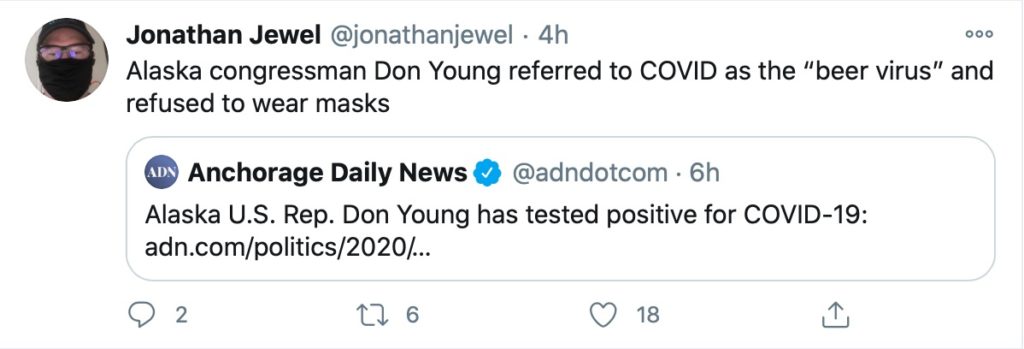
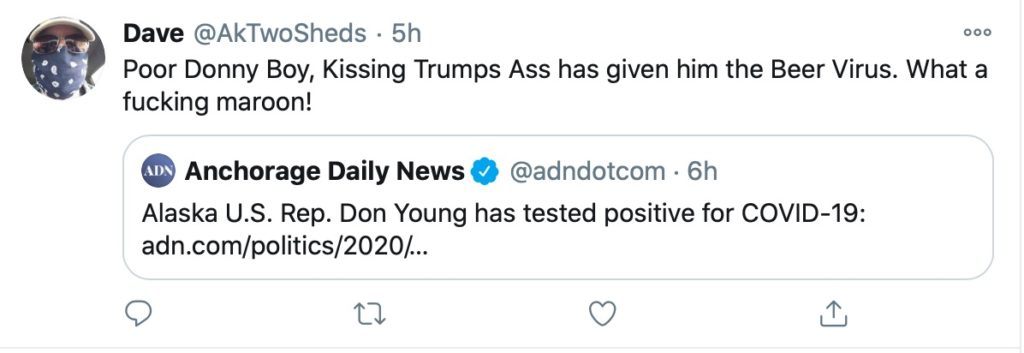
The keyboard warriors were laughing online at Congressman Don Young for contracting the COVID-19 coronavirus, as was announced by him on Twitter on Thursday.
Some examples of the hundreds of comments made on Twitter on Thursday:
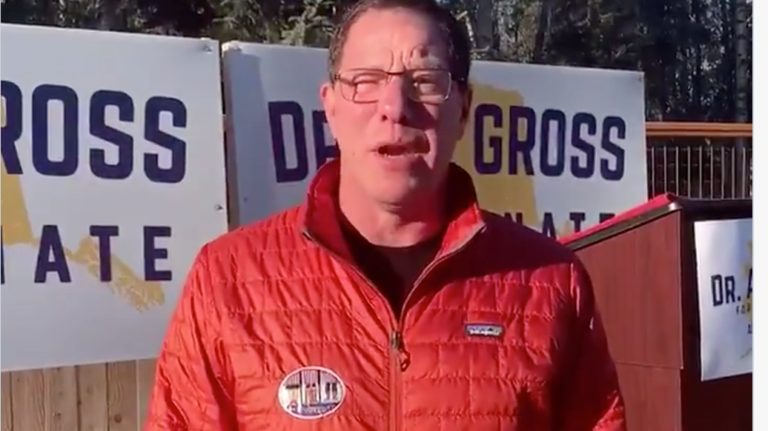
With nearly 95% of the votes accounted for in Alaska’s 2020 General Election, it’s over for U.S. Senate candidate Alan Gross. As the dust settles, and as Gross has finally made his brief concession call to Sullivan, Sullivan’s win is a double-digit advantage.
This margin of victory may have come as a shock to the Gross campaign and its supporters. Over the past several months, Gross has carefully handpicked polling data that aligns with the campaign narrative. It’s almost as if they began believing their own polling.
Pushing out false polling numbers is a strategy for increasing Outside donations and invigorating potential voters to join with “a winner,” but real, final poll numbers are always at the ballot box.
Sullivan’s landslide leaves the Gross campaign sifting through the debris of an $18 million campaign that finds itself being asked an important question:
Where did it all go wrong?
One thread on the fraying garment is how the Gross campaign overvalued Democrat-leaning poll data, created misleading numbers to keep a “unifying” campaign narrative, and underestimated Sullivan’s support altogether.
Early in 2020, Gross began pushing unverified polling data to entice potential donors to give to his campaign. The public and the donors were told the numbers, but never given the cross-tabs.
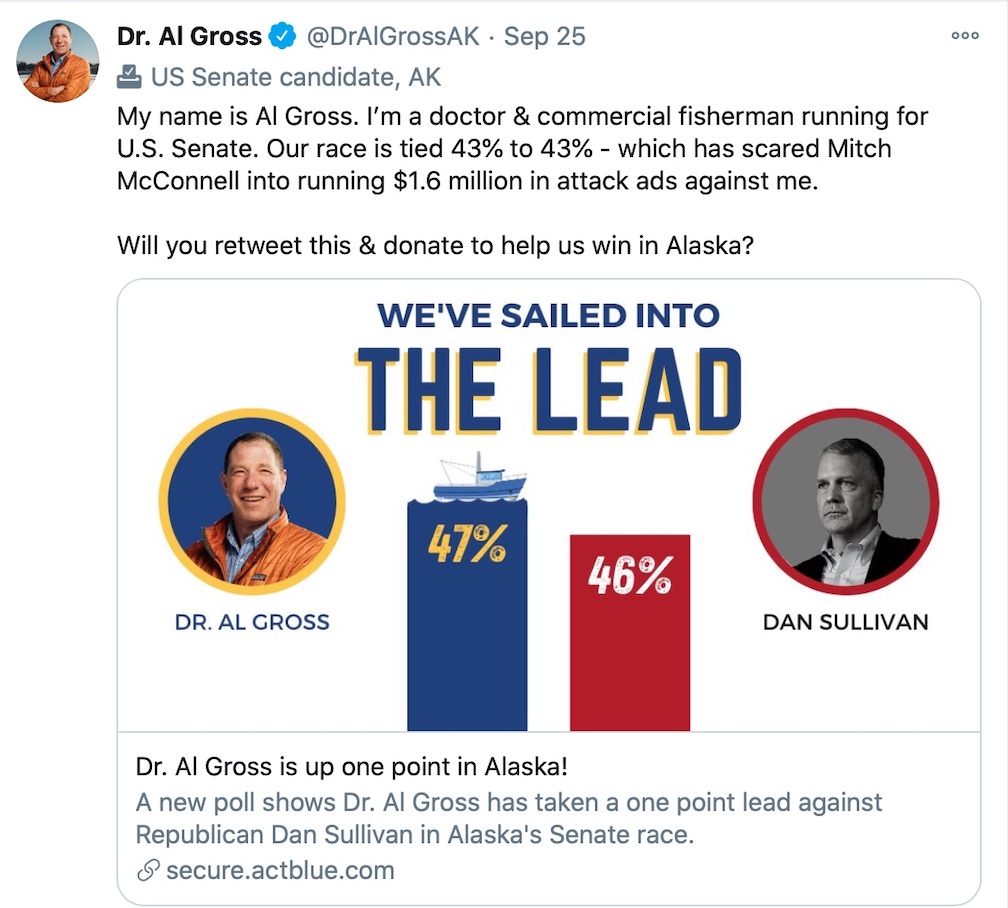
In particular, one reoccurring Twitter post toward the end of the campaign announced Gross had “sailed into the lead” by moving ahead 47% to 46% over incumbent Dan Sullivan.
The social media post linked to an ActBlue.com site, the place where Democrats raise money for their candidates.
Since it first appeared, the 47/46 myth was posted at least 17 times on Gross’ campaign Twitter feed. In that time, Gross never verified the 47/46 projection, but that did not stop the campaign from naming and claiming, and raising money on a lie that was weeks in the making.
On Aug. 31, Gross posted a Public Policy Polling (PPP) survey, indicating Gross and Sullivan were tied 43% to 43%.
One month prior to that, the PPP poll had Sullivan ahead 39% to 34%. Gross omitted that data point from his Twitter feed in July.
PPP is described by InfluenceWatch.org as “a Democratic polling firm that conducts publicly released surveys routinely cited in mainstream media accounts.” Dean Debnam, who founded the firm in 2001 in Raleigh, NC, is described by Businessnc.com as “one of the state’s most ardent donors to Democrat politicians.”
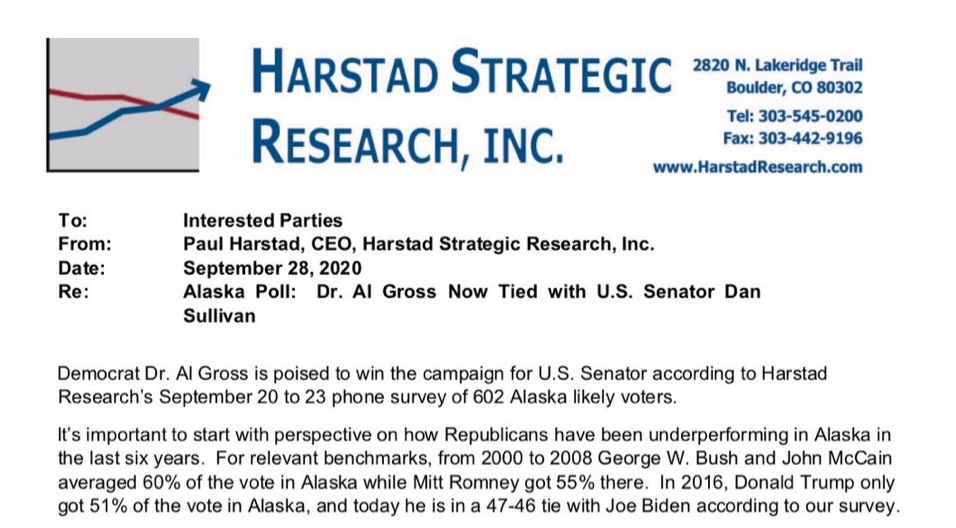
In late September, Gross tweeted out the survey from the Democrat- and Obama-affiliated polling firm, Harstad Strategic Research, saying his campaign was now ahead in the Alaska Senate race, 47% to 46%.
The Harstad survey was an internal poll paid for by the Gross campaign. It’s also the polling firm used by former Sen. Mark Begich.
“The latest poll on the race for Alaska’s U.S. Senate seat gives Democrat-backed independent challenger Al Gross a one-point lead against Republican U.S. Sen. Dan Sullivan,” wrote the Daily Kos, a heavily left-leaning news blog.
“Gross has the support of 47% of the 606 Alaska likely voters covered in the poll to Sullivan’s 46%, according to a polling memo released Harstad Strategic Research. The poll was conducted between Oct. 10 and Oct. 13 with a self-reported 4% margin of error and is the third such poll conducted by the firm.
“’This progress confirms Dr. Gross’ continuing momentum and steady climb in recent months to his first tiny lead over Sullivan,’ explained the memo by Paul Harstad, the firm’s CEO,” the Daily Kos wrote.
On Oct. 22, Gross tweeted yet another poll from Change Research, which had Sullivan in the lead at 47% to 44%. Both polls had a margin of error of 4%.
On Oct. 28, Gross tweeted a poll from Gravis Marketing, which had Sullivan leading 48% to 45%.
Even after the election, on Nov. 5, Gross campaign manager David Keith sent a memo to the media telling them to not call the race because “independent polling” and Patinkin Research Strategies both said Gross went into Election Day with a 47-46 advantage.
The Gross campaign’s narrative was straightforward: We’re not just in this; we could win it.
But it was kabuki theater. Leaning on polling data that only aided in his campaign’s messaging proved to be a costly mistake. It’s something that happens in campaigns that are using polls to push narratives — the campaigns start believing them.
In the other camp, Sen. Dan Sullivan’s campaign never released a single poll. That campaign also conducted polling, to see where the voters were at, but the numbers were closely held.
Friday, Gross conceded the Alaska U.S. Senate race to Sullivan. In his statement, Gross labeled his campaign the “underdogs” and reinforced how proud he was of his campaign.
“We were underdogs from the start, but we ran a strong campaign and raised important issues that deserved to be heard.”
After spending tens of millions in ads dishonestly attacking the character and record of Sullivan, he had created one more lie: That he was the underdog.
One of the biggest political stories of the year is the polling malpractice being pushed by companies pretending to be pollsters, but serving as propagandists.
They do it for the money. They’re not held accountable because what dishonest campaigns want are some type of polling numbers that buttress their rise to credibility. It happened all over the country, with most national pollsters badly calling the presidential race as a landslide for Biden.
The doctor from Juneau knew this was polling malpractice, but he engaged in it willingly to try to fool voters into thinking he was the lead dog, rather than the underdog.
In the end, he flipped the narrative and became the underdog. It may have taken a piece of his soul to run such a campaign, and likely destroyed his political credibility for good.
Is it safe to have a big Thanksgiving potluck in Anchorage? How about the Mat-Su?
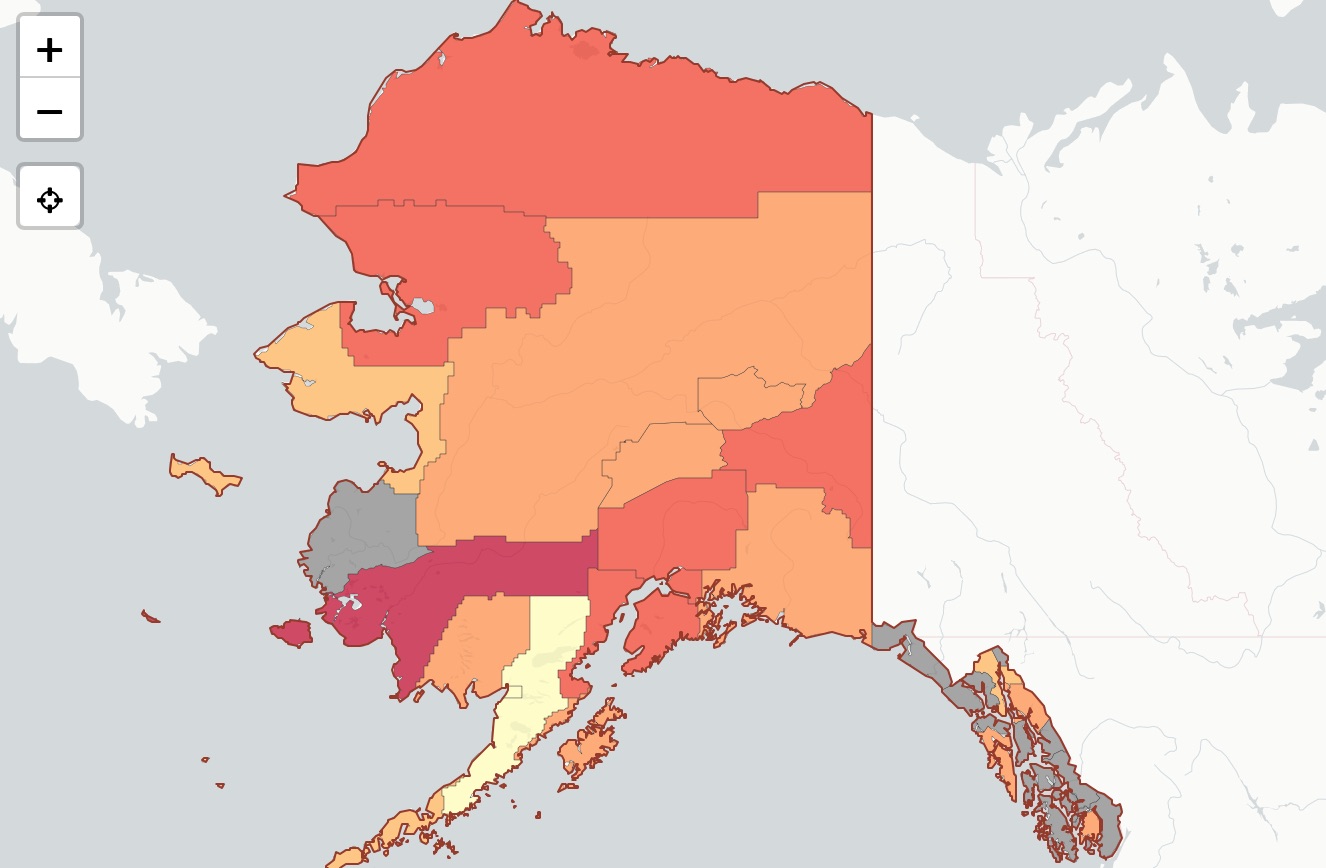
Georgia Tech professors have produced a peer-reviewed map of America, showing the risk levels in various parts of the country as it pertains to COVID-19.
If you’re in Anchorage, for instance, and go to a crowded event with 50 people, the risk of a person with COVID being at that event is 99 percent, according to the map.
The map shows the risk level of attending an event, given the event size and location. If you’re planning to go to a North Dakota bar or a wedding dinner in Los Angeles, or at a birthday party in Nome, you can assess your risk.
Based on seroprevalence data available, the map designers assume there are 10 times more cases than are being reported (10:1 ascertainment bias). In places with more testing availability, such as Anchorage, that rate may be lower.
For example, if you go to an event with 50 or more people in the Bethel region, your chance of having one person at that event who is COVID-19 positive is 99 percent. In Anchorage, the chance is 94 percent, while in Juneau it’s 67 percent. The safest place in Alaska to have Thanksgiving, according to the map, is in the Lake and Peninsula Borough, where the risk is less than 1 percent.
The COVID-19 Event Risk Assessment Planning Tool is a collaborative project led by Prof. Joshua Weitz and Prof. Clio Andris at the Georgia Institute of Technology, along with researchers at the Applied Bioinformatics Laboratory and Stanford University.
With the national election behind us, it’s again time to turn our attention to the local economy.
Trump may be conceding, but the pandemic will not be receding, at least anytime soon. This will continue to work against a significant economic recovery in our state and community.
While Alaska might expect additional federal relief next year, nothing is guaranteed. If it does materialize, additional compromise and time will likely be required to achieve it.
In Juneau, this year’s local municipal budget reflected a $3.1 million deficit (even while including over $10 million in federal Covid funding). But city staff now projects a $9.9 million deficit, reducing the unrestricted general fund balance 45% to $12.2 million.
Juneau’s budget faces a worse picture in FY 22. Even with a projected $1.1 million property tax increase, their budget deficit is expected to balloon to $18.4 million, fully depleting its unrestricted fund balance and reducing the restricted budget reserve 45% to $7.4 million.
A deficit of this magnitude has severe implications for city finances. In short, Juneau’s current municipal budget path has become unsustainable.
During this year’s budget deliberations, other than delaying some capital projects, options considered by the City and Borough of Juneau Assembly primarily centered around some variation of increasing sales taxes or property taxes. Thanks to CARES Act funding, neither was required.
While the private sector suffered massive layoffs, city staff never considered serious operating spending reductions. Instead, the Assembly approved $1.5 million in scheduled pay raises, new hires, and longevity pay. Also continued was an effort to fund a brand-new childcare program that would add millions to future expenses.
Harder to understand, the Assembly is considering a $1.5 million grant to Sealaska Heritage Institute to subsidize its $14 million arts plaza under construction in downtown Juneau.
How much longer can the Juneau Assembly eat into savings for non-essentials while only looking to taxes as the solution to its deficit?
Another idea, largely ignored, is removing some of the 37 different sales tax exemptions currently in place – an action that would increase tax revenues – with minimal impact on most residents. This has the advantage, unlike property taxes, of shifting some of the burden to visitors.
Some exemptions are not significant enough to warrant much consideration but one of the most unjustifiable exempts sales to or from certain non-profit entities.
While one can argue that exempting certain non-profits from paying sales taxes helps them and, thereby, benefits society generally, no such argument can be made for exempting retail purchases by Juneau residents and visitors when they shop at non-profit retail establishments.
Some non-profits operate businesses in Juneau that sell goods and services in direct competition with private sector businesses that have no such advantage.
In Juneau, the Sealaska Heritage Store, Discovery Southeast Glacier Gift Shop, Juneau Arts and Humanities Council, the state museum store, and DIPAC are examples of non-profit sellers that are not required to collect sales taxes on retail sales such as art, books, jewelry, souvenirs, tours and other tourism related goods.
A separate exemption that deserves similar scrutiny also allows tribal entities, such as Tlingit-Haida Central Council, to avoid collecting sales taxes on retail sales and tourism related activities.
This issue is especially relevant as the Juneau Assembly considers the aforementioned grant request from Sealaska Heritage Institute, also an operator of a for-profit retail store in downtown Juneau. Why should taxpayers subsidize the operation of a high-end store that competes directly with Juneau’s hard-hit private sector?
Ironically, a recently removed tax exemption for sales on cruise ships was justified as being “fair” since onboard cruise ship activities theoretically compete with local stores.
Past estimates by Juneau City and Borough of non-taxable sales by non-profit entities exceed $27 million annually. This exemption, then, essentially forfeits up to $1.35 million in sales tax each year if the bulk of sales are by 501(c)3 and 501(c)4 organizations currently exempted under the code.
Most cities and states do not have a similar exemption and have crafted ways to carve out exceptions for organizations like the Salvation Army, Girl Scouts, community sports leagues, etc.
While some municipalities in Alaska have taken a more conservative approach to their budgeting, Juneau is not among them. Given the uncertainty in how quickly the visitor industry and global oil demand will recover, caution is warranted in the months ahead.
Municipal governments cannot afford to leave any option off the table (including across-the-board pay cuts and employee furloughs) when dealing with current and future deficits.
Win Gruening retired as the senior vice president in charge of business banking for Key Bank in 2012. He was born and raised in Juneau and graduated from the U.S. Air Force Academy in 1970. He is active in community affairs as a 30-plus year member of Juneau Downtown Rotary Club and has been involved in various local and statewide organizations.
KINY – Bradley Grigg, the chief behavioral health officer at Bartlett Regional Hospital in Juneau, told the city’s Economic Sustainability Taskforce that the hospital is seeing more youth in the emergency department during the COVID-19 pandemic.
“We have seen a serious uptick in the number of suicide attempts in the last six months. We’ve had five from the age of 14 to 17, and seven, ages 13 and under, that kills me,” he told the group.
Grigg said the problem is widespread, serious, and affects someone you know.
The task force was established in April by Mayor Beth Weldon.
The Lincoln Project, a group of political grifters who play-act as disaffected Republicans but are spending Democrat donors’ money, spent $4.3 million on the Alaska Senate race this year, attacking Sen. Dan Sullivan and supporting Democrat Alan Gross.
Rick Wilson, George Conway, Steve Schmidt, Jennifer Horn, John Weaver, Ron Steslow, Reed Galen, Mike Madrid are the founders of the Lincoln Project, which hit the scene in 2019.
The race has been called for Sullivan, and he is currently ahead by 14 points, 174,791 to 131,627.
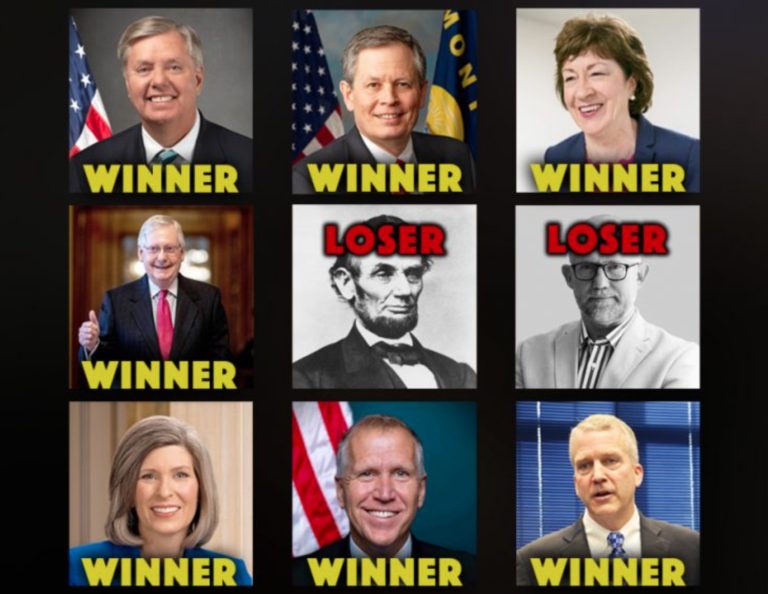
The Lincoln Project went 0-7 in Senate races across the U.S., after spending nearly $12 million in support of Democrats.
They targeted Republican Sens. Steve Daines of Montana and Susan Collins of Maine, along with Joni Ernst of Iowa, Mitch McConnell of Kentucky, Lindsey Graham of South Carolina, and Thom Tillis of North Carolina.
Now, with the election behind us, the Lincoln Project has launched an attack on the lawyers who are representing the Trump campaign.
“What the Lincoln Project is doing is both a frontal assault on longstanding professed ideals of the legal profession and a tactic of personal harassment and intimidation that stands in clear violation of Twitter’s stated rules. Moreover, the harassment initiative aimed at Jones Day and Porter Wright attorneys openly extends to pressure campaigns against the other clients of Jones Day,” wrote Dan McLaughlin, senior writer at The National Review.
Although the group helped take out its main target, Donald Trump, its Senate ambitions were completely thwarted, as detailed at the Washington Free Beacon.
The ballot measure that will radically and historically change how Alaskans choose their leaders is now passing narrowly.
The measure will break the party system in Alaska politics by creating a free-for-all open primary, and a ranked-choice voting method that many say is confusing and hard to verify.
The 313,485 votes on the ballot measure broke slightly toward the yes side, with 156,991 “yes” votes to 156,494 “no” votes. The measure, which was written by a couple of liberal attorneys and funded with $7 million of Outside liberal money, puts in place an election system never tried anywhere in America.
With about 23,000 votes left to count, it appears this measure will pass narrowly, although it may come down to a recount.
The language of the ballot measure is boiled down from 25 pages to a few short paragraphs that fail to actually describe all the changes the ballot measure will bring:
An Act Replacing the Political Party Primary with an Open Primary System and Ranked-Choice General Election, and Requiring Additional Campaign Finance Disclosures.
This act would get rid of the party primary system, and political parties would no longer select their candidates to appear on the general election ballot.
Instead, this act would create an open nonpartisan primary where all candidates would appear on one ballot. Candidates could choose to have a political party preference listed next to their name or be listed as “undeclared” or “nonpartisan.”
The four candidates with the most votes in the primary election would have their names placed on the general election ballot. This act would establish ranked-choice voting for the general election.
Voters would have the option to “rank” candidates in order of choice. Voters would rank their first choice candidate as “1”, second choice candidate as “2”, and so on. Voters “1” choice would be counted first. If no candidate received a majority after counting the first-ranked votes, then the candidate with the least amount of “1” votes would be removed from counting. Those ballots that ranked the removed candidate as “1” would then be counted for the voters’ “2” ranked candidate.
This process would repeat until one candidate received a majority of the remaining votes. If voters still want to choose only one candidate, they can.
This act would also require additional disclosures for contributions to independent expenditure groups and relating to the sources of contributions.
It would also require a disclaimer on paid election communications by independent expenditure groups funded by a majority of out of state money.
Alaska Democrats used ranked-choice voting during their privately held primary election this spring for the first time.
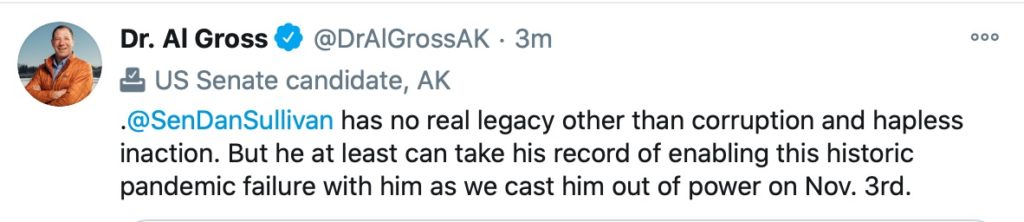
As one politico put it, Alan Gross was “born in the wake of an avalanche and his political career ended in the wake of a landslide.”
From the start, it was obvious the Alan Gross campaign was going to go negative against Sen. Dan Sullivan, who is completing his first term as Alaska’s U.S. senator.
But just how negative he would go was difficult to gauge last year, when Gross began his unlikely quest for the Senate.
No one could guess it could get so ugly or so personal. Gross and his third party helpers such as the Lincoln Project spent $36 million — more money than any candidate in Alaska Senate race history. Sullivan and third party helper groups had just $16 million to fight off the attacks. In the end, Gross in 2020 will end up with just 41 percent of the vote.
Gross’ initial campaign in 2019 was to introduce himself to Alaskans. He was an unknown from Petersburg and he needed to define himself, to show “Al” Gross as an upbeat real Alaskan on a real fishing boat. He glossed over his flaws and made fantastical claims about his larger-than-life Alaskan adventures. This was a candidate made up by marketers.
By the summer of 2020, Gross and his handlers had painted Gross as the “bear doctor,” (a doctor who kills bears), with a catchy jingle, and $36 million and change to batter Sullivan. By now, he and his Outside funders were on a rampage to assassinate the character of his opponent.
During the final days of the campaign in October of 2020, the attacks got so ugly that the New Jersey communication director, who had been brought in to be Gross’ spokesperson, was sidelined. She wasn’t exactly fired, because Gross had unionized his campaign and couldn’t exactly fire her, but Julia Savel was essentially let go — no more spokesperson role for her.
Alaskans, even his supporters, were by then disgusted and alarmed at how vicious and dirty the attacks from Comms Director Savel had become, and word was getting back that she was hurting Gross’ brand of being a real Alaskan.
The media, which had been sympathetic to Gross, lost respect for her because she would not tell them the truth, and in the last weeks of the campaign they didn’t want to talk to her anymore.
After the Gross campaign called Sullivan anti-Semitic and racist, even the liberal media had had enough.
But Savel had done her dirty work by then, and it was all over but the shouting. She had shopped a story idea around to all the media that Sullivan had voted time and again for policies that benefited his father’s Ohio company, a company for which his brother is the CEO.
Finally, after every other outlet had turned it down, Salon.com bit and wrote the 2+2=3 story; it was a piece of spun-up opposition research, and it was not interesting to Alaska voters. They were tired of being carpet-bombed by the Gross campaign.
Gross, in the final weeks, attacked Sullivan as “corrupt,” and said repeatedly that he was born a billionaire.
That is also not true. Not even close. Sullivan was born in a modest 2,000-square-foot house with a five siblings crowding the bedrooms. His father built a company from scratch, employed hundreds of Americans, and was generous with his fortune — so well that he earned the highest award given by the Jewish community of Cleveland, Ohio for his community service. Tom Sullivan gave away much of what he had earned to philanthropic causes in his hometown.
Tom Sullivan and his late wife, Sandy, started modestly in life but became well-known philanthropists, and were the lead donors to the nonprofit Menorah Park Center in Cleveland, which was designed to serve the Jewish senior community.
Sullivan’s family also has a long record of military service, one that is continued by Sen. Sullivan to this day as a Marine Corps reservist, the only active Marine Corps member of the Senate. He’s been in the Marine Corps / Reserve since 1993 and served in Afghanistan dismantling terrorist networks.
Gross, overreaching for nearly the last time, called Sullivan an anti-Semite because of an ad Sullivan’s side ran concerning the massive amounts of Outside dollars Gross had, many millions coming from NY Sen. Chuck Schumer.
While Gross was calling Sullivan an anti-Semite, a coward, and corrupt son of a billionaire, Sullivan’s father was gravely ill and is, at this writing, not expected to live much longer.
Some Alaskans wondered why, when Gross attacked Sullivan as corrupt, and attacked Sullivan’s family as he did, the favor was not returned.
It could have been, but Sullivan and others took the high road.
Gross’ father, Avrum Gross, whom Al referred to often during the campaign to shore up his “Alaska-born credentials,” was more than just an attorney general for Alaska. He was a hippie lawyer, a well-known drug abuser and alcoholic in Juneau, and he had proclivities that are just not ripe for telling, since one should not speak ill of the dead.
Gross, who ran on a health care platform, is known by only a few around him to be a heavy smoker. His campaign ads said, “it’s time to send a doctor to the Senate.” The smoking doctor.
While Gross pounded on Sullivan’s upbringing and father’s business interests, Sullivan never brought up any of Gross’ family history.
At this writing, Gross has not yet conceded the race, although the math just doesn’t work for him any longer. With 66,000 votes left to be counted, Gross would have to get 95 percent of them to win. He went quiet on Twitter two days ago, after wishing everyone a happy Veterans Day. The day before that, he wrote that he still could win.
He did make his mark, even if he didn’t win. The ugliness and dishonesty Gross engaged in during his campaign for Senate set the bar lower than it’s ever been in Alaska politics.
Alaskans, however, saw through it. For all his tens of millions, Gross performed worse than Alyse Galvin in her run against Don Young, and even worse than Joe Biden did with Alaskans.
Sullivan got more votes than any other statewide candidate this year by sticking as much as possible to the high road. As they say, maybe the good guys don’t always finish last.