Sunday, June 14, 2026
Home Blog Page 1232

No, Alaska does not deliver its ballots by dog sled

5

Most Must Read Alaska readers don’t follow MSNBC on a regular basis, but we do, so you don’t have to.

On Meet the Press, Jessica Taylor of Cook Political Report commented that the race for U.S. Senate in Alaska is one to watch:

“This is a race that we, I think, don’t know on election night because literally they have to bring in some of the ballots by dog sled.”

Uh, no. Not really. These are the experts?

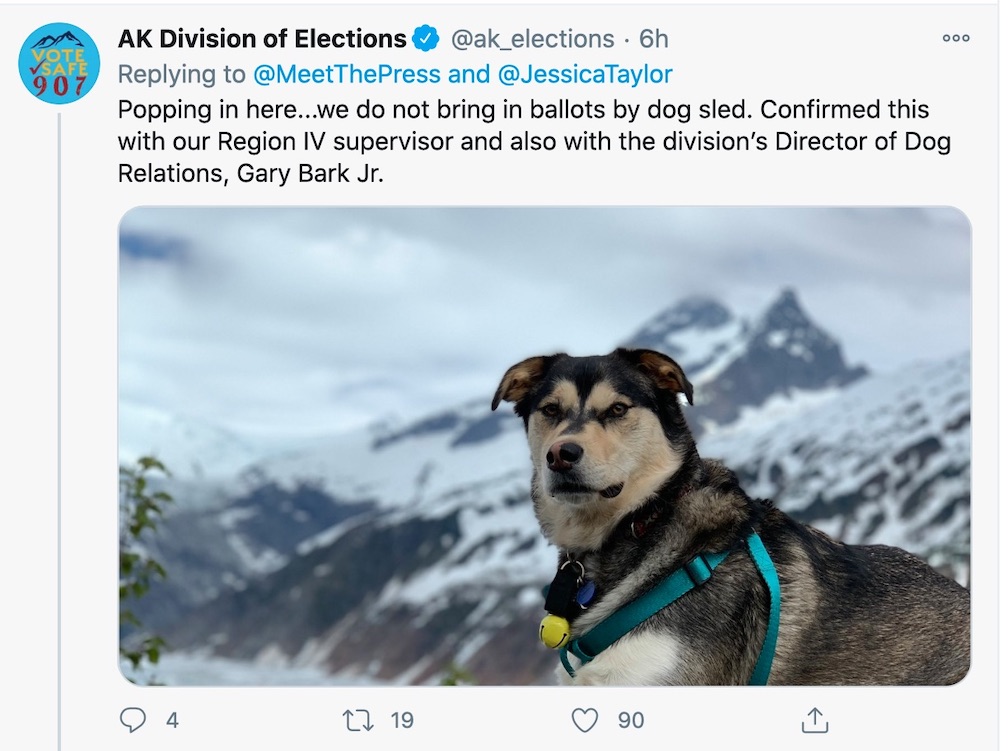
“Popping in here…we do not bring in ballots by dog sled. Confirmed this with our Region IV supervisor and also with the division’s Director of Dog Relations, Gary Bark Jr,.” quipped the Division of Elections on Twitter, where the Division runs what is arguably the most entertaining Twitter feed in Alaska.

Most prognosticators believe U.S. Sen. Dan Sullivan is ahead, even though Alan Gross has spent $25 million to unseat him. Like any other race, it matters that conservative voters show up and not take it for granted.

Cook Political Report has rated this race “Lean Republican.”

Glenda Ledford is new mayor of City of Wasilla

9

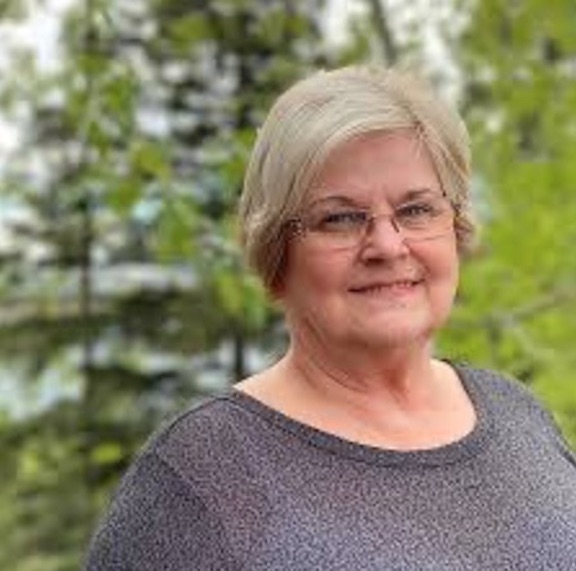
Glenda Ledford won the runoff election for mayor of the City of Wasilla. The election is being certified tonight, Oct. 30.

The final tally was Ledford 411, and Doug Holler 350.

“This is my opportunity to serve my community,” Ledford said. “We will stay open for business, keep our neighborhoods safe, and support jobs in our community.”  

Photoshop: Did they finally zip up Alan Gross’ pants?

13

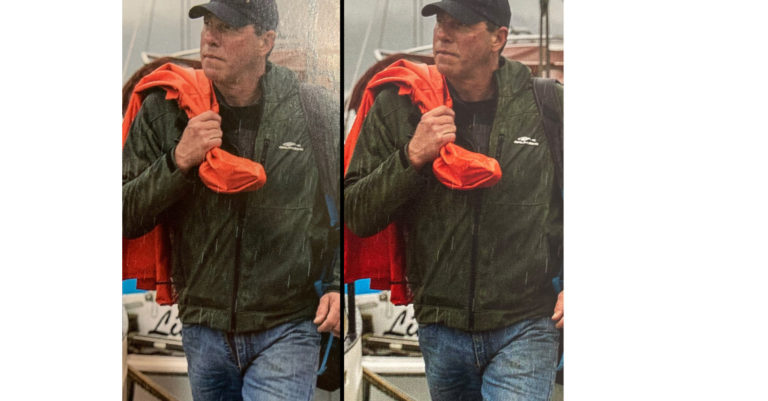
It appears to be an open-and-shut case of photo-doctoring.

An earlier version of the door-hanger showing Senate candidate Alan Gross walking on a dock in the photoshopped rain caught the eye of several Alaskans: His zipper was down. Really down — as seen on the photo at left, above.

These things happen, but rarely in political campaign advertising. Gross, a millionaire doctor, has a multi-million-dollar campaign going, one of the most expensive in state history, and the best ad agencies money can buy.

Now, through the miracle of Photoshop tools, the jeans are zipped up in the current version of the flyer.

Gross’ ad doctoring is one example of just how easy it is to make things right — or at least better than reality — with tools available to designers.

“Pity the poor ad guy who had to zip up Gross’ pants,” noted one eagle-eyed critic. “But at least, unlike [Mayor] Ethan Berkowitz, he had pants on, even if they weren’t zipped.”

Trick-or-treat II: Ballot harvesters are swarming

15

They’re here.

“I just had someone asking for my husband by his first legal name, soliciting to seek if we were voting, specifically for Al Gross just about 5 minutes ago. I thought it wasn’t allowed to solicit in the neighborhood? Also….it’s 8pm? I find this super abnormal,” wrote a woman from the Bayshore area of Anchorage.

She isn’t the only one being pestered. Others report being asked for their ballots by out-of-staters who come to their doors.

They know who you are and they know how you typically vote, thanks to Big Tech.

The canvassers are for the Alan Gross campaign, and they’ve been flown in from all over the country. Some of them are staying at a midtown hotel, while others have been put up at the Captain Cook hotel, with an open meal and bar tab. They are being paid a stipend to crawl through neighborhoods and harvest ballots.

The ballot harvesting is creepy, said one Anchorage man who lives in the downtown area. A pair of Gross volunteers from Wisconsin showed up at his door, asked him if he was planning to vote, and when he said he had an absentee ballot, but had not decided if he was going to vote it or vote in person, the two offered to take that ballot and drop it off at a polling station for him. He is elderly, but was not addled and was not about to hand his ballot over.

Downtown Anchorage is prime hunting grounds for ballot harvesters, as it is heavily Democrat. The practice is not illegal, but may raise questions about whether those ballots ever make it to their intended destinations.

“Don’t give your ballot to anybody that you don’t know,” said Randy Ruedrich, former chairman of the Alaska Republican Party. “Paid visitors are not expected to do you a favor.”

Gross volunteers from out of state have been at it for weeks, first asking people to fill out absentee ballot applications, and trying to get them to hand those application over to them, and now going through their preprogrammed lists to get the ballots themselves from those who have not voted.

Walmart pulls guns, ammo from Alaska shelves, then the order was suddenly reversed from headquarters

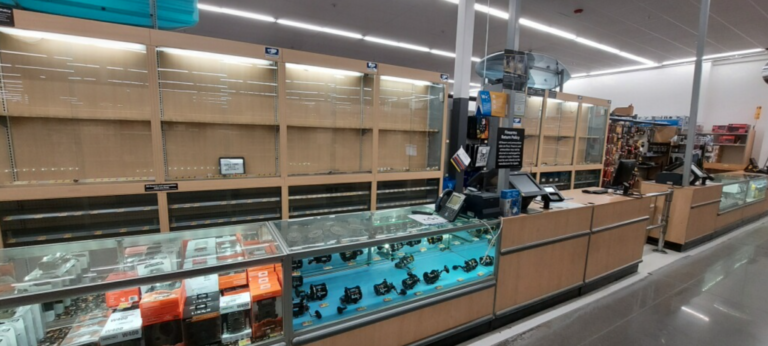
Across the nation, Walmart had a new temporary store mandate: All guns and ammunition must come off of shelves and put into storage in back. The company is anticipating widespread looting on Election Day or the day after, if elections do not provide a Biden presidency.

In midtown Anchorage, the guns and ammunitions section was completely cleared out on Friday midmorning, presumably put into storage, as it has been across the nation.

Then, in a surprise reversal, Walmart issued a new order: Return the guns and ammo to store floors.

“After civil unrest earlier this week resulted in damage to several of our stores, consistent with actions we took over the summer, we asked stores to move firearms and ammunition from the sales floor to a secure location in the back of the store in an abundance of caution. As the current incidents have remained geographically isolated, we have made the decision to begin returning these products to the sales floor today,” the statement said.

In Los Angeles, San Francisco, Washington, D.C., and other major cities, store owners began boarding up their exteriors on Friday, in anticipation of rioting over the election results.

Boundary Commission says Soldotna annexation must go to vote of the people

6

The Alaska Local Boundary Commission voted Thursday to allow local citizens to vote on the City of Soldotna’s annexation of nearby properties. In the commission’s history, the decision has always gone to the Legislature, instead.

For two years, Soldotna has gone through procedural steps to annex a number of properties adjacent to the existing city boundary, and there has been an outcry from members of the public for two years.

Public hearings were held, and the city hired a group to survey public opinion and communicate the plan to the to-be-annexed property owners. A website explaining the process was developed.

Kenai Borough Mayor Charlie Pierce heard from a number of residents over those years, and they told him “we want no part of this.” During public comment periods, the Borough, on the authority of the Assembly, sent its objections to the Boundary Commission, and evidently those arguments were persuasive.

“We have folks in Borough, looking at the city’s sign ordinance, animal control, taxes at a higher level at some point in the future,” Pierce said. “There are no absolutes in this, but people didn’t want to be bothered and the city could not prove the people were being provided benefits.”

“The voice of the people should be heard,” Pierce said.

The Boundary Commission agreed and amended the petition on a vote of 3-2. Commissioners Lance Roberts, Kenny Gallahorn, and Clayton Trotter voted in favor of allowing the affected public to vote. Commissioners John Harrington and Larry Wood voted against the amendment to the petition.

Gruening: Experience and accomplishment beat dishonesty every time

7

By WIN GRUENING

Alaska’s 2020 U. S. Senate race has turned into one of the most negative I’ve ever seen. Alan Gross, the Democrat nominee, has set a new low bar in his attempt to spend the millions of dollars pouring into his campaign from Outside dark money groups.

Those asking for the privilege to represent Alaska at the very highest levels of elected office should be the most qualified and most deserving of the honor.  I don’t want someone representing Alaska who stands proudly proclaiming after countless outright false and misleading attack ads,  “I’m Alan Gross and I approved this message.”

Gross’s campaign ads accuse his opponent, incumbent Senator Dan Sullivan, of secretly pushing the Pebble Mine (Sullivan opposes it), voting against lower-priced prescription drugs (Sullivan voted against a Bernie Sanders amendment allowing non-FDA approved drugs), and in favor of denying insurance coverage of pre-existing conditions (Sullivan has never supported that).  Gross’s accusations are all demonstrably false, but they continue day-in and day-out because he apparently doesn’t care about the truth or running an honorable campaign, only winning.

Gross claims to be an “independent” but this is more deceit.  He has changed his party affiliation numerous times including changing from a registered Democrat just months before filing for office. On a private call with Democrat donors, now made public, Gross admitted his “values are to the left” and that he will “caucus with the Democrats.”  Democrats have told him his best chance to get elected is to pose as an “independent.”

Gross lacks experience in any kind of leadership position, elected or otherwise.  With no accomplishments or recognition to cite, he has resorted to attacking his opponent hoping no one will notice he hasn’t earned the respect and recognition that comes with community involvement and public service.

Most stunning is the total absence of grassroots support for Gross in his hometown.  After earning up to $2.5 million annually during his 20-year career as an orthopedic surgeon in Juneau, one must wonder two things: First, where is his legacy of philanthropy?  There seems little evidence of any significant contributions to the fundraising campaigns of his community’s many arts and cultural organizations or social service agencies.  Second, where are the legions of classmates, colleagues, patients, and hospital personnel who would presumably step up to attest to his character, judgement, generosity, and record of community service?

Crickets.

Weigh that against Senator Sullivan’s experience and record.

Senator Sullivan served under President George W. Bush and Secretary of State Condoleezza Rice as the U.S. Assistant Secretary of State for Economic, Energy, and Business Affairs and as a Director on the National Security Council, where he worked to dismantle terrorist finance networks. He also served as Commissioner of the Alaska Department of Natural Resources prior to being elected to the U. S. Senate. Dan holds a B.A. in Economics from Harvard University and a joint Law and Master of Science degree in Foreign Service from Georgetown University.

Dan Sullivan’s extensive expertise in military, national security and international affairs is critical, not only to Alaska but to the nation.  

Since his election to the U.S. Senate, Dan Sullivan has been a leader in rebuilding our country’s military, promoting responsible resource development, opening markets for Alaska fishermen and cleaning up our oceans.  He has worked to expand benefits for our veterans and to help society’s most vulnerable, especially survivors of sexual assault and domestic violence and those recovering from addiction. Now, in the face of unprecedented challenges caused by the COVID-19 pandemic, Senator Sullivan continues to fight for Alaska’s health and economic future.

We deserve a senator whose roots in the state are deep.  We need someone who has demonstrated he genuinely cares about Alaskans and will fight for all of us, not just for the political party aiming to capture Alaska’s U. S.  Senate seat.

Sen. Dan Sullivan has earned re-election on November 3. 

Sen. Shower: Ballot Measure 1 gets a ‘no’ vote from me

6

By SENATOR MIKE SHOWER

Alaskans are voting on important issues to determine our next steps in dealing with the budget, resource allocation, taxes, and citizens’ general welfare. 

I know where I stand, but nothing can replace hearing directly from you. It’s essential to construct comprehensive solutions through inclusiveness and diversity of thought. We must keep all options on the table when discussing how to put together a systemically impactful solution and, most importantly, a sustainable one.

From my perspective, the choice is clear; we must vote No on Ballot Measure 1. 

Ballot Measure 1 was crafted behind closed doors by a few people. The referendum process is a constitutional right, but we should reserve it as a last resort, not a first resource.

The process to put this issue on the ballot excluded a rigorous public debate, prohibits refinement, rejects modifications, and suppresses diverse inputs.

Instead, it attempts to solve massive budget problems independently without considering the impacts it will have system-wide on all of the dynamic components involved.

Much like taking the Permanent Fund dividend to “solve” our budget deficits, this is another single-source solution. We are not addressing the root causes of the problem and are not working on a comprehensive solution.

No matter how smart a person is, our laws must be a collaboration of many ideas, diverse views, inputs, and include opposing arguments. Laws should endure the deliberative legislative process, unlike Ballot Measure 1.

The integrity of sound legislation results from processes that are facilitated through open committee hearings, floor debates, et cetera. Tax policy is complex and requires checks and balances, not a simple yes or no vote on a ballot measure.

Alaska has a budget problem. We spend more than we generate in revenue. There is waste and there are redundancies. We have an unbalanced budget and an insatiable appetite for spending far beyond our means. How can we trust the government to spend money wisely? Our government has even shown an unwillingness to follow its own statutes and rules.  

We need a comprehensive fiscal solution which fixes our structural spending and revenue issues. The “easy” answer for too many politicians has been to avoid the difficult task of searching for operational efficiencies. Instead, we have endeavored to convince Alaskans we have worked tirelessly, and there is no other option except to access the Permanent Fund dividend.

I disagree with arbitrarily cutting the budget. I support lowering our state government’s operating cost through data-driven decisions, process improvement, and pragmatic budget system design. Reducing Alaska’s operating budget is a critical piece of the puzzle. Still, we must do it wisely and with legislation that is exhaustively debated and cross-examined. 

For instance, it is not a constitutional mandate to buy new furniture for state offices or keep hundreds of vacant – but funded – employee positions. We are administratively heavy, with 54 administrative school districts for only 125,000 students statewide.

Examples abound, and yet Alaska still operates like it has massive oil revenue. All while struggling to support our most essential core responsibilities, from rural Alaska’s failing infrastructure to urban crime prevention and all points in between. 

If we confiscate the entire Dividend, it doesn’t fix our structural fiscal problems but merely masks them a little while longer. Our current constitutional spending cap is irrelevant; it’s so steep we can never reach it. Bills and constitutional amendments protecting your stake in our state by keeping politicians’ hands away from the Dividend have been repeatedly killed by legislative leadership, often using the “binding caucus” rule to keep legislators from voting for such proposals. 

Alaska needs a stable fiscal and tax environment if we are going to attract new business and cultivate existing enterprises. To attract new revenue, we need to signal that we are open for business, which requires a balanced budget, long-term fiscal planning, and stopping the pattern of constant emergency fiscal behavior year after year. If not, we will be right back here, scrambling for dollars in a few years.

Did you know there is between $100 to 200 million a year in planned increases to state spending each year? That’s before anyone shows up for the next session and starts adding money through legislation!

In the short-term, we need more oil in the Pipeline, generating more revenue to support the growing costs of government we’ve committed ourselves to. Does Ballot Measure 1 do so? Does it “solve” our underlying issues?

I believe the answer is no. Ultimately this is bigger than oil. Long term, we need to think like innovators, beyond oil, and attract both outside businesses and grow a thriving instate entrepreneurial base.

Ballot Measure 1 discourages new investment, fails to change our patterns of overspending and lacks any plan to increase our business community’s productivity. Particularly the commodity-driven private sector, which provides our largest revenue source outside of permanent fund earnings.

Be mindful of unintended consequences. Without the legislative process, where many of these “landmines” are vetted when we examine and debate the pros & cons of a bill, it’s too late. And while unintentional, you couldn’t pick a worse possible time to hit one of our critical industries with increased taxes during a worldwide economic depression due to COVID.

In conclusion, we need to address Alaska’s oil tax structure as part of a comprehensive plan to fix our structural issues and create a sustainable fiscal environment moving forward. I’ve consistently said for some time; all options must be on the table. However, we must find a way to balance our budget without putting an undue burden on one group, a plan that doesn’t hurt the lowest income Alaskans with a draconian PFD “tax” damage our “golden goose” oil industry with yet another significant tax policy change or harm essential government services. We need a plan that handcuffs government overspending by changing our constitutional spending cap, which, by itself, is a critical step in creating a stable economic environment, and one that finds wise, data-driven, and reasonable reductions to state spending.  

Acknowledging the political reality that any fiscal plan will have to address budget shortfalls left with various revenue measures if the legislature and governor fail to balance the budget through reductions to spending. Ballot Measure 1 fails to measure up. It merely throws a little more money at the same old problem – without fixing the problem. Why would we want to do that? 

Mike Shower is an Alaska State Senator representing Senate District E, which covers the MatSu from Skwentna to Delta Junction to Valdez.

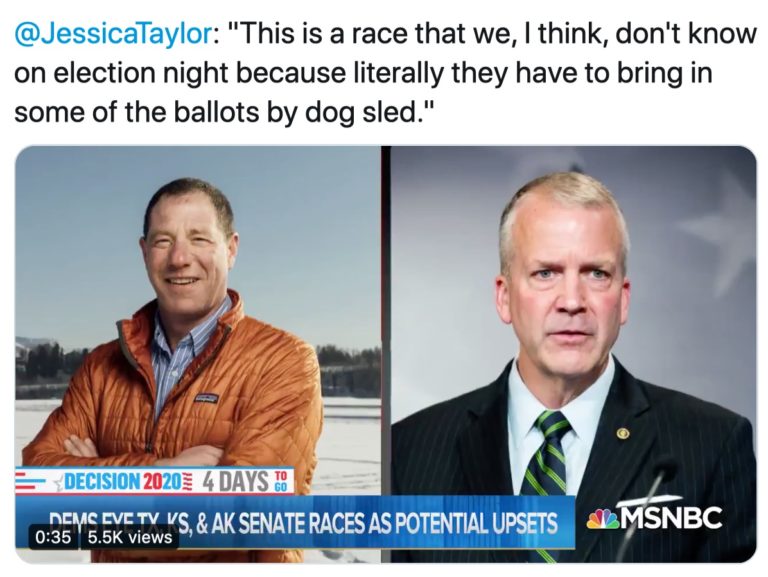
This sign is illegal in Alaska (but it will come down soon)

Bussell Electric has been advised by the Department of Transportation that the large Sullivan U.S. Senate banner on the commercial building is illegal.

Why? Because, as it is hung on the building’s exterior, it is visible from Minnesota Drive in Anchorage. It’s not in the right of way. But it is visible.

Charlie Bussell has been hanging campaign signs to showcase candidates he supports on his building for decades. This year, someone complained to the Right of Way Division at the Department of Transportation. And so a letter was issued from the bureaucracy, telling Bussell to take the sign down within 30 days … or else.

The letter arrived this week, “to inform you a large banner located on your property at 1800 W 47th Ave. has been brought to our department’s attention, as it violates state and federal laws regarding outdoor advertising within and along state rights-of-way,” the letter stated.

The letter continued to explain, “political candidates running for public office ask private property owners to pace their advertising campaign signs on their property. But did you know this simple act is really breaking the law?”

“Offsite advertising guidance, specifically political signs on private property, are addressed in the 2018 Superior Court ruling which allows the display of small, temporary political campaign signs on private property outside state highway rights-of-way. These signs cannot be larger than 4 feet x 8 feet in size. They must be located completely on private property by the owner or occupant, who may not be paid to display them,” the letter explained.

Bussell would have been just fine, it seems, had he placed a series of Sullivan 4×8 signs on his building. But the one long banner is restricted speech in America, according to DOT.

The Department of Transportation letter was dated Oct. 27. Bussell will certainly comply with the 30-day removal demand, as he takes his campaign signs down as soon as the election is over.

He’ll have time to spare.