According to national news sources, two members of the National Guard have been removed from duties surrounding the inauguration of Joe Biden. The New York Times says they had “links to right-wing extremist movements,” citing a Pentagon official who declined to provide details about what type of vetting is being done on the 25,000 men and women being assigned to protect the inauguration. The two were from two different states.
Acting Defense Secretary Christopher C. Miller said that the FBI is aiding the military in vetting the troops for the inauguration, which takes place on Wednesday amid a strong public backlash from those who believe the election was stolen.
A new report says that the NRA, Turning Point USA, and Patriot Guard Riders are three of many non-militia groups on the list that FBI is using to cross reference in vetting for potential “extremists.”
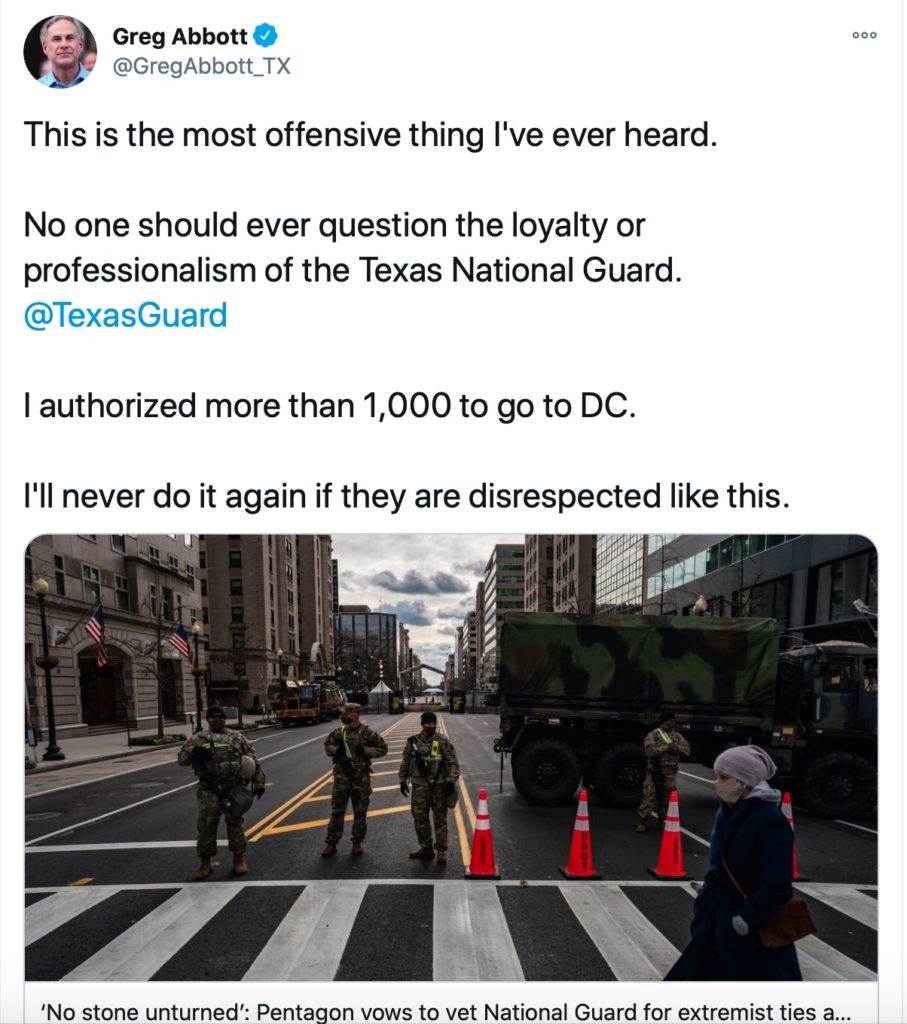
Gov. Greg Abbott of Texas said he was outraged about the extra political purity test being given to National Guard members and said he would not have sent his troops had he known about it.
Of the 25,000 guardsmen deployed to Washington, D.C., 80 were from Alaska.
Update: Due to road conditions, in-person classes will not begin today in Anchorage.
Some of the youngest students returning to classes today in Anchorage will enter a dystopian classroom world, where they must kneel for hours on end on the floor while masked, and have no recess or art or physical expression.
Pre-K–2, K–6, self-contained special needs programs, and the Whaley School (clarification, not pictured in this article) are returning to in-person learning at Anchorage School District classes on Tuesday, Jan. 19.
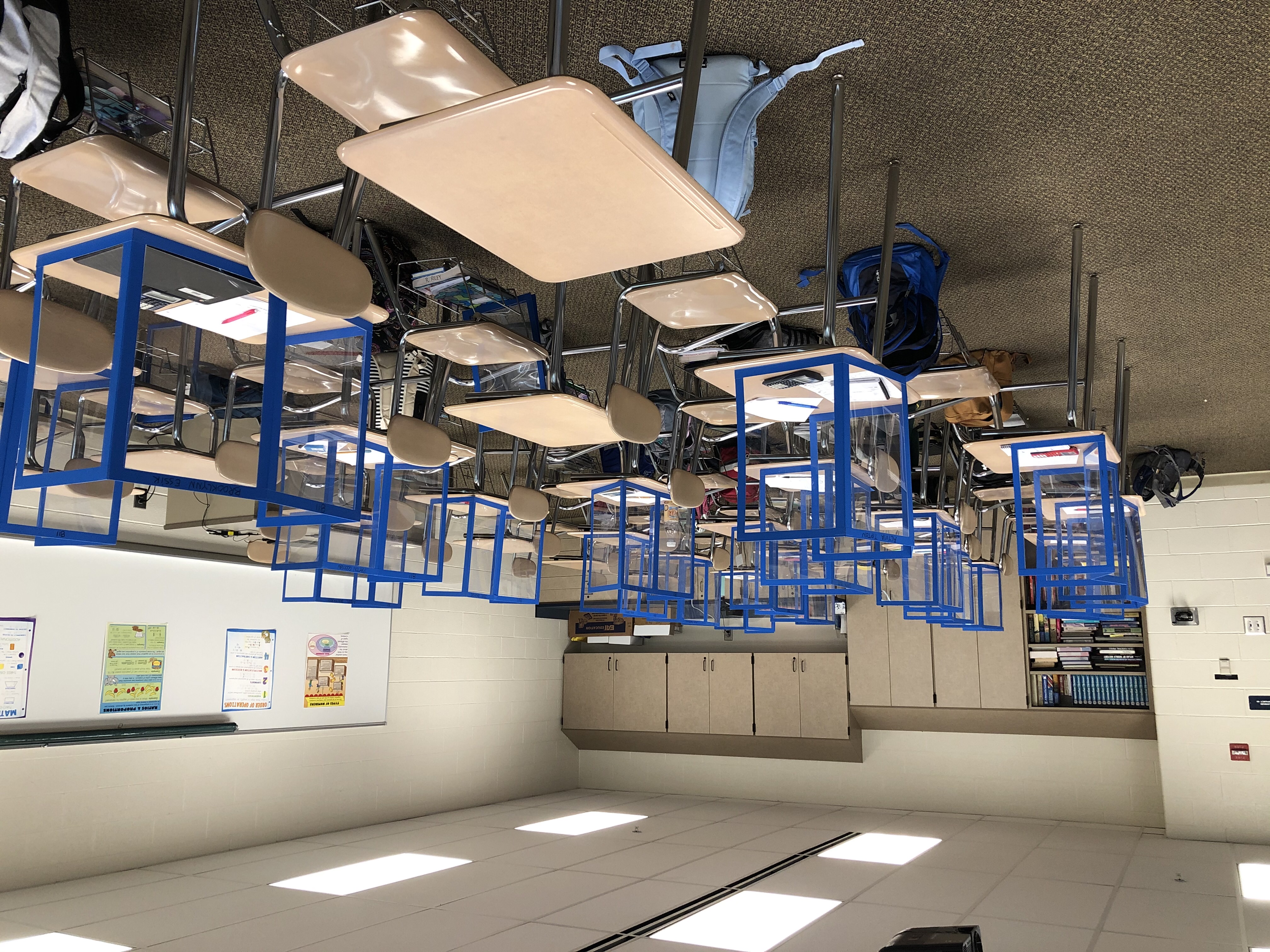
Parents who viewed the classroom above that their students will be returning to expressed shock: All desks have been removed. Students will kneel on gardening pads and use chairs as their desks for 5.5 hours.
[Parents, send photos of your children’s classroom conditions to this address: suzanne @ mustreadalaska.com]
Rather than lockers, they will have to bring a five-gallon utility bucket to store their lunch, jackets, and supplies in. The parents were told all students will be masked over their nose and mouth.
“We wouldn’t allow terrorists to be treated like this,” said one concerned parent, who asked to be kept anonymous.
Another parent has sent in this photo of her child’s classroom in Anchorage.
The new classroom design represents one solution to keeping children apart so they do not spread the COVID-19 virus.
Some of these young students have never been to school before, so they may not see the situation as abnormal. Anchorage schools have been closed due to the coronavirus since last March.
In at least one Ohio school, the desks are in place, but plastic barriers have been placed around each one, to contain moisture coming from students as they breathe through their masks, as shown from this parent’s photograph:
Grades 3–6 will continue with current Zoom and online classes for now in Anchorage. The District has a goal of bringing them back “as soon as possible after our first tier of students.”
Select middle and high school students who need extra support will also begin in-person, small-group classes for 5.5 hours each day on Jan. 19. All middle and high school students will return to in-person learning at the beginning of the fourth quarter, the District says.
“It may be hard to remember what ‘school in school’ was like. That’s okay! We will transition to a new routine together. We are paving the way for a new approach to learning in-person. The District is prepared with Individual School Safety and Mitigation Plansthat are in line with CDC guidelines and customized by school principals and staff to ensure the mitigation works for each unique schools’ building and culture,” the district said.
Meanwhile, Anchorage Education Association, the union for teachers and staff, has sent highly detailed instructions to all of its members telling them exactly how to document their discontent with returning to in-person learning, so that they may file a successful grievance against the school district.
AEA has already filed its first grievance, demanding that teachers may refuse to carry out orders that they feel threaten health. The letter to teachers points out the dangerous situation that will occur when students remove their masks to eat and drink in the classrooms:
“With many students returning to buildings next Tuesday, many of you will have difficult decisions to make regarding your health and safety. The District’s position is that they have plans in place that mitigate and minimize exposure to COVID-19. AEA is focusing on student and staff safety as we return to face-to-face learning.
“AEA has filed a grievance asserting violations of Article 421B: “A member may refuse to carry out an order that threatens health (excluding normal childhood diseases including but not limited to colds, flu, mumps, measles, chicken pox) or physical safety; or which is a violation of federal or state statutes. If the member refuses, the member shall have the burden of proof.” Page 48 in the AEA Contract.
“This grievance includes any members who refuse to carry out an order that they believe threatens their health or physical safety. The specific safety violations are in these areas:
“Classrooms are being set up that do not have six feet of distance between students.
“Student are being allowed to remove masks and eat in the classroom.
“SEL mask breaks in buildings do not comply with CDC guidelines.
“Classrooms may not meet CDC, OSHA, or other regulatory requirements for proper air circulation and filtration to minimize COVID-19 exposure.”
The entire union letter to teachers and staff is at this link:
Joint Base Elmendorf-Richardson announced on Facebook that, as of Jan. 15 it has banned the sale of alcohol on base between 10 pm and 5 am, in an effort to reduce suicide attempts and to generally lessen consumption.
The announcement was made on Facebook on Jan. 14.
“The number 1 priority of JBER leadership remains the health and safety of our people,” the post said. “Several scientific studies reviewed by the National Institutes of Health have concluded that restricting the hours when alcohol may be sold is an effective strategy for reducing excessive alcohol consumption and related harms.”
There were more than 290 comment on the Facebook post, many of them not favorable toward the new policy.
The 1776 Commission, created by executive order of President Donald Trump and comprised of scholars and historians, released its report rebutting reckless “re-education” attempts, such as the New York Times’ 1619 project, which seek to reframe American history around the idea that the United States is not an exceptional country but an evil one.
The report comes out on the penultimate day of the president’s four-year term.
The 45-page report Monday offers “a definitive chronicle of the American founding,” according to the White House.
“States and school districts should reject any curriculum that promotes one-sided partisan opinions, activist propaganda, or factional ideologies that demean America’s heritage, dishonor our heroes, or deny our principles,” the report said.
Until proven otherwise, many legislative observers are saying that Alexei Painter, the young director of the Alaska Legislative Finance Division for the past five months, is the real deal: A knowledgeable, politically neutral, good-faith analyst working to inform the Legislature about the realities of the state’s budget.
He’s somewhat of a rarity in liberal-washed Juneau.
Just after being hired by the Legislature, Painter produced his first comparison of where the State of Alaska’s fiscal situation is at, weighing the matters of current policy and current law.
He presented the current Legislature’s policy as one in which the Permanent Fund dividend is the last item funded by the Legislature. But he did so without judgment.
On Friday, he presented a clear-eyed analysis of the governor’s proposed budget, which had been submitted to the Legislature in December. His analysis was neither friendly toward it, nor full of “tone,” as sometimes was the case with his predecessor David Teal.
“The overview provides a starting point for legislative consideration of the Governor’s spending and revenue plans. It does not discuss the merits of budget plans; it focuses on outlining the fiscal situation and presenting the budget in a way that provides simple, clear information to the legislature,” Painter wrote. Indeed.
Painter went on to describe how Alaska is in its ninth straight year of deficit spending.
“Though the State has reduced UGF expenditures by 43% over that time and increased revenue by setting up a structured draw from the Permanent Fund, we still face a structural deficit. During this period, the State has gone from $16.3 billion in reserves to under $1 billion at the end of this year. The Governor’s FY22 budget request is smaller than the FY21 budget (other than the Permanent Fund Dividend) but still leaves a deficit of over $2 billion, which the Governor fills by increasing the draw from the Permanent Fund beyond the statutory sustainable draw,” he wrote. In fact, that is the case.
“The Governor also draws an additional $1.2 billion from the Permanent Fund for a second dividend payment in FY21, for a total of $3.2 billion in overdraws from the Fund,” he wrote.
That, too, hard to argue with. It’s just the facts.
“The Governor recognizes that this is unsustainable, however, and in his budget release he emphasized that these draws are necessary because of the COVID—19 pandemic. The Governor’s long-term plan calls for balancing the budget in FY23 by adding $1.2 billion of unspecified new revenue, reducing the dividend by $400 million, and further reducing agency operations,” he wrote.
The unspecified new revenue is something that has caught the attention of others, as well. The plan seems vague.
“The legislature faces dual problems: a state struggling with a historic pandemic that has caused record unemployment and economic hardship, and a long-term budget crisis that has drained the State’s budget reserves. The incoming legislature faces difficult choices that will have a lasting effect on the State of Alaska,” he wrote.
Painter fills in a role recently vacated by Pat Pitney, who is now interim President of the University of Alaska system, and David Teal, who was the budget guru for the Legislature for 22 years, who seemed to lose patience with the Republicans in the Legislature during his final few years, while siding with Democrats who sought broad-based taxes, such as an income tax or state sales tax.
Painter returned to the Legislative Finance Division after serving as a Policy Analyst with the Alaska Office of Management and Budget. He had earlier served for more than five years as a fiscal analyst, senior analyst and capital budget coordinator for the Legislative Finance Division. And he was an economist for the Alaska Department of Revenue. He and his wife own a small bookstore in Juneau, Rainy Retreat Books.
Although he most certainly comes from the Democratic tradition — the son of State workers and a former aide to Reps. Beth Kerttula and Reggie Joule — Painter has found a way to present budget choices in a nonpartisan manner.
A member of CIRI, he is especially interested in Alaska Native issues, and appreciates what policy has done to better the lives of Natives.
“When I think of how Native policies were implemented, I really think about how lucky we are as Alaska Native people. For the most part, we have the opportunity to live close to our original lands and enjoy our traditional values, if we so choose. Compared to California, we have a much better ability to control our own destiny,” he told the CIRI blog while he was finishing up his master’s degree at U.C. Berkeley.
See his budget overview and reports at these links:
Acting Attorney General Ed Sniffen will become Alaska’s Attorney General, said Gov. Mike Dunleavy in a statement today.
Sniffen took on the role of the AG after the resignation of Kevin Clarkson, subsequent to a series of personal text messages between Clarkson and a woman in the Governor’s Office.
Mr. Sniffen received his B.A. in Biology and Sociology from the College of Idaho and his J.D. from Willamette University College of Law. Upon graduating from law school in 1988, he began practicing law in Anchorage with a focus on natural resources, environmental, labor and employment, maritime, and utility law.
In 2000, he began his career with the Alaska Department of Law, serving as a senior assistant attorney general in the consumer protection unit, then as a chief assistant attorney general, deputy attorney general, chief of staff, and most recently as acting attorney general.
His appointment must be confirmed by the Alaska Legislature. Democrats will be sure to make his appointment difficult, and will likely ask him about his role in joining with the Attorney General of Texas in a challenge of four battleground states’ presidential election results, an effort that failed to gain traction in the U.S. Supreme Court, which rejected the case.
NATIONAL GUARDSMEN RETAIN THEIR FREE SPEECH RIGHTS
By CRAIG E. CAMPBELL
I just finished reading a very disturbing story in Must Read Alaska that said Major General William Walker, Adjutant General of the District of Columbia National Guard, stated that National Guardsmen deployed to D.C. for the inauguration of President-elect Joe Biden “went through an additional background check to weed out any whiff of domestic extremism.”
I verified this story with three other sources. I am totally outraged by a senior leader in the National Guard’s insinuation that some members of the National Guard may not serve our nation honorably when called to service and may actually be a threat to our national security.
National Guard members are American citizens. They do not give up their First Amendment freedoms to serve in the National Guard. They retain their individual rights of free speech and expressing their opinions through the political process when not in uniform.
We have reached a new low within the United States military by this action and it should scare the hell out of every American that a leader in the D.C. National Guard would even question the integrity and patriotism of any National Guard member assigned to the National Capital Region when serving under Federal orders of the President of the United States of America.
As a former Adjutant General of the Alaska National Guard, if General Walker had told me that this requirement would be levied upon those who volunteered to serve our nation for this event, I would have flatly declined his request. No Alaska National Guard member would be volunteered.
During my tenure as Adjutant General, there were some who strongly disagreed with my leadership and disagreed with actions of the President of the United States. However, I knew that when called into federal service these American patriots would fulfill the oath they took to serve the United States, without hesitation.
The National Guard has a very diverse membership which includes Republicans, Democrats, Libertarians, independents, probably even some Socialists and other fringe groups. But every single one takes an oath to uphold the laws of the State of Alaska and the United States of America when in uniform.
It has been the rare exception that I ever witnessed a National Guard member not serve this state and nation honorably, and when it happened, disciplinary action was taken, often resulting in that person being separated from the National Guard.
National Guard members are citizen-warriors. They take the same oath of office as active duty members. It reads “I, [name], do solemnly swear (or affirm) that I will support and defend the Constitution of the United States against all enemies, foreign and domestic; that I will bear true faith and allegiance to the same; that I take this obligation freely, without any mental reservation or purpose of evasion; and that I will well and faithfully discharge the duties of the office on which I am about to enter. So help me God.”
I am incensed the FBI did additional back ground checks on all 25,000 National Guard troops coming into Washington for the inauguration. What a slap in the face to the National Guard.
Did the FBI vet every single active duty military member that is stationed in the National Capital Region and will be serving during the inauguration? Of course not, despite the fact that Army Secretary Ryan McCarthy has been quoted as saying there may be up to 25 active duty military members that participated in the Jan. 6 U.S. Capitol occupation.
That raises the serious question about security within our active duty forces. I recall that the recent acts of violence by military members were conducted mostly by active duty personnel such as the 2009 mass killings by US Army Major Nidal Hassan at Ft. Hood; or the US Navy sailor killing two at Pearl Harbor in 2019; or the Marine who tried to enter Offit AFB with firearms, a silencer, body armor and ammunition, or the airman the shot his commander before killing himself at Joint Base San Antonio-Lackland in 2017.
America has reached a dangerous low, starting to resemble the practices of the former Soviet Union, and the Left is using this dark period to undermine our constitutional rights as Americans, using the federal bureaucracy to “weed out” undesirables and to institute a police state where a political purity test is necessary if you are to be allowed to participate in national events.
What’s next, a national score for every American citizen, like they have already instituted in China?
If a loyalty test is required for service in the military than I would recommend the Alaska National Guard court-martial Captain Forrest Dunbar (Alaska Army National Guard) under the Uniform Code of Military Justice for insurrection to the United States of America based on his publicly stated belief that the U.S. Constitution is based on racism. If Dunbar really believes the United States Constitution is such a flawed document that he must correct it as a political figure, then he has less standing to serve in the United States military than any of the “vetted” patriots that volunteered to serve in D.C during this up-coming inauguration.
I am continually amazed how the uber-left is able to twist the truth to fit their narrative. They tell us this past summers riots were peaceful protests. They say the Jan. 6 Capitol occupation was instigated by Trump and neo-nationalists. We now see that the occupation was actually instigated by left-wing anarchists, planned days before President Trump delivered his speech.
Now honorable citizen-warriors of the United States National Guard, under Federal orders, are being subjected to background checks to “weed out” the undesirables. Unbelievable!
Wake up America, our Constitutional Democratic Republic is under siege by Leftists determined to create a Socialist/Communist regime where the greater good of government trumps your individual rights, freedom, and liberties. May God bless America.
Craig E. Campbell served on the Anchorage Assembly between 1986 and 1995 and later as Alaska’s Tenth Lieutenant Governor. He was the previous Chief Executive Officer and President for Alaska Aerospace Corporation. He retired from the Alaska National Guard as Lieutenant General (AKNG) and holds the concurrent retired Federal rank of Major General (USAF).
Most civilians would be forgiven if they believed that when you join the National Guard, you’re vetted for fitness, patriotism, and duty to country, and that you wouldn’t have to be re-vetted for patriotism and duty prior to an assignment.
But National Guard members being assigned to the inauguration this week received another layer of scrutiny, just to make sure they are not one of the insurrectionists they would be guarding against in the nation’s capital.
Late in 2020, Alaska Guardsmen were asked via email if they wanted to volunteer for the assignment to D.C. to take part in the events around the Inauguration. That was before America witnessed the citizen siege on the U.S. Capitol on Jan. 6.
About 80 of them volunteered, and it appears most of them are on their way to DC on Sunday, Jan. 17.
“The roughly 25,000 National Guardsmen deployed to the U.S. capital to ensure President-elect Joe Biden is able to be sworn in peacefully went through an additional background check to weed out any whiff of domestic extremism,” Major Gen. William Walker told a national security reporter from DefenseOne.com. (Italics ours). Walker, pictured above, is the 23rd commanding general of the District of Columbia National Guard.
The extra layer of security is more of a deep dive into guardsmen’s backgrounds than when they initially enlisted, he said, describing it as “another layer” of security above and beyond the continuous monitoring of the force.
That likely means poking around into social media activity of guardsmen, or social clubs, and memberships.
Update: Associated Press is reporting that the FBI vetted all guard members before allowing them to go to D.C.
The vetting process, spurned by worries from defense officials, was confirmed by Army Secretary Ryan McCarthy, according to AP.
”We’re continually going through the process, and taking second, third looks at every one of the individuals assigned to this operation,” McCarthy is quoted as saying. “The question is, is that all of them? Are there others? We need to be conscious of it and we need to put all of the mechanisms in place to thoroughly vet these men and women who would support any operations like this.”
One guardsman likened it to sending all Japanese-American fighters in World War II to Italy because of the perception they could not be trusted.
Members of the National Guard, unlike those in the active duty military, do not relinquish their First Amendment rights, and so many of them may still express their opinions on social media platforms.
Must Read Alaska reached out to members of the Guard, who said they had never before seen additional screening on political grounds.
Walker may demand more screening, but it’s up to Alaska Maj. Gen. Torrence W. Saxe to accept the task and the purity test conditions with it. Saxe is the Adjutant General of the Alaska National Guard.
It’s unclear if Saxe was told of the extra screening that would be applied. Must Read Alaska has requested a comment. This story will be updated with his comments.
The filing period for Anchorage mayor and school board seats opened on Friday. So far, eight have filed for mayor for the April 6 election.
The filing deadline is Friday, Jan. 29 at 5 pm. Here are the applications that were received on Friday by the Municipal Clerk’s Office, with more expected on Monday for school board: