Gov. Mike Dunleavy joined a phone call with 20 Republican governors on Friday to discuss a lawsuit to be filed in federal court against the Biden Administration over its extreme federal mandate requiring Covid shots for the entire federal workforce and any business with more than 100 employees. Congress and the U.S. Postal
The lawsuit may need to be filed in a state that is not in the Ninth Circuit Court of Appeals, but in one that is more friendly to the U.S. Constitution.
Republican leaders, including GOP Chairwoman Ronna McDaniel, expressed horror last week at Biden’s coronavirus vaccine mandates. On Thursday, Biden openly bashed Republicans during his address, in which he announced his immunization orders for all federal employees, federal contractors, health-care workers in facilities that have Medicare or Medicaid clients, as well as all private businesses with more than 100 employees. Business who don’t want to comply with the shots must do mandatory testing for Covid of their unvaccinated employees.
Biden said his patience was wearing thin for people who are unvaccinated against Covid-19.
Dunleavy immediately last week called the president’s order outrageous and unenforceable. Gov. Greg Abbott of Texas called it “a power grab.” South Carolina Gov. Henry McMaster said he will fight Mr. Biden to “the gates of hell.”
In past pandemics, the Supreme Court has upheld the government’s right to inject medicine into people, but this court is more conservative and the past rulings may be ripe for overturning.
The president’s mandate says that Department of Labor Occupational Safety and Health Administration will put in place an “emergency temporary standard” until a permanent standard is in place. OSHA’s website says it has the power to issue standards if “workers are in grave danger” from toxic substances or agents or to new hazards.
The governors are consulting with their legal advisors about the best path forward and which state takes the lead.
The Municipality of Anchorage awarded the contract to continue mass care shelter to contractor 99 Plus 1, Inc. The contract with Bean’s Cafe to run the mass care shelter ends Sept. 15.
“I am pleased that mass care shelter will continue without disruption in service,” said Mayor Dave Bronson. “One of my top priorities has been a commitment to helping our homeless neighbors in need.”
It will continue for now at the Sullivan Arena, although the mayor’s plan is to have a navigation center for those experiencing homelessness on Tudor Road at Elmore Road.
As part of the transition to 99 Plus 1, an Anchorage company, no clients will have to leave and there will be adequate staff, Bronson said. There will be bedding, food, and navigation services available.
99 Plus 1, Inc. will be onsite at the Sullivan Arena on Monday, Sept. 13 to interview prospective employees. Although Bean’s Cafe applied to continue running the mass care services, the nonprofit did not win the contract.
The contract is not indefinite; it will end on Oct. 31. The plan is to move forward with Bronson’s initial plans and get the Sullivan Arena back to use as a hockey venue. Bronson is being blocked by the liberal members of the Assembly, who want to continue to use the facility as a homeless shelter until they can push through their own plan, which differs from the mayor’s.
I was a presenter at the Juneau–Gastineau Rotary Club in January, 2020, speaking on “Several sanctioned avenues for immigration to the United States.” At the end of my presentation, an attendee asked a question: “Alexander, what was the most difficult area of your acculturation and assimilation in the United States?”
“My behavior,” I said without any hesitation. As I answered the question, I instantly observed by the reaction of the audience; they expected a different, perhaps more obvious response, such as food, language, customs, economics, politics, appearance, etc.
True, for a newcomer’s adaptation, these socio-economic categories are essential for survival in a foreign environment. Nevertheless, people’s behavior (e.g., temperament, manners, demeanor, gestures, conducts, actions, bearing, comportment, preferences, motivation, ambition, etc.) is the most critical obstacle for acculturation and assimilation to new cultural traditions.
According to prominent American sociologist Joseph Elton, “Acculturation is the adoption of cultural traits, norms and customs by one society from another… There is no clear line [that] can be drawn between acculturation and assimilation processes. Assimilation is the end–product of a process of acculturation, in which an individual has changed so much as to become dissociated from the value system of his group, or in which the entire group disappears as an autonomously functioning social system.”
All of us live within a culture. Most cultural descriptions have labels such as “middle class,” “American,” or “Yupik and Inupiat.” These labels often become associated in our minds with certain habitual features. One such attribute for “middle-class Americans,” for example, might be typical foods — hamburgers, hot dogs and Coca Cola. Of course, this is a very broad and superficial understanding of culture.
Culture is learned behavior passing from one generation to another—an ongoing process that changes gradually over time as a learned means of survival. In contrast, all animals adapt to their environment through biological evolution. If an animal was well adapted to its physical environment, it prospered. If it was not, it either evolved or became extinct.
As a result of biological evolution and adaptation to the northern environment, for example, the polar bear developed a thick coat and layers of fat to protect it from the arctic cold. But the Yupik and Inupiat do not possess fur. They wear warm clothing, and in the past, made sod houses to protect themselves from the harsh environment. Their ancient tools and dwellings were part of their culture—their adaptive system that coincides with the polar bear’s fur.
In short, language, religion, education, economics, technology, social organization, art and political structure are typical categories of culture. Culture is a uniquely human system of habits, moral values and customs carried by the society from one’s distant past to the present.
Acculturation and assimilation to a culture by newcomers is a personal and self-determined process—the right to make one’s own decisions without interference from others. No one can force a newly–arrived legal immigrant to accept the cultural traditions, lifestyle, and customs of his new country. The newcomer himself must see a socio–economic necessity and benefit in accepting new traditions and values in order ultimately to embrace and accept his new culture without external influence.
I first visited Alaska in 1981, while participating in archaeological field research for graduate school at Brown University. Then, I was one of few, if not the only, Soviet–born people in Alaska since 1945 (Russian Old Believers arrived in Alaska in the 1960s from Oregon and South America).
In fact, from 1946 to 1986, or during the Cold War between the U.S. and the Soviet Union, travel to Alaska was officially closed to Soviet citizens, just as Siberia was closed for American citizens. There was an exception for select scientists, visiting both places for research–related purposes under the auspices of the International Research Exchange Board. In 1981, I already was a permanent resident of the United States, with a green light for traveling to Alaska.
Then, as a recent political refugee from the Soviet Union, my behavior was still typically Russian—direct, impulsive, critical, opinionated and emotional (certainly, very general stereotype of the Russian character). Fortunately, my sponsors and hosts in Alaska, Charles Holmes from Anchorage and Glenn Bacon from Fairbanks, were trained and professional anthropologists; they cross-culturally were able to understand my behavior and occasional awkward expressions and guide me through rough waters and unfamiliar landscapes.
After 40 years, Charles and Glenn are still my good and loyal friends. From the mid-1980s and on, Bill Ruddy, Robert Price, Wallace Olson and Tom Hanley of Juneau played a similar role in my life.
On one occasion, a humorous cross-cultural incident took place in Fairbanks in the summer of 1981. Glenn’s in-laws invited me to their house for dinner. To experience Russian cuisine, they asked me to cook some traditional Russian meal. So, I managed to cook a borshch (cabbage soup) and authentic Salad Olivye (boiled potatoes cut in cubes, green peas, boiled eggs, cooked carrots cut into cubes, cubed ham, olives, onion, large pickles cut into cubes, and ½ cup of mayonnaise—all mixed together).
After a dinner, I played a guitar and performed several Russian songs for everyone. At some point, Glenn’s mother-in-law approached me and confessed, “I had always envisioned Russians as tall, dark, with shaking hands. But you are different.” I only smiled in my response, and took her description of a “Russian man” without offense. After all, I was the first Russian she had ever met, except for the demonic Russian characters portraited in Hollywood.
Indeed, the process of acculturation and assimilation can be long and turbulent for many legal newcomers. It is critical, therefore, for American society to be inclusive, tolerant and educated in cross–cultural communication in order to welcome legal newcomers to our diverse and exceptional country.
Alexander B. Dolitsky was born and raised in Kiev in the former Soviet Union. He received an M.A. in history from Kiev Pedagogical Institute, Ukraine, in 1976; an M.A. in anthropology and archaeology from Brown University in 1983; and was enroled in the Ph.D. program in Anthropology at Bryn Mawr College from 1983 to 1985, where he was also a lecturer in the Russian Center. In the U.S.S.R., he was a social studies teacher for three years, and an archaeologist for five years for the Ukranian Academy of Sciences. In 1978, he settled in the United States. Dolitsky visited Alaska for the first time in 1981, while conducting field research for graduate school at Brown. He lived first in Sitka in 1985 and then settled in Juneau in 1986. From 1985 to 1987, he was a U.S. Forest Service archaeologist and social scientist. He was an Adjunct Assistant Professor of Russian Studies at the University of Alaska Southeast from 1985 to 1999; Social Studies Instructor at the Alyeska Central School, Alaska Department of Education from 1988 to 2006; and has been the Director of the Alaska-Siberia Research Center (see www.aksrc.homestead.com) from 1990 to present. He has conducted about 30 field studies in various areas of the former Soviet Union (including Siberia), Central Asia, South America, Eastern Europe and the United States (including Alaska). Dolitsky has been a lecturer on the World Discoverer, Spirit of Oceanus, andClipper Odyssey vessels in the Arctic and sub-Arctic regions. He was the Project Manager for the WWII Alaska-Siberia Lend Lease Memorial, which was erected in Fairbanks in 2006. He has published extensively in the fields of anthropology, history, archaeology, and ethnography. His more recent publications include Fairy Tales and Myths of the Bering Strait Chukchi, Ancient Tales of Kamchatka; Tales and Legends of the Yupik Eskimos of Siberia; Old Russia in Modern America: Russian Old Believers in Alaska; Allies in Wartime: The Alaska-Siberia Airway During WWII; Spirit of the Siberian Tiger: Folktales of the Russian Far East; Living Wisdom of the Far North: Tales and Legends from Chukotka and Alaska; Pipeline to Russia; The Alaska-Siberia Air Route in WWII; and Old Russia in Modern America: Living Traditions of the Russian Old Believers; Ancient Tales of Chukotka, and Ancient Tales of Kamchatka.
Democrats who want to fight the Texas “heartbeat law,” which prohibits abortions after the baby is six weeks old in the mother’s womb, now can voice their opinion on their shirt.
Six weeks is when the baby’s heartbeat can first be detected by ultrasound. That’s the new cutoff date for abortions in Texas.
The National Democratic Committee is now hawking a shirt that proclaims abortion is “Health Care.” There are sizes through 3X are available, just in case a pregnant mom wants to sport the Democrats’ message.
For $30, you can sport a shirt that is sure to offend half the people you meet. According to the Rasmussen Report’s more recent poll on the matter, 46 percent of likely U.S. voters support the new Texas law banning abortion after six weeks in the womb, while 43 percent oppose the law and just 11 percent are undecided. The survey was conducted Sept. 5-6 with 1,000 Americans. (To see survey question wording, click here.)
The shirt is a fundraiser for the Democrat Party and proceeds will be used to support candidates who support abortion, the DNC said in a fundraising letter.
The third special session during the 2021 calendar year is turning out to be another bust, even as it winds its way to the end on Wednesday night. A fourth special session is surely on the way, but the governor has only hinted at it, and has not yet set a date for it.
The main purpose of the fourth special session is determining a Permanent Fund dividend, which remains entrenched as the third rail of Alaska politics.
As Alaska turns the corner to fall, there is still no dividend, which is a statutory obligation of the government. Every year of the Dunleavy Administration, the Legislature has blocked the release of the full statutory amount for Alaskans.
The House passed HB 3003, a spending bill for dividends of $1,100 per person, less than a third of the statutory amount. The bill has languished in Senate Finance for weeks but appears to be heading for a floor debate and vote on Sunday afternoon.
The comprehensive fiscal plan working group, which the Legislature formed to come up with a fiscal solution, met in July and August, but has not seen its work adopted by the Legislature.
There has also been a little activity recently on the governor’s request for a resolution that would allow voters to put the 50-50 Permanent Fund dividend calculation into the Alaska Constitution. Senate Bill 53 is queued up for a floor debate and vote.
There’s no spending limit to be placed before voters for consideration as a constitutional amendment, and even critical legislation to get more medical professionals in the state is bogged down; Rep. Zack Fields of Anchorage has said the bill that would allow the transfer of nursing licenses from other states will pass over his dead body.
The one bill that has moved at a pace is the governor’s Telehealth bill, which passed the Senate on Friday. It will take a bit of the pressure off of medical facilities round the state, allowing them to bring more staff in — if they can find staff to hire at all. Stripped from the bill by Democrats were protections for Alaskans from vaccine mandates that were added to the bill in the Senate.
Democrats and some Republicans are advancing various taxes, such as Senate Minority Leader Tom Begich’s corporate income taxes and fuel taxes, while over in the House Ways and Means Committee, Rep. Ivy Spohnholz is trying to advance a 75-25 Permanent Fund dividend proposal — the government gets 75 percent, and the people get 25 percent, combined with revenue measures like taxes.
Led by Democrats and turncoat Republicans, the House has only met for a regular floor session five times since the third special session convened Aug. 16.
The Senate has met in a regular floor session just seven times. The rest of their obligatory meetings have been “technical sessions” — gavel in and gavel out, with only a couple of people present.
So far, the Legislature will have been in session for 186 days this year, and another special session will bring the time to 216 days, or 61 percent of the year’s calendar.
In 2016, the Anchorage East High School girls flag football team all wore patriotic socks when they played their game on Sept. 11.
It was their way of honoring their country on what is a solemn day, a day also known as Patriots Day.
Times are different and this year’s team is different. It is more “woke.” A third of the girls on the East High School Flag Football team “took a knee” to protest America’s faults during the playing of the “National Anthem.”
The girls were getting ready to play Eagle River at Eagle River High School when the tradition of the “National Anthem” was being observed.
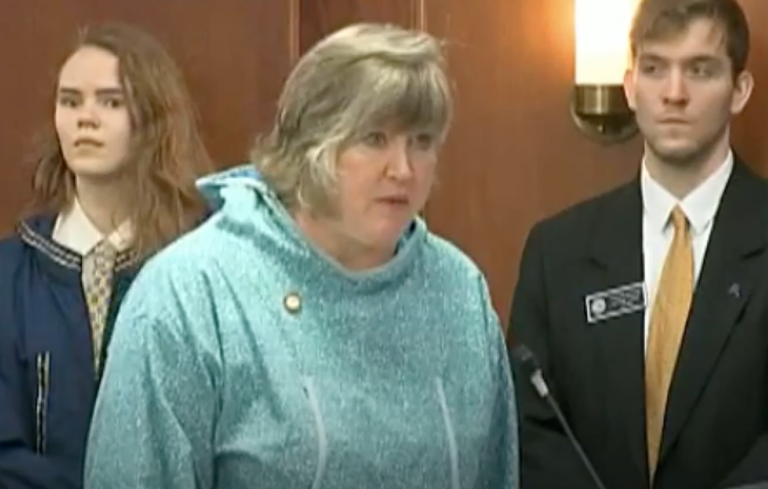
Rep. Sara Hannan, a Juneau Democrat, appeared to praise the Nazis today in her floor speech about how their experiments on unwilling human victims led to scientific breakthroughs.
“If we go back to the Nuremberg Code and look at some of the experiments conducted by the Nazis and know that there were violations of human dignity, of scientific methodology, yet they produced results,” Hannan said.
She was trying to make the case for following science when it comes to vaccinations and how important science is in general.
Hannan was speaking during the “special orders” part of the House floor session, when she made the remarks, acknowledging the work of Nazis in Germany leading up to World War II.
She then mentioned the late Dr. William Mills.
“A very famous Alaskan doctor – Dr. Mills – who was an expert – word-renown – on frostbite and survival, frequently told that he came to that research as a young doctor looking at science that was conducted on humans, and knowing that it was done in these horrific conditions, yet knowing that it could still benefit us to look at the results of that,” Hannan said.
“And he became this renowned expert on frostbite, knowing that the science was developed by the Nazis – was horrifically done on people who were not voluntary scientific experiments, subjected to conditions where they were placed – where body parts were freezed and they were broken off.”
She seemed to be arguing that the Covid-19 vaccine may have been experimental, like the Nazi work on frozen limbs, but that it led to good outcomes. Listen to her speech to try to discern the entire context, which seems to argue the ends justify the means in science:
Like with the Nazis and their “science,” the forcing of vaccines on people is considered by many to be a violation of the Nuremberg Code.
Hannan then went on to contradict herself on her argument as she acknowledged that settled science last year claimed the Covid-19 virus could be picked up from surfaces, while this year, science says that is not the case.
“Sometimes bad science tells us a lot. But just because you don’t like the conclusions of scientific work doesn’t mean it’s experimental,” Hannan said.
But it was the comment that gave a nod to Nazi scientists that caught the attention of critics, who say that Hannan is a social justice warrior who often talks about Nazis, although never in such complimentary terms.
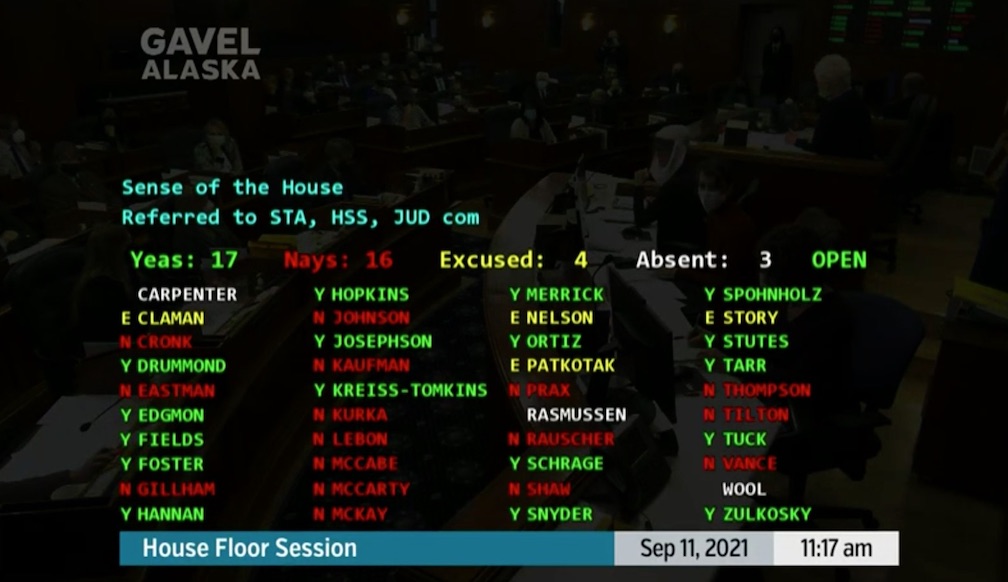
She was responding to Republicans in the House who wanted the House to reaffirm the Nuremberg Code, but Speaker Louise Stutes referred the matter to three committees. Republicans objected to the ruling of the chair but the majority agreed with Stutes, 17-16, with Republican Rep. Kelly Merrick of Eagle River voting with the Democrats to bury the matter in committees that are not meeting.
The vote to bury the Sense of the House in supporting the Nuremberg Code into three committees.
Rep. Sarah Vance had spoken on the topic of medical free choice just before Hannan’s remarks:
The group called “We’ve had enough! Vote yes! Recall Zaletel” has launched a website.
The group is working to unseat Anchorage Assemblywoman Meg Zaletel, who has one of two District 4 seats in Anchorage, in the midtown area.
The Supreme Court said the petition to recall her was sufficient because she broke the law when she violated the mayor’s emergency orders last summer during an Anchorage Assembly meeting. She argued in court that it was a minor infraction, but her recall was approved by the Alaska Supreme Court.
The recall election takes place until Oct. 26, with ballots going in the mail around Oct. 5.
“A majority of the Anchorage Assembly have ignored the City Charter that Anchorage residents passed. They have ignored spending caps and enacted the largest budgets in Anchorage history. They have misappropriated COVID Cares Act funds to buy buildings and fund political allies. They have increased property taxes and imposed taxes on selective sectors. They have shut the public out of public places. They have mandated business closures that have destroyed many of those businesses. They have restricted access to churches and sporting events. They have literally ignored the law,” the website says.
“Meg Zaletel wrote legislation in 2020 to prevent Anchorage Police Officers from protecting themselves from dangerous criminals,” the recall advocates say.
“Many Assembly Members deserve to be recalled – but a recall of Meg Zaletel is now on the ballot for October 26th and that is the beginning of the end for an Assembly that has ignored the will of a majority of Anchorage residents. They have redefined the entire municipal government to make it serve a small minority who believe in dismantling the rule of law and the standards of society that America was built on. The standard which has made us the greatest nation on earth!
“We are saying enough-is-enough right here at the local level!” the group writes on its website.
The defense for Zaletel is also busy. It has two groups registered with Alaska Public Offices Commission.
“Stand Up for Meg Zaletel” is chaired by AFL-CIO President Joelle Hall, who signed the Recall Dunleavy petition in 2019. “No on Zaletel Recall” is chaired by another person who also signed the Recall Dunleavy petition, Carolyn Ramsey, of Anchorage.
The “We’ve Had Enough” group is chaired by Dr. Russell Biggs, an Anchorage doctor who also tried, but failed, to get Assemblyman Felix Rivera recalled earlier this year. The unions brought in tens of thousands of dollars to keep Rivera in office, vastly outspending Biggs and his small group of grassroots activists in midtown.
Learn more about this recall on the election and see if you are eligible to vote in Anchorage municipal District 4, check the Municipality’s website here.
November, 2022 may provide another angle before stepping in that direction with a better working Legislature and a conservative governor, unless Ballot Measure 2 upsets that design, which it may.
Our vote on the constitutional convention will not be under the regulation of Ballot Measure 2 and therefore may be an opportunity and a decisive decision for republicanism (Little “r” where power is held by the people and their elected representatives.).
I would like to point out that fascism is Left on the political spectrum heading towards totalitarianism, while anarchy is the extreme Right.
I don’t seeBob Bird, in his column in Must Read Alaska, as advocating the tyranny of the Left nor the lawlessness of the Right. If anything, Bird is attempting the move the discussion to the Right side of the spectrum to just about the position of the U.S. Constitution. Stunningly accurate, if we are to maintain Americanism and a constitutional republic.
But I meander, let’s stay on topic.
Keep in mind the state has refused to implement Janus, Espinoza, and Thompson. If you don’t know what these decisions are, look them up (they refer to public employee labor unions, education tax dollars, and Citizens United). It’s time we all get a better civics lesson in Alaska.
These are cornerstone Supreme Court decisions in implementing individual constitutional protections under the First Amendment. Such implementations may provide the people of Alaska with more responsibility and accountability, rather than the current entitlement and hegemony, thus building strength and comity instead of weakness and chaos.
While the governor has not implemented his Article III, Section 22 and 23, duties in a manner which I believe he has authority to do, the governor has sought to put before the electorate three constitutional amendments, the PFD, budget spending cap, and voter approved taxes.
All three are timely and necessary in the greatest natural resource development potential state in the world, to assist in stopping the pillaging of our state treasury.
For some this was a great start.
For myself, I would agree with Bird that the Alaska governor clearly has the constitutional authority to make sweeping changes in our state government’s organization. He has not, and for that I lay this at his feet, especially when he had the strategic advantage when the Alaska Legislature had taken so much time to organize.
Regarding our state constitution:
My first thought is elect candidates who do their duty under the oath of office and honor and obey Article I, Section 2, allowing the true source of government to decide the issues such as stated above. Simple and genuine.
Article IV, Section 1, second sentence, albeit has no real 1955 constitutional explanation. I still contend it does give the legislature and the voters an effective tool for regulating state judicial jurisdiction as well as regulating the role of the judicial council, yet to my knowledge, this has never been done.
The cornerstone of our social construct is Article VII, Section 1, yet the 1995 constitutional delegates had no committee studying this, instead, the delegates left the single most major societal component up to the Alaska Legislature which started as a political football and evolved into a political weapon.
Article VII, Section 1, has yet to be addressed despite several sweeping federal acts which impacted the state.
Delegate Bob Bartlett believed in the role of resource development in Alaska’s future could only benefit the state through careful management when he stated, “. . . fifty years from now, the people of Alaska may very well judge the product of this Convention not by the decisions taken upon issues like local government, apportionment, and the structure and powers of the three branches of government, but rather by the decision taken upon the vital issue of resources policy.”
Fifty years later, the Citizens’ Advisory Commission on Federal Areas and Alaska State Lands Advisory Group’s “Recommended Petition By The State Of Alaska To Congress And The Executive Branch For Transfer Of Certain Federal Lands To The State And Power Sharing In Governance And Planning On Remaining Federal Lands” issued the greatest challenge by the State of Alaska to federal colonialism.
Yet this topic, which should be in every course in Alaska’s education system has received little if any recognition and attention as we head to 2022. This is the foundation of our state Constitution, the true vestige of our Last Frontier.
Bob Bartlett may be rolling in his grave.
The list goes on and on with each successive state government administration working hard to front the pillaging of our state despite themselves. This is behavior derived from the schizophrenia of our current state Constitution.
I contend that if we examine the actions, we will find we no longer have a Democratic and Republican Party in Alaska, instead we are now “Marxists” and “conservatives.”
Arguably this is another part of the discussion, but the risk avoidance tolerance and courage appear to be much greater in the Marxists than the current conservatives and this is the real dilemma.
After all, when we read the state Constitution, do we all realize that the aim of Article XII, General Provisions, Section 11, was to avoid confusion created by different expressions for the concept of law, yet it does the very thing the delegates meant to prevent by creating unfettered discretion by the state government about the scope of law-making, whether legislative or by the people?
Yes, I realize we have probably run out of time, but then again, where are the adults in the room? Bob Bird is an adult in the room attempting to create reasonable and legitimate discussion and change amongst many who will not even try.
“It is far easier to whisper advice from cover than to risk its merit at the point of attack.” – Sir Cedric Willingham, King Ralph.
Michael Tavoliero is a realtor in Eagle River, is active in the Alaska Republican Party and chairs Eaglexit.