Sunday, June 7, 2026
Home Blog Page 1047

National poll: Most Americans think Biden went too far with his Covid shot mandates

31

Most Americans think that President Joe Biden has overstepped his authority in mandating vaccines for Americans in the private sector. Last week, the president issued an executive order that says vaccines are mandatory for at least 100 million Americans, including all who work at businesses with more than 100 employees.

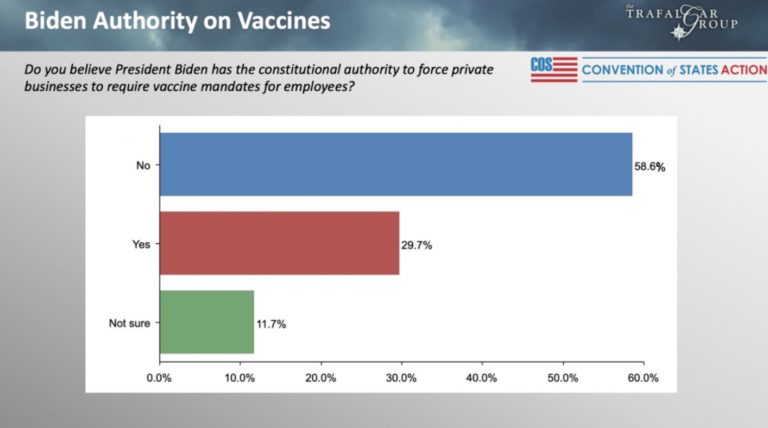
When asked, “Do you believe President Biden has the constitutional authority to force private businesses to require vaccine mandates for employees?” 58.6 percent of respondents said that he does not have the authority. 29.7 percent said he has the authority to mandate shots.

Even Democrats who answered the question are divided on whether the president has the authority. 55 percent of Democrats think Biden can mandate vaccines, while 27 percent don’t agree with that position.

As for Republican voters, 83.5 percent say the president does not have the authority. Only 10.7 percent of Republicans think he does have the authority.

For people who have either no party registration, or a third party, more than 68 percent say Biden doesn’t have the authority, while 21 percent say he does.

When asked if they think governors should oppose Biden’s nationwide vaccine mandate on private businesses, 56.1 percent said that governors should, indeed, oppose the president, while 40.1 percent oppose that idea.

It splits out by party: Democrats are against governors opposing Biden, while Republicans strongly favor governors opposing Biden on these mandates. Unaligned or third party voters side strongly with the Republicans.

Read the poll details at this link.

Conducted 09/10/21 – 09/12/21 • 1098 Respondents
• Likely General Election Voters
• Response Rate: 1.46%

• Margin of Error: 2.96%
• Confidence: 95%
• Response Distribution: 50%

Stranger than fiction: ADN publisher, writer are co-producing ABC series on their paper

A drama that will star Hilary Swank and Tom McCarthy is sure to feature the Anchorage Daily News, as two of the coproducers are tightly bound with the newspaper.

The Hollywood Reporter announced that Swank will star in a newspaper drama that is being written, directed and exec produced by McCarthy for ABC, which has picked up the untitled Alaska drama.The project is being eyed for consideration as part of a 2022-23 pilot season.

“The drama revolves around a star journalist (Swank) who moves to Alaska for a fresh start after a career-killing misstep and finds redemption personally and professionally after joining a daily metro newspaper in Anchorage,” the publication wrote. Ryan Binkley, publisher and owner of the ADN as a member of the Binkley Company, and Kyle Hopkins, a hardline leftist who writes for the newspaper, will co-produce.

Swank has won Oscars for Boys Don’t Cry and Million Dollar Baby, and recently starred in Netflix’s drama Away.

Alaska lawmakers took big bucks from a hospital trade group, and then voted accordingly

31

Alaska members of the House of Representatives have been tangling over a number of patients’ rights amendments to a telehealth bill that the governor has requested.

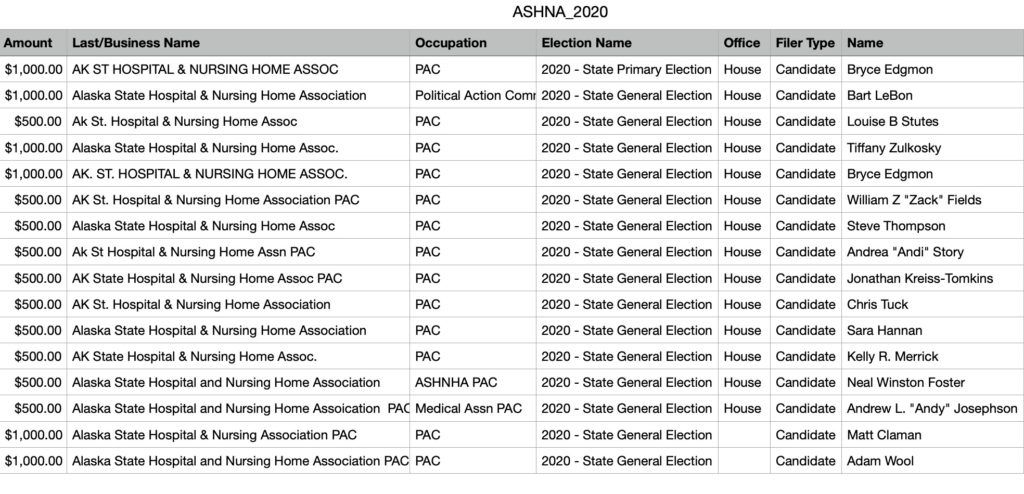
Their votes on Sunday night lined up almost exactly according to how they have been funded by ASHNHA, the Alaska statewide association of hospitals, nursing homes, and healthcare partners. 

For example, many of those who voted against an amendment to allow patients to have an advocate in their hospital room with them received campaign funds from ASHNHA.

Listen to the debate segment, featuring opposite points of view — Rep. Zack Fields arguing for the bureaucracy, and Rep. David Eastman arguing for patients and families — here:

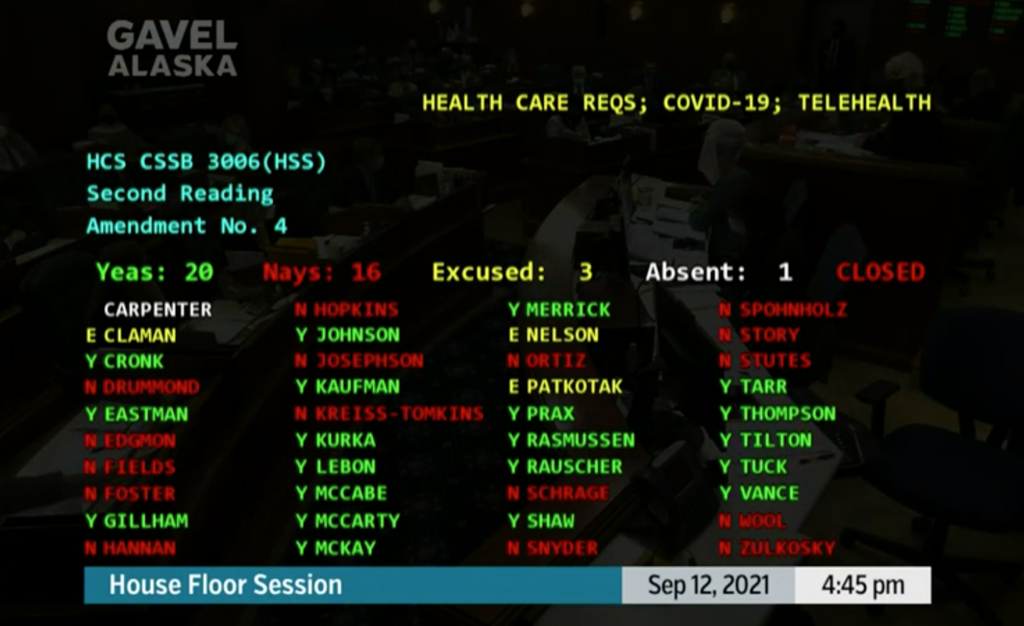
Amendment Four passed 20-16, against ASHNHA’s wishes. If it stood, it would guarantee hospitals must allow a patient to have an advocate with them in ths hospital.

That’s when Democrats, such as Rules Chair Bryce Edgmon, said the entire bill was now too flawed to proceed, and Speaker Louise Stutes sent it back to Rules Committee to have that provision stripped out of it.

Here are the members of the House who received campaign contributions from ASHNHA in 2020. ASHNHA opposes this provision to allow patients to have their advocates with them:

Now, here is how the vote went down on Amendment 4, the rights of patients to have a family member or advocate with them, within parameters, while they are being cared for by the medical establishment. Most members who received funds from ASHNHA voted the way ASHNHA wanted them to — against the amendment.

Chugiak High is requiring students to sign contracts that they will mask up

60

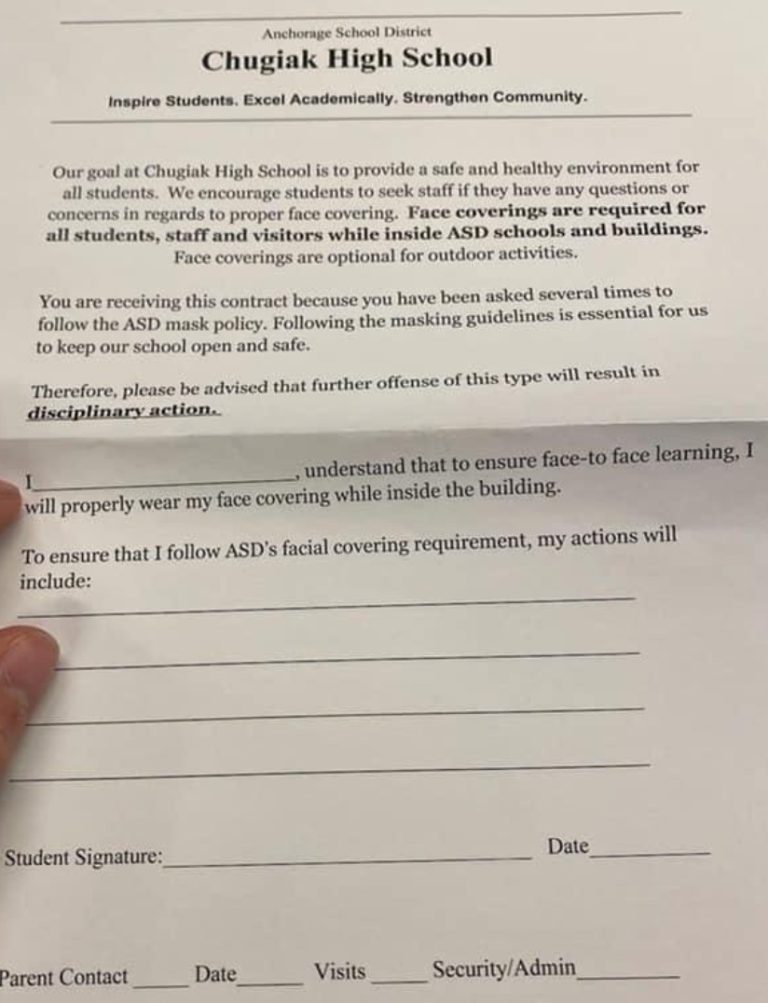
Chugiak High School is using a behavioral contract for students who are not complying with the Anchorage School District’s mask mandate.

The contract is being given to students who have been warned in the past that they are not wearing their masks properly. The contract requires the student to sign it and detail what steps he or she will take to ensure they don’t break the mask rules again.

Behavior contracts are common in high schools and are designed to make students accountable or their actions in the classroom and to document repeat incidents or behaviors for student examination.

Mark Hamilton: Here we go again, with EPA doubling down on power grabbing

5

By MARK HAMILTON

Part 10 of a series on the Pebble Project.

Here we go again with another power grab by a corrupted federal agency.

We learned a lot during Act I of this farce. That extraordinary fantasy was an introduction of a 404(c) section of the Clean Water Act to block the Pebble Project before it was allowed to enter the National Environmental Policy Act process.

This wasn’t simply rare; it was unprecedented.

EPA was very aware of this circumstance, and cheered in internal emails both the honor of being the first and the value of such a play to allow EPA to render such judgments without the lengthy, science-based assessment of the NEPA process.

Think about this for just a moment. Skipping the NEPA process means EPA will not need the input from any of the nearly two dozen who could potentially be cooperating agencies (there were 8 Federal agencies involved in the environmental impact study for the Pebble project).

Skipping the NEPA Process meant no public comment, no state agencies, it meant no science worthy of the name. Remember, EPA did no field work in Bristol Bay before making this decision.

A resource development state should be terrified from both sides of the political spectrum — if EPA under an anti-development government can dismiss projects without the NEPA process; why couldn’t EPA under a pro-development government approve a project without going through the NEPA process?

EPA tried, of course, and was sued and lost on their initial effort to be the single arbiter of developer projects. Allow me to correct a common and erroneous assessment of the 404(c) saga. The adjudication of the actions by EPA all happened under the Obama administration (people usually get that right).

The second assessment is typically incorrect. That report says something like “Trump’s EPA reversed it” or a version that is similar. Not exactly. The adjudication had only two meaningful directives— one was that the Pebble project could be allowed to enter the NEPA Process (as had been allowed to many many thousands of projects since 1972). The second is what gets glossed over too often— that within 90 days of the signing of the settlement “EPA must begin the process of lifting the preliminary determination” (what is often called the veto).

Obama’s EPA was directed to remove the preliminary determination — they essentially refused — more than two year’s past the settlement’s directed time-line , Trump’s EPA met the requirements of the settlement. They didn’t “reverse” anything (and they didn’t exactly hurry it along).

Now we hear about efforts to give the 404(c) another go. The vague goal is to give Bristol Bay “more protection.”

In fact EPA is back to the “zoning” precedent they sought with the first effort at 404(c). The honest definition of “more protection “ is “advanced prohibition.” This has been discussed at EPA since 2005 and was the goal of the first 404(c) efforts.

EPA wants you to believe this is good for you, that it will facilitate planning by developers and industry.  They claim it “will eliminate the frustrating situations in which someone spends time and money developing a project for an inappropriate site and learns at an advanced stage that he must start over.”  

Who do you think would be the authority to determine “inappropriate” sites?  Exactly how would that be determined?

Get ready for the next promise.  “…in addition, advance prohibition will facilitate comprehensive rather than piecemeal protection of wetlands.”

Let’s digest this one for a moment. The phrase “advance prohibition” should make you take a breath.

Advance of what? In the 2005 case, any science, even the pathetic Bristol Bay Watershed Assessment (BBWA), pseudo-science at best, had not yet begun.  Advance of public input?  Advance of a development plan?

Concerned yet?  How about “comprehensive rather than piecemeal protection”.  That way no one needs to deal with a single development project, we can skip site specific assessment, size of development, environmental baseline assessments, the whole array of environmental safeguards that might apply to a “piecemeal” evaluation.

With this claimed authority EPA can zone massive regions with advance prohibition.  Indeed, the conclusion of BBWA was “no mine of any size” should be allowed in Bristol Bay.  They had hoped to have the effort serve as a model for a new wave that they termed “proactive watershed planning”.  There you have it Alaska, prohibitive zoning of a piece of land as large as the state of Ohio.

With the end game revealed, you can start to see the reason and the purpose of the massive narrative of fear campaign carried out by EPA and its host of environmental activists. EPA desperately wants that precedent, and Bristol Bay seems eager to give it to them.

The “Pebbled” series at Must Read Alaska is authored by Mark Hamilton. After 31 years of service to this nation, Hamilton retired as a Major General with the U. S. Army in July of 1998. He served for 12 years as President of University of Alaska, and is now President Emeritus. He worked for the Pebble Partnership for three years before retiring. The series continues next week. 

Pebbled 1: Virtue signaling won out over science in project of the century

Pebbled 2: Environmental industry has fear-mongering down to an art

Pebbled 3: The secret history of ANWR and the hand that shaped it

Pebbled 4: When government dictates an advance prohibition

Pebbled 5: EPA ‘just didn’t have time’ to actually go to Bristol Bay

Pebbled 6: The narrative of fear

Pebbled 7: The environmentalists who cried wolf

Pebbled 8: Build your media filter based on science, not narrative

Pebbled 9: The history of hysteria

Part 10: Here we go again, EPA doubling down on power grabbing

Joe Geldhof: Vote like your taxes depend on it

11

By JOE GELDHOF

Happy with how things are going down at City Hall in Juneau?  Do you understand how commercial property tax assessments increased by a huge amount during a pandemic, even while some property values diminished?  Do you have an explanation how the City and Borough of Juneau added the equivalent of 25 new staffing positions at a time when sales tax and other revenues were plummeting?

Juneau’s Assembly and the senior management team apparently believe there is an unending source of revenue available for them to spend.  And spend, spend, spend is the main activity of our elected and appointed servants here in Juneau.

Not only did commercial property tax assessments increase by a vast amount during a pandemic, the City and Borough of Juneau keeps adding new staffing positions even as sales tax revenues plummeted.  Next up is a proposal to add staff to plan for the new city hall building that is the dream of the bureaucrats who really run our little city.

I’ve owned and managed a modest business in Juneau and collected and paid sales tax to the CBJ for over 25 years.  We pay our personal property taxes around my home. My business regularly supports youth athletic teams and provides funding for a variety of charitable activities that enhance Juneau and its residents. I understand that taxes and contributing are important.

But Juneau’s local government has an addiction to spending. Our little community of 32,000 has an adopted budget of $421 million.  That means we intend to spend $421 million on local municipal functions according to the most recently adopted budget passed by the Assembly.  And, in order to adopt this outsized budget, the Assembly dipped into savings.

The Assembly routinely adds expensive staff to coordinate policy discussion about hot-button topics, including housing, tourism, and other topics du jour.  These positions never seem to sunset, but instead evolve.  The expense of the positions continues, and the bureaucracy grows.

Juneau generously supports an economic development entity that does little for actual economic activity and is clueless as to the real world of commerce.  

Juneau spends tax dollars paying dues to the ineffective Southeast Conference, an organization that hasn’t added significant value to public decision making for decades.  

Our little town, located in the capital of our state has two lobbyists on the payroll who deliver with the same regularity as the post office on Sunday.  

For way too long, we paid an expensive deputy manager who elevated process over results, causing various observers to wonder just why we need a deputy city manager anyway?  Perhaps so the City Manager could take a sabbatical, which to the wonder of many and the amusement of nobody actually happened.

If you are tired of the dithering and antics that too often characterize the decision-making of our Assembly, there is something you can do to register your dissatisfaction with the status quo.

Vote!

Don’t be put off by the lack of candidates who might reform the way budgets are adopted and how our city operates.  Get the ballot, fill in the oval next to the “write in” line and cast your ballot for “none of the above,” if you are not satisfied with the direction of our municipal government. 

Each candidate deserves to be reviewed, but if you are not satisfied, express your dissatisfaction.  If enough voters indicate their unwillingness to support continued government growth and more spending, maybe our elected officials and the senior management team will start acting differently.

There is another democratic act you can take to signal that Juneau’s local government is out of control:  

The municipal ballot this October will ask whether you want to extend the 3% sales tax.  Personally, I have not made up my mind whether I will support the extension. I can think of some decent reasons to extend the sales tax, but what will persuade me to vote “yes” on the extension will be a clear commitment from the candidates running for office that they will spend public funds more efficiently and thoughtfully.  Without a commitment to spend like adults, why would anyone continue taxing themselves to keep government growing?

My complaint is not with the hard-working folks who plow the streets, collect the taxes, and complete the activities required to pay our bills. I believe the employees who deliver the water and conduct essential services deserve a decent wage and benefits. But anyone who thinks there isn’t fluff and fat in the City budget isn’t paying attention. 

Juneau’s budget is $421 million and likely to grow. Our population is and has been plateaued for a while and isn’t likely to increase anytime soon. This is a situation that is unsustainable and why “None of the Above” makes sense.

Joe Geldhof is an attorney and civic activist in Juneau.

Rep. Zack Fields accuses House Republican colleagues of purposefully causing death because they object to vaccine mandates

97

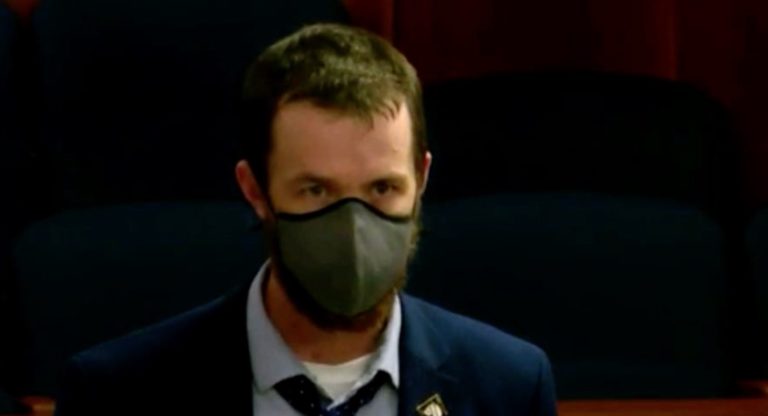
Rep. Zack Fields, who represents downtown Anchorage, told his House colleagues on Sunday that people who have not gotten the Covid-19 shot are dying because Republican politicians in the House are posturing.

“We have 1,500 people dying every day because politicians, and bloggers, and conspiracy mongers have discouraged people from getting vaccinated … And we are considering the first in a long series of vaccine bashing amendments, and it is a travesty! … With this amendment we would be discouraging vaccination, directly would result in more people dying avoidably.”

Fields flipped back and forth between yelling and mock-laughing during his remarks.

He continued to angrily bash “politicians, bloggers, and conspiracy mongers,” repeating the target of his ire in case people had not heard it the first time. As for the people who are dying, he said, “It’s not really their fault that they primarily get their information from Facebook or from some of our colleagues.”

“This is just unbelievable that for political self-aggrandizement we would be endangering Alaskans, I urge a no vote,” Fields said, before pandemonium erupted in the House as Republican members objected to his impugning the motives of his colleagues, a clear violation of decorum and floor rules. Several called for a “point of order.”

Fields shouted at them, “I would assert my right to make a simple observation,” the observation being that Republicans are causing deaths for political purposes.

Speaker Louise Stutes issued no warning against Fields for accusing his colleagues of causing Alaskans to die. She frequently warns Republicans and also frequently calls them out of order, but often lets Fields, who has a history of bad behavior, slide.

The House was debating a number of amendments to the governor’s telehealth bill, which was a bill to allow more access to telehealth.

But when the House got the bill, various issues were tacked onto it, mainly from Republicans interested in protecting the rights of Alaskans to make their own medical decisions regarding vaccines.

The amendment to protect people from vaccine mandates failed 18-18, with Speaker Stutes casting the deciding vote to make it fail.

An amendment offered by Rep. Sarah Vance, also drew the ire of Fields and Rules Chair Bryce Edgmon. The Vance amendment would prevent hospitals from denying patients the ability to have a person with them as a personal advocate, family member, or comforter. Many Republicans spoke to the need for sick people to have such an advocate by their side. Ultimately that amendment passed, but not before Fields and Edgmon objected strenuously.

At Amendment 5 it became clear the Democrats were losing control and there were 16 more amendments to go. The Democrat majority sent the bill back to the Rules Committee and it will appear on Monday on the House Floor for its second reading.

Will Dunleavy join lawsuit with other Republican governors to defend against Biden’s Covid shot mandates?

27

Gov. Mike Dunleavy joined a phone call with 20 Republican governors on Friday to discuss a lawsuit to be filed in federal court against the Biden Administration over its extreme federal mandate requiring Covid shots for the entire federal workforce and any business with more than 100 employees. Congress and the U.S. Postal

The lawsuit may need to be filed in a state that is not in the Ninth Circuit Court of Appeals, but in one that is more friendly to the U.S. Constitution.

Republican leaders, including GOP Chairwoman Ronna McDaniel, expressed horror last week at Biden’s coronavirus vaccine mandates. On Thursday, Biden openly bashed Republicans during his address, in which he announced his immunization orders for all federal employees, federal contractors, health-care workers in facilities that have Medicare or Medicaid clients, as well as all private businesses with more than 100 employees. Business who don’t want to comply with the shots must do mandatory testing for Covid of their unvaccinated employees.

Biden said his patience was wearing thin for people who are unvaccinated against Covid-19.

Dunleavy immediately last week called the president’s order outrageous and unenforceable. Gov. Greg Abbott of Texas called it “a power grab.” South Carolina Gov. Henry McMaster said he will fight Mr. Biden to “the gates of hell.”

In past pandemics, the Supreme Court has upheld the government’s right to inject medicine into people, but this court is more conservative and the past rulings may be ripe for overturning.

The president’s mandate says that Department of Labor Occupational Safety and Health Administration will put in place an “emergency temporary standard” until a permanent standard is in place. OSHA’s website says it has the power to issue standards if “workers are in grave danger” from toxic substances or agents or to new hazards.

The governors are consulting with their legal advisors about the best path forward and which state takes the lead.

Anchorage awards homeless mass care shelter contract — not to Bean’s Cafe

35

The Municipality of Anchorage awarded the contract to continue mass care shelter to contractor 99 Plus 1, Inc. The contract with Bean’s Cafe to run the mass care shelter ends Sept. 15.

“I am pleased that mass care shelter will continue without disruption in service,” said Mayor Dave Bronson. “One of my top priorities has been a commitment to helping our homeless neighbors in need.”

It will continue for now at the Sullivan Arena, although the mayor’s plan is to have a navigation center for those experiencing homelessness on Tudor Road at Elmore Road.

As part of the transition to 99 Plus 1, an Anchorage company, no clients will have to leave and there will be adequate staff, Bronson said. There will be bedding, food, and navigation services available.

99 Plus 1, Inc. will be onsite at the Sullivan Arena on Monday, Sept. 13 to interview prospective employees.  Although Bean’s Cafe applied to continue running the mass care services, the nonprofit did not win the contract.

The contract is not indefinite; it will end on Oct. 31. The plan is to move forward with Bronson’s initial plans and get the Sullivan Arena back to use as a hockey venue. Bronson is being blocked by the liberal members of the Assembly, who want to continue to use the facility as a homeless shelter until they can push through their own plan, which differs from the mayor’s.