
This article is a partial reprint of “There Was Never a Clean Bill” first published in the author’s personal Substack, August 13, 2026.
For two months, the loudest complaint from the governor’s office and the House Republican minority has been that Alaska cannot get a “clean gasline bill” passed. On July 15, the Alaska House Republican Caucus called on the Senate to place “urgent focus” on approving what it described as a clean gasline bill for the Railbelt. Rep. Justin Ruffridge, R-Soldotna, a member of the HB 381 Conference Committee, put it this way: “We cannot lose sight of why we are here. This isn’t about state government squeezing every last penny out of a pipeline that hasn’t even been built yet.” The Alaska Support Industry Alliance, the Alaska Chamber of Commerce, and the Alaska Oil and Gas Association used the identical phrase days earlier, urging lawmakers to pass “a clean version of HB 381 focused solely on advancing the Alaska LNG Project.”
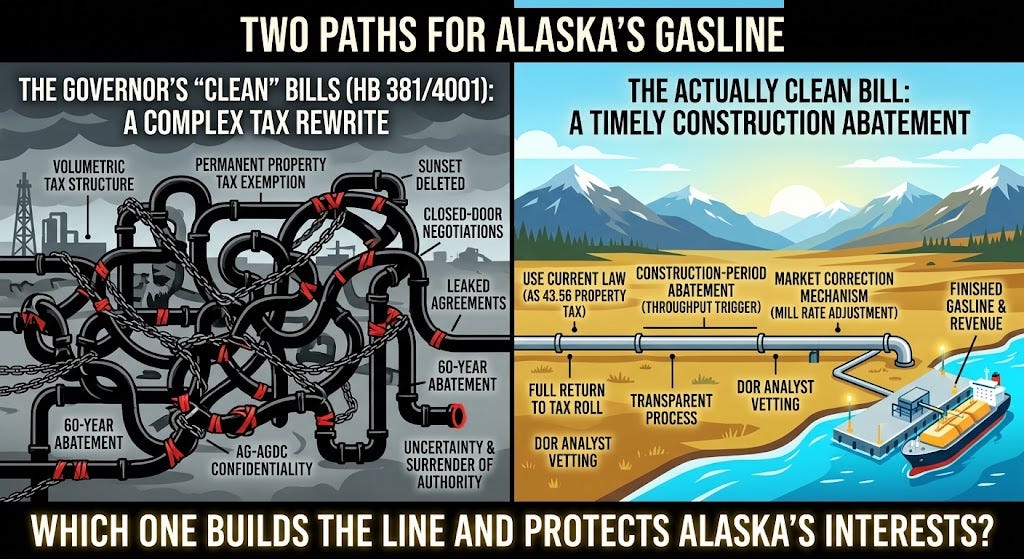
Listen to that framing long enough and it starts to sound like the fight in Juneau has been between a simple pipeline bill and legislators who keep dirtying it up with unrelated taxes. That is not what has been on the table at any point since March. Every version of this legislation, from the governor’s original March 20 introduction through the House Finance committee substitute that passed 34-5 on June 12, through the Senate’s rewrite, through the conference committee product that died 19-19 on July 16, through the governor’s August 12 compromise that never received a floor vote at all, has done the same thing: eliminate Alaska’s existing 20-mill property tax authority over a $54 billion natural gas project and replace it with a fraction of that revenue under a volumetric tax structure no other American jurisdiction has ever used. That is not a pipeline bill with some tax provisions attached. That is a tax bill, full stop, and “clean” has never described anything other than which version of that tax restructuring gets voted on. When the House Republican Caucus and the industry coalition say “clean,” they mean the bill without the Senate’s added corporate income tax on pass-through entities like Hilcorp. They do not mean a bill that leaves Alaska’s property tax authority intact. No such bill has ever been introduced by anyone.
What an Actually Clean Bill Would Look Like
Start with current law, the same 20-mill property tax every other piece of oil and gas infrastructure in this state already pays, collected by the same boroughs that have always collected it. Layer a construction-period abatement on top of it, structured the same way every version of HB 381 and HB 4001 has already structured its own abatement period: no tax until the pipeline has moved a defined volume of gas for a defined stretch of time, a rolling throughput average over a set number of days. HB0381D and GH5321\A both use exactly this kind of trigger already, just pointed at a different outcome, the start of a permanent volumetric tax instead of a return to the property tax roll. The drafting is not the hard part. The legislature has already written this exact mechanism twice. It just needs to be aimed at the right destination.
That alone matches what LNG developers get everywhere else in the country. Louisiana’s Industrial Tax Exemption Program has given Cheniere’s Sabine Pass terminal, Cameron LNG, and Calcasieu Pass LNG property tax exemptions running up to ten years apiece, worth billions of dollars combined. Texas ran a similar school-district abatement program for years before it expired in 2022. Neither state rewrote its underlying property tax statute to do it. They granted a time-limited exemption under the tax code that was already on the books, and when the exemption ended, the facility went back on the same roll as everyone else. Alaska’s version does the same thing, tied to actual throughput instead of a calendar, which is arguably tighter and more defensible than the Gulf Coast standard, not looser.
If Glenfarne or its backers still want more certainty once the abatement period ends, that is a fair ask, and Alaska already has the tool for that too. The state’s oil production tax has tied its rate to a published market benchmark, the ANS crude price DOR calculates and publishes on a regular schedule, for years. Apply the same logic to gas. Have DOR select or blend an appropriate published index, Henry Hub for the domestic benchmark or the Platts JKM for the Asian LNG spot price Glenfarne is actually selling into, and build a market correction mechanism into the mill rate: if the realized price falls below a defined floor for two consecutive quarters, the rate steps down on a pre-set schedule until prices recover. Neither piece of this requires new administrative machinery. DOR already tracks a market benchmark and adjusts a state tax rate against it every month for oil. This asks the same agency to do the same job for gas.
This is a directional proposal, not a finished bill, and it should be read that way. Which index, what the exact floor price is, how many steps the mill rate takes on the way down, those are technical questions with technical answers, and DOR’s own analysts are the ones equipped to work them out, the same way they already work out the state’s oil tax calculations every month. That is a feature of this approach, not a gap in it. A legislature that actually wanted a clean bill would send DOR the direction and let them return with the number, the same process every serious fiscal note in this state already goes through. Nobody has asked DOR to do that work on this specific structure, because nobody in five months of hearings has proposed this specific structure for DOR to do the work on.
Put together, that is the whole proposal: current law, a construction-period abatement using a throughput trigger the legislature has already drafted twice, and a market correction mechanism modeled on a benchmark-pricing tool DOR already runs for oil. No new chapter of statute. No exclusion from the school funding formula. No permanent surrender of taxing authority, and no sixty-year sunset because there is nothing to sunset, current law simply resumes. That is offered here understanding that gas itself, by the project’s own consultant’s testimony to the Senate, is not actually what is driving this deal. If it is the commodity that matters, this structure protects it. If it is the federal credit stack behind it, no version of HB 381 or HB 4001 has ever asked Alaska a fair price for that either, and this proposal does not pretend to solve that fight. It solves the one the governor and the House Minority say they are actually having.
The Question Nobody Saying “Clean” Has Answered
None of this requires opposing the pipeline. Alaska’s gas is real. The case for connecting a stranded resource to a paying market is legitimate on its own terms. What is not legitimate is the repeated substitution of a marketing word for the actual content of five months of legislation. Every version of this bill has restructured the same tax authority. Every version has asked the legislature to act faster than the information available to it justified. The House voted on June 12 without the clawback analysis that would surface in a leak two weeks later. The House Minority’s own representative on the conference committee got the July text 30 minutes before it passed. The governor’s August compromise never got a vote at all, and when it collapsed, the state’s most consistent advocates for a “clean” bill would not defend the one actually placed in front of them.
If the goal has genuinely been a clean bill this entire time, the question worth asking every legislator and every spokesperson who has used that phrase is a simple one: clean of what, exactly, and who decided that a construction-period abatement under current law, the actual clean version, was never worth proposing?
Glenfarne spent the summer handing out buttons that say “Build the Line.” Fine. Let’s build the line, on current law, with a construction-period abatement to get it financed and nothing more permanent than that. That is what a clean bill looks like. Everything else on the table since March has been a tax code rewrite wearing the pipeline’s name.
Dana Raffaniello lives in Palmer, Alaska. He works as a network engineer, reads Alaska energy legislation closely, and publishes analysis of its fiscal and structural implications at raff6482.substack.com. He is running for the Mat-Su Borough Assembly, District 2. He has no commercial interest in any energy project discussed in this analysis.



