By James Parkin
When I first launched my campaign for Governor of Alaska, my goals were simple, direct, and focused on fiscal responsibility. As a 30-year veteran teacher, my objective was to create a self-sustaining budget system while protecting working families by preventing sales or income taxes. Above all, I stepped up to stop the continuous, unlawful attacks on our Permanent Fund and the Permanent Fund Dividend.
I believed our challenge was strictly financial. I had no idea of the scale of political corruption operating inside our state capital.
My eyes were first opened when I was contacted by Ed Martin Jr., who brought forward a disturbing reality: public officials in Alaska are explicitly required by law to be bonded, yet many simply refuse to comply. The state administration’s defense? They claim that because Alaska carries general insurance, formal individual bonding is unnecessary.
Having studied the governing statutes carefully, Mr. Martin’s conclusion is indisputably correct. Insurance is not a substitute for official bonding. The law remains active on the books, yet our state leadership has unilaterally decided to ignore statutory mandates when compliance becomes inconvenient.

This disregard for written law is not an isolated incident—it is a systemic pattern.
Consider the statutory Permanent Fund Dividend. For years, the Legislature has disregarded the legal formula establishing the dividend payout owed to the people of Alaska. When challenged, the Alaska Supreme Court ruled that lawmakers were well within their rights to alter those statutory payouts.
Independent evaluations consistently show the real-world impact of these administrative breakdowns: Alaska regularly ranks among the highest states in the nation regarding vulnerability to public corruption.
When David Haeg reached out regarding critical issues surrounding our Grand Jury system and judicial oversight, I applied the same approach I taught my students for three decades: I did my homework. I analyzed our State Constitution line by line, alongside every court record and document available.
The constitutional framework is unambiguous. Article I, Section 8 of the Alaska Constitution establishes that the people shall not be denied direct access to a Grand Jury. Furthermore, the Grand Jury holds broad authority to investigate public welfare and government misconduct—including potential overreach within the judiciary itself.
Despite these constitutional guarantees, administrative rules established by the Supreme Court have effectively restricted direct citizen petitions. The court system has instructed Alaskans to route claims through the Executive Branch—specifically the Attorney General—rather than going straight to an independent citizen panel. In multiple instances, judicial orders have sealed records and restricted active Grand Jury inquiries.
The breakdown of constitutional checks extends directly to executive appointments. Alaska’s Judicial Conduct Commission is structurally designed to balance judicial oversight through three attorney seats and three non-lawyer public seats. Yet, when an executive advisor—a lifelong attorney whose license had been suspended for unpaid dues—was appointed to a public, non-lawyer seat, the arrangement was legally challenged. The Supreme Court upheld the appointment, ruling that an inactive license qualified the individual as a non-lawyer for commission seat purposes. That decision altered the structural intent of our constitutional design, leaving Alaskans with virtually no immediate mechanism for administrative appeal.
The real-world consequences of a delayed, indifferent legal system fall hardest on Alaskan families. I received a letter from a grieving mother whose husband was killed and son severely injured by a driver under the influence of methamphetamine. Over two years later, her family is still waiting for prosecution to move forward. Justice delayed is justice denied.
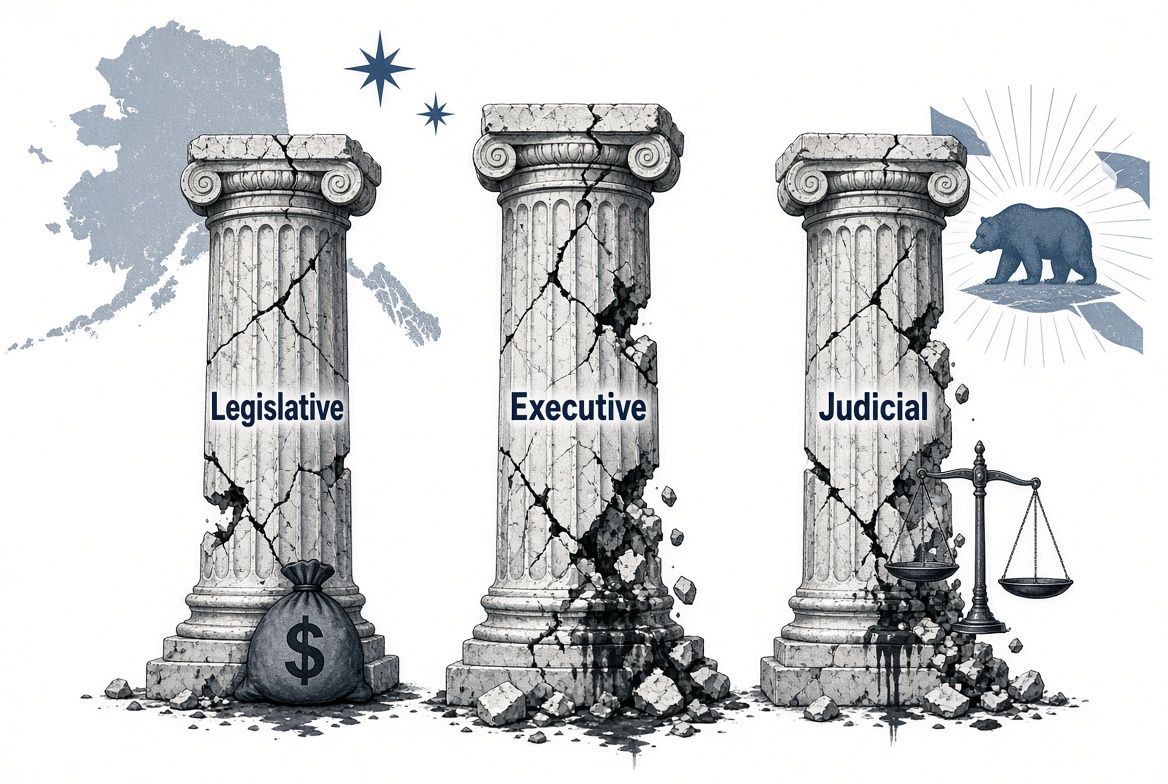
In 1748, French philosopher Baron de Montesquieu articulated the fundamental necessity of separating government powers into three independent branches to prevent tyranny. Decades later, James Madison incorporated these principles into the American constitutional system, establishing a framework where each branch serves as a check on the others to safeguard individual liberty.
In Alaska today, those vital checks and balances have been fundamentally eroded:
- The Legislative Branch repeatedly bypasses statutory mandates.
- The Judicial Branch issues rulings that stretch the spirit of our constitutional protections, operating with minimal legislative oversight.
- The Executive Branch fails to consistently enforce accountability under existing state law.
When traditional state avenues stall and direct Grand Jury access is constrained by court rules, Alaskans are left asking a crucial question: Where do we turn for recourse?
Some may dismiss these concerns as routine political differences. But when public accountability mechanisms are obscured and constitutional protections are sidelined, it ceases to be a debate over policy—it becomes a matter of fundamental justice.
Every Alaskan deserves a transparent government that honors the rule of law.
James Parkin is running as a 2026 write-in candidate for Governor. Learn more here: https://www.jp4gov.org/
This op-ed was voluntarily submitted by the James Parkin and not solicited by Must Read Alaska. All candidates running for elected office are welcome and encouraged to submit articles for publication. Must Read Alaska unequivocally supports the election of a conservative candidate to the Office of Governor but does not endorse a particular candidate.