
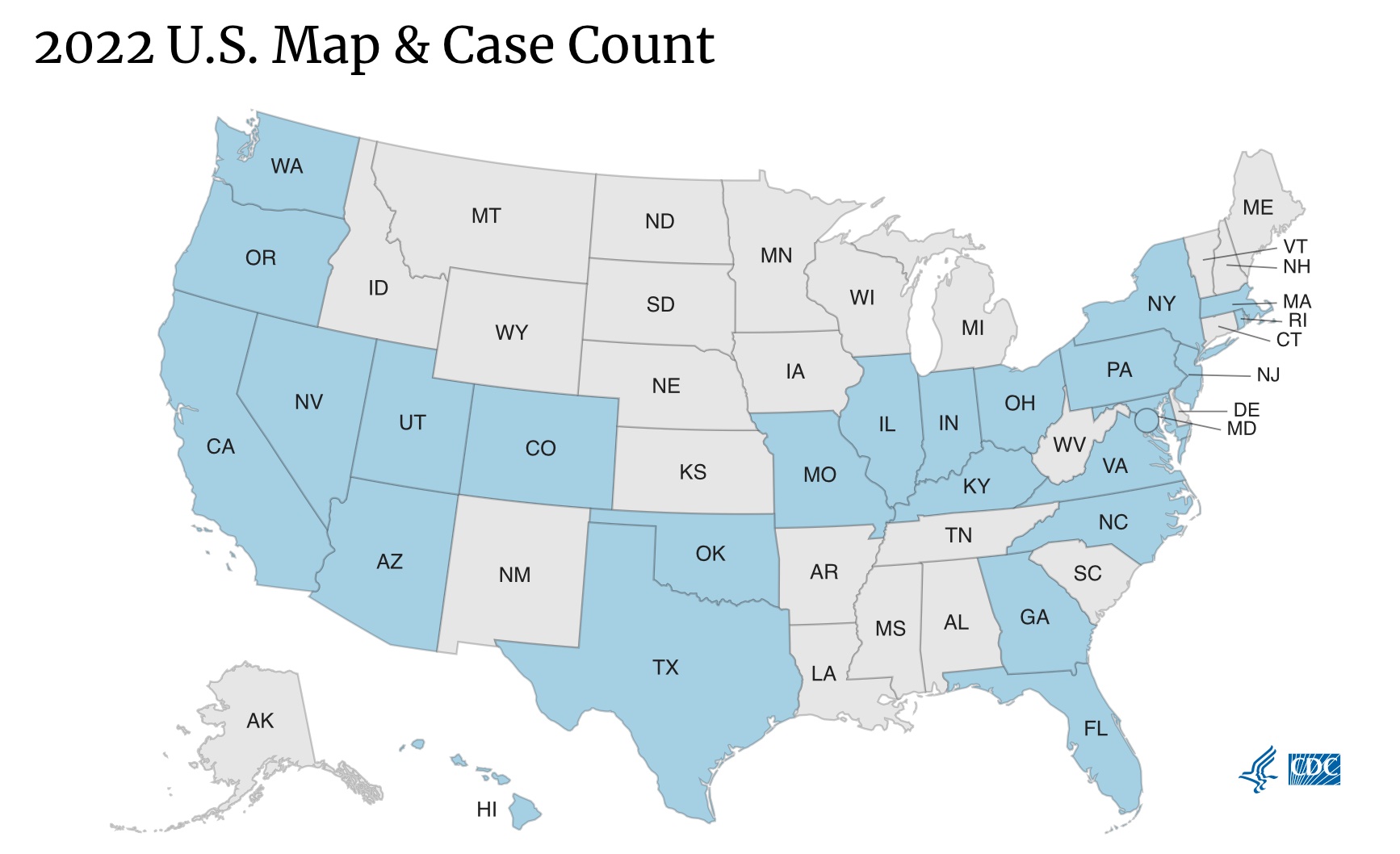
In just a few short weeks, the monkeypox virus has spread to more than half of the states in the U.S., according to the Centers for Disease Control and Prevention. Alaska has not had any reports of the illness. The major outbreaks are found in California and Illinois, with 51 and 26 cases respectively.
One month ago, the CDC reported nine cases in seven states.
Now, the number has risen to 201, according to the data released Friday.
On Saturday, the World Health Organization decided to not declare it a global health emergency, but rather, labeled it an “evolving health threat.” Over 3,000 cases have been diagnosed worldwide since early May, when there were just 550 cases. The disease, once mostly confined to continental Africa, has spread to over 50 countries.
The CDC still says it’s not clear how the people are coming in contact with monkeypox, but the agency advises that gay, bisexual, and other men who have sex with men make up a high number of cases. However, anyone who has been in close physical contact with someone who has monkeypox is at risk, the CDC advises.
CDC is urging healthcare providers in the U.S. to be alert for patients who have rash illnesses consistent with monkeypox.
It’s a disease that is not unusually contagious unless there has been close contact with an infected person. The illness is rarely fatal in countries where health care is available.
According to the CDC, after infection, the virus has an incubation period of roughly 1-2 weeks. The development of initial symptoms include fever, malaise, headache, and weakness.
A feature that distinguishes infection with monkeypox from that of smallpox is the development of swollen lymph nodes. Swelling of the lymph nodes may be generalized (involving many different locations on the body) or localized to several areas, such as the neck and armpit.
Shortly after the early symptoms, a rash appears. Lesions typically begin to develop simultaneously and evolve together on any given part of the body. The evolution of lesions progresses through four stages—macular, papular, vesicular, to pustular—before scabbing over and resolving.
The illness typically lasts 2-4 weeks. The severity of illness can depend upon the initial health of the individual, the route of exposure, and the strain of the infecting virus (West African vs. Central African virus genetic groups, or clades). West African monkeypox is associated with milder disease, fewer deaths, and limited human-to-human transmission. Human infections with the Central African monkeypox virus clade are typically more severe compared to those with the West African virus clade and have a higher mortality. Person-to-person spread is well-documented for Central African monkeypox virus, the CDC says.


