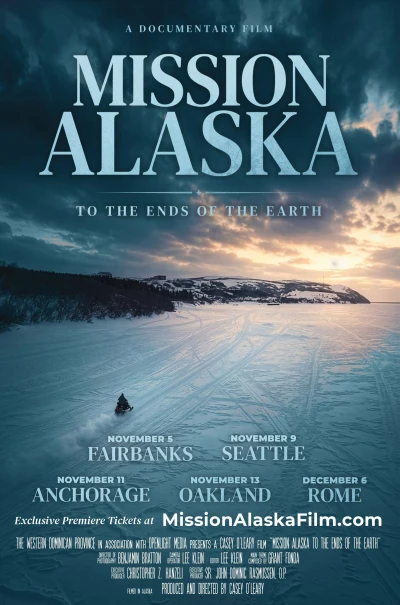
Stepping into the Theater at the Bear Tooth, excitement was growing. You could feel it in the air. Friends who had not seen each other for a while were getting reacquainted, Dominican Friars all about, priests from Fairbanks, and crew members alike. This was going to be a night to remember. The faithful were gathering to see the follow-up documentary film to Sleigh Ride, a film about the Dominican Friars bringing the Gospel and the Sacraments, starting on Christmas Eve and culminating on Christmas Day, to those outlying parishes in the Archdiocese of Anchorage/Juneau.
This follow-up documentary takes you deeper into the mission of the Diocese of Fairbanks.
The film opens with then-Fr. Steve Maekawa speaking of the challenges the Alaska interior presents, not only to the faithful who live in the remote villages, but for the priests who travel there to bring the Gospel and the Sacraments. Fr. Steve said, “The Mission in Alaska is simmering, kind of like a pilot light, and we need to turn up the flame.” What a powerful opening statement!
The Diocese of Fairbanks covers roughly 410,000 square miles, the largest U.S. diocese by area, and serves about 46 parishes and missions. Most are in remote “bush” villages accessible only by plane, boat, or snow machine; only a handful are on the road system. Some are in the Yukon-Kuskokwim Delta region, like Alakanuk, Aniak, Emmonak, and Pilot Station, to name a few. In the Interior region there are places like Galena, Koyukuk, and Kaltag, and in the Northern Region places like Kotzebue and Little Diomede Island. These are but a handful of the places where these brave priests faithfully take the Gospel.
Priests currently serving in the Diocese of Fairbanks are not all local men. They come from all parts of the world, answering the call to the Last Frontier. Priests come from as far as Nigeria, Zimbabwe, Poland, and South Korea.
The film gives way to the truth of what it takes to do what they do: battling the cold, harsh winters; traveling to each village by snow machine, airplane, and boat. If there is a road, sometimes it is not a road that goes all the way into the village.
One of the priests, Fr. Yakubu Aiden, from Nigeria, when asked to go to Alaska by his Bishop, replied, “NO! No, I will not go to Alaska to die!” He was told it would only be a two-year assignment. It has been nine years since he first stepped foot in Alaska. He has grown to love not only this great state, but the people he serves in the villages he ministers to. He has become part of the communities he serves and has earned the respect that comes with having the grit to stick it out. The faithful know that he is not “just a passing-through kind of priest,” but one who is invested in the care and welfare of their souls.
Fr. Stan Jazek, a priest from Poland, has served in the villages on the Y-K Delta in Emmonak, Alakanuk, Kotlik, and Nunam Iqua. He has served the people of the Fairbanks Diocese for over 25 years.
A priest from the Anchorage/Juneau Archdiocese, one of the last of the pilot priests, Fr. Scott Garrett, has been in Dillingham for most of his priesthood. He has logged many flying hours in his time there. He flies from Dillingham to Clarks Point and King Salmon/Naknek. When talking about life in Dillingham, Fr. Garrett got a bit emotional as he fondly remembered one of the priests, Fr. James F. Kelly, a retired Navy chaplain and pilot, who served his retirement years in Dillingham. Fr. Scott said he knew he had some big shoes to fill; Fr. Kelly’s shoes were captured in the film.
Fr. Kelly died on March 23, 2002, when the single-engine Piper Cherokee 140 which he was piloting crashed into a mountain during a snowstorm. He was on his way to celebrate Palm Sunday Masses in the Togiak area.
The film’s message is very clear. Each and every one of these priests has given of themselves to serve the people of God, the faithful in these villages. They don’t ask for medals or seek accolades of any sort. They are selfless men doing what Our Lord has called them to do, and that is to bring the Truth of the Gospel and to administer the Sacraments to people who otherwise might never receive them.
One other message from the film was crystal clear, and that is the need for more priests. The flame has been turned up, but it needs more priests—young men to help keep the flame alive. Many of the priests currently serving in these remote areas are close to or at retirement age.
The hope of Mission Alaska: To the Ends of the Earth is to foster more vocations to the priesthood. The prayer is that young men would be moved by the needs of the people of God and discern a vocation in the priesthood.
As the film came to a close, a Q&A section soon followed. The last question taken was for Bishop Steve Maekawa, O.P. The question: what was his takeaway from the film? He paused for a brief moment and answered with a great smile on his face: “We are all on Mission, use me Lord, with generous surrender.”
My takeaway from this film is that I am spoiled. I live in a city that offers me the opportunity to attend any number of Masses on any given weekend. Our brothers and sisters who live in these remote places do not have that. They have no choice but to wait, sometimes months at a time, for a priest to arrive and administer the Sacraments they so desperately need.
Let us together, as believers in the One True God, pray for an increase in vocations to the priesthood, and that this film will reach the “Ends of the Earth” so that others may share in this opportunity to help in this much-needed mission.
“Greater love has no man than this, to lay down his life for his friends.” Jn. 15:13
Beginning December 6th, Mission Alaska: To the Ends of the Earth, will be streamed for free. For more information, go to credostudios.com
Live your life worthy of HIS Sacrifice +
God bless you.