On December 14, 2024, the Dominican Friars of the Western Province premiered Sleigh Ride: Christmas in the Last Frontier at the Bear Tooth Theatre in Anchorage. The short documentary follows two friars on a 548-mile journey, from Christmas Eve into Christmas Day, to celebrate Mass in Trapper Creek, Talkeetna, and Glennallen, Alaska: three remote communities with no resident priest. The film won a Gold People’s Telly Award in the Film & Shorts category (decided by public vote) and a Bronze Telly Award in the Film & Shorts Holiday & Seasonal category (selected by a judging council of more than 250 media industry experts). It was also named a runner-up in the Documentary Short category at the Catholic Media Association’s 59th Annual Gabriel Awards.
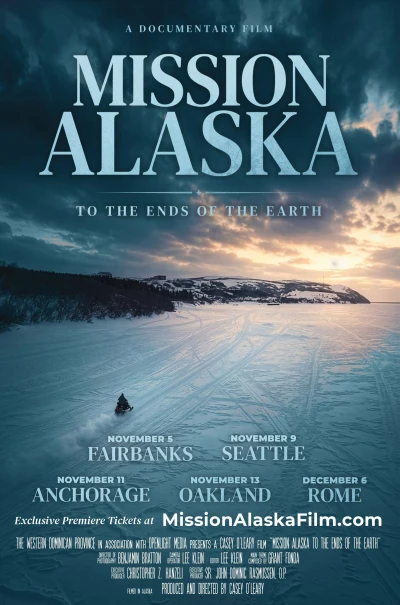
Sleigh Ride is the companion piece to a larger feature documentary, Mission Alaska: To the Ends of the Earth, which premiered in Fairbanks on November 5, 2026, with further premieres in Seattle (November 9), Anchorage (November 11), Oakland (November 13), and Rome (December 6), ahead of its general release in December. Deacon Dez and I recently sat down with Fr. Matthew Heynen, O.P., the friar at the center of Sleigh Ride, to talk about how the film came together, what the journey was really like, and what he hopes both films will do for the Church in Alaska.

From a pitch to a premiere
Dr. Cindy: What is the history behind Sleigh Ride, from inception to debut?
Fr. Matthew: A layman named Casey O’Leary, who attended our Newman Center in Seattle, wanted to help promote our Province. He handled media for us, often filming our ordinations and assisting with advancement. He said it would be wonderful to show the Dominican Friars bringing the Eucharist to the ends of the earth, and that it would be a great project for the Province to invest in to illustrate our ministry. As he considered the different things we do, he thought of Alaska as a cool, exotic place. We have a solid ministry out here, so why not lean into the image of friars traveling the ice roads to bring the Eucharist to remote communities? That is essentially how it started. He made the pitch, people liked it, and we moved forward.
Dr. Cindy: How long did it take, from planning to filming and then from filming to debut?
Fr. Matthew: I arrived in Anchorage on July 17, 2022, and they had already done a little filming to begin the project. Overall, filming took somewhere between a year and a half and two years. They originally planned to wrap after about a year and a half, but then Fr. Steve Maekawa, who was then pastor of Holy Family Old Cathedral in Anchorage, was named Bishop of Fairbanks. That led to extensions and additional material.
Dr. Cindy: That’s right, and he appears in the film, correct?
Fr. Matthew: Yes. He is in Sleigh Ride, but not yet as bishop. His role as bishop will be featured more prominently in the next documentary, Mission Alaska.
Nerves, banter, and very little script
Dr. Cindy: What are some of your favorite highlights or memories from filming?
Fr. Matthew: Mostly how nervous I was. When a camera is on me, my instinct is to freeze up and wait for someone to tell me where to go. Daniel, who was then Brother Cassian and my companion on the drive, had a good sense of where we were headed, so I mostly followed his lead. A lot of the time I was simply thinking, “What’s the next thing I have to do?” so I wouldn’t freeze in front of the camera. During Mass itself, I wasn’t nervous. In the car, I was trying to come up with natural banter with Daniel as we drove. But the dominant feeling was focusing on the next task so I wouldn’t lock up.
Dr. Cindy: Was it all scripted, or was it ad-libbed?
Fr. Matthew: It was almost entirely ad-libbed. There were a couple of small scripted moments, but the vast majority was organic. Watching Sleigh Ride, you can tell we didn’t plan most of it in advance. There is a scene where we drive past a car that had flipped and been destroyed. We obviously didn’t cause that, but the director, Casey, saw it and said, “That was wild. Can you turn around, go slower, and let the cameraman film you driving past it?” So that was a small directed bit. Everything else (the talking, the joking, the ordinary interactions) happened in the moment. Sometimes we tried to think of things to say, but it was still us. We didn’t plan the dialogue.
Dr. Cindy: When you came to Alaska, did you know you would be involved in this?
Fr. Matthew: No. When I arrived, my student master, Fr. Steven Maria, told me, “Don’t get too excited about doing all the mission work, because you’re probably going to start by hanging out at the parish.” I said that was fine. Then, within a week or two of my arrival, Fr. Steve (now Bishop Steve) said, “You’re going to do this Sleigh Ride film this Christmas, and you’re going to drive out to Talkeetna, Trapper Creek, and Glennallen.” I thought, “Oh, I guess that’s happening.” I was in the right place at the right time. They had decided to make a larger documentary, Mission Alaska, along with this smaller companion piece, Sleigh Ride.
The 548-mile sleigh ride
Dr. Cindy: How long is the “sleigh ride”?
Fr. Matthew: The whole route comes to 548 miles.
Dr. Cindy: Take us through the journey. You leave Anchorage and then…?
Fr. Matthew: We leave Anchorage and head to Trapper Creek, then Talkeetna, all on Christmas Eve. We arrive in Trapper Creek around 8:00 p.m. and Talkeetna around 11:00 p.m. After Midnight Mass, we visit with parishioners and usually don’t get to bed until about 2:00 a.m. Then we have to leave the next morning, probably around 3:00 or 4:00 a.m., to get out of the Trapper Creek–Talkeetna area and head to Glennallen. One thing that delayed us was a big data dump: after filming, all the footage has to be uploaded for storage, so we were a bit behind. In the end, we made a roughly five-hour drive to Glennallen that morning.
Going out on Christmas Eve was relatively uneventful. There were a couple of places where we had to double back because they wanted a drone shot of us driving, and the drone wasn’t very fast, so we had to go about three miles an hour. When a car passed us, they would say, “That was great. Turn around and do it again,” because they didn’t want the shot to show us creeping along. You can’t really tell in the finished film.
On Christmas morning, when we got into the Valley, there were 70-mile-per-hour winds. Big gusts would hit the car and you could feel us slide on the ice. I remember that being pretty wild. We stopped at a gas station, and standing outside, even bundled up, you felt the cold cut through you immediately. As we prepared to leave, Casey asked, “Do you want to say a prayer for us, Father?” So we prayed an Our Father. We got knocked around a bit by the wind and ice, and we drove past a car that had recently wiped out; thankfully, no one was in it. Eventually, we reached Glennallen for Mass. It was roughly 15 to 20 degrees below zero. We were a bit late, but the people were happy to see us, and the Mass was beautiful. At the end, we did interviews outside wearing Santa hats. It felt fine at first, but after a ten-minute interview at 15 below, your ears start to hurt.
Communities hungry for the sacraments
Dr. Cindy: What is it like for the people who live in these places? If I understand correctly, they do not have Mass every week.
Fr. Matthew: No, they do not. I believe Talkeetna has Mass more regularly, Trapper Creek has it every other week, and Glennallen only once a month. So it is a huge deal for the people out there. It is rare, and they really appreciate it. There is no priest permanently assigned to them, so this is often their one chance, and they are very grateful that someone comes out to give them that time. It is wonderful.
I can speak more to Glennallen because I have been there much more regularly throughout the year than to Talkeetna or Trapper Creek. I made a point of hearing confessions every Sunday. In the beginning, not many people came, but slowly (since I am a big promoter of Confession) it almost became a problem because everyone started coming. I would hear some confessions before Mass, then start Mass, and afterward more people would want to go. It became hard to greet people because I needed at least thirty minutes for confessions beforehand, which is a great problem to have. It went from relatively few confessions to a steady stream that pushed into the start of Mass. People were very happy to be there and wanted to engage in their spiritual lives.
Dr. Cindy: During the Sleigh Ride, did the communities have events you took part in?
Fr. Matthew: In Trapper Creek, they have a large gathering with lots of snacks after Mass, but I had to leave fairly quickly to get to Talkeetna. Talkeetna itself has a big choir and a full production. After Midnight Mass, they have tons of desserts and a huge feast, and we were able to eat and stay a while. A wonderful couple invited us to the Swiss-Alaska Inn and gave us a room. They also host their own family feast late into the night, so we were able to spend time with them, have some drinks, and share some food.
Mission Alaska: The larger story
Dr. Cindy: Earlier you mentioned the second film, Mission Alaska. Sleigh Ride is essentially part one, and Mission Alaska is the larger project. Tell me more about it.
Fr. Matthew: Mission Alaska is about the entire mission we have here in Alaska. Initially the idea was to feature the Dominicans, but as the filmmakers started putting it together, they said, “Why not show the whole mission that is here in Alaska?” So the Dominicans are featured prominently (they are kind of the main characters), but the story expanded. It began with the Dominicans in the Anchorage area, then broadened to the whole Archdiocese of Anchorage-Juneau. Then, partly because we were in the middle of filming Fr. Steve when he became bishop, it expanded to the Diocese of Fairbanks as well. When he first went up to Fairbanks, the camera crew went with him and visited all sorts of places: Fairbanks itself and many remote communities.
Dr. Cindy: So it is essentially a film about all of Alaska?
Fr. Matthew: Yes, it evolved into that, from the Dominicans in Alaska, to the Dominicans and the archdiocese, to the Dominicans and the entire state. You will see the Dominicans very prominently featured, but you will also see the bishops of both dioceses, priests who grew up here, and priests from other countries. It will give you the whole spectrum.
Dr. Cindy: So we will see priests going out to the truly remote villages of Alaska?
Fr. Matthew: Yes, absolutely, you will see that.
Dr. Cindy: What is the purpose of Mission Alaska? Is it primarily to bring awareness to the missionary work done here, or to how remote it is?
Fr. Matthew: I think it is to highlight the mission work we do out here, to show that there is an amazing mission going on. The Dominicans are working very hard to bring the Eucharist to the very ends of the earth. As the filmmakers spent time here, it evolved into something broader, because this is a wild undertaking for the Church. You have a state bigger than Texas but with a population smaller than the city of San Francisco, and everyone is spread out. You see the importance of the mission, what the Dominicans do, and the very unique way you have to minister in a giant state with a small population, extreme weather, and everything that comes with it.
An apostolic echo
Dr. Cindy: Do you see similarities to what the first disciples of Christ, the Twelve Apostles and the early disciples, had to do in going to places that had not yet heard the Gospel?
Fr. Matthew: Yes, it has a very scrappy, ragtag quality. The smaller churches out here are newer and not built up the way you find in the Midwest, the East Coast, or even the West Coast. Anchorage is built up, but when you go to the smaller remote places, whether in the Diocese of Fairbanks or places like Dutch Harbor in the Archdiocese of Anchorage-Juneau, there are simply fewer resources. There are wonderful people, but far fewer resources to draw on.
Dr. Cindy: You have been here going on four years now. What stands out most to you in your ministry in Alaska?
Fr. Matthew: Maybe two things. First, pushing things to the limits. You are literally going to the edge of the earth, to far extremes and extreme weather, with fewer resources. There is an intense awareness of the weather and the physical location. Second, the importance of the individual. We have huge populations all over the world, but at the end of the day we are here to save individual souls, not some amorphous blob of people. We care about the individuals we meet. When you go to remote places in the middle of nowhere, it is really humbling. You see that even at the very edge of the world, people need the Gospel just as much as they do in a big secular city. Both of those things stand out: pushing things to the extreme, and the supreme importance of the individual. Christ loved each of us as individuals.
Dr. Cindy: When does Mission Alaska come out?
Fr. Matthew: It will be toward the end of 2026. I forget the exact month (I think it is October or November), but it will be at the very end of 2026.
(Author’s note: Since this interview, Mission Alaska premiered in Fairbanks on November 5, 2026. Premieres follow in Seattle on November 9, Anchorage on November 11, Oakland on November 13, and Rome on December 6, with the film’s general release set for December.)
Recognition and reach
Dr. Cindy: I want to go back to the first film briefly, because Sleigh Ride received some significant recognition, starting with the Telly Awards.
(Author’s note: The Telly Awards, founded in 1979, honor excellence in video and television across all screens.)
Fr. Matthew: Yes, we won a couple of Tellys.
Dr. Cindy: And while that was happening, the film was also entered for another award, correct? Did you have to fly out to receive it?
Fr. Matthew: Yes, that was the Gabriel Awards in Phoenix, Arizona. We won the two Telly Awards, and then we came in as runner-up in our category for the Gabriels.
Dr. Cindy: What do you hope this film will do for Mission Alaska and the Church in Alaska?
Fr. Matthew: I would hope that it inspires people to become priests in Alaska. I would love for it to inspire young men to become priests, both Dominican and diocesan, in the Archdiocese of Anchorage-Juneau and the Diocese of Fairbanks. And I hope it inspires more people to want to be Catholic and to evangelize.
Deacon Dez: Do you know what the reach of Sleigh Ride has been outside of Alaska? Especially since you mentioned wanting more young men to consider the priesthood, how far has the film traveled? Has it reached Europe or other parts of the world?
Fr. Matthew: I remember going to a FOCUS conference (the campus ministry conference) in Denver, Colorado, and people there had seen it and came up to talk to me about it. More recently, at a confirmation Mass, I was distributing the Precious Blood and noticed a couple looking at me. At the end, they came up and said they had seen me in the film. I can’t remember exactly where they live; I want to say Wyoming, or somewhere on the edge of the Midwest. They had watched it on FORMED. So people have definitely seen it there.
Deacon Dez: That’s awesome. It ties directly into the call to preach the Gospel to the ends of the earth, and you are doing that. Both Pope John Paul II and Pope Benedict XVI were strong proponents of using whatever technology we can, for the good, to spread the Gospel. I believe this film does exactly that. It lets people see what is actually happening: that you are putting yourselves in demanding conditions on icy roads, and what it truly means to go out and find people on the fringes, in remote places, to bring them the Gospel.
Fr. Matthew: Yes, 100 percent. We are certainly not as hardcore as St. Paul getting shipwrecked, but when you go to places with extreme weather, where you could be stuck for days or a huge storm could roll in, it is a reminder of what we aspire to. You go to the very ends and into the extremes. We literally go to a tiny island like Dutch Harbor, where people live in a very remote place, and we bring the Gospel out there. It reminds us that we are here to save everyone and to go as far as we possibly can.
How Alaska changes you
Deacon Dez: Did the experience change the perspective of the film crew as well? They had probably never experienced this kind of weather.
Fr. Matthew: Oh, yes. Some of them lived in Michigan, so they had experienced some cold weather, but nothing quite like this, and nothing like the remoteness. They were used to bigger towns in Michigan; they had never been to tiny villages and frozen areas in the middle of nowhere. For them, it was definitely an encounter with the depth of Alaska. People are hidden deep in the bush, and you have to go out to find them there.
Deacon Dez: That was on my mind when you described stopping with the wind really blowing. It has to be life-changing for them, because they are not only filming the movie and doing post-production; they also come away with a personal story from what they experienced. I think that is part of changing hearts as well: what they went through to put this film together.
Fr. Matthew: Oh, totally. You have to change in a lot of ways to be able to do it. There is a sign I see in Alaska that says something like, “It’s not so much that Alaska changes, but Alaska changes you.” As you go, you very much have to be conformed to Alaska.
Dr. Cindy: There is quite a bit of curiosity about Alaska from people around the world. We have had shows like Alaska: The Last Frontier and Deadliest Catch. In that spirit, Sleigh Ride could be called “extreme Catholicism.”
Fr. Matthew: Yeah, or maybe “Ice Road Friars.”
(Laughter)
Dr. Cindy: Or “Frozen Friars of the Last Frontier.”
(More laughter)
“It is what Dominicans do”
Dr. Cindy: Is there anything else you would like to share about Mission Alaska, Sleigh Ride, or the ministry of the Dominicans?
Fr. Matthew: It is just super humbling to be able to do this. Any one of our guys could have done it; I simply showed up here and stepped into this great scene. Whenever we do these things, it is never about the individual. In Sleigh Ride you see me as the main person, and in Mission Alaska Bishop Steve’s story of becoming bishop will probably take center stage as the film comes together. But the really beautiful thing is that there is a mission we share as Dominican Friars. It is the same mission of preaching the Gospel and of living our religious and prayer life, and you see it even in extreme weather and brutal conditions. Fundamentally, it is about the mission. We show up here because we are Dominicans, not because Fr. Matthew is so special or creative. It is what Dominicans do. It is humbling to simply be a representative of what all the brothers out here are doing.
I would also say there is a sense of gratitude. One of the awesome things about being a Dominican friar is that the life is incredible, and the Order provides opportunities to go to wonderful places, meet incredible people, and, in this case, be part of a film and do something kind of cool. There is gratitude, and a humility that I get to be part of something much greater than myself: ultimately serving God, continuing a unique spirituality, and promoting it.
Sources
Catholic Media Association. (2025). 59th Annual Gabriel Awards winners list.
Dominican Friars, Province of the Most Holy Name of Jesus. (2024). World premiere of Sleigh Ride.
Dominican Friars, Province of the Most Holy Name of Jesus. (2025). Sleigh Ride wins two Telly Awards.
Dominican Friars, Province of the Most Holy Name of Jesus. (2026, October 8). Mission Alaska premiere: Tickets available now.
The Telly Awards. (2025). Sleigh Ride: Bronze winner, General–Holiday & Seasonal [Award listing].
United States Conference of Catholic Bishops. (2023, July 11). Pope Francis names Father Steven Maekawa, O.P., as Bishop of Fairbanks.