By Tommy Thompson
An article published in Must Read Alaska on October 23, 2026, titled “Brenda Josephson: Haines projected to lose over a third of its population by 2055” highlights a core local priority: ensuring long-term economic opportunity and preventing community decline. One perspective advocates for industrial projects and resource extraction to spur growth—developments that rely heavily on foreign investors and transnational corporations that stand to capture the majority of profits, alongside a small layer of well-connected local middlemen, property owners, and speculative contractors. An opposing tendency is often expressed by tribal governments determined to maintain subsistence and commercial fishing resources, or by conservation groups supporting limits to economic growth. Crucially, the backbone of both of these ideological tendencies consists of working-class Alaskans—the fishermen, miners, longshoremen, and tradespeople who keep the local economy running. Rather than fitting neatly into national political parties or ideological ruts, these blue-collar workers hold pragmatic views. Our main priority is securing a viable future for our families, community, and natural resources.

While outspoken individuals on social media, local assemblies, or op-eds attempt to frame the debate around whether outside investment will save or destroy the local economy, their focus often overlooks more immediate structural pressures. For most local workers, major industrial projects yield limited, temporary benefits that cannot keep up with the more fundamental cost-of-living crisis. Rising healthcare, childcare, housing, and utility expenses have remained unaddressed by either Republican or Democratic Party politics, at both national and regional levels. This raises two critical questions: Can public discussion move past the polarized pro- versus anti-development camps? Can repossession of local government by the people address the practical, everyday economic realities facing resident workers in Haines?
The political landscape of the Chilkat Valley
Our region, the Chilkat Valley, is split about 50/50 between pro-development and conservation factions, reflecting a broader political divide. A firm 20% on either side aligns with national party lines (Republican and Democrat), leaving a crucial 40–60% majority of non-party, independent, and swing voters who decide local elections. Alaska has the highest percentage of independent voters in the nation, often over 55–60% statewide.1
While this high local proportion of independent voters is typical across Southeast Alaska, Haines differs significantly from off-road and bush communities (which lean predominantly Democratic) and from road-connected rural Alaskan communities—especially the suburbs of Anchorage and parts of Fairbanks, which lean heavily Republican (~60–75%).
In the major population centers of Alaska the pattern is nearly reversed (with approximately 50% more Democrats than Republicans):
Among total adults in Anchorage, studies estimate roughly 37% vote Democratic, 25% vote Republican, and 38% do not vote. Among all adults in Juneau, about 42% vote Democratic, 27% vote Republican, and 31% typically do not participate.2
Contextualizing Haines’ population decline
With that demographic and ideological data analyzed, we can now examine the Haines-specific economic and population data that Josephson outlined. She makes an emphatic point by citing a projected population decline for Haines, Alaska from 2023 to 2055 of a shocking –36.3%.
The figure is provided standalone in the article. When compared to Alaska’s statewide projected population decline of roughly 2%, the 36% population decline of Haines is a dramatic and troubling number. I won’t pretend anything can be said to make this number less shocking or problematic for our community. I firmly believe that this problem must be solved. That said, the 36% population decline of Haines deserves context—especially in light of Josephson’s implications that controversial large-scale resource extraction projects would increase population growth in the Chilkat Valley.
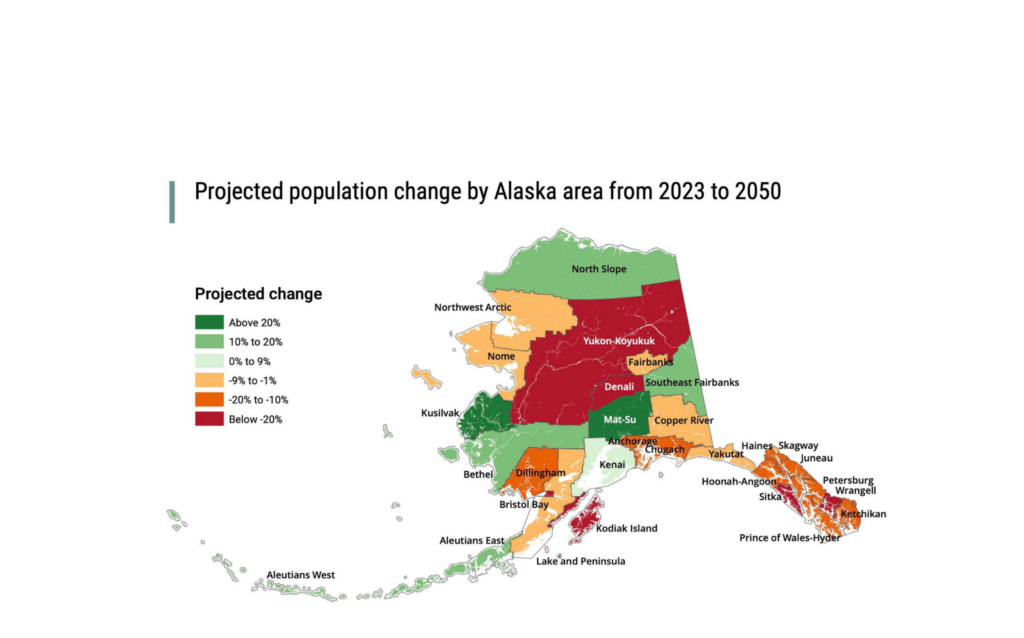
2023 projected population changes in Alaska between 2023 and 2050. Note: these figures differ slightly from data presented in Table 1 of this writing; the overall trends remain the same. (Alaska Department of Labor and Workforce Development, Research and Analysis Section)3
Approximately 17% of young adults in the 18–30 age bracket leave Alaska annually. After accounting for those moving into the state, Alaska experiences a net loss of ~6.3% of its 18-to-30 population in a single year. Per capita, this represents the highest net youth outmigration rate of all 50 U.S. states. Within 5–8 years following high school graduation, ~40% of Alaska-born/raised youth move down south. Of these Alaskan high school graduates, nearly 50% no longer reside in our state by their mid-30s.4 So, why are we losing so many young Alaskans? And why don’t more young people move into Alaska, replacing those we have lost to the Lower 48?
Josephson suggests that Haines is experiencing a severe population decline caused by anti-development policies of Democrat politicians running our local government. Admittedly, the projected population decline of Haines is much greater than most other Southeast Alaska communities, sometimes 2–3× greater. It’s important to note that all of rural Southeast is currently experiencing population declines—a phenomenon not isolated to any one community. Instead of making apples-to-oranges comparisons between one Southeast town’s expected population decline and another town’s economic development, we would be wise to focus on the fact that with or without new large-scale industrial projects, communities across Southeast Alaska are shrinking.
If we only look to existing infrastructure in these other communities—which are also experiencing severe population declines—how can we expect to stop hemorrhaging our people? Does the economic strategy of any of these Southeast communities offer a solution for retaining young Alaskans and improving our economic outcomes?
Neither the $100 million Haines Highway reconstruction nor the major SEARHC hospital expansion has reversed local population decline. Given that recent large-scale infrastructure investments have failed to stimulate population growth, it’s unrealistic at best to expect the proposed Palmer Project or the desperately needed Lutak Dock redevelopment to increase the population of Haines.
While projects such as the existing SEARHC facility include dedicated employee housing, potential industrial developments like the proposed Palmer Project raise a critical question: who stands to build and profit from the housing they might require? Local developer Roger Schnabel has consolidated a diverse property portfolio, making him one of the largest private landowners in Haines. Schnabel’s construction companies have a substantial amount to gain from increased industrial development activities, regardless of the activities’ effect on demand for housing or population decline. Furthermore, Schnabel’s residential real estate holdings have been positioned to yield significant private financial incentives for potential outside workers of the proposed Palmer Project.5
The five Southeast communities mentioned in Brenda Josephson’s article have not experienced any meaningful current or expected population growth after new large-scale industrial projects (see Table 1). Other recent massive development projects in our region have not prevented population decline in the communities where they took place. These include Juneau’s large-scale cruise ship modernizations, Ketchikan’s and Sitka’s industrial harbor expansions, Ketchikan’s highway construction projects, and mining expansions/modernizations at Kensington and Greens Creek. Juneau, Ketchikan, and Sitka have experienced population declines of –5%, –3%, and –2% respectively across the past decade during those project lifetimes.6
The real cost-of-living crisis: energy, fisheries, tourism, and childcare
Brenda Josephson hit the nail on the head when she brought up AP&T’s proposed 112% rate increase for electricity for the people of Haines. This is a flagrant example of price gouging. Such an increase in our electricity bills is preventable, but if companies like AP&T continue to dramatically raise the cost of living in Haines, we will inevitably lose many people to outmigration.
We need to acquire this infrastructure, through eminent domain or municipalization, thereby converting AP&T into a public utility. Above and beyond necessary maintenance of our existing energy grid, we need to massively expand new local projects like hydropower, geothermal, solar, and tidal energy. There are large pools of Department of Energy money available for such projects, but if we allow our local economy to be dominated by price-gouging fuel and electricity monopolists, we will never keep people here in Haines. When we can provide a cheap, abundant, and stable supply of energy, manufacturing can increase. Rather than simply exporting raw natural resources, Haines must focus on the production of value-added goods. This is the only way to create jobs and keep locals around.
We need to start expanding our harbor as Zeke Frank has proposed and make fuel more accessible to our fishermen through subsidies or tax breaks. We need our fishermen involved in the management of the fisheries, to remove the Chilkoot fish weir, and to come to long-term agreements with the subsistence and sport fishing communities. Haines can and should act decisively to prevent our community from accompanying the regional decline in commercial fishing:
“Over the past decade, the number of active Southeast resident commercial fishermen fell by 600, or 29%. By 2025, the region had fewer than half as many resident fishermen as it did in 1980.”7
Instead of the Haines status quo of being subservient to the cruise ship industry and afraid they will leave Haines at any moment, we must stand up for our people, not the $2 billion Alaska cruise industry. Why do we let the cruise ship companies get away with slandering our town? Some of the companies tell their passengers that our Haines small business owners are scammers, while they shepherd their passengers into their own stores in Juneau or Skagway to buy non-local jewelry and furs.
Meanwhile, our community allowed state agencies to unilaterally destroy Kroschel’s wildlife center—one of the best and most memorable tourism attractions we had to offer. For decades the cruise ship companies have been dumping their waste in Lynn Canal and using diesel exhaust scrubbers that poison our saltwaters and marine ecosystems.8 The Haines Borough sells freshwater to cruise ships at a 75% discount compared to what residents pay. When these ships fill their massive tanks, they draw down so much of our freshwater reservoir that we regularly endure boil-water notices and horrific drinking water quality.
If we change our ways and Haines requires a dignified working relationship with tourism companies, we may lose some cruise ship business. However, not all of the tourism revenue comes from the largest cruise ships, and the best and most reliable tourism business comes from the kinds of people that value an upright community engaged in mutual recognition of value between the host destination and the tourism industry.
I oppose transnational corporations plundering our commonwealth. I vehemently disagree that such capitulation to foreign capital is the only solution to our outmigration problem. Many people, especially local experts, have suggested a scarcity of childcare as a main cause behind young families leaving Haines in droves. There is childcare available for less than 20% of the kids who live here.9
Childcare scarcity is driven by high operating costs, low wages, and severe staff shortages tied to local housing limits. We can solve this by treating early childhood education as a universal public utility, funded like K–12 schooling. A potential solution is decentralized neighborhood micro-centers throughout the Valley that are backed by the borough, state, and federal governments. Building housing and upgrading existing childcare facilities for pre-K education staff will create a construction boom. This will help young people stay in Haines.
Table 1. Population Growth & Decline Comparison (2025–2055)
The Alaska Department of Labor and Workforce Development (ADOLWD) publishes long-term cohort-component projections. While Haines is evaluated as an individual borough, several comparison communities are grouped under Census Areas or have distinct municipal trends in the state demographer’s report:
| Community | 2025 Population | Projected 2055 Population | Projected Change Rate (2025–2055) | Notes on Population Trajectory |
|---|---|---|---|---|
| Haines | 2,447 | 1,613 | –34.1% (or –36.3% from 2023 base) | Projected to lose over a third of its population due to negative net migration and an aging demographic. |
| Petersburg | 3,395 | 3,162 | –6.9% | Experiencing gradual population decline at <1/5 the rate of Haines, driven by low birth rate. |
| Wrangell | 2,037 | 1,691 | –29.5% | Large projected decline driven primarily by natural aging; projected to have one of the highest crude death rates in the state. |
| Craig (Prince of Wales-Hyder Area) | 5,690 (Town ~1,000) | 4,554 | –21.0% | Evaluated at the Census Area level; projected large population decline driven by outmigration combined with aging. |
| Skagway | 1,134 | 1,225 | –4.3% | Minimal population contraction over the 30-year span. (Data extrapolated from the Skagway Development Corporation’s 2023 report yields a +8% population increase from 2023–2025, in contrast to the ADOLWD 2026 report.) |
| Hoonah (Hoonah-Angoon Area) | 2,228 (Town ~834) | 1,774 | –20.4% | Evaluated at the Census Area level; projected decline driven by natural aging, one of the highest projected crude death rates in the state, alongside low birth rate. |
| Yakutat | 633 | 473 | –25.3% | Large projected decline driven primarily by one of the highest crude death rates in the state. |
Key Observations
While most of our regional neighbors face moderate population declines or steady downward-to-neutral trends, Haines is projected to experience an extreme contraction of over 34% by 2055, alongside Wrangell’s 29.5% population decline and Juneau’s population decline of 24% from 2025–2055. Every single borough and census area in Southeast Alaska is projected to experience a net population decline over the 30-year timeframe, with a region-wide average population decline of 22.34% from 2025–2055, and a statewide reduction of 1.8%.10
Table 2. Infrastructure & Tourism Per Capita Comparisons
Including harbor slips and annual cruise passenger volumes alongside local population estimates reveals the differing economic strategies and municipal infrastructure scales across these Southeast Alaska communities.
| Community | 2025 Population | Boat Slips / Berths | Boat Slips Per Capita | Average Cruise Passengers (2020–26) | Cruise Passengers Per Capita | Notes on Infrastructure & Tourism |
|---|---|---|---|---|---|---|
| Haines | 2,447 | ~114 | 0.05 (1 slip per 21 people) | ~65,000 | 26.7 | Single small boat harbor; lacks drive-down work float or boat lift. |
| Petersburg | 3,395 | ~650 | 0.19 (1 slip per 5 people) | ~10,000–15,000 | 2.8–4.4 | 3 municipal harbors focused on high-volume commercial fishing; limited large cruise traffic. |
| Wrangell | 2,037 | ~710 | 0.35 (1 slip per 3 people) | ~23,633 | 11.6 | Marine Service Center with 150t/300t haul-out lifts and multiple harbor basins. |
| Prince of Wales-Hyder Census Area | 5,690 | ~650 | 0.11 (1 slip per 9 people) | 3,500 | <1.0 | 2 municipal harbors with boatyard and ice-plant; increasing cruise traffic. |
| Skagway | 1,134 | ~110 | 0.10 (1 slip per 10 people) | ~1,018,000 | 898 | Small boat harbor capacity scaled for local watercraft; waterfront infrastructure heavily optimized for mega-cruise berthing. |
| Hoonah-Angoon | 2,228 | ~350 | 0.16 (1 slip per 6 people) | ~360,000 | 162 | Icy Strait Point facility drives massive cruise passenger volume relative to resident population size. |
| Yakutat | 633 | ~60–70 | 0.15 (expected) | NA | NA | Harbor size expanding. |
Key Observations
- Moorage Infrastructure: Large-scale fishing and logging waterfront hubs like Petersburg, Craig, and Wrangell maintain 3× to 7× more harbor slips per resident than Haines.
- Cruise Tourism Focus: Skagway and Hoonah operate as high-density cruise destinations and can receive hundreds to over a thousand cruise passengers per resident annually, whereas the cruise ship industry in Haines operates at a moderate capacity and intensity relative to the region at large (compare ~27 average annual passengers per resident in Haines across 2021–2026 vs. Southeast Alaska’s 26.45 annual passengers per resident in 2026 alone [1,970,000 annual passengers and 74,479 residents]).7
Sources
- Alaska Division of Elections, “Voters by Party and Precinct” (October 2025). elections.alaska.gov ↩
- BestNeighborhood.org, “Conservative vs. Liberal Map – Anchorage Municipality, AK.” bestneighborhood.org ↩
- Chilkat Valley News, “Southeast Alaska’s population expected to drop 17% by 2050, by far the most statewide” (December 5, 2024). chilkatvalleynews.com ↩
- Alaska Department of Labor and Workforce Development, “Alaska’s Young Adults Are Leaving” (March 2021). laborstats.alaska.gov ↩
- KHNS, “Longstanding Haines construction company to get new owner.” khns.org ↩
- Federal Reserve Economic Data (FRED): Juneau population (AKJUNE0POP), Ketchikan population (AKKETC0POP), Sitka population (AKSITK0POP). ↩
- Southeast Conference, “Southeast Alaska by the Numbers 2026.” seconference.org ↩
- Alaska Public Media, “For months, Carnival Corp. has withheld water pollution data from Alaska regulators” (March 31, 2026). alaskapublic.org ↩
- Chilkat Valley News, “Assembly briefs: childcare recognition, Four Winds Resource Center, new dock info and more” (September 24, 2026). chilkatvalleynews.com ↩
- Alaska Department of Labor and Workforce Development, Research and Analysis Section, Population Projections. live.laborstats.alaska.gov ↩
Tommy Thompson is a Haines resident. Opinions expressed belong to the author.