Editor’s note: We are experiencing technical difficulties with the author display, which we are working on solving as soon as possible. For clarity: this article was written by Brenda Josephson.
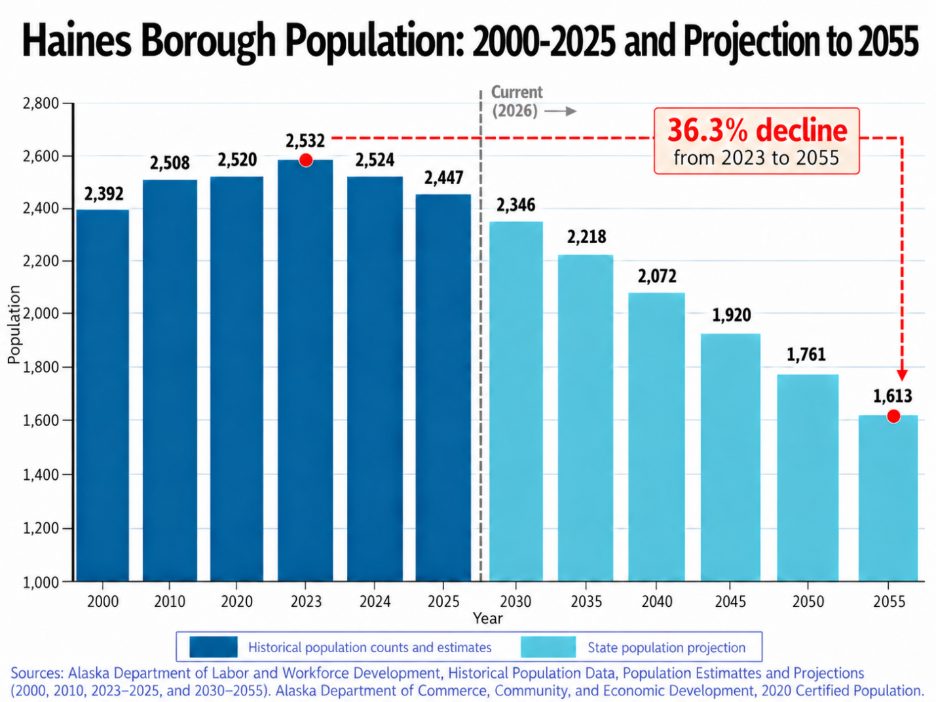
What kind of future is Haines building? During the first two years of outgoing Mayor Tom Morphet’s tenure, Haines Borough’s estimated population declined by 3.4% from 2023 to 2025. With just 2,447 residents in 2025, the Alaska Department of Labor and Workforce Development projects a further loss of 834 people by 2055, bringing the total projected population loss to 36.3% from 2023 to 2055.1
Haines cannot keep doing the same things and expect different results. The community needs to chart a new course.
For years, Morphet has spoken out against major public infrastructure projects, and his positions are documented on his personal website. In “What’s the Big, Ugly Parking Lot For?” he called the Small Boat Harbor expansion an “unnecessary monstrosity,” criticizing its design and cost. In “Time for Haines to Divorce Large Cruise Ships,” he advocated turning away cruise ship dockings, despite acknowledging the loss of sales tax revenue. In “The Absurdity of Owning Lutak Dock,” he advocated transferring the Borough’s freight dock to private companies, arguing that it was not a municipal asset.
The outgoing mayor is not alone in opposing investments to maintain and develop key municipal infrastructure. He and others who share his perspective claim to support an economy built around small businesses and local manufacturing, yet question investments in the very facilities those industries depend on for their growth.
The commercial fishing fleet still needs key improvements originally envisioned as part of a 2017–2018 Small Boat Harbor expansion plan: additional moorage slips and the long-promised drive-down work float. Lutak Dock, the community’s essential freight facility, remains unrepaired despite more than $25 million in funding secured for its reconstruction. During Morphet’s tenure, litigation began over the Lutak Dock project, and the Assembly terminated both the construction and consulting contracts. The lawsuit remains unresolved, and the project is still unfinished. Haines needs feasible solutions to complete these projects and strengthen the industries that depend on them.
Consider what other Southeast Alaska communities have developed.
Petersburg, with 3,395 residents, supports more than 500 homeported fishing vessels through three municipal harbors. Wrangell, with 2,037 residents, operates a Marine Service Center with 150-ton and 300-ton boat lifts, supporting more than 280 vessel haul-outs annually. Craig, with approximately 1,000 residents, maintains two municipal harbors with 220 annual moorage slips, an ice facility, and a boatyard.2
Tourism provides another comparison. In 2025, Skagway, with 1,134 residents, received approximately 1.36 million cruise passenger visits. Hoonah, with just 834 residents, received more than 500,000. Haines received approximately 68,000 cruise passenger visits.3
These communities have different economic foundations and development strategies, but each demonstrates how public and private infrastructure can support businesses, employment, and outside revenue.
Haines needs more than empty promises of support for small businesses. What is needed is essential public infrastructure and fewer barriers to economic opportunity.
High electricity and freight costs already put local businesses at a competitive disadvantage. Adding to those challenges, Alaska Power & Telephone warns that regulatory requirements for submarine cable replacement funding could increase rates in both Haines and Skagway by an estimated 112.6%. AP&T cautions that the resulting costs could damage the economy and accelerate population decline. Haines Borough’s own planning documents acknowledged high energy costs as a challenge for Ocean Beauty’s seafood processing plant at Excursion Inlet, where fish had been processed for more than a century before operations ceased in 2021. The closure ended a longstanding operation and cost Haines Borough valuable fish tax revenue. How can local businesses compete and grow, and how can the community attract new processors and manufacturers without addressing these fundamental costs?
There is a broader divide over how Borough resources should be invested. Morphet is among those who question major public infrastructure investments while supporting higher taxes and expanded recreation programs and other amenities. But when economic development is opposed or restricted, what will replace the year-round jobs, businesses, and tax revenue that sustain the community? A shrinking population cannot continue to shoulder rising costs. Without a stronger economic foundation, difficult decisions about reducing nonessential Borough expenditures become unavoidable.
In a recent essay, “The Future of Haines,” Morphet warns that Haines could become a “seasonal recreation enclave for the wealthy.” Yet without sufficient economic opportunities for working families, the policies he advocates could contribute to precisely that outcome.
Haines is running out of time.
The State of Alaska has already provided a glimpse of what Haines can expect if it continues down its current path, projecting a further 34% decline in population by 2055.
With population already declining, responsibility now rests with the newly elected mayor and Assembly to address unfinished infrastructure projects and make financially responsible investments that support year-round businesses and employment.
The state’s projection is a warning, not a future Haines has to accept. Removing obstacles to economic opportunity, rather than creating them, is essential to changing that trajectory.
Sources
- Link to State of Alaska Population Projections ↩︎
- Alaska DOL (2025 population estimates) and municipal harbor departments. ↩︎
- Rain Coast Data, Southeast Alaska by the Numbers 2026 ↩︎