
The House Finance Committee took House Bill 2001, which was written by the Rules Committee specifically to pay $1,600 Permanent Fund dividends to Alaskans…
"An Act making a special appropriation from the earnings reserve
     account for the payment of permanent fund dividends; and
     providing for an effective date."
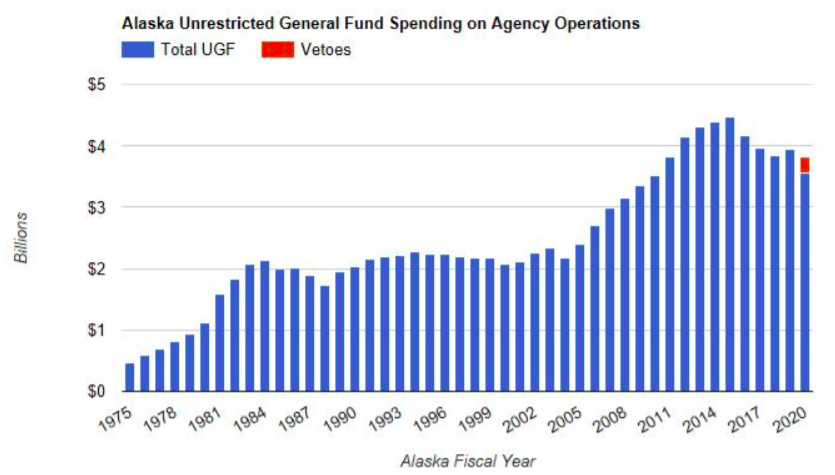
…and the committee hoisted a substitute amendment that stuffed $444 million in spending into it, every cent of spending that Gov. Michael Dunleavy had vetoed out of the operating budget for the fiscal year that began July 1.
[Read the House Finance substitute that reverses the vetoes]
The dividend amount remaining would be about $929 per eligible Alaskan.
All in a day’s work.
A problem exists for the House and Senate Majorities, both of which are operating as bipartisan coalitions: Even the Legislature’s own attorney is hinting that the stuffing of the unrelated spending into the Permanent Fund appropriation is “outside the call” of the Special Session.
Because the session was called by the governor, he sets the agenda, just as he sets the location.
If the Legislature wants to restore those cuts, they need to call themselves into Special Session. They don’t have the votes to do that.
But the stuffing of the spending today served a purpose. Should it ever get to the floor of the House, and should the Juneau Special Session be deemed legal by the courts, such a spending spree only requires a simple majority vote, rather than the three-quarters vote needed to access the Constitutional Budget Reserve. The majorities have that vote, it appears.
Perhaps that is why the Board of Regents of the University of Alaska system took no action today to start the reorganization of the universities. They are hoping for one last miracle to restore higher education’s $130 million veto.
The governor would likely veto this spending a second time, and the Legislature still doesn’t have the votes to override his vetoes. He might even veto the $929 or $1,600 Permanent Fund dividend and send lawmakers back to the drawing board.
Today’s action was a clear message that spending comes first for the House and Senate Majority, and anything else left over will be used to pay Permanent Fund dividends.
That wasn’t the intent of Senate Bill 26 last year, when the Legislature agreed on a structured draw of the Earnings Reserve Account to pay for state operations. Nor was it the intent of those who created the Permanent Fund dividend program.
Critics of SB 26 predicted that this would be the result of an incomplete SB 26, however. The Legislature could not agree on how to restructure the formula for paying dividends, and punted the problem to this year.
In a Journal of Commerce article by Elwood Brehmer in May, 2018, Sen. Bill Wielechowski warned that “leaving the existing formula in place … means the Legislature will continue to bypass the PFD in law in favor of providing more cash to government agencies.”
“One statute will inevitably be violated and my prediction is it will probably be that statute that provides for a full dividend,” Wielechowski told the Journal. “In fact, that’s what’s happening this year, in this budget [2019 fiscal year]. That’s what’s happened the last two years.”
Also in the report by Brehmer, Rep. David Eastman, R-Wasilla, argued that SB 26 reversed the Legislature’s historic priorities by putting government funding ahead of the dividend and ahead of inflation-proofing the fund. Both Wielechowski and Eastman were prescient, as the first year after SB 26 was passed into law, the Legislature is still arguing over the Permanent Fund Dividend well into the second Special Session.
[Read: Legislature approves draw from Permanent Fund]
The Legislature first gaveled into session on Jan. 15, some 181 days ago and has yet to pass the funding of the dividend or a funded capital budget.
By existing statute, which the Legislature could change if it wants, the dividend payout is about $3,000 for every man, woman and child who qualifies.


