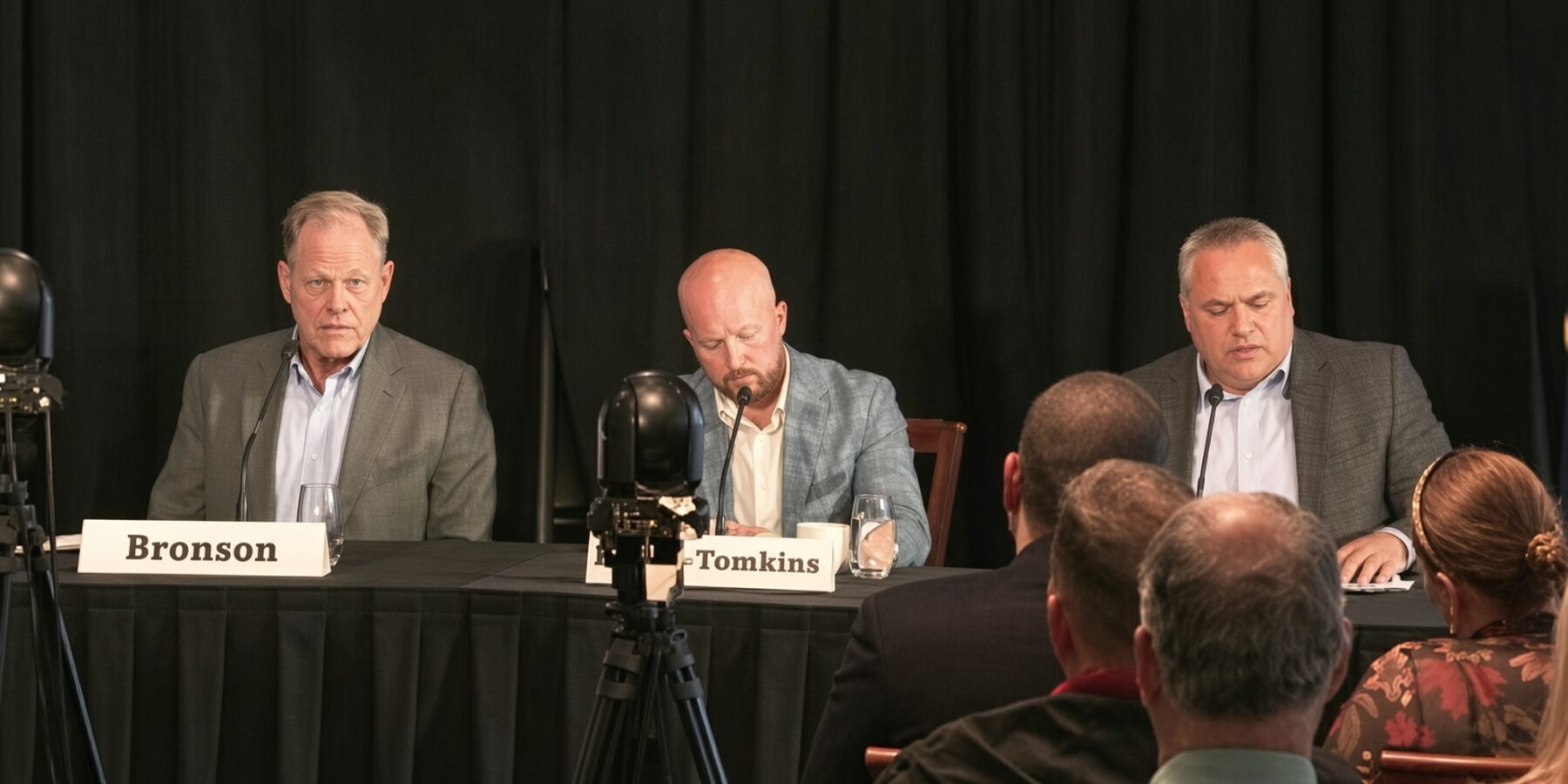
On Tuesday, September 8, the Last Frontier Republican Club hosted a governor’s debate in Anchorage, asking candidates the hard questions about securing reliable energy, stabilizing the budget, reviving the economy, and reversing outmigration. Dave Bronson, Treg Taylor, and Jonathon Kreiss-Tomkins participated in the debate, offering competing visions for building a thriving Alaska and bettering our schools, businesses, and governance. Bernadette Wilson did not participate in the event.
The first questions focused on Alaska’s energy problems: Southcentral’s looming natural gas shortfall, the Alaska LNG project, and the necessity of a unified Railbelt grid.
Treg Taylor emphasized the need to “greenlight now, recalibrate later,” arguing that there is no revenue to tax if the project never gets built. Additional taxes can be discussed down the road when the pipeline is producing revenue. He also argued that the State must further incentivize development in the Cook Inlet to provide for Alaskans’ energy needs until phase two of the Alaska LNG project can be completed. According to Taylor, importing LNG is “probably inevitable at this point.” He also spoke about the unification of the Railbelt into one grid. When asked if government should force the utilities to unite, he indicated force via legislation is not necessary and the utilities are already trending that direction.
Dave Bronson noted, “We’re not running out of gas in Alaska… What we’re running out of is contracts for deliverable gas.” His solution, similar to Taylor’s, is to keep drilling the Cook Inlet and incentivize further development. “We need to drill about 30 to 33 wells a year, and HEX is doing that. Hilcorp is still doing that. We’ve got the rigs. We just need to keep drilling. As much as we can in the inlet to keep that supply in place until the gas line comes in and is able to help supply us,” stated Bronson. According to Bronson, the legislature failed to get the Alaska LNG project over the line because of “failed personal relationships.” He emphasized the need for the next governor to develop relationships with the legislators to get policies through the process rather than fighting with them. Regarding the unified grid, he stated that he would not try to force the utilities to unite but work to convince them.
Jonathon Kreiss-Tomkins argued in favor of additional taxes in a gasline bill but did not identify a specific policy or tax structure. He also emphasized an “all-of-the-above approach” to energy, including the development of renewables such a wind, hydro, and solar. He agreed with Taylor and Bronson that further Cook Inlet development should be “aggressively” pursued. However, he differed from the Republican candidates in saying he would pursue legislation forcing the Railbelt utilities to unite as one grid rather than leave that decision to the utilities.
Countering the point raised by Kreiss-Tomkins about renewable energy, Bronson stated, “Windmills are not renewable energy because they don’t last. You have to bury them. They only last 15 years. Windmills never pencil. Solar panels, on the hand, on the grid are actually effective because they use the excess sunlight we have in the summertime to create electricity.” Kreiss-Tomkins countered, “If you talk to our friends in Kodiak, I think they feel pretty happy with their investment in wind power… I think you should respond to what the economics are. I think if the economics are good in Alaska, we should aggressively pursue the development of renewable sources.”
The next set of questions turned to economic growth, outmigration, and education. All three candidates saw poor quality public education and economic constraints as the main driver of outmigration. Taylor emphasized the need to deregulate, citing personal experience with burdensome government bureaucracy that discourages potential entrepreneurs from starting businesses in Alaska. Bronson also highlighted Alaska’s intense bureaucratic culture stifling businesses, stating, “Government is the greatest challenge small businesses face.” Kreiss-Tomkins said he supports a “strong minimum wage” and paid sick leave but also agreed to some extent with cutting burdensome regulations.
Regarding school choice, Taylor and Bronson both said they would support a constitutional amendment structuring public education funding to follow the child so parents have expanded education options. Bronson expressed concerns about the NEA’s influence on the school choice discussion. Kreiss-Tomkins said he supports freedom of education, but not publicly funded freedom of education, and ultimately disagreed with such an amendment. Taylor was given an opportunity for rebuttal to Kreiss-Tomkins. He stated, “We are failing our kids. Plain and simple. Parents shouldn’t be forced to put their kids in a failing school.” Kreiss-Tomkins then countered by saying he generally agrees with what Taylor said but believes public funds should stay in public education. Bronson also mentioned his support for another constitutional amendment— this one to forward-fund education, locking in education funding at the beginning of the legislative session.
When asked if they would have vetoed the recent defined benefits plan (HB 78) vetoed by Governor Dunleavy, answers fell predictably along party-lines with Bronson and Taylor saying they would have vetoed it and Kreiss-Tomkins saying he would have signed it.
Regarding trawling and bycatch, all three candidates agreed on the importance of reducing trawling bycatch and habitat destruction. Kreiss-Tomkins spoke about his legislative record, claiming he spent the most amount of time on reducing bycatch and habitat destruction caused by trawling out of all the legislators during his time in office. Taylor argued, “One user should not benefit to the detriment of all the other users.” Both Bronson and Taylor reiterated their committment to not take any money from the trawling industry. All the candidates talked about pursuing nominations to the North Pacific Fishery Management Council that put Alaskans first and reduce trawling bycatch.
The last all-candidate question concerned the Permanent Fund Dividend and whether or not an endowment should be made to protect the corpus. Taylor argued that if the legislature keeps taking from the dividend, more families will just leave. Families are struggling. The State is struggling. Taylor’s answer is to get the economy moving again. “The PFD wasn’t an issue when the economy was moving,” he stated. “We are still running 400,000 barrels of oil through the pipeline. What did we do in our heyday? 2 million. 2 million. We have a lot of room for improvement, and if we jumpstart this economy, we are not going to be fighting over the PFD.” He also said he would pursue a constitutional amendment enshrining the PFD.
Bronson dispelled the popular idea that the State can “cut its way to a full PFD,” arguing that cuts would never mathematically produce enough money to fund a full statutory dividend. “You could eliminate every state employee and only get to half of a year’s full PFD,” he said. However, he agreed with Taylor that the solution is to grow the economy. “There’s only one mechanism to get to a full PFD… You have to grow your way out of it, like Treg was saying.” He also stated he would support creating an endowment to protect the corpus of the Permanent Fund. Kreiss-Tomkins stated he agreed a lot with Bronson’s answer and that he had worked on legislation to create such an endowment during his time in office. “I believe deeply this is the single most important thing we can do, which is to fully and permanently protect the Permanent Fund so it can never be spent down, it can never be overspent,” stated Kreiss-Tomkins.
Learn more about Bronson, Taylor, and Kreiss-Tomkins by watching the full governor’s debate, recorded live by the Last Frontier Club. Click here to watch the full debate!