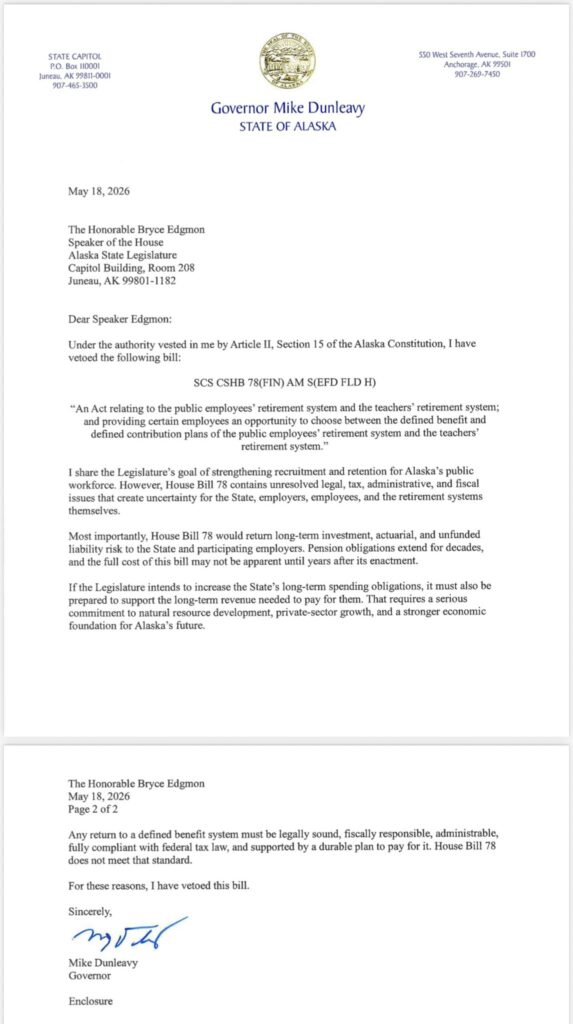
On May 18, 2026, Governor Mike Dunleavy vetoed House Bill 78, a bill that would have reestablished a defined benefits retirement plan for public employees.
HB 78 had passed the Senate by a vote of 12-8 and the House by 21-19.
The Senate Majority had hailed the bill as “a fiscally responsible path to recruit and retain public employees by providing a modest pension plan with structural safeguards, including adjustable contributions and shared risk provisions that ensure the plan remains fully funded without creating unfunded liability for the state.”

However, opponents in the Senate Republican Caucus warned that the bill carries “unknowable future costs, obscure fiscal notes, and a legacy of failure.” House Minority Leader DeLena Johnson (R-Palmer) echoed these concerns: “Alaska is already struggling under a $7 billion deficit in its retirement systems, despite a massive $3 billion infusion in 2014. While other states struggle under the weight of their own defined benefit plans, Alaska had previously found a more stable path. This plan costs $40 million a year. Where is the state going to find the money to cover these new costs?”
Dunleavy urges the Legislature to consider this revenue question, stating in his veto letter: “If the Legislature intends to increase the State’s long-term spending obligations, it must also be prepared to support the long-term revenue needed to pay for them.”
He then urges the Legislature to put Alaska’s economy first, saying that any increase in public employee retirement benefits will first “require a serious commitment to natural resource development, private-sector growth, and a stronger economic foundation for Alaska’s future.”
Although Dunleavy states that he “share[s] the Legislature’s goal of strengthening recruitment and retention for Alaska’s public workforce,” he clearly outlines the standard for a sustainable pension bill: “legally sound, fiscally responsible, administrable, fully compliant with federal tax law, and supported by a durable plan to pay for it.”
According to Dunleavy, HB 78 does not meet that standard and thus is vetoed.