
By SUZANNE DOWNING
Part 2: What could possibly have gone wrong, other than China controlling Alaska? Read Part 1 here.
China President Xi Jinping is no ordinary communist leader. He is starting an unprecedented third five-year term as the head of the Communist Party, which controls the economy and social order in China. He’s 69, and could have another 10 years at the helm of China.
Sunday is a big day for Xi, as he consolidates his power during the Communist Party’s twice-in-a-decade national congress, which opened its five-day meeting. In his opening speech to delegates, Xi made barely concealed references to war with the United States.
The man to whom former Alaska Gov. Bill Walker had signed a deal to sell 75% of Alaska’s natural gas has today laid out his vision for the People’s Republic of China’s future, and it is to be far more powerful than the United States, and to be prepared to dominate in a war with the West.
If Walker’s 2017 agreement had not expired after he left office, and if Walker had signed permanent agreements with Xi, Alaska’s gas would today be essentially owned by Communist China.
In the speech before 2,296 delegates on Sunday, Xi warned of storms ahead, and “incomparable glory,” as he makes China the premiere global power. He said he would bring free-market Taiwan back under control of the communist People’s Republic — by force if necessary.
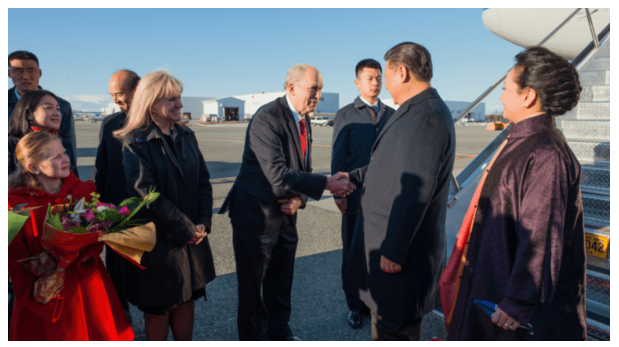
President Xi is now the most powerful communist leader of the People’s Republic of China since Mao Tse Tung. It’s no wonder that when Walker saw this alpha male step off the jet in Anchorage in 2017, Walker bowed to him in submission.
Xi is a man on a mission for world dominance.
“The attempt to suppress and contain China’s growth could escalate anytime,” Xi said to delegates.
While Xi did not mention the U.S. by name, he said that in the face of rapidly changing international tensions and “external blackmail, containment, blockade and extreme pressure,” China’s national interests would be defended. Analysts say this is the first time he has used the word “blackmail” to describe a political situation.
The Wall Street Journal predicted as much on Friday, in its story titled, “Xi Jinping’s Endgame: A China Prepared for Conflict With the U.S.”
Xi has unleashed an array of military, economic, and political campaigns to brace the country for the possibility of this confrontation, the Journal said.
“Since rising to power a decade ago, Xi Jinping has unleashed an array of campaigns to help ensure that China would prevail in, or at least withstand, a confrontation with the West. He has bolstered China’s military, reorganized the economy and remade society around a more ideologically committed Communist Party,” the newspaper wrote at this link.
“Mr. Xi has made clear that his overarching goal is to restore China to what he believes is its rightful place as a global player and a peer of the U.S. As a consequence, he has come to see the possibility of a showdown with the West as increasingly likely, according to people familiar with his thinking. Now he stands on the edge of a third five-year term in power at a Communist Party conclave starting Sunday, in a break with a recent precedent of stepping aside after two terms. That will likely ensure that his vision, which is simultaneously assertive and defensive, will guide China for years to come.”
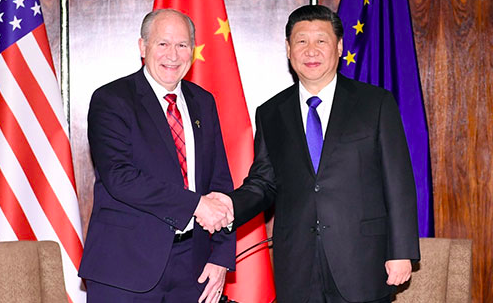
Former Gov. Walker didn’t see it coming. Five years ago, Walker was fast-tracking a long-term, multi-faceted contract with Xi. Both men had just risen to power for their respective jurisdictions — Xi in 2013, and Walker in 2014.
As Walker pressed ahead with Xi, the private-sector energy companies such as Exxon, ConocoPhillips, and BP, which had been partners in the AKLNG project, stepped out, and Walker consolidated the project under his control.
From there on out, it would be Walker and Xi.
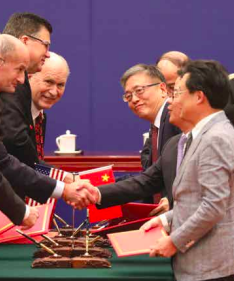
Walker’s partnership was with the People’s Republic of China, and government-owned Sinopec, Bank of China, and China Investment Corporation. The CIC is China’s sovereign wealth fund, much like the Alaska Permanent Fund — except that CIC is the world’s largest sovereign wealth fund that controls over $1 trillion in assets, including ports, airports, and real estate around the world. It would invest in the gasline project and the Bank of China would loan Alaska the money the state needed to complete the deal.
With Walker’s China plan, the communist government would provide 75 percent of the $43 billion in needed funding for the AKLNG project and would have contracts to build the components of the gas line.
It’s not known what collateral Walker would have offered, but the Alaska Permanent Fund would have been an attractive target. Alaskans decided to remove Walker before he could go from just dating to jumping into bed with the communist Chinese, when he didn’t fully comprehend that China could become a master to Alaska and cripple the state by pulling its support for the project at any time. Alaska, even if it was a nation and not a state, would have had no recourse to recover.
This is not theoretical. As an example, in March of 2022, Sinopec Group suspended work on a mega gas marketing venture in Russia, as the Communist Party of China called for reducing risk due to the invasion of Ukraine. China’s most important diplomatic partner is Russia, and yet Xi moved quickly to pull Sinopec out of Russia in order to reduce the nation’s risk due to sanctions from the West against Russia.
In Uganda, where Chinese entities paid for the construction of the nation’s only international airport as part of the hundreds of billions of collars China is lending in African countries under President Xi’s Belt and Road Initiative. Last year, the country defaulted on the terms of the loan and it’s unclear today who actually controls the Ugandan Entebbe International Airport.
This year, one of the companies in the now-expired Alaska agreement, Sinopec, has been delisted from both the New York Stock Exchange and the London Stock Exchange, because the Western requirement for transparent audits is not something Sinopec wants to do.
Xi has already amassed power and placed himself in control of domestic affairs, foreign policy, the military, the economy, and most other key matters through party working groups that he leads, the Wall Street Journal notes.
Alaska, if Bill Walker had remained governor, could have been the extension of Xi’s Belt and Road signature project. What could possibly have gone wrong?
Suzanne Downing is publisher of Must Read Alaska.


