

By DAVID BOYLE
The Anchorage School District has been wrestling with the math program for decades. Under former School Superintendent Carol Comeau, the district implemented the highly conceptual “Every Day Math” (EDM) program, which focused on high-level math concepts as opposed to foundational math such as Saxon Math.
Read: Is Every Day Math the worst math program ever?
This EDM program was not a good fit for most of the students, as it was meant for those who would go on to college.
Additionally, the majority of teachers didn’t like the program, according to a 2011 audit by the Council of Great City Schools. The customers — parents and students — were not even asked their opinions.
At its Dec. 20 school board meeting, the board was presented with the status of algebra II as part of the new College, Career and Life Ready standards. Algebra II is said to be the best indicator to ensure college success. The ASD is focusing on improving the successful completion of algebra II to reduce the math remediation of freshmen at the university system, which is more than 60 percent.
The most recent PEAKS standards show only 37 percent of all Anchorage students are proficient at math and 37 percent of ninth graders are proficient at math. It appears as if some foundational math is lacking.
The below chart shows a downward trend of students successfully completing Algebra II:
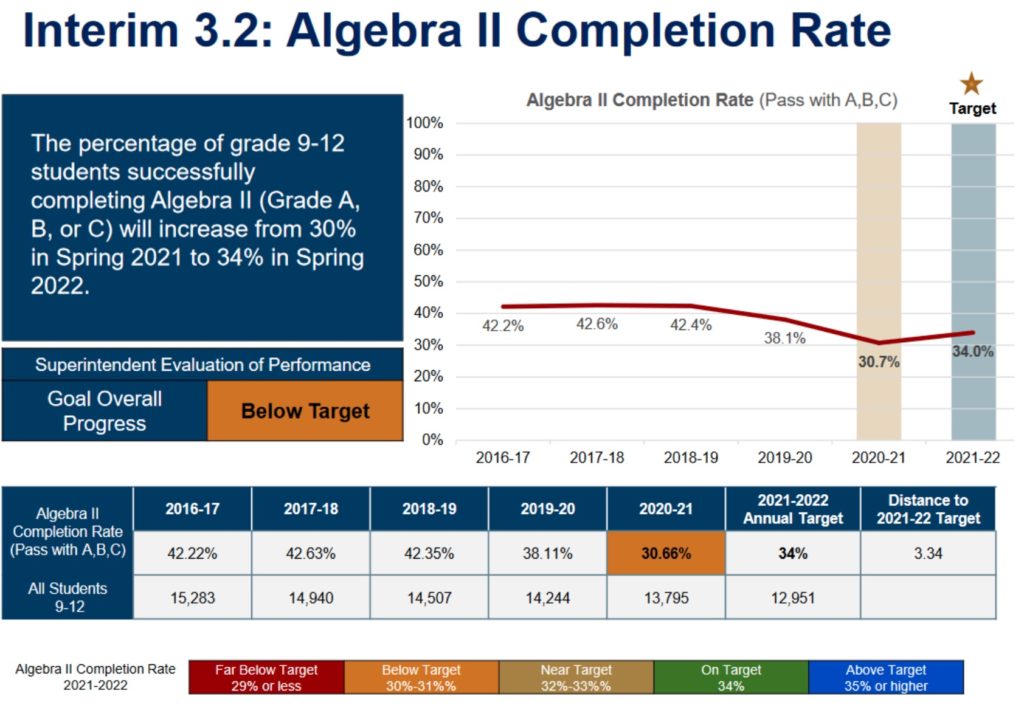
This group of students represents the percentage of all grade 9-12 students, not just those taking algebra II. There is a significant drop in completion rates between the years 2018-19 and 2019-20. A 4.3 percentage drop is nearly 10 percent.
The low point in 2020-2021 shows the impact of distance learning due to the pandemic and school closures.
The interesting part is that there is a trend in the decline in the number of students taking algebra II. From 2018-19 to 2020-21 there is a drop of 715 students.
This may be attributed to the pandemic or the fact that students may be ill-prepared with earlier math and fear they will fail at algebra II. It’s also possible students believe they don’t need this math to succeed in life.
This chart shows a breakout of students according to race/ethnic group, English language learners, special education, economic status, and type of school attended:
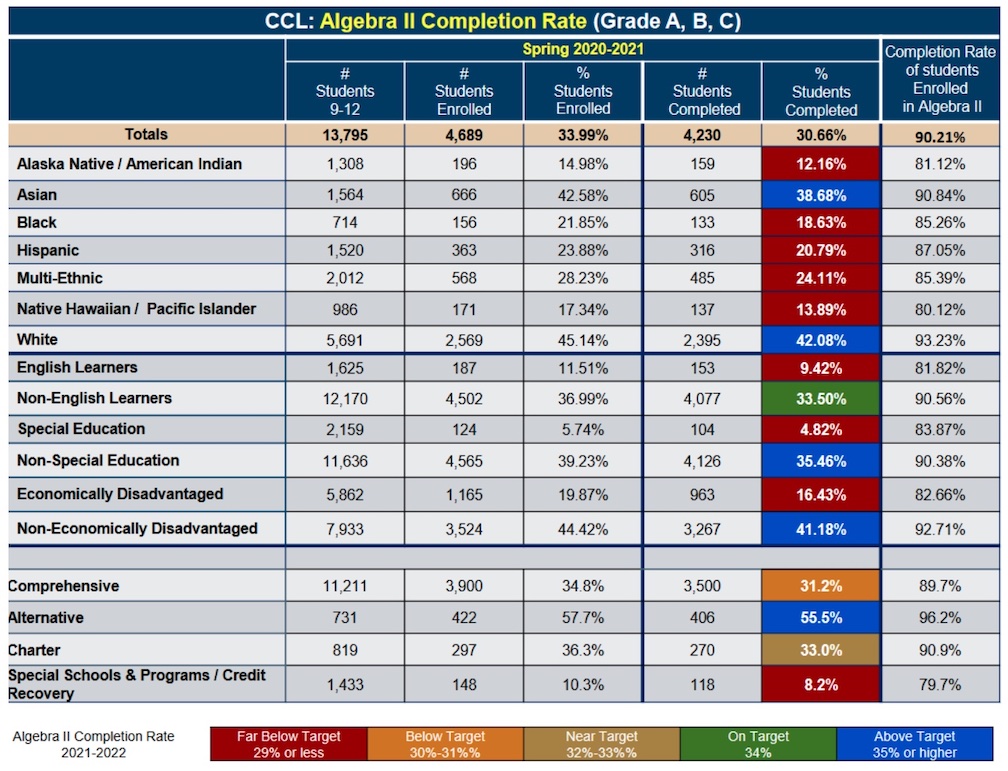
The most important column here is the “% Students Enrolled,” because that determines the excellent “Completion Rate of students Enrolled in Algebra II” column. The overall 90.21% of students completing algebra II only considers those who are enrolled in the course. If they enroll in the class, they typically complete it.
This chart also shows that the Alternative schools far outpace the neighborhood (Comprehensive) and charter schools. These alternative schools are Alaska Middle College, King Tech High School, Polaris, and Steller Secondary School. Most of the students in these schools are college-bound.
The school board didn’t ask any questions regarding the downward trend in completion rates.
Instead, the left-dominated board focused on “equity “in math programs regarding minority students, those students who are in the 63% “not proficient” in math as shown in the state’s PEAKS assessment.


