

By DAVID BOYLE
The Anchorage School Board has kicked the can down the road on its budget for the past few years. Consequently, it is facing a $68 million budget shortfall for the next school year.
This shortfall results from bad decisions made since the infusion of federal Covid relief dollars.
Much of this deficit is due to the district using one-time federal Covid money to pay for recurring costs. For example, the district has used $39.4 million federal Covid money to pay for teacher salaries and benefits.
It has also used another $2.9 million of federal Covid money to pay for non-certificated salaries. Here is a chart from the State showing percentages of expenses spent from federal Covid money on various categories by ASD:
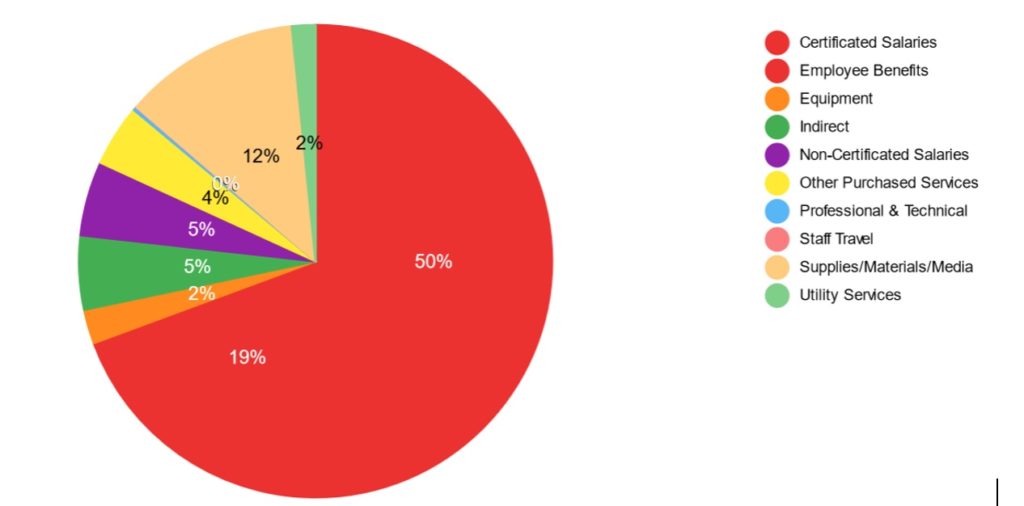
The total expenditure in the above chart is approximately $56.8 million.
The State Department of Education and Early Development warned school districts to not use the one-time Covid money for recurring expenses.
“It is your responsibility to communicate to your constituents that this approximately $504 million in funding statewide is a one-time addition to your budgets. You should not make permanent programmatic commitments with these funds. You should communicate clearly to your communities the temporary nature of this funding and its intended purpose. In order to minimize the impact when these funds expire, school districts must wisely invest these one-time funds. For example, consider how you can focus on a limited number of short- term goals that promise the maximum benefit for your students in the years ahead,” the Department of Education warned.
But the Anchorage School Board ignored the warning.
The State Department of Education said, “Furthermore, it is important to understand that since these are one-time funds and given the State of Alaska’s current fiscal situation, do not anticipate a replacement of these funds with State funding when they expire”.
But that is what the district is betting on by pressuring the legislators once again to increase the Base Student Allocation and add additional funding to close the $68 million budget gap.
As the district faces this budget crisis, student enrollment has also declined, leading to decreasing funded from the State.
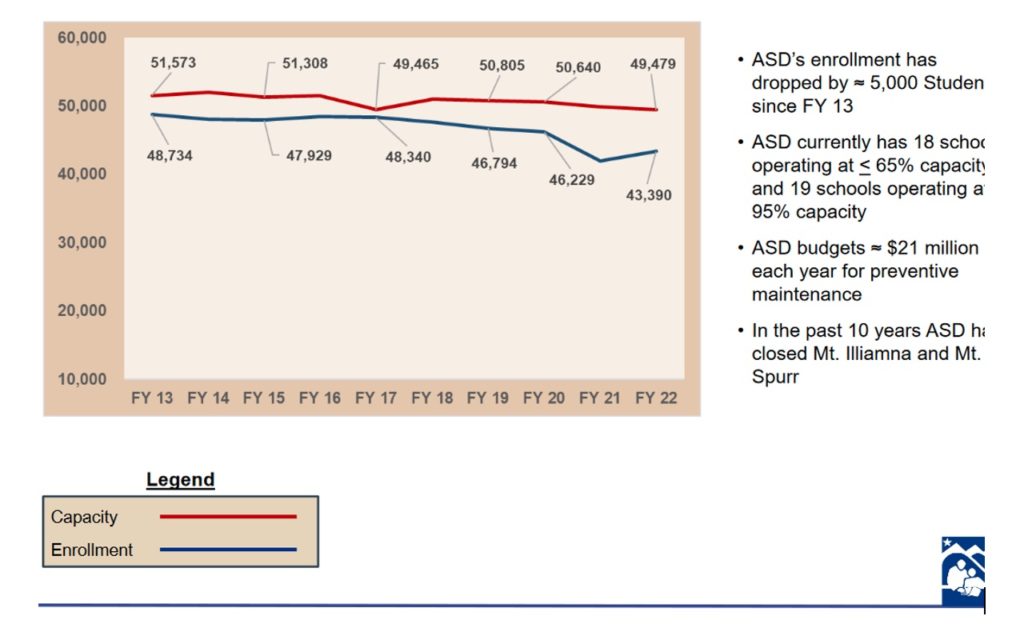
Since fiscal year 2013, the Anchorage has lost more than 5,000 students while continuing with an even larger staff and excessive school buildings. The following graph by ASD shows this disconnect:
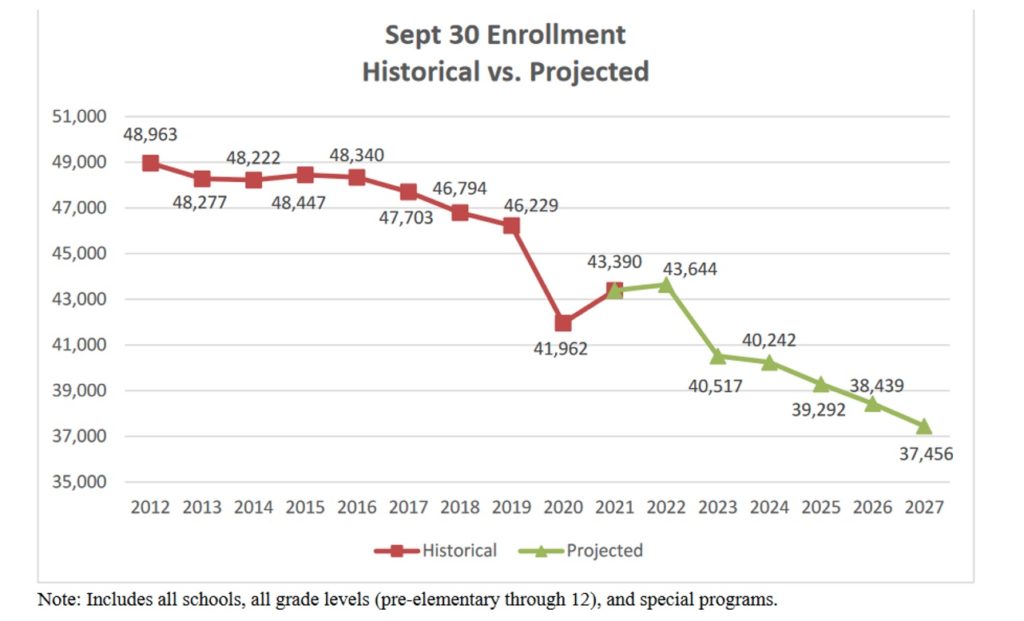
The ASD Capital Improvement Plan shows an even more dramatic downward trend of students. This projects a decrease of an additional 6,000 students by 2027.
It seems obvious to most that the need to close/consolidate schools to increase efficiency and lower costs is necessary. Once again, the school board faces some difficult decisions it previously failed to make.
But tough decisions must be made.
The district acknowledges that 18 schools are less than 65% filled, based on its own space requirements, not the State’s space requirements.
To help close a $68 million budget gap in the next fiscal year, the district must decide which schools to close and how to redraw school boundaries.
School closings and redrawing boundaries will be met with an uproar by parents.
However, closing a school will only save about $500,000 annually. The real cost is in salaries and benefits. These account for 86% of the general operating budget of the district.
The most recent Annual Comprehensive Financial Report (formerly CAFR) shows that from 2016/17 to 2020/21 school years there has been an increase from 176 to 220 “administration” employees. This is a 25% increase in overhead.
Since the 2022 adopted budget, Human Resources has grown from 29.69 FTEs (full -time equivalents) to 35 FTEs. Likewise, the Equity & Compliance office grew from zero FTEs to 5 FTEs.
This is typical of mission creep seen in a large bureaucracy.
During that same period of 2016/17 to 2020/21, the number of teachers decreased from 3263 to 3023, a 7% decrease in teachers.
We need effective classroom teachers more than administrators who push gender identity, diversity, equity and inclusion, aka critical race theory.
The board needs to focus on its core business of teaching students reading, math, history, and social studies.
Our students need to be able to enter college without taking remedial classes. Students need to be able to enter the work force able to read, do basic math, and use critical thinking skills to succeed.
The district needs to use multiple strategies and choices to avoid going over the fiscal cliff.
And you can help in this effort. You can provide your comments and recommendations to the ASD here: https://www.asdk12.org/Page/19360.
David Boyle is an education writer for Must Read Alaska.
Schools vs. parents: Anchorage public schools secretly affirmed a student’s transgender leanings


