

By DAVID BOYLE
Readers have been led to believe the Anchorage School District was preparing to close schools due to major budget shortfalls. Instead, two out of the six of the proposed schools are being “repurposed” by the Anchorage School District as pre-kindergarten academies, even though it has no data to prove the effectiveness of such programs.
When questioned about the “proof of concept” on how these pre-k academies will operate, the administration stated it will just develop the concept once it has the program in place.
Most programs have an approved proof of concept prior to being implemented. However, the administration doesn’t seem to think it needs one.
At the Nov. 15 work session, school board member Kelly Lessens asked the vital questions regarding the success of the current pre-k program. She wants data that show the effectiveness of the current program.
“If we want more preschool funding, I am interested in finding a proof of concept. Are our investments positively impacting our students?” Lessens asked.
Only board member Dave Donley showed an interest by seconding the request for information. Other board members remained quiet.
Superintendent Jharrett Bryantt responded to Lessens’ question by stating, “Are you seeking data on ASD pre-k programs?”
Lessens answered yes,
“I would anticipate that it would be slightly difficult to produce, and it would be difficult to discern a causal relationship for a number of reasons,” Bryantt said.
Bryantt noted the district has no data on its pre-k program. He did not explain why it would be “slightly difficult to produce.”
Bryantt also did not explain his reasoning as to why it “would be difficult to discern a causal relationship for a number of reasons.”
Bryantt did offer to provide national research on the effectiveness of pre-k programs. However, member Lessens was more interested specifically in the effectiveness of the ASD pre-k program.
She responded that national data are fine, but she wanted to know what philosophy is dictating the Anchorage pre-k programs. There was no response from the district regarding its program philosophy.
Lessens asked if the pre-k program translates into kids who are more ready for kindergarten and asked if they are succeeding in kindergarten. She was interested in the education outcomes and the value added.
Lessens wanted data to show the Alaska Legislature before the session starts, so the district can get more funding. Member Bellamy said it would take a long time to get the pre-k data.
There is national research available that shows pre-k has little to no impact on student achievement.
The Vanderbilt Study, which consisted of 3,000 low-income pre-k students, showed that at the end of kindergarten the kids who had not gone to the program caught up with the kids who had gone through pre-k.
More importantly, at the end of third grade, the kids who did not go to pre-k were doing better on state tests and had fewer suspensions than the pre-k kids.
Alabama has had the highest quality pre-k system for the last 13 years, according to the National Institute for Early Education Research.
Unfortunately, that investment in high quality has not seemed to pay off in NAEP scores. Over the last 13 years Alabama has fallen from 47th to 50th in low-income NAEP 4th grade reading scores. Alaska is the only state that scores lower.
Can the Anchorage School District expect any better than Alabama?
The correct question is: “Will these pre-k 3- and 4-year-old children be able to read better than other children?”
Regardless, the Anchorage School District will go forward with growing its pre-k program. The goal here seems to be grow the program to get more State funding due to the decreased population of children entering schools in Anchorage
The ASD graph below shows that decline:
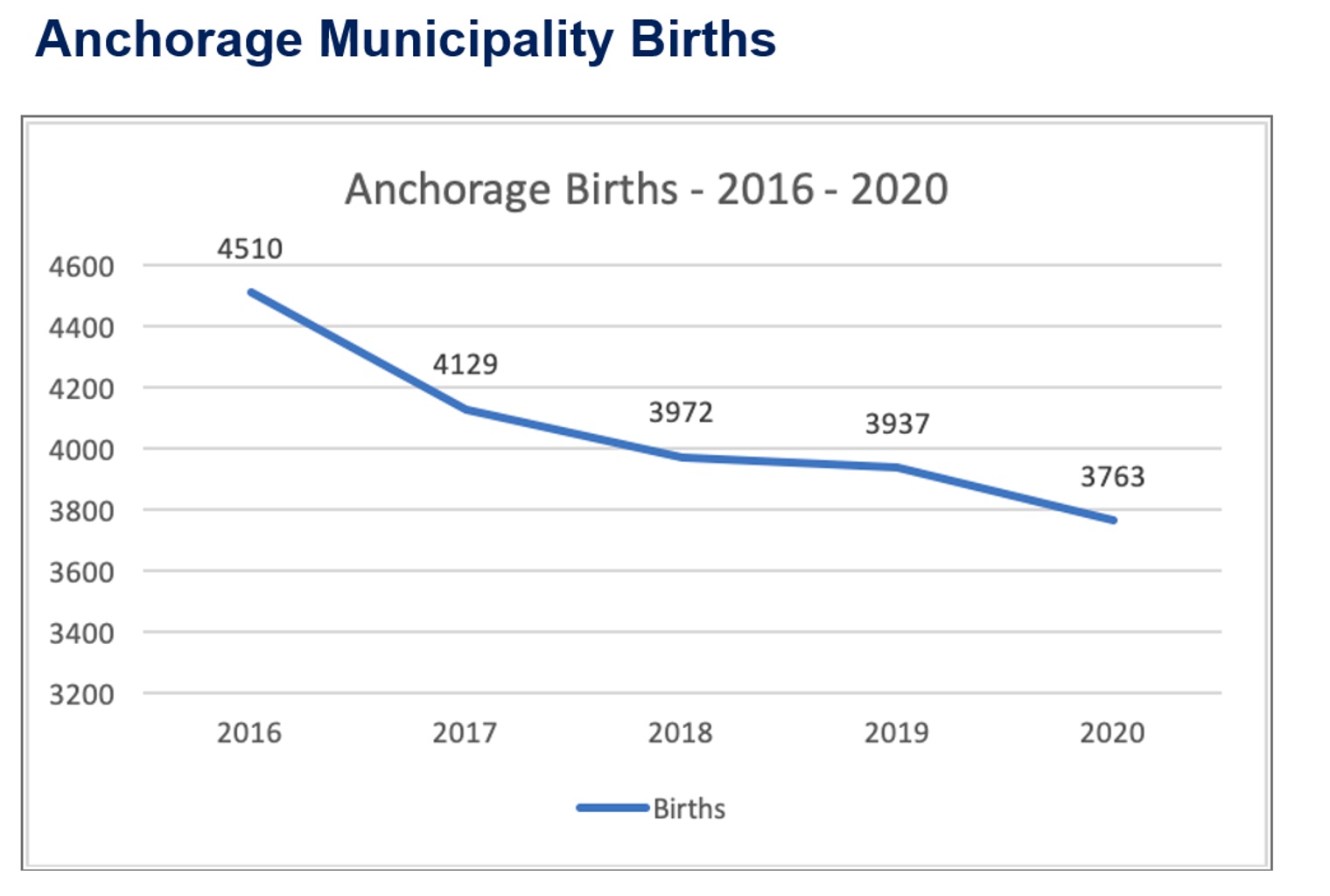
One can see the quandary the district is in. It wants to maintain its current budget, but the declining birth rate means it will have fewer k-12 students and less funding in the future.
The administration’s solution is to grow unproven pre-k programs and ask the Legislature to fund them. The Legislature needs to have accurate data before it makes a decision.
Member Kelly Lessens should be applauded for her pointed questions. The district needs to respond with data, a proof of concept, and a concept of operations.
Otherwise, it may be saving its funding without helping children to achieve their potential. Any decision should be focused on the children, not the institution.
David Boyle is an education writer for Must Read Alaska.
Schools vs. parents: Anchorage public schools secretly affirmed a student’s transgender leanings


