
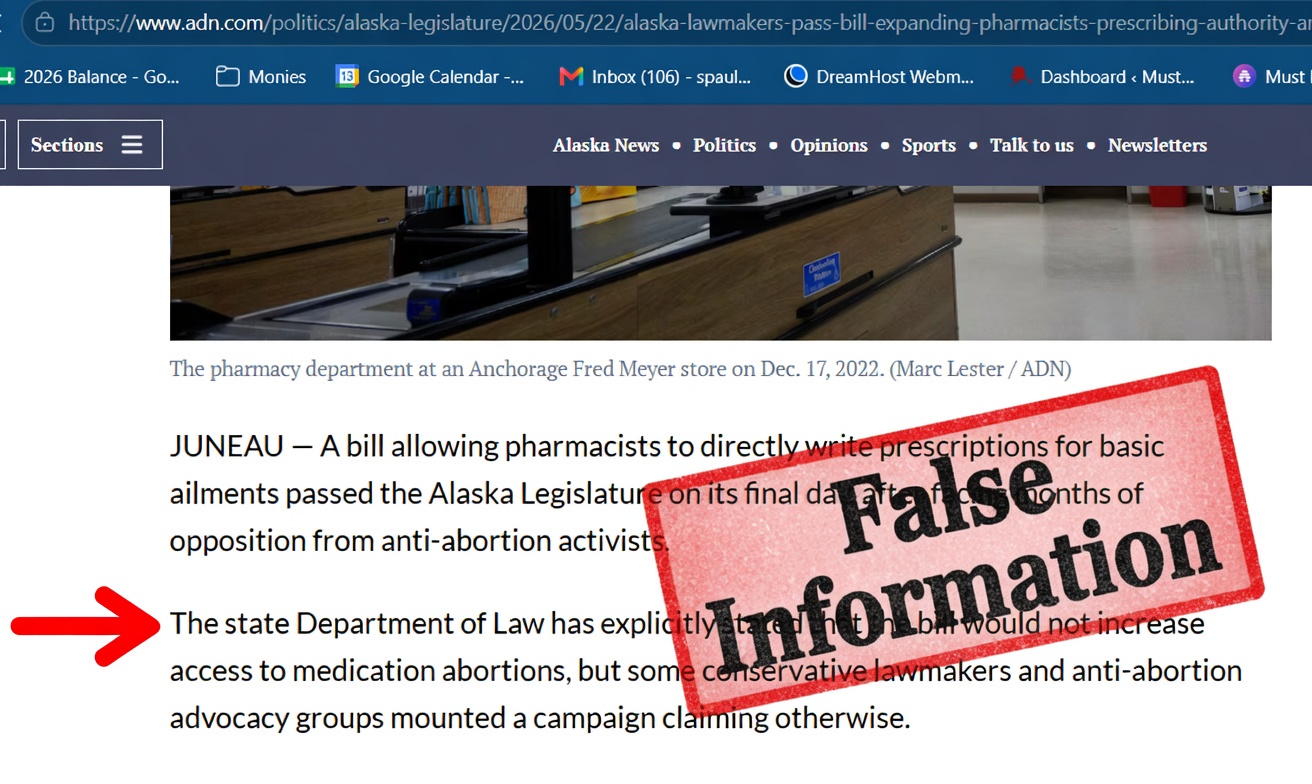
After Governor Dunleavy vetoed 9 bills, the Legislature successful overrode two of those vetoes, one of which was for HB 195. State legislators sold HB 195 as a compassionate bill that allows pharmacists to prescribe common medications without waiting for a physician’s order. Proponents said the bill would increase patient access to basic healthcare, especially during crisis times caused by natural disasters. Pro-life opponents to the bill raised concerns about the bill’s potential to grant pharmacists the ability to prescribe chemical abortion.
According to an article published by the Anchorage Daily News on May 22, 2026: “The state Department of Law has explicitly stated that the bill would not increase access to medication abortions, but some conservative lawmakers and anti-abortion advocacy groups mounted a campaign claiming otherwise.” The article was written by Juneau-based ADN reporter Mari Kanagy.
But that is not what the Department of Law said. Representative Jamie Allard (R-Eagle River) inquired of the Department of Law whether HB 195 grants pharmacists the ability to prescribe chemical abortion. The answer was not an explicit statement assuring the bill “would not increase access to medication abortions.”
What the Department of Law actually said in response to Rep. Allard in a memorandum published April 1, 2026: “HB 195 expands the prescription and administration authority of pharmacists by amending AS 08.80.337 to allow pharmacists to prescribe and administer a drug that is ‘intended to achieve outcomes related to the cure or prevention of a disease, elimination or reduction of patient’s symptoms, or arresting or slowing of a disease process.’ However, before prescribing such a drug, the pharmacist would need to enter a ‘collaborative practice agreement with a written protocol approved by a practitioner who is not a pharmacist….’ If that written protocol included prescribing or administering an abortion drug for one of the reasons described above, then the pharmacist would be permitted to administer a drug that induces an abortion to a patient.”
The Department of Law does recognize a caveat: “One caveat, however, is that all health care professionals must confine the care they provide to their scope of practice.” Then the Department of Law acknowledged that current State law (As 18,16.010) “states that abortions performed in the state must be performed by a physician licensed by the Medical Board.” However, advance practice clinicians (APCs)— who are not licensed physicians— won a superior court case in which the judge ruled that AS 18.16.010 (a)(1) is unconstitutional when limiting a medical professional from acting within their scope of practice (Planned Parenthood v. State of Alaska, et. al., 2024). The court “entered an injunction that prohibits the state ‘from enforcing AS 18.16.010(a)(1) against otherwise qualified APCs whose scope of practice includes medication … abortion.'” The case is currently on appeal to the Alaska Supreme Court, “but the injunction remains in effect.”
According to the Department of Law, “If abortion care falls under the scope of practice of pharmacists and HB 195 gets enacted into law, pharmacists would likely make the same argument APCs made in that case and argue that AS 18.16.010(a)(1) unconstitutionally prohibits them from practicing within their scope of practice.”
So, in summary, HB 195 does not explicitly grant pharmacists the ability to prescribe abortion drugs, but it does give pharmacists a footing to challenge AS 18.16.010(a)(1) in court. Considering the court’s decision regarding APCs, it is possible the court would rule in favor of allowing pharmacists to prescribe abortion drugs. This would increase abortion access in the State of Alaska.
Now that HB 195 is law, can a woman walk into her local Alaska pharmacy and get a chemical abortion? No, but pharmacists may challenge the law that prevents that as unconstitutional under similar reasoning used by APCs.
Can a woman staying in a hospital be prescribed and administered a chemical abortion by a pharmacist? Possibly, if that pharmacist has a collaborative practice agreement with the patient’s doctor that explicitly grants the pharmacist ability to prescribe and administer abortion for the purpose of curing, preventing, arresting, or slowing a disease, or eliminating or reducing symptoms.
The truth is pregnancy is not a disease. Elective abortion does not cure anything. It ends the life of a unique human person. If medical professionals would honor their oath to “do no harm” and adhere to the scientific fact that unborn babies are human persons, not diseases or medical conditions, then HB 195 does not pose a problem. In fact, it could be the compassionate bill legislators claim it is. However, the State of Alaska’s Supreme Court does not recognize the inalienable right to life of babies in the womb. Left-wing medical professionals reject fetal personhood and prioritize the pro-abortionist agenda. Widespread ideological propaganda falsely characterizes abortion as “healthcare” and “reproductive rights.” With those realities in mind, the bill unfortunately does open a door for the expansion of abortion access.
Read the full memorandum from the Department of Law here:


