
William Seward was always controversial. He was not exactly beloved by all who knew him in his day, and even in 2021, he has a few marks against him, with not so many devoted defenders.
Seward became a New York State senator for the newly launched Anti-Masonic Party in 1830. They hated the Freemasons; there were all kinds of conspiracy theories around the secretive group. After the Anti-Mason Party began to fizzle, he joined the Whigs, and was elected governor of New York.
Controversy continued. He worked across party lines, reaching out to Irish-Americans and proposing to fund Catholic schools for them. The new immigrants were keeping their children out of public schools, which were then using the Protestant King James Version of the Bible. Very controversial. His move to create state-paid parochial schools was not universally praised.
He ran for president against Abraham Lincoln and lost, which surprised him. But then he helped Lincoln with his inaugural address, and as soon as Lincoln was sworn in, Seward became Secretary of State.
Seward, a long-time abolitionist, championed emancipation for slaves, and later he engineered the purchase of Alaska from Russia. Once, he sold a seven-acre plot of land to Harriet Tubman, with whom he was friends until he died. Selling land to an ex-slave involved in the Underground Railroad? Quite controversial.
During the plot to assassinate the president, he was laid up in bed, after having been thrown from a carriage. His neck was in a brace, which was the only thing that saved him from certain death when a knife-wielding assassin broke into his home and slashed him repeatedly.
In 1869, Seward began an epic voyage to Alaska, beginning with a railroad trip across the country on the new transcontinental railroad. He boarded a ship in San Francisco, the Active, and sailed to Sitka. Alaska had only been in U.S. hands for two years when Seward visited as one of the first tourists.
Times are different now. White men are being redefined as universally evil. A statue was commissioned of William Seward by the Seward Statue Committee to mark Alaska’s sesquicentennial. Today stand in front of the Alaska Capitol in Juneau, with cheek scars and all, only to be critiqued by the far left because Seward is … controversial.
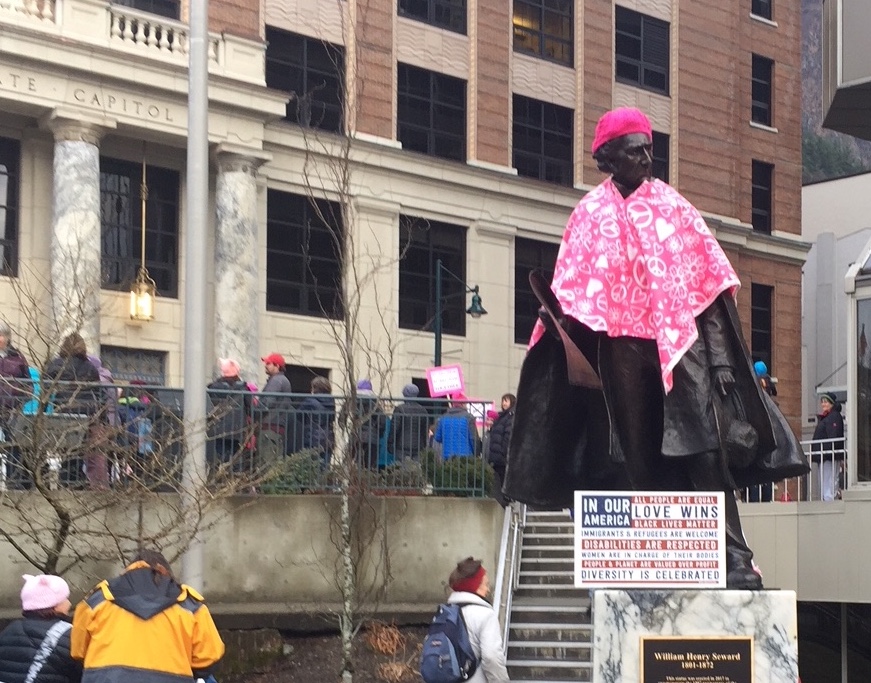
By 2020, hardline Democrats wanted the statue gone, and an online petition was started to demand the removal of the bronze depiction of the man who petitioners call a “colonizer who contributed to the disenfranchisement of Alaska Native peoples.” Once again, Seward was controversial, but this time not because he was anti-slavery, but because he was a colonist.
In their words, “In this current climate, where other monuments depicting racists and representatives of slavery are being taken down across the country, Juneau should honor our Indigenous hosts whose land we stand upon and remove William H. Seward from the capital courtyard,” said the petition, signed by 1,942 people with a limited view of history and time itself.
Another petition quickly was launched, this one to save the statue, which challenged “the action of a small group of citizens wanting to dismantle all things that ultimately honors the peoples history … If this small group of individuals get their wish of the removal of this statue then it is going to do nothing to change our history and will only cost the people more money … The removal of the statue will only serve to increase the tension of the people on both sides of this issue.”
Although the petition to keep the statue in place was signed by 1,386 people, both petitions lost momentum during the tumultuous months that followed, when statutes were toppled and vandalized, as cities were looted and burned. The election of Joe Biden seems to have, ironically, tamped down the fury unleashed against white founders of the nation, at least for now.
Seward’s life is uniquely celebrated as a state holiday in Alaska on Monday, which means state services are shuttered for the day and state workers can get outside and enjoy the land that Seward purchased from people who, frankly, didn’t really own it, but who had an organized system of government that allowed them to at least transfer titles.
One of the many ironies is that slavery continued in the District of Alaska after the Civil War and the freeing of southern slaves. Alaska Native tribes raided and took slaves from neighboring tribes.
On Seward’s trip to Southeast Alaska, he very well may have witnessed slavery, but not had the cultural competency to recognize it.
Although slavery ended with the 13th Amendment on Dec. 18, 1865, when Alaska was purchased, little was known about the ubiquitous human trafficking that continued in far-off Alaska for decades to come.

