
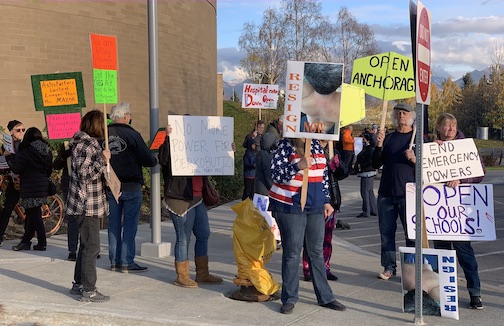
A judge on Friday heard arguments for and against a preliminary injunction to stop the Anchorage Assembly from pursing actions taken during a several-week span when it closed its meetings to the public this summer.
Superior Court Judge Una Sonia Gandbhir heard from Alaskans for Open Meetings attorney Michael Corey, who argued that the Assembly, by shutting out members of the public, had broken the Alaska Open Meetings Act.
From Ruth Botstein, the municipal attorney defending the Assembly, the court heard a “we’re too big to fail” argument — that the actions taken during the violation of the Open Meetings Act were so consequential, so monumental that they simply cannot be undone.
In late July, the Assembly forbade the public from entering the Loussac Library’s Assembly Chambers. The barricading of the Assembly came after former Mayor Ethan Berkowitz used his emergency powers and placed a ban on public gatherings.
For all of August the public was prohibited from observing the Assembly, Planning Commission, or other quasi-judicial meetings. The only way taxpayers could participate was by watching the meetings through a grainy, government-controlled camera, and by calling in their testimony via telephone — if they could get through.
The Assembly conducted some extraordinary business during those closed meetings: It decided on expenditures for $156 million in CARES Act funds, including the purchase of four buildings for homeless and vagrant services. It passed an ordinance prohibiting the counseling of gay teens in a practice loosely referred to as “conversion therapy.” And it approved the hiring of a new municipal employee called an “equity officer,” to address systemic racism in the city, at the cost of over $120,000 a year.
[Read: Mayor seeks to hire equity officer]
During meetings leading up to meeting closure and the final decisions on how to spend CARES Act funds, the Assembly Chair Felix Rivera spoke on the record that the funds would have to remedy racial equity, or he would not vote for them.
The State of Alaska’s Open Meetings Act (AS 44.62. 310-. 312) requires that all meetings of a public entity’s governing body be open to the public. The act also says the meetings may be attended by the public via teleconferencing, but the attorney for Alaskans for Open Meetings said that teleconferencing was never meant to be a substitute for attendance in person.
The fact that the Assembly members themselves were inside the chambers during those meetings was proof that it was possible to have in-person meetings, said Frank McQueary, a member of the group that is suing the Assembly.
“They had meetings. They even brought in people who they wanted to hear from. They excluded the rest of the public and created their own echo chamber,” McQueary said.
Botstein argued that the open meetings group had taken too long to file their lawsuit and that there’s too much to undo now.
“That argument is yet another barrier to participation,” McQueary said. ” The public is crippled on the best day of the year because it’s at such a disadvantage financially and in terms of time, while the city has its lawyers lined up and ready to go.”
McQueary said that the public assumes the governing body of the Assembly has its best interests at heart, and simply isn’t ready at any given moment to finance a lawsuit against lawmakers.
His group, whose members include former Lt. Gov. Craig Campbell, had to raise money and hire a legal team — all during a time when indoor gatherings were made illegal or impractical due to the COVID-19 pandemic. The Alaskans for Open Meetings group itself has had to cancel some of its meetings due to lockdowns by the current acting mayor.
“This ‘Too big to fail’ argument is the Assembly admitting that what they have done is wrong, but is too costly to unravel. If that is given too much weight by the court, then it eviscerates any remedy in the Open Meetings statute,” McQueary said.
During the hearing, Corey explained to the court that the Municipality was trying to give the court all the reasons why it was OK for the Assembly to break the law.
It’s like telling a police officer all the reasons why was OK to drive 80 miles per hour in a school zone — the roads were dry, the car was in good shape, and there wasn’t anyone around.
Corey said it is not the intent of the law to say people can follow the law only when they decide it’s appropriate for them personally.
Judge Gandbhir didn’t give a sense on when she might rule on the matter. A ruling from her either way will almost certainly be appealed to the Alaska Supreme Court by whichever side loses the argument.
The open meetings group wants Judge Gandbhir to at least stop the purchase of the buildings, which are controversial uses of CARES Act funds, until the matter of the Open Meetings group works its way through the court appeals.
The public’s involvement is critical, the group said on Saturday.
“We think ongoing public activity on this issue is very important,” said Craig Campbell, who once served on the Assembly. “I would ask people to get involved. Attending Assembly meetings is one way to show that we want the meetings open.”
Campbell then pointed out the hypocrisy of closing the meetings in August, when the coronavirus was not yet that widespread.
Today, the Assembly chamber is open again for limited public participation, and yet the incidence of positive COVID cases has never been higher in Alaska. That reopening of the Assembly meetings only came about because of intense public pressure, including weekly and often noisy demonstrations outside the Loussac Library, where the meetings are held.


