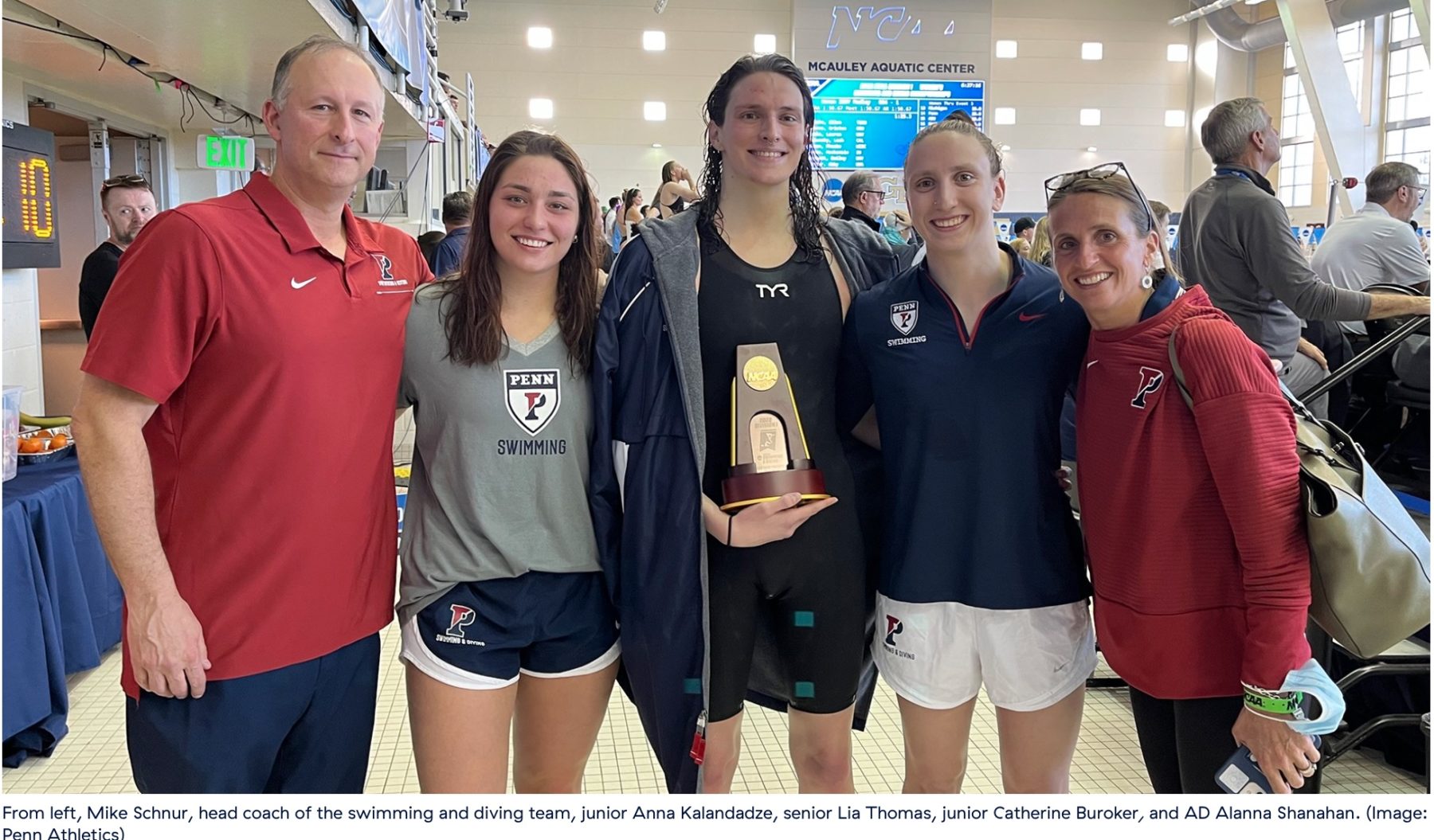
The University of Pennsylvania has doubled down on men dominating women’s sports by allowing a biological male, who swam in the men’s division prior to this season, to represent the school as its woman nominee for the NCAA Woman of the Year award.
Schools may nominate up to two female athletes, and there are 577 nominees from eligible schools this year.
Lia Thomas competed with UPenn’s men’s team and was a middle-ranked swimmer, but now has set records for the women’s team, and dominated in the Ivy League and NCAA championships.
Thomas’ switch to the women’s division drew intense national criticism, and 16 of Thomas’ teammates wrote an anonymous letter to UPenn and to the Ivy League, asking the institutions to defend women’s right to compete on a level field, without transgenders like Thomas taking their trophies.
“Biologically, Lia holds an unfair advantage over competition in the women’s category, as evidenced by her rankings that have bounced from #462 as a male to #1 as a female,” the women wrote. Their pleas fell on deaf ears.

The Woman of the Year award is an honor given to “female student-athletes who have exhausted their eligibility and distinguished themselves in their community, in athletics and in academics throughout their college careers.”
Earlier this year, the 22-year-old Thomas told Sports Illustrated that “I just want to show trans kids and younger trans athletes that they’re not alone. They don’t have to choose between who they are and the sport they love. I don’t know exactly what the future of my swimming will look like after this year, but I would love to continue doing it. I want to swim and compete as who I am.”
The international federation that governs the elite swimming competitions has since made a rule that says transgenders may compete as women only if they begin taking puberty blockers before puberty begins. Thomas began transitioning to present as a woman just two years ago, after having competed for years as a male. UPenn is clearly going a different direction, and making waves by doubling down in its war on women athletes.