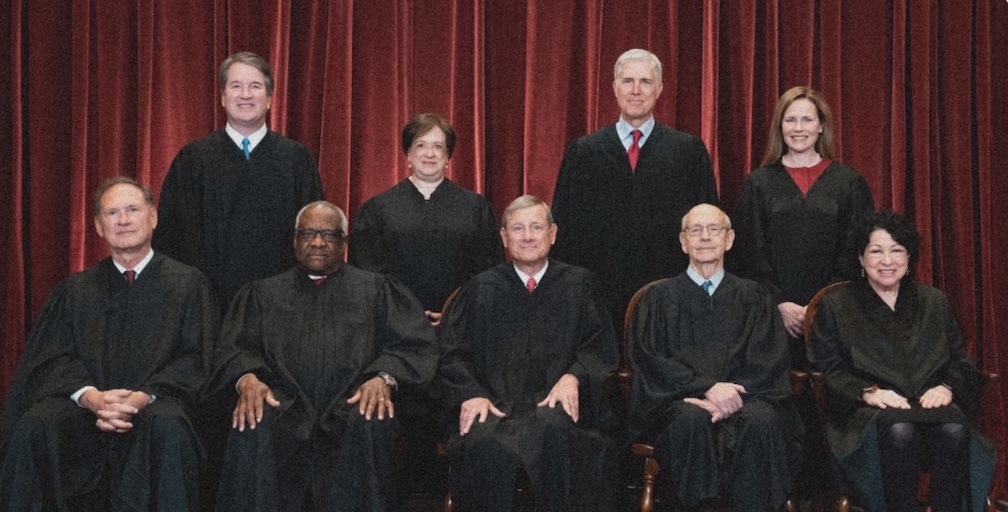
The U.S. Supreme Court ruled on Wednesday that the State of Oklahoma can prosecute crimes committed by non-Indians on tribally owned land.
“We conclude that the Federal Government and the State have concurrent jurisdiction to prosecute crimes committed by non-Indians against Indians in Indian country,” wrote Justice Brett Kavanaugh. Three other conservative members of the court joined him in the decision: Chief Justice John Roberts, and Justices Clarence Thomas, Samuel Alito, and Amy Coney Barrett.
Justice Neil Gorsuch, usually considered conservative, joined the three liberal justices in a dissent; the ruling was 5-4.
The case involves a non-tribal man who was tried and convicted by the state of Oklahoma on charges of child neglect of his stepdaughter, who is part Cherokee and living on reservation land. The man challenged the conviction, saying only the federal government can bring charges against him, not the State of Oklahoma, because the crime occurred on tribal land.
This Supreme Court ruling sides with the State of Oklahoma, and carves out exceptions for tribal sovereignty from a 2020 decision, McGirt v. Oklahoma.
The ruling in McGirt said that eastern Oklahoma is “Indian Country,” where state and local authorities have no ability to prosecute for crimes committed on Indian Country land.
That decision said only the federal government and tribes can prosecute Indians country crimes. The decision in McGirt was based on the Trade and Intercourse Act of 1790, in which Congress federalized all aspects of Indian affairs.
Another previous case, Worcester v. Georgia, also said in 1832 that states have no ability to enact laws in Indian Country without permission of Congress.
In Wednesday’s ruling, the court reversed the presumption against a state’s law enforcement jurisdiction. Without Congress taking further action to expand tribal sovereignty, states can now prosecute non-tribal members for all crimes committed in Indian country.