
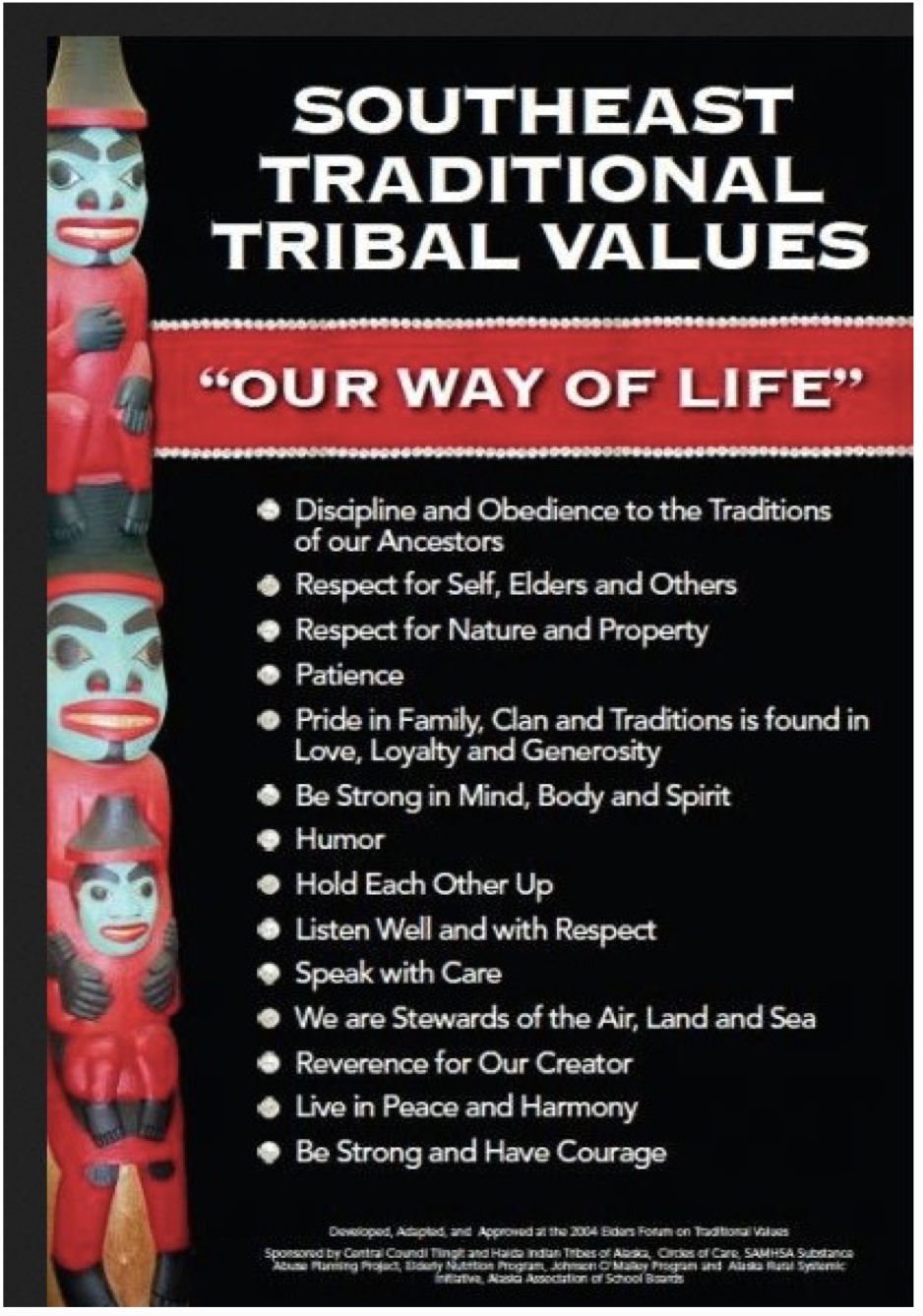
Think of them as a tribal form of Ten Commandments being used to give out good-behavior rewards in a public school. Is it appropriate?
This week, a trial got underway in a civil suit against the Ketchikan School District and Ketchikan Charter School, relating to posters on the walls of schools that were titled “Southeast Traditional Tribal Values” that plaintiffs say has religious content, and that students are rewarded for following those values.
The phrase that is being litigated is among 14 traditional values listed, including pride in family and clan, and being stewards of the air, land, and sea. The item in question is “Reverence for Our Creator.” At Ketchikan Charter School, the school was using a tribal value of the week or month, and students were encouraged to follow all of the tribal values as these are the values that would make a good student. The school never actually used that specific value to reward students, because that value had become controversial.
Pushing “Reverence for Our Creator” on students through rewards is a violation of the U.S. Constitution and Alaska Constitution, parents Justin Breese and Rebecca King say, since the charter school is giving out behavioral rewards based on following this value.
Six witnesses testified on day one of the trial, including King and the principal of the charter school. The courtroom was packed and the phone lines to listen in on the proceedings were jammed.
The school district argued that the posters simply promote cultural understanding and that Breese and King should have first reached out to tribal members.
Breese and King did reach out to the district one year ago in April about their concerns. In the district’s response to them in May of 2022, the school’s business manager wrote:
“There is no Southeast Alaska tribal religion, nor specific religious belief in Creationism amongst the Southeast tribes. Therefore, none of the Southeast Traditional Tribal Values are religious statements or tenets. It follows, then, that no intent exists, whether historically or contemporaneously, for the values to be used in a manner other than as cultural knowledge sharing. This has been confirmed by Southeast Alaska tribal leaders, and local and regional cultural experts, elders, and culture bearers.”
The district went on to say, “The posters on display in KGBSD schools identify the listed values as Southeast Traditional Tribal Values developed, adapted, and approved at the 2004 Elders Forum on Traditional Values.”
Read the district’s letter at this link.
Breese, commenting on the negotiated development of the traditional values document said, “They were determining the common themes of different tribes — Tsimshian, Haida, Tlingit, and one other. We have never complained about use of the tribal values poster to teach about tribal beliefs and culture. Our complaint was entirely about how school district using it.”
In other words, it would be one thing in a public school to teach the 10 Commandments, but it’s another thing, and acceptable to teach about the 10 Commandments.
“It’s a fine line,” Breese said. “We’re not against teaching about tribal values.”
Those listed values were not, however, handed down to Moses on tablets thousands of years ago, but were negotiated at a conference two decades ago. They evidently reflect spiritual beliefs of various tribes in Southeast Alaska.
Tlingit Haida Central Council credits Raven as the Creator: “The Haida legend of ‘The Raven and the First People’ expresses how Raven discovered mankind and is responsible for the present order of our universe. Likewise, the Tlingit legend of ‘Raven and the Creation Story’ tells us how the Raven created the world,” the council writes on its website.
The poster itself has sponsorships listed at the bottom that include state and federal government education agencies, “indicating appropriateness for use in public schools,” the district wrote to Breese and King last year. Those agencies include:
- Central Council Tlingit and Haida Indian Tribes of Alaska
- Circles of Care SAMHSA Substance Abuse Planning Project
- Elderly Nutrition Program
- Johnson O’Malley Program
- Alaska Rural Systemic Initiative
- Alaska Association of School Boards
The Ketchikan trial, which has constitutional implications, took two days, ending Wednesday. The lawsuit can be read at this link:


