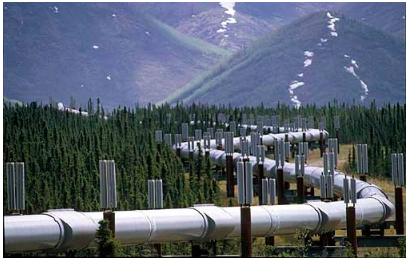
It’s a bit of a moonshot for the environmental litigation industry, but they’re giving it their all: Several environmental groups filed a petition Wednesday with the Department of Interior, demanding an analysis of the harm that the Trans-Alaska Pipeline System does to the climate, and calling for the department to not grant a right-of-way extension in 2034 and begin phasing out TAPS.
TAPS transports about 480,000 barrels of crude oil every day from Alaska’s North Slope to Valdez, where it is shipped to refineries. It has the capacity for 2 million barrels per day, but has not seen levels exceeding 1.8 million since the heyday of Alaska’s oil boom. Alaska, once a major oil producer, has dropped to fifth place and now produces less than 4% of the nation’s oil.

Because Alaska is now a minor oil producing province, it’s an easier target for environmental lawsuits than, say, Texas or New Mexico.

The Center for Biological Diversity, Pacific Environment, Sovereign Iñupiat for a Living Arctic, Alaska Community Action on Toxics, Fairbanks Climate Action Coalition, and Public Employees for Environmental Responsibility submitted the petition, saying that the international scientific consensus is that there must be a rapid transition away from fossil fuels.
The environmentalists also claim the pipeline harms “caribou, polar bears and other vulnerable wildlife and subsistence resources in Alaska.”
“We can’t wait 10 more years for federal officials to wake up to the daily climate devastation Alaska’s oil pipeline enables,” said Cooper Freeman, Alaska director at the Center for Biological Diversity. “Not only are they ignoring current threats, but fossil fuel extraction is actually expected to grow on the North Slope in the coming years. To ward off climate devastation here in Alaska and globally, we have to move quickly to plan for the end of this pipeline. The sooner we confront reality and put all our energy toward a rapid and just transition away from oil, the better.”
The group claims that massive new drilling projects on federal and state lands on Alaska’s North Slope, including the Willow and Pikka projects, could dramatically increase the oil transiting the pipeline in the coming years, although even the Willow and Pike projects are only projected to stem the decline of what is being squeezed out of other aging fields.
Rick Whitbeck, Alaska director for Power the Future, responded, “The absurdity of this petition is unbelievable. Just where do the groups think the thousands of items they touch weekly come from? Petroleum, in all of its processed forms. Would they rather wear their Patagonia and Salmon Sister boots made from Chinese or Russian oil, or from the U.S.? How do they plan to announce their next Church of Climate Change revival without phones, computers, Internet service and message boards only made possible because of the labors of hundreds of thousands of American oil and gas workers.”
Whitbeck continued, “To demand an end to TAPS is to gut Alaska’s economic engine, and it ignores a simple truth: the North Slope is seeing a renaissance because the world needs more oil, not less. There is no climate crisis, nor is there a reason to turn our daily lives upside down because the doom-and-gloom wailing of a lunatic fringe says so.”
The Bureau of Land Management projects that Willow will deliver up to $17 billion in new revenue for the federal government, State of Alaska, and Alaska Native communities. When completed, Willow is estimated to produce approximately 600 million barrels across the 30-year lifetime of the project, which will lower American dependence on foreign energy supplies. The project is supported by the majority of Alaskans and is designed to support and coexist with subsistence activities on Alaska’s North Slope. The Willow Project survived five years of regulatory, environmental, and environmental litigation. It will create 2,500 construction jobs and about 300 long-term jobs.
“Enhancements in oil recovery techniques that are unlocking huge ‘heavy’ oil deposits in existing fields could also contribute to even more oil in the pipeline,” the group breathlessly claims.
“To build a healthy economy that doesn’t further warm the planet, Alaska must transition beyond fossil fuels,” said Kay Brown, Arctic policy director at Pacific Environment and former executive director of the Alaska Democratic Party, where she is a member of the party’s “Climate Caucus.”
Brown warned, “Alaska is warming faster than any other state and nearly four times faster than the global average. As the Trans-Alaska Pipeline System approaches the end of its life, climate change is impacting Alaska and the Arctic region significantly. It’s time for the Department of the Interior to review this nearly 50-year-old aging infrastructure and put a plan in place to decommission it. Alaska can have a thriving economy based on its abundant renewable energy as the world transitions away from fossil fuels.”
The nearly 50-year-old pipeline is also increasingly threatened by climate change-driven environmental shifts and events, such as thawing permafrost and major floods. The pipeline was originally projected to have a life expectancy of 30 years, and the risk of oil spills grows annually, the groups warn.
Pamela Miller of the Alaska Community Action on Toxics says to allow the pipeline to remain operational is “foolhardy” and “sadly ironic” that the pipeline is in “peril” because of climate change.
“It’s foolhardy for the Department of the Interior to ignore the hazards associated with further dependence on fossil fuels and aging infrastructure of the TAPS given the climate crisis that we are facing,” said Miller. “It is sadly ironic that the pipeline is in peril largely because of climate warming and lack of planning for this consequence. We call on Interior for a visionary approach to stopping harmful oil development and to make it possible for a quick transition to clean, renewable energy. BLM must implement a plan to safely decommission the pipeline.”
The coalition points out that the right of way granted by the Bureau of Land Management in 1974 was renewed in 2004 and is set to expire in 2034. They are gearing up now to ensure that it doesn’t get renewed in 10 years.
“Alaskans are on the frontlines of climate tipping points,” said Tara Starlight, communications manager at Fairbanks Climate Action Coalition. “We must act urgently to ensure that Alaskans do not also bear the brunt of inevitable and enormous costs for Dismantlement, Removal, and Restoration (DR&R) of the Trans-Alaska Pipeline when the time comes due. If we seize the opportunity to plan ahead and include impacted communities early, we can build a future that ensures the health of people and our ecosystems.”
Today’s petition argues that “an abundance of new information, including new science about the climate crisis, the risk of oil spills, and harms to people and wildlife from fossil fuel development shows that the existing analysis is woefully outdated.”
What it ignores is that dismantling Alaska’s pipeline would destroy the state’s economy and turn it into another Appalachia, with a few pockets of isolated residents who would languish in poverty, while the environmental nonprofit groups thrive in their cities of the Lower 48.
The petition asks Interior to “immediately initiate and complete a supplemental environmental impact statement, include meaningful alternatives and mitigation measures, and draft a plan for the decommissioning, removal and restoration of the pipeline.”