
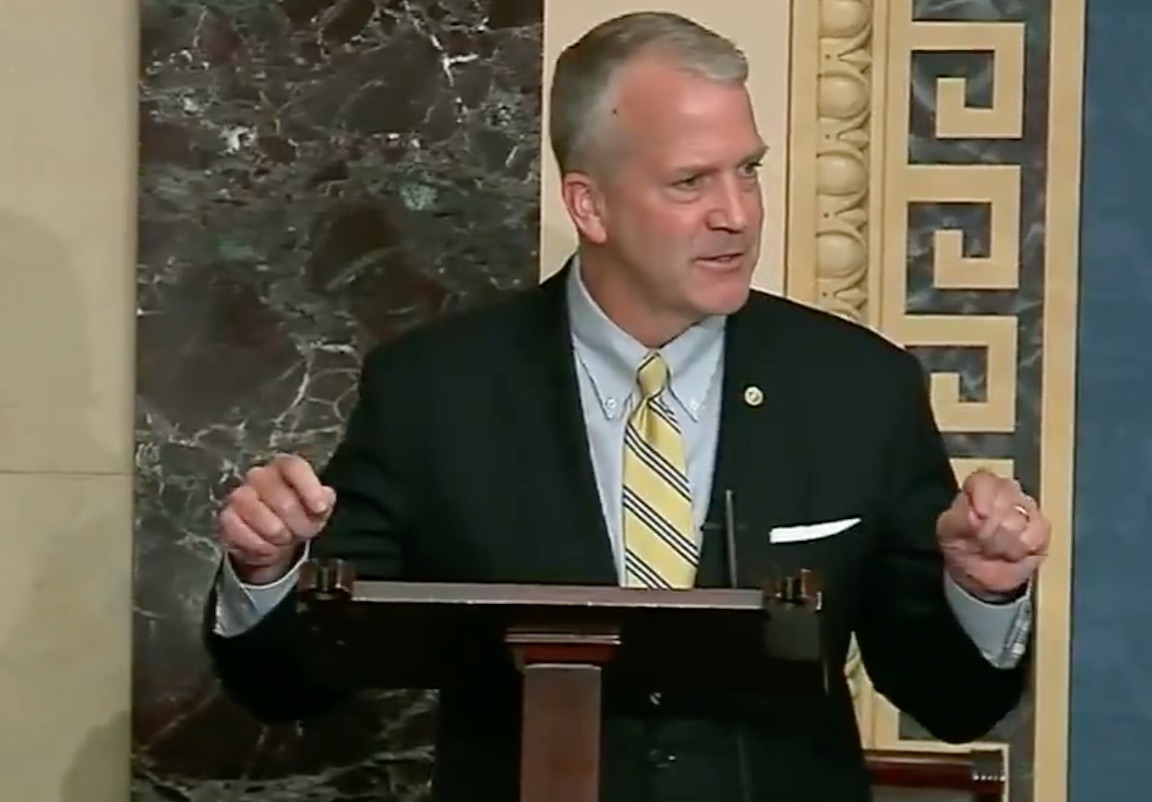
Sen. Dan Sullivan joined 43 other Republican senators on Thursday in signing a letter to U.S. Attorney General Merrick Garland, asking for an update on Special Counsel John Durham’s report on an FBI investigation into a wide variety of claims about Russian collusion in the 2016 presidential election.
Durham was tasked two years ago to review the origins of the Robert Mueller investigation, which focused on President Donald Trump and his supposed ties to Russia. Durham was appointed special counsel in October 2020 to continue his work with greater independence.
Mueller’s investigation into Russian interference in the 2016 election ended in 2019, after finding no evidence that Trump’s campaign colluded with Russia. That’s when Trump appointed Durham to dig into how the “Russia collusion claims,” got started; they have since been strongly linked to the Hillary Clinton campaign.
“The Special Counsel’s ongoing work is important to many Americans who were disturbed that government agents subverted lawful process to conduct inappropriate surveillance for political purposes. The truth pursued by this investigation is necessary to ensure transparency in our intelligence agencies and restore faith in our civil liberties. Thus, it is essential that the Special Counsel’s ongoing review should be allowed to continue unimpeded and without undue limitations,” the senators’ letter stated. “To that end, we ask that you provide an update on the status of Special Counsel Durham’s inquiry and that the investigation’s report be made available to the public upon completion.”
A report in The Wall Street Journal said Durham has uncovered evidence against FBI agents and possibly others who used false information or tips at the start of the Russia investigation in 2016 and has been presenting evidence to a grand jury.
“Those ‘others’ could include a virtual who’s who of Washington politics, and even if they are not indicted, Durham could implicate some of the most powerful figures in politics in his final report,” wrote Jonathan Turley, professor of public interest law at George Washington University.
“Even for those of us who followed and wrote on the Russia investigation for five years, much has been revealed in the last year,” Turley wrote in The Hill last week.
“It was disclosed in October, for instance, that President Obama was briefed by his CIA director, John Brennan, on July 28, 2016, on intelligence suggesting that Hillary Clinton planned to tie then-candidate Donald Trump to Russia as ‘a means of distracting the public from her use of a private email server.’ The date was significant because the Russia investigation was initiated July 31, 2016, just three days later,” Turley wrote.
“Throughout the campaign, the Clinton campaign denied any involvement in the creation of the so-called Steele dossier’s allegations of Trump-Russia connections. However, weeks after the election, journalists discovered that the Clinton campaign hid payments for the dossier made to a research firm, Fusion GPS, as ‘legal fees’ among the $5.6 million paid to the campaign’s law firm. New York Times reporter Ken Vogel said at the time that Clinton lawyer Marc Elias, with the law firm of Perkins Coie, denied involvement in the anti-Trump dossier. When Vogel tried to report the story, he said, Elias ‘pushed back vigorously, saying ‘You (or your sources) are wrong.’”
According to The Washington Post, however, Hillary Clinton’s campaign and the Democratic National Committee funded research that resulted in the very dossier filled with allegations about President Trump’s connections to Russia and alleged coordination between his campaign and the Kremlin.
Clinton campaign lawyer Marc Elias and the DNC, retained Fusion GPS, a notorious Washington opposition research firm, to conduct the research.
Read the 2017 interview with Marc Elias
Fusion GPS hired former British intelligence officer Christopher Steele, who was well known to the intelligence community, to complete the damning dossier.
Later, Clinton’s campaign chairman John Podesta was grilled by Congress over the campaign’s contractual agreement with Fusion GPS. He denied having any knowledge of it, as Clinton’s campaign attorney Elias sat by his side to ensure he did not go off-message.
Steele was part of the campaign to sway the media, shopping the dossier to any reporter who would use it before the election.
Turley also reported about meetings between Steele and members of the Justice Department, including senior Justice official Bruce Ohr, whose wife Nellie Ohr worked for Fusion GPS as a researcher attempting to connect Trump to Russia.
The liberal Brookings Institution was also involved, Turley said, with Igor Danchenko, an analyst from the Washington think tank, being used as a source for Russian disinformation.
Then there’s the Alpha Bank conspiracy theory.
“Durham also is reportedly looking into information concerning Alfa Bank, a privately owned commercial bank in Russia. That information led to possible access to the Trump campaign server. The Alfa Bank controversy is likely to make a number of powerful people particularly uneasy. Clinton campaign-linked figures such as Fusion GPS co-founder Glenn Simpson allegedly pushed the debunked claim that the Trump campaign had a server linked directly to the bank, which in turn was linked to Vladimir Putin and his cronies. The Alfa Bank conspiracy reportedly was pitched to the Justice Department, including in contacts with Bruce Ohr,” Turley wrote.
The Washington establishment, which has a legacy of protecting powerful Democrats, wants the Durham report buried.
Thus, the letter from 44 members of the U.S. Senate asking for an update and reminding Durham that they have not stopped following the matter, is timed for a reason: It was sent as word spreads that the investigation may be coming to a close.


