
By TIM BARTO
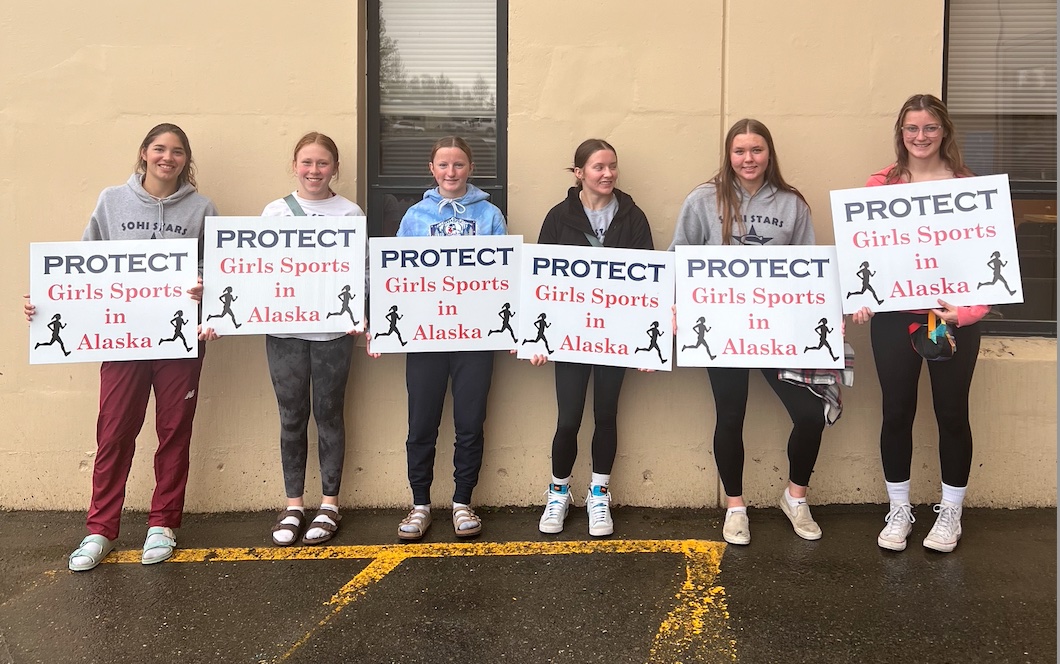
Alaska took a big step towards becoming the 23rd state to protect girls’ sports for girls when the State Board of Education voted overwhelmingly to approve a resolution to keep biological males from competing with and against biological females.
The following board members voted in favor of the action to support female athletes:
- James Fields, Board Chair
- Lorri Van Diest, First Vice Chair
- Jeffrey Erickson
- Bob Griffin
- Sally Stockhausen
- Barbara Tyndall
- Pamela Dupras
The board’s military advisor, Air Force Lt. Col. James Fowley, abstained; while the lone no vote went to student advisor Felix Myers.
Also in attendance were five non-voting participants, including Commissioner of the Alaska Department of Education & Early Development Dr. Deena Bishop, Deputy Commissioner Heidi Teshner, Assistant State Attorney General Susan Sonneborn, Alaska School Activities Association Executive Director Billy Strickland, and board Executive Secretary Janell Andrews.
This was a special meeting, conducted virtually, and called for the sole purpose of discussing and voting on the resolution. It lasted almost exactly one-and-one-half hours, and accomplished exactly what was needed to protect girls’ sports from the intrusion of boys who identify as girls, as well as those who seek to deconstruct Title IX and use the public education system to further their radical views on human sexuality.

Most of the comments were in favor of the resolution to protect girls’ sports.
Lorri Van Diest argued for common sense in acknowledging that male athletes have physical and physiological advantages over female athletes, and she provided examples from around the country where biological males took away hard-earned victories away from female athletes and teams. Additionally, Van Diest provided an example in which a biological male volleyball player spiked a ball into the head of an opposing player (a true female), causing long-term injury.
Billy Strickland forwarded the idea that school sports would continue to be organized in their present state: there will be a sport and there will be a girls’ sport. Transgender athletes will be encouraged to participate, but will need to do so in the main sport – not the girls’ sport.
Similarly, a biological girl who wants to play a traditionally male sport such as football but who would rather play tackle football instead of on the girls’ flag football team, can opt to try out for the tackle football team. So, essentially, there will be an open sports category (the traditional male teams) open to everyone, and the female teams that will be limited to true females.
A few of the members acknowledged the overwhelming input provided by Alaskans during the 30-day open comment session, noting that there were arguments made on both sides of the issue. Cited statistics revealed an overwhelming majority of Americans support keeping girls’ sports for girls only, and it was noted that Alaska Family Council provided over 2,000 signatures on its statewide petition to save girls’ sports.
The lone voice of dissent was Felix Myers who, despite acknowledging that there are, in fact, differences between males and females, still called for a no vote on the resolution. Time and money, he argued, would be better spent on helping female athletes with eating disorders and providing more funding for girls’ sports (which would, of course, include biological males who identify as females).
Almost immediately after the vote, Anchorage School Board president Margo Bellamy, and Anchorage School Superintendent Jharrett Bryantt, issued a joint statement, praising student member Myers and questioning why the board was prioritizing the issue. Bellamy and Bryantt do not see this as an urgent matter. The board members, with the exception of Myers, disagreed.
The speed at which transgender issues are developing, and disrupting the entirety of human existence, is alarming, and the topic of female-identifying males competing against true females is not going away.
It is just a matter of time before the issue becomes a major issue in Alaska, as it has throughout the United States. The Alaska Board of Education found that it was time to draw the line, and did so without further delay.
Tim Barto is Vice President of Alaska Family Council.



