

By DAVID BOYLE
Anchorage School District leaders presented an update on reading proficiency in grades K-2. The results are disappointing and unsettling. In summary, reading proficiency from the fall to winter of 2021 dropped in every demographic.
This is not good news for parents, students and Anchorage School District staff. Most of the board members were silent when this information was presented on Jan. 18. Anchorage Board Member Dave Donley asked about a 2019 report regarding the correlation between the new curriculum and reading progress. The district had no relevant response.
Most schools in Anchorage underperformed. Here is a summary of the K-2 students at or above grade level showing the decrease in achievement from fall to winter:
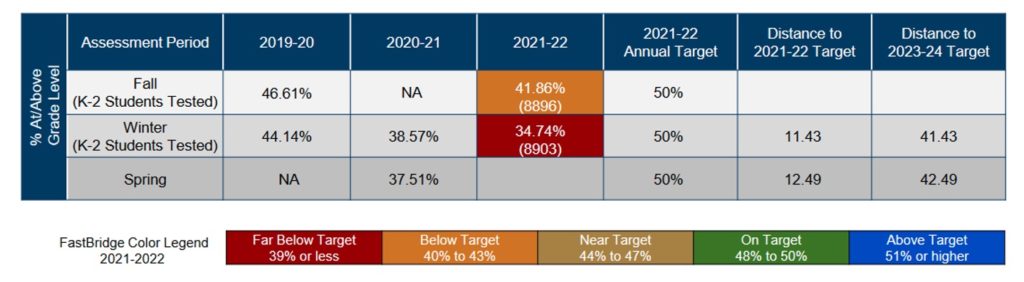
The scores for all the K-2 grades decreased from nearly 42% above the benchmark to about 35% above the benchmark from fall to winter, a dramatic fall of about 20% of all K-2 students from the benchmark.

Clearly, something is broken.
Only the white/non-Hispanic and the lottery schools (charter and alternative) performed above targeted goal. Here is the chart broken down by every demographic:
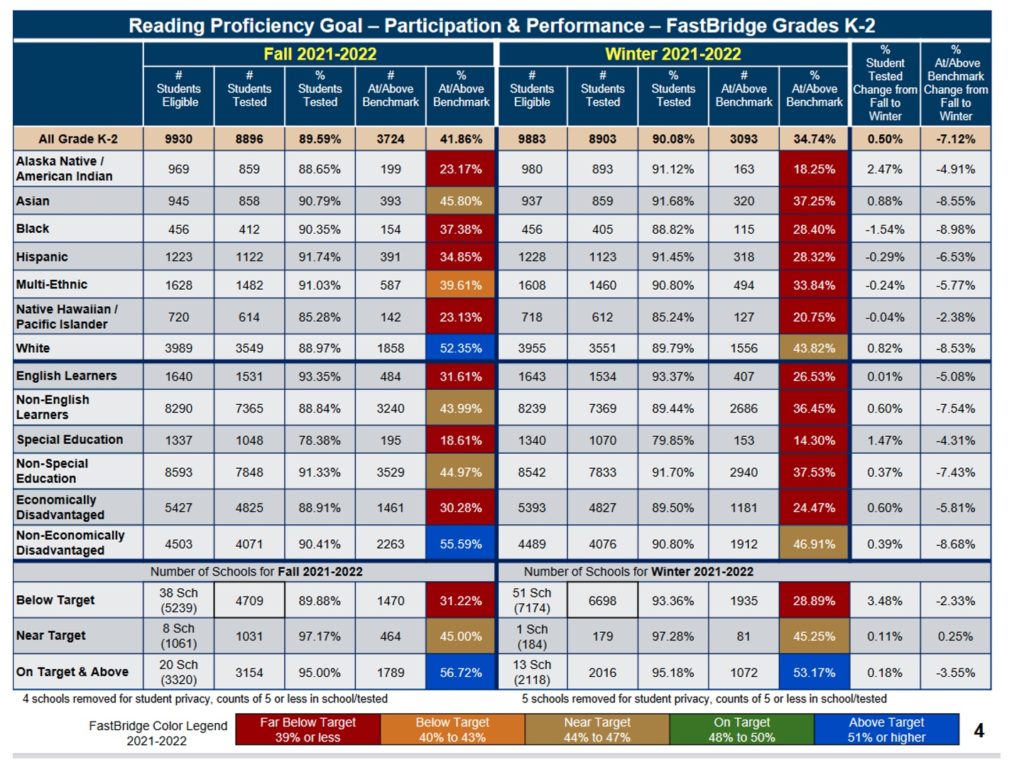
Note that even the white and wealthy children dropped in achievement from fall to winter.
Anchorage and Alaska has provided adequate funding, according to Superintendent Deena Bishop, yet our children are failing in reading. It’s important to note that children were back in the classroom when these data were collected.
Is the curriculum not working? Are the teachers ineffective in teaching reading to K-2? Are the face masks impeding the learning process?
Superintendent Bishop stated that the lottery schools did well because they are probably upper socio-economic class. Lottery schools are attractive to parents who want to send their children to a school not within their designated area. They are hard to get into and the applications must be made annually and are not guaranteed year to year.
Bishop said, “It isn’t that our kids haven’t learned the longer they are with us. It’s that they’re trying to catch up but the goalposts keep moving for them. It doesn’t mean there is not growth, it’s just not the expected growth.”
The chart above would seem to contradict the fact that “kids haven’t learned the longer they are with us.” Board Member Carl Jacobs questioned if the assessments were too ambitious and implied that he wants to lower the standards so the students would look more proficient.
Lowering the goalposts will not improve reading proficiency. But that will make it appear there are improvements.
School Board Member Kelly Lessens probed deeper by asking about the cause of the drop in reading, or the “elephant in the room.”
Bishop said that there were several factors. She named them: consistent (or lack of consistent) instruction, staffing shortages, behavioral issues, Covid, and the earthquake. Thus, student learning took a backseat. All these barriers were the “elephant in the room.”
Note that the earthquake occurred several years ago (2018) and the K-2 students were not in the classroom then. Why isn’t there not consistent instruction?
Twenty schools were above target and 38 schools were below target in the fall. That dropped to 13 schools above target and 51 schools below target in the winter.
Bishop said, “Wealth probably has the most to do with that, or socio-economic status.”
But all children decreased in proficiency, regardless of socio-economic status.
The district should drill down to the classroom level and determine what teachers are the most effective in teaching reading. Take those best practices and implement them in all classrooms.
The per-student cost in the ASD is more than $19,000, according to its audited report. Money is not the solution. Pre-K is not the solution if the district cannot teach K-2 children to read at grade level.
David Boyle is former executive director of the Alaska Policy Forum and is Must Read Alaska’s education writer.



