
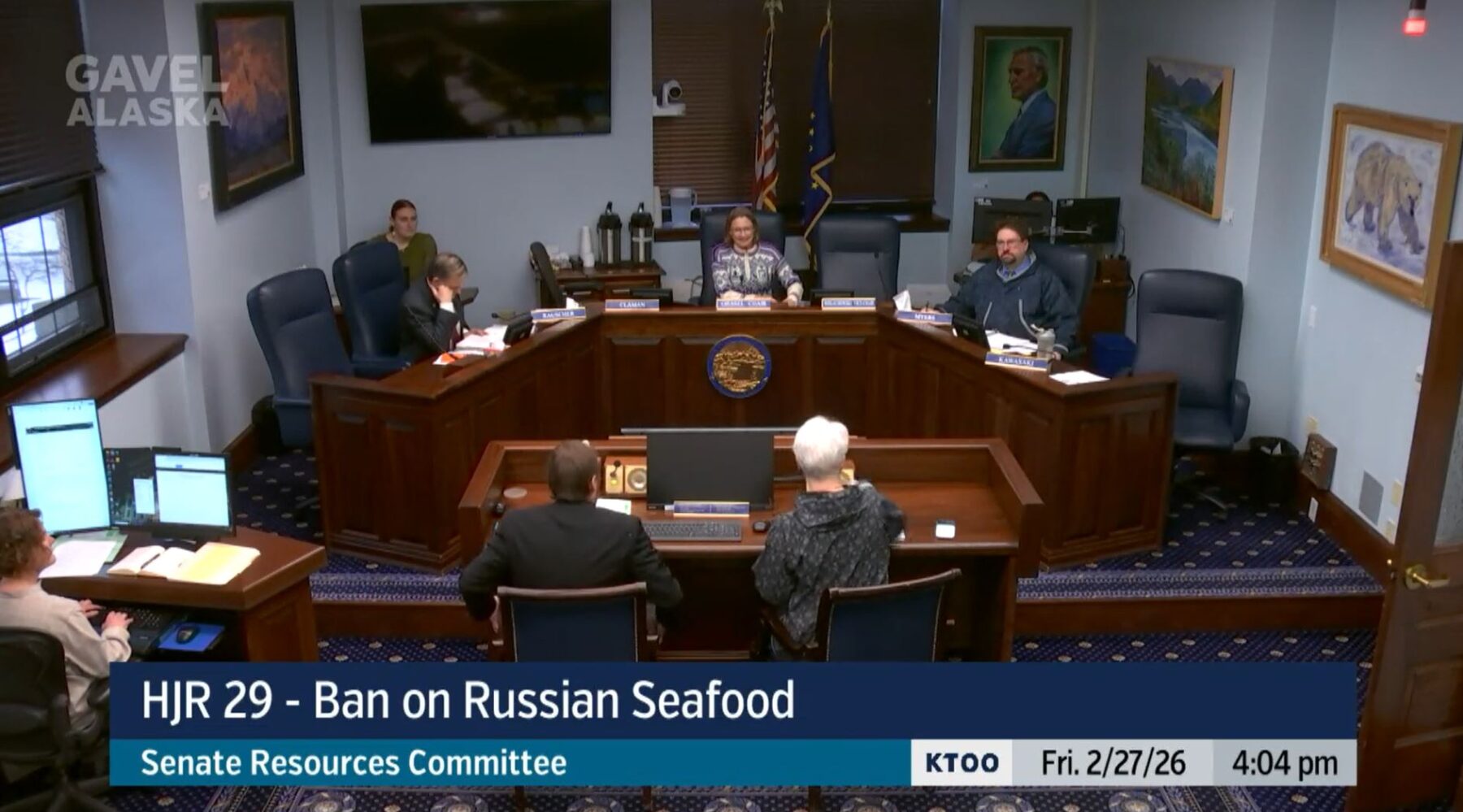
The Alaska Senate Resources Committee convened Friday afternoon to consider two resolutions with significant implications for Alaska’s economy and coastal communities. Senators advanced SJR 26 supporting the federal 8(a) Business Development Program and held HJR 29 calling for continuation of the ban on Russian seafood imports.
SJR 26 – Defending the 8(a) Program for Alaska Native Corporations
The committee opened with SJR 26, which expresses legislative support for preserving full participation of Alaska Native Corporations and tribally owned entities in the federal 8(a) program amid ongoing federal review. Chair Senator Cathy Giessel (R – Anchorage) invited staff Paige Brown to present the resolution, framing it as a defense of long-term economic opportunity rooted in the Alaska Native Claims Settlement Act.
Brown highlighted ANCs’ role: “Through 8(a) participation, ANCSA and tribal entities have created thousands of jobs across Alaska, including in rural and underserved regions.” The resolution underscores billions in statewide economic activity from construction, engineering, energy, defense, logistics, IT, and professional services.
Nicole Borromeo, representing the ANCSA Regional Association, noted that in 2022, regionally based ANCSA firms generated upwards of $13.5 billion in total revenue, including $4.5 billion from Alaska-based operations. “Dollars earned out of state are brought home to support Alaska’s economy,” she emphasized, adding that regional corporations spent $2.8 billion in Alaska on wages, goods, services, distributions, charitable giving, education, and taxes. Including direct, indirect, and induced effects, they supported nearly 25,000 jobs and paid nearly $2 billion in wages, contributing upwards of $6 billion in statewide economic activity.
Senator Myers (R – North Pole) questioned the resolution’s scope, noting non-Native small businesses also benefit from 8(a). The committee adopted a committee substitute (Version N) to broaden language, addressing the entire program under federal scrutiny while maintaining focus on ANCs.
Sheri Buretta from Chugach Alaska Corporation and the Alaska Federation of Natives reinforced the message: “The 8(a) program is how we got here.” She described how 8(a) helped recovery after the Exxon Valdez spill and detailed $32.6 million returned to shareholders and communities in 2024 alone. “When you weaken the 8(a) program, you don’t just hurt Alaska, you weaken our national defense,” she stated, citing strategic assets like critical minerals and missile defense at Fort Greely.
The committee opened and closed public testimony with no additional speakers. An amendment deadline was set for March 4 at noon, and the resolution was held for further consideration.
Part 2: HJR 29 – Protecting Alaska’s Seafood Industry from Russian Imports
The committee then turned to HJR 29, urging continuation and enforcement of the federal ban on Russian seafood imports set to expire April 15, 2026. Representative Louise Stutes (R – Kodiak) presented the resolution as a critical tool to support Alaska’s largest private employer.
Staff Matt Greuning detailed the executive orders (14024, 14068, 14114) and their expansion, noting the ban’s extension through April 2025. Without renewal, Alaska faces “a serious existential threat” from Russia’s state-subsidized fleet and dumping practices. “We finally got to the point this last winter where Russian seafood is out of retailers and out of grocery stores in the U.S.” He warned that without extension, stability remains elusive amid depressed prices and inflationary pressures.
Jeremy Woodrow of the Alaska Seafood Marketing Institute provided market context: “The challenges we have is due to the seasonality and the volatility of our fisheries, right? Not every year is a perfect season. Our seasons kind of come and go as well. So the timing to be able to really get our products into the market respond to consumers’ needs. There is a little bit of lag; it takes a little bit of time. Why this ban is important is we need more time.”
Julie Decker from the Pacific Seafood Processors Association, representing processors in 22 coastal communities, quantified impacts: “In 2023, the Alaska seafood industry faced historically challenging economic conditions. NOAA estimated losses felt by Alaska in 2023 was $1.8 billion dollars.” She highlighted Russia’s ban on U.S. seafood since 2014 and ongoing investments in a seafood hub with China and North Korea, including reported use of North Korean labor.
A resident from Kodiak, a commercial fisherman with 50 years of experience, offered a straightforward assessment: “When they produce triple the amount of pink salmon that we produce and turn around and sell it for half the price that we’re trying to break even with… this resolution will help with our domestic market.”
Both measures reflect the committee’s focus on protecting Alaska’s unique economic drivers—Native corporations and the seafood industry—while navigating federal policy shifts.


