
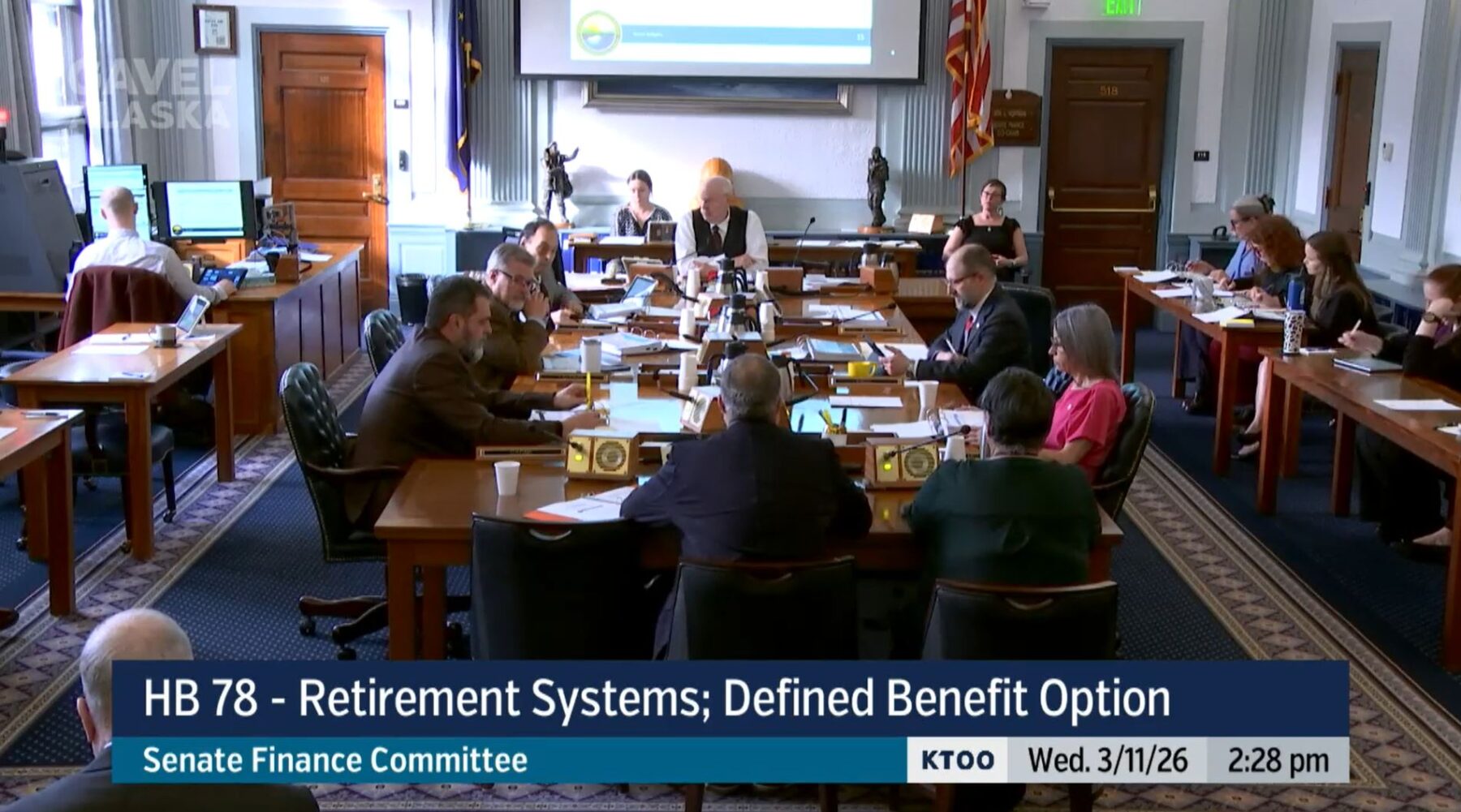
The Alaska Senate Finance Committee opened its afternoon session with a frank discussion of statewide information technology modernization needs and the potential fiscal consequences of HB 78, the proposed defined-benefit retirement option. Chair Bert Stedman (R-Sitka) reordered the agenda after OMB redirected retirement presenters, prioritizing an OMB/Office of Information Technology briefing before resuming HB 78 details. Legislative Finance’s analysis was deferred to March 12 to allow thorough review of complex material.
OMB Director Lacey Sanders and Chief Information Officer Bill Smith outlined the scale of the challenge. Modernization is “not cosmetic work. It’s deep foundational work,” Smith explained, involving core business applications, user interfaces, and infrastructure layers. Decades-old legacy systems carry undocumented business rules, massive data volumes, and compliance risks that force agencies to operate dual systems during transition. “We have to keep the old while building the new,” he noted, highlighting duplication costs and data-cleaning demands that stretch timelines.
Governance tools include the Investment Review Board (IRB), which vets projects over $25,000 for security and standards, and the new IT Application Modernization Council, modeled after DOT’s facilities council. The council will rank needs by mission criticality, technical condition, and department impact, feeding OMB a prioritized list for FY28. Recent wins include rapid cloud migration (Azure and Oracle environments), cybersecurity platform upgrades that reduced critical incidents, and the Department of Public Safety’s Criminal Justice Information System (CJIS) modernization, which moved off mainframes after five years.
Sanders acknowledged “sticker shock” from large replacement estimates—such as $58 million for the Department of Labor’s Unemployment Insurance mainframe and urgent needs for the Department of Family and Community Services’ antiquated ORCA system, which faces federal compliance deadlines. A Department of Administration payroll RFI is underway to address broader processing issues. The committee pressed on funding strategy. Stedman reminded the panel that bond financing suits long-lived assets whose useful life exceeds debt terms. Sanders confirmed project-by-project life analysis would precede any capital request, but added that with oil-price volatility and no comprehensive fiscal plan, “a request for several hundred million dollars would just be added to the budget” remains unlikely.
Our fiscal situation continues to be unstable… without a fiscal plan at this point, it’s unlikely that a request for several hundred million dollars would just be added to the budget
No formal funding ask advanced. Stedman noted the committee would be “reluctant to put tens of millions of dollars down on the table… without a direct request from the administration” given veto risk. Sanders committed to evaluate bond suitability and return with sequencing when ready. Senator Jesse Kiehl (D-Juneau) and Senator James Kaufman (R-Anchorage) raised cloud prudence and AI obsolescence risks; Smith affirmed Alaska’s hybrid “Cloud Smart” approach and incremental AI adoption via enterprise tools, including over 1,000 licensed AI agents for documents and email, plus secure internal chatbots.
The committee then resumed discussion on HB 78, the defined-benefit restoration bill. Division Director Kathy Lea and CFO Christopher Novell, with actuary David Kershner of Gallagher, illustrated FY2030 impacts. Under statutory 22% employer caps for PERS (12.56% for TRS), HB 78’s higher normal costs crowd out contributions to legacy unfunded liabilities. Non-state PERS employers currently allocate $173 million of their 22% toward the $275 million legacy past-service target; under HB 78 that drops to $151 million, shifting $22 million more to the state. TRS sees a $3 million shift. State-as-employer totals rise accordingly—PERS from $415 million to $453 million, TRS from $278 million to $285 million.
Lea described the dynamic as a “hidden cost”: legacy DB plans were never fully closed in funding mechanics, so residual capacity under the cap helps amortize past service. HB 78 raises employer normal costs, compressing that residual and increasing the state’s backfill “forever till it’s paid off,” Stedman observed. Kershner walked through the math, confirming the mechanics while noting no guarantees against future shortfalls. Even with HB 78’s 90% funding floor and 7.25% assumed return, adverse experience could extend full-funding timelines beyond the projected 2039 date, mirroring legacy PERS history that saw funded status fall from near 100% to about 69% in the early 2000s.
The Chair emphasized public clarity, directing presenters to minimize acronyms and translate mechanics into plain dollars. No action was taken on HB 78; the session built shared understanding of cost drivers and risks ahead of Legislative Finance’s March 12 analysis. Follow-up requests include current-year monetary examples of the shift, risk-sharing triggers under varied returns, and plain-language materials.
University of Alaska’s FY27 budget request begins as a full subcommittee at 9:00 AM March 12, followed by sponsor remarks and capital requests.
“Our fiscal situation continues to be unstable… without a fiscal plan at this point, it’s unlikely that a request for several hundred million dollars would just be added to the budget,” Director Lacey Sanders stated, underscoring the administration’s measured approach.
The briefing reflected conservative principles of disciplined governance, transparent cost analysis, and reluctance to commit taxpayer dollars absent clear prioritization and long-term fiscal stability.


