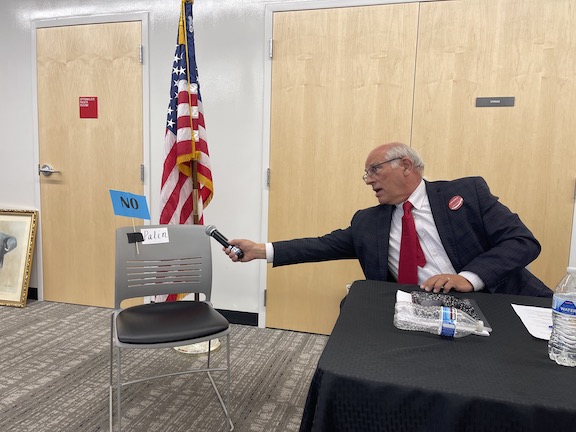
The Anchorage Republican Women’s Club had placed a “No” sign on an empty chair with former Gov. Sarah Palin’s name on it on Wednesday night, and left it by the side of the table where the other leading Republican candidates for Congress were seated for a spirited candidate forum in midtown Anchorage.
Palin had been noncommittal about attending the forum, and had advised the influential group of conservatives in Anchorage on Tuesday that she would not be able to fit their marquee event into her schedule.
Club President Judy Eledge was not amused, and reminded the room of over 75 people that the club had worked hard to get Palin elected as governor in 2006, and had also worked hard to set a date that would work with Palin’s schedule for this forum.
Palin also took a pass on the Republican forum in Juneau earlier this month and has generally taken a harsh line against Alaska Republicans, calling them a “good old boys’ network.”
Attending the forum were former Sen. John Coghill, Tara Sweeney, Nick Begich, and Sen. Josh Revak. The four spent an hour fielding questions on everything from abortion to the the Deferred Action for Childhood Arrivals immigration law.
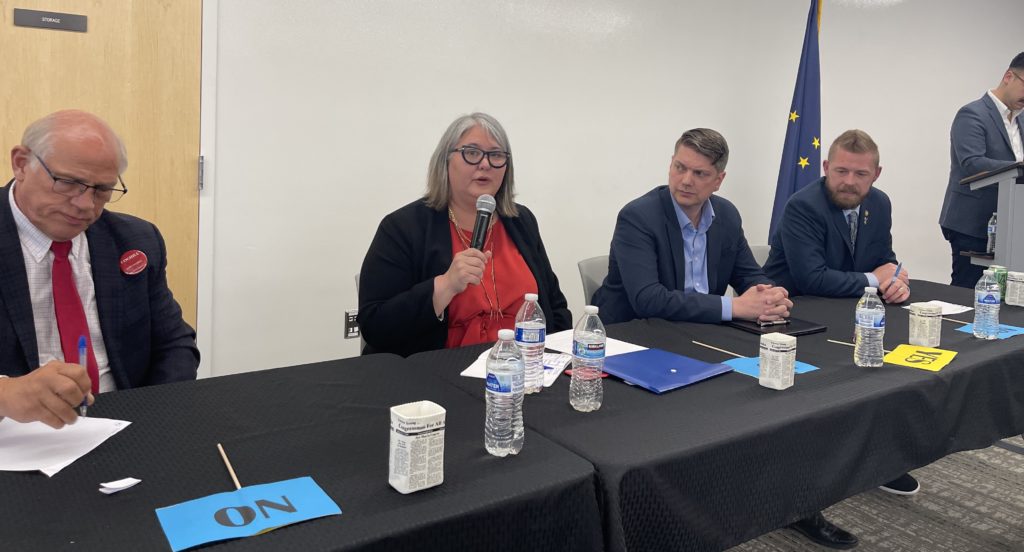
During the candidate-to-candidate questions, Begich asked Coghill, “What do you think is important as Alaskans head to polls that they need to know about Sarah Palin?”
Coghill jokingly held the microphone to the empty chair as if to ask Palin for a response. The room broke out in laughter. Then he said, that while he likes Palin, “I think her celebrity has gone beyond her ability to work seriously for Alaska.” The audience was largely supportive of Coghill’s comment.
The four Republican candidates agreed on most items, and they each scored points for how they would defend Alaska in Washington, D.C. On issues like abortion and the trend of transgenders taking over women’s sports, Sweeney distinguished herself as the social liberal among the panel, while the other three were unequivocally pro-life and willing to defend women’s sports. Also, during the last question, defining what a woman is, Sweeney would only answer that, “I’m a woman,” while the others on the panel referred to the science of x and y chromosomes and genetic expression, and the wrongness of grooming children into thinking they are a different gender.
On the question of whether they would have voted for a $40 billion aid package for Ukraine, Nick Begich was the only panelist who said that European countries and other NATO countries needed to step up more and that America should be concerned about defending its own borders; he would not have voted for the $40 billion aid. The others would have. The crowd largely agreed with Nick.
The only attack on a candidate came from Sweeney, who badgered Nick Begich for having run a negative campaign against Don Young when he was alive. Begich defended his record, saying he had only differentiated himself from Young on issues of policy: He would not have voted for the PRO Act, because it’s anti-business, and he would not have voted for Biden’s infrastructure bill, which only 13 Republicans voted for. Begich also would not have voted for the vaccine database, as Rep. Young had done, or the “red flag” gun control laws that Young had voted for. Begich said he was running an issues-based campaign and was not afraid to talk about the issues.
All of the panelists were advocates for Alaska energy, all think the Biden Administration is a disaster, and all of them would replace Deb Haaland as the secretary of the Department of Interior.
About a third of the people attending the event raised their hand when asked if the evening’s event had helped them make up their minds about who to support in the special election to fill out the remainder of the term of Congressman Don Young.
Ballots must be returned to the Division of Election by June 11. The top four vote getters will appear on the Aug. 16 ballot, where voters will then use the ranked choice method to pick their favorite. It’s the first time Alaskans have used the new voting scheme developed by Ballot Measure 2 of 2020.
Also on the August ballot will be candidates for the primary for the regular election.