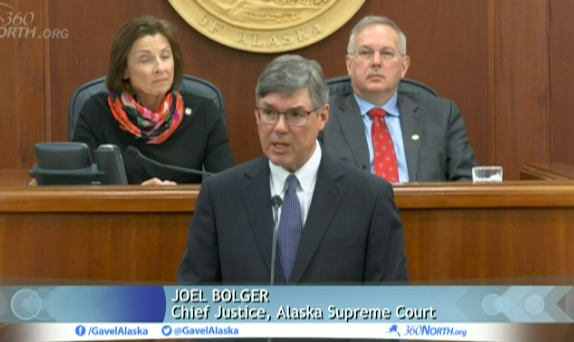
Supreme Court Chief Justice Joel Bolger has refused to recuse himself from the Recall Dunleavy case, scheduled for March 25, even though he is a material witness to the first of the recall “charges” made by the Recall Dunleavy Committee, and even though he has publicly weighed in with his criticism of the governor on another one of the recall “charges.”
That first charge relates to the appointment of a judge to the Palmer District Court in 2019. The Alaska Judicial Council, which is led by Bolger, had forwarded just two candidates’ names to Gov. Mike Dunleavy, and the governor wanted to know why so few names had been forwarded — were that few candidates actually qualified?
The two met on March 26, 2019, in a private meeting in which Bolger and Dunleavy discussed the judicial appointment process, during which time Dunleavy was able to express his concerns about too few candidates being sent to him for his consideration.
“I believe the governor’s office does not understand the constitutional requirements for these nominations,” Bolger said, before his meeting with the governor. “So I’m going to spend some time outlining the requirements of the constitution and the bylaws and procedures the council has adopted to follow the constitution.”
The meeting was lengthy and detailed.
A few days after that meeting with Bolger, Dunleavy appointed someone to the position from the “list of two,” fulfilling the vacancy as prescribed by the Alaska constitution, but a few days past when the Alaska statute says the appointment should be made.
During this time, the retiring judge in Palmer was still on the bench, and would not be leaving for several weeks. There was no vacancy yet.
The delay in the appointment is the first charge on the recall petition, which Bolger and the other Supreme Court judges says must be printed and distributed for signatures. Recall Dunleavy Committee says the governor broke the law by missing the statutory deadline.
There’s no putting the toothpaste back in the tube on this conflict — Bolger was at the center of the discussion about the judicial council’s decision that Dunleavy was questioning.
Bolger has yet another conflict with one of the recall “charges.”
At the Alaska Federation of Natives convention last year, he asked the assembly present to help him:
“It’s absolutely essential that judges maintain independence to make decisions based on the law and facts and not on political or personal considerations,” Bolger said in October 2019.
“We are facing a great deal of political pressure. Some people want to make the judicial selection system more political. Others would like to impose political consequences for the content of judicial decisions.
“So I respectfully ask this convention to join me in resisting political influence in our courts.” – Justice Joel Bolger to Alaska Federation of Natives, referring to Dunleavy
The message had been sent by Bolger. There was no question Bolger was referring to the governor in his remarks to AFN.
The governor had cut the Supreme Court’s administrative budget, and stated that he did so because the Supreme Court insisted the state pay for optional abortions with Medicaid funds. The governor was going to shift those funds from the courts over to the Medicaid accounts to pay for the mandate.
This makes Bolger deeply conflicted on the third recall “charge.”
Today, the Stand Tall With Mike group, which was defending the governor in court, withdrew from the case at the Supreme Court, in part because it appears the judges have already made up their minds, and because Bolger refused to recuse himself. The state attorneys will have to continue on without the independent legal team.
[Read: The fix is in II: Stand Tall With Mike pulls away from lawsuit]
It’s important to note that no formal request was made to ask Bolger to recuse himself. Normally, lawyers who are getting ready to appear before a judge do not make such a request because if the judge thinks he or she should recuse himself, he or she does so “sua sponte,” which means you do something without having to be asked.
But if a lawyer goes so far as to ask a judge to recuse himself, the lawyer can be guaranteed to have a rough time in front of what is then going to be an annoyed judge. Lawyers do not poke that hornet’s nest except in very rare cases.
Chief Justice Bolger has undeniable direct involvement with Recall Charge No. 1, and he has made political statements about Recall Charge No. 3. But voters have little recourse — Bolger himself will not be up for retention for six more years.