Tuesday, August 4, 2026
Home Blog Page 366

Northern border sector breaks records in apprehensions, getaways

9

By BETHANY BLANKLEY | THE CENTER SQUARE

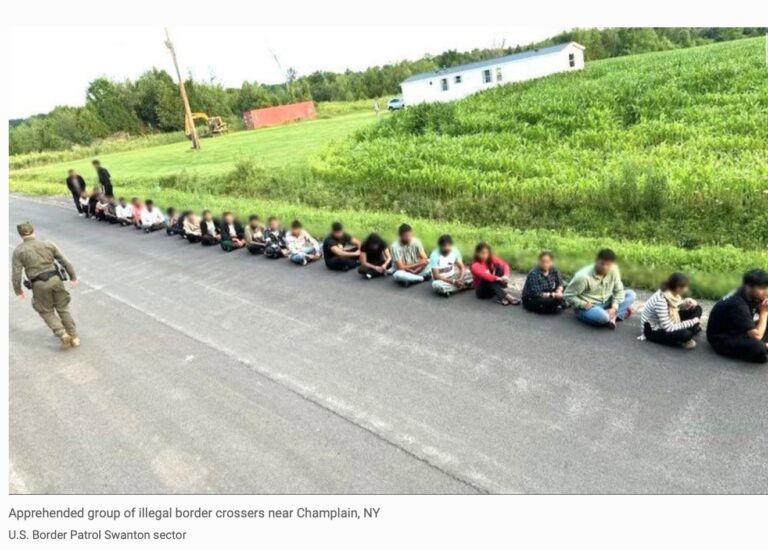
The busiest U.S. Customs and Border Protection sector at the northern border continues to break records in apprehensions with foreign nationals coming from 85 countries to Canada to illegally enter the U.S.

In less than 10 months, Swanton Sector Border Patrol agents apprehended 15,000 foreign nationals from 85 countries who all illegally entered the U.S. through Canada, the greatest volume reported in this time period in history.

By contrast, the Swanton Sector apprehended 365 illegal border crossers in all of fiscal 2021, according to CBP data.

The total number apprehended this fiscal year, which ends Sept. 30, exceeds apprehensions Border Patrol agents made in 13 fiscal years combined (fiscal 2011 through fiscal 2023), Swanton Sector Chief Patrol Agent Robert Garcia said.

The 15,000 illegal border crossers is equivalent to 15 U.S. Army battalions.

Foreign nationals flew from 85 countries to eventually reach Canada and then make their way to the U.S. border, where they illegally entered the Swanton Sector. The sector includes all of Vermont, six upstate New York counties, and three New Hampshire counties.

It spans 295 miles of international boundary with the Canadian provinces of Quebec and Ontario and is the first international land boundary east of the Great Lakes.

In fiscal 2023, Swanton Sector Border Patrol agents broke previous records by apprehending the greatest number of illegal border crossers in history of more than 6,700 foreign nationals from 76 countries, The Center Square exclusively reported.

In just one year, that number tripled and countries of origin increased to 85.

Foreign nationals illegally entering the U.S. from Canada in the Swanton Sector alone are citizens of Afghanistan, Albania, Algeria, Angola, Anguilla, Argentina, Australia, Azerbaijan, Bangladesh, Belgium, Bolivia, Brazil, Cameroon, Canada, Chad, Chile, China, Colombia, Congo, Costa Rica, Croatia, Cuba, the Democratic Republic of the Congo, Ecuador, Egypt, El Salvador, Equatorial Guinea, Eswatini, Finland, France, Georgia, Germany, Greece, Guatemala, Guinea, Guyana, Haiti, Honduras, Hungry, India, Iran, Iraq, Ireland, Israel, Italy, Jamaica, Kazakhstan, Kosovo, Liberia, Lithuania, Mauritania, Mexico, Morocco, Nepal, Netherlands, Nicaragua, Nigeria, Pakistan, Panama, Papua New Guinea, Peru, Philippines, Portugal, Romania, Russia, Rwanda, Saudi Arabia, Senegal, South Africa, Spain, Sri Lanka, Sudan, Sweden, Syria, Taiwan, Togo, Turkey, Ukraine, United Kingdom, Uzbekistan, Venezuela, Vietnam and Zimbabwe, according to Swanton Sector data.

The Biden-Harris administration continues to maintain U.S. borders are secure and numbers are down compared to the Trump administration, a claim fact-checked as false by The Center Square.

In one Derby, Vermont, local news report, residents described how “at all hours of the day,” illegal foreign nationals cross their backyards having come from Canada to illegally enter the U.S. They’ve shared similar experiences on a much smaller scale as those living in rural border counties of Texas, The Center Square has reported. In Texas, illegal border crossers total in the millions under the Biden-Harris administration, prompting 55 Texas counties to declare an invasion and 60 to issue disaster declarations citing the border crisis.

Like those at the southwest border, those at the northern border describe how home surveillance video captures foreign nationals trespassing on private property, next to their homes, in the middle of the night to be picked up by someone nearby. Border Patrol agents have warned residents “not to interfere because they may have weapons. They want to get through, they’re going to have nobody stopping them,” WCAX 3 News reported.

They are describing gotaways, those who illegally enter between ports of entry, don’t make asylum or immigration claims, and intentionally seek to evade capture. Many have criminal records and are armed and dangerous, authorities have told The Center Square. They total at least two million nationwide since fiscal 2021, the greatest number in recorded history, The Center Square first reported.

Labor Day cautionary tale for gig workers: How Seattle crashed its food delivery industry

37

After the Seattle City Council imposed minimum wage laws that required delivery apps to pay drivers more, the food delivery business model for hundreds of gig workers in Seattle has all but vanished. The cost of delivery is now so great that people have changed their habits and are no longer ordering over the apps. Instead, they’re ordering food to-go and going to pick it up themselves.

Food delivery grew in popularity across the country during the Covid pandemic policies, which scared many people into not going out to eat, and which made economics of the restaurant and hospitality industries challenging. People started driving for extra dollars, sometimes as their chosen work, and other times to fill in between other jobs or gigs and earn extra money. People could make decent money on the tips alone.

In Seattle, the socialist-run city council put in a minimum wage rule that required the app companies to pay drivers $5 per order, or 44 cents per minute, and an additional 75 cents per mile. It was supposed to ensure that delivery drivers make the same as Seattle’s minimum wage of $19.97 per hour.

Immediately after the “PayUp law” went into effect in January, restaurants reported they had fewer orders. Drivers have quit driving as contract workers for new companies like GrubHub, Uber Eats, and Door Dash because they found they were losing money, with fewer and fewer customers.

In May, the city council was set to reconsider its actions, but as of Sept. 1, has taken no action, and has not scheduled any action in the future.

Seattle and New York City are the first two cities in the country to introduce such a minimum wage for contract drivers

One driver told the Seattle Times that she worked for five and a half hours, hanging around Belltown during what should have been a busy time for orders. Instead, she only was able to deliver two orders during that five and a half hours, for a total of 40 minutes of work. For her day of mostly waiting for orders, she made $23.71.

The owners of Spice Waala in the Capitol Hill neighborhood told a reporter that since the law took effect, delivery orders have declined 40%. It’s made his Indian Street food out of reach for the service. A kati roll used to cost a customer around $10, he said, and now it costs $20. Nobody is ordering them for delivery anymore.

Jamie Allard: From Reaganomics to Bidenomics, a Labor Day look at contrasting visions and outcomes

By REP. JAMIE ALLARD

I recall being just 14 years old when President Ronald Reagan delivered his iconic Labor Day address in 1984 from the Oval Office. Growing up in the glory days of Reaganomics, I witnessed firsthand how conservative policies led to a thriving economy where American workers and families flourished. Our nation enjoyed unprecedented growth, with both unemployment and inflation decreasing simultaneously for the first time since the Kennedy Administration.

Dubbed the “American Miracle,” Reaganomics was driven by the belief that “what is good for the American worker is good for America,” and that shaped my political values from an early age.

Forty years later, as we approach Labor Day weekend in 2024, we are presented with a pivotal moment. November’s election offers a choice that will shape our economic future. Labor Day is a time to celebrate the productivity and spirit of America’s working people, but also a moment to recognize the challenges we face, and to consider our role in steering America toward prosperity once again. 

Currently, approximately 161 million Americans are employed, yet 7.2 million remain unemployed. This is a significant number, and it highlights the need for a change with policies that stimulate job growth and economic stability. Under President Joe Biden, the average inflation rate has soared to 5.7%, in contrast to the 1.9% average inflation rate under President Donald Trump.

These figures are not just statistics; they represent the daily struggles of American families facing skyrocketing grocery prices, highway robbery at the gas pumps, and being priced out of the housing market. 

To navigate out of the economic downturn we face, we must adopt policies that stimulate growth and create jobs, like the historic tax cuts delivered during President Trump’s first term. We must bring back jobs that have been outsourced to countries like Mexico and China and bring our manufacturing home. Let’s become the economic powerhouse we once were and promote the production of American-made goods. We can no longer take the American worker for granted. This is not just about economic policy but about pride and belief in the American worker, the backbone of our communities. 

Recently in an unprecedented move, President Trump opened the door for Teamsters President Sean O’Brien to address the Republic National Convention for the first time in the Teamsters 121-year history. The tides are changing as a groundswell of voices rise to preserve the American working class against gigantic multinational corporations. As O’Brien points out, “Remember, elites have no party, elites have no nations. Their loyalty is to the balance sheet and the stock price at the expense of the American worker.”

Sadly, it took a global pandemic for the elites to notice that the American worker is essential. We must not lose that perspective moving forward as we vote for policies that put the American worker first and reign in runaway national debt and inflation.”

The groundswell can be seen across the nation as the workforce demonstrates their priorities in this election. For example, despite the United Auto Workers endorsing the Harris campaign, there is contention between union officials and the auto workers who are on the plant floors. The “Auto Workers for Trump 2024” movement is gaining momentum, with workers planning to rally weekly at Detroit’s Big Three facilities through Election Day. They know that their jobs are on the line as a Harris/Walz administration would continue the current push to make gas vehicles obsolete by 2032, only eight years away. 

Today’s working class feels the sting of “Bidenomics.” The dream of homeownership has become elusive, and the reality of affording basic necessities has become a burden for the average family. We all know that the system is broken. Yet, meaningful work—not government handouts—remains the hope of most Americans. We must foster an environment where the American Dream is accessible to all through free-market policies that limit government intervention, decrease and simplify taxes, and cut down on burdensome regulations.

I believe a strong workforce develops in the classroom. We must focus on revitalizing our education system to better prepare the next generation for the workforce. We need innovative educational reforms that encourage continued trade schools and develop better local vocational training opportunities for high school age students.

Unlike the new “Academies of Anchorage” in the Anchorage School District, we must ensure these initiatives are backed by data and effective research. For example, moving from six to eight class periods in the ASD Career Academies Master Plan might dilute core learning time, hindering students from obtaining the well-rounded education they need for college. How many of us chose our lifelong careers in ninth grade?

Rather, proven successful reforms like school choice are necessary, particularly as our state continues to rank among the lowest in educational performance. Our children are our future. 

This Labor Day, we salute the workers of America, the backbone of our nation. As we celebrate the principles of freedom and take advantage of those sales that boost our local economies, let’s take a moment to remember those in countries where basic human rights and freedoms are still out of reach. We are fortunate to live in a nation where freedom prevails, but we must actively work to preserve it. 

With the right leadership and policies, we can ensure that the spirit of American enterprise and the power of the American worker continue to thrive for generations to come.

As Ronald Reagan wisely said, “Let us in America be thankful for the strength of our free labor movement; may it long endure.”

Rep. Jamie Allard serves in the Alaska Legislature for Eagle River District 23 and was previously on the Anchorage Assembly.

Alexander Dolitsky: A woke professor declares a dead language to be undead, and other follies of false history

By ALEXANDER DOLITSKY

Ethnic minorities, religious refugees, and other groups segregated by a dominant society have developed and implemented strategies and tactics to protect their national identity, religious practices, ancient traditions, and community cohesiveness.

In most cases, the tactics and strategies of these unique orthodox groups, created to secure cultural continuity and “living memory” among their members, have historic roots and have resulted from cognitive rational choices.

This process of assimilation in which an individual has changed so much as to become dissociated from the value system of his group, or in which the entire group disappears as an autonomously functioning social system is evident in today’s many ethnic minority, religious refugee, and immigrant groups in the United States, including Alaska, and, presumably, in other free democratic societies around the world.

In his article of Aug. 29 Juneau campus gives esteemed speaker invite to woman who sees racism in study of Arctic ice, Joel Davidson of the Alaska Watchman reported:

“Dr. Jen Rose Smith is a young academic who has dedicated her early career to studying Arctic ice through the critical race theory lens of colonialism, white privilege and racism. On Aug. 30, the publicly-funded University of Alaska Southeast (UAS) will host Smith for its prestigious Egan Fall Lecture Series, where Smith will pontificate on her forthcoming book, ‘Ice Geographies: The Colonial Politics of Race and Indigeneity.

“Like many emerging critical race theorists on the cultural left, Smith holds to the belief that racism, colonialism and white privilege lurk hidden in myriad corners of Western civilization, both past and present—even in our understanding of ice and kelp.”

I attended Smith’s presentation at the Egan Library in Juneau on Aug. 30. Indeed, not only are her ideas simply convoluted, but it is also false and poorly researched.

At the end of her presentation, I commented that about 15 years ago, the last fluent speaker (an elderly woman) of the Eyak language passed away. It was well documented by the Anchorage Daily News, Juneau Empire, several anthropologists in Alaska, etc.

Nevertheless, Dr. Smith was visibly offended by my comments, stating that, “It depends how you define a ‘speaker’ of languages.”

I responded that, “Speakers of languages communicate in full sentences and fluently convey messages to each other; not just limit their communication by saying ‘hello’ and ‘goodbye’ or few other common words or expressions.”

I also argued that disappearance, revival and/or evolution of languages has only partially to do with colonization politics and influences of Western civilization; and many other factors and causes involved in cultural changes, including evolution, extinction and revival of languages. 

For example, while in Alaska in the mid-19th century, Russian Orthodox Bishop Ivan Veniaminov learned the Aleut language, for which he invented an alphabet and charted a grammar. 

However, Presbyterian missionaries in Alaska in the 19th and early 20th centuries were known for suppressing Native languages in Alaska, forcing Natives to speak only English.

Indeed, if languages of ethnic minorities are not institutionalized (the process of becoming a permanent or respected part of a society, system, and organization) or contribute very little to socio-economic development of the dominant culture, then those languages will eventually decline or become a symbolic representation of a given ethnic minority. It happened to many native languages in Siberia, Alaska, Africa, etc.

Yes, languages of ethnic minorities decline, change and become extinct every year worldwide. Typically, languages have become extinct because of the process of cultural assimilation leading to language shift, and the gradual abandonment of a native language in favor of a foreign lingua franca, largely those of European countries.

Israel’s revival of the authentic Hebrew language (a Semitic language—a subgroup of the Afro-Asiatic languages spoken across the Middle East) from 1948 (i.e., when Israel was re-established by the United Nations) has resulted in a gradual disappearance of the Yiddish language (West Germanic language) that was historically spoken by Ashkenazi Jews of Eastern Europe.

In fact, Yiddish is a German dialect which integrates many languages, including German, Hebrew, Aramaic, and various Slavic and Romance languages. Today, Yiddish, a language of my parents and grandparents, is at the stage of extinction and its unfortunate destiny has nothing to do with colonial politics.

In her presentation, Smith argued that there are many speakers of the Eyak language left in Alaska.

Alaska Native Language Archive, however, describes it otherwise.

Eyak is not an Athabaskan language, but a coordinate sub-branch to Athabaskan in the Athabaskan-Eyak branch of the Athabaskan-Eyak-Tlingit language family. Eyak was spoken in the 19th century from Yakutat along the south-central Alaska coast to Eyak at the Copper River delta, but by the 20th century only at Eyak. It is now represented by about 50 people but no surviving fluent speakers. With the passing of Marie Smith Jones on January 21, 2008, Eyak became the first Alaska Native language to become extinct in recent history.

Frankly, most people in the audience could not understand Smith’s awkward concepts of ice, open space, and colonial politics. However, new UAS Chancellor Dr. Aparna Dileep-Nageswaran Palmer was delighted by Smith’s convoluted presentation.

In short, “Professor Jen Rose Smith” is a new version of the far-left woke ideology in our troubled country and a clear representation of the poor scholarship.

Alexander B. Dolitsky was born and raised in Kiev in the former Soviet Union. He received an M.A. in history from Kiev Pedagogical Institute, Ukraine, in 1976; an M.A. in anthropology and archaeology from Brown University in 1983; and was enroled in the Ph.D. program in Anthropology at Bryn Mawr College from 1983 to 1985, where he was also a lecturer in the Russian Center. In the U.S.S.R., he was a social studies teacher for three years, and an archaeologist for five years for the Ukranian Academy of Sciences. In 1978, he settled in the United States. Dolitsky visited Alaska for the first time in 1981, while conducting field research for graduate school at Brown. He lived first in Sitka in 1985 and then settled in Juneau in 1986. From 1985 to 1987, he was a U.S. Forest Service archaeologist and social scientist. He was an Adjunct Assistant Professor of Russian Studies at the University of Alaska Southeast from 1985 to 1999; Social Studies Instructor at the Alyeska Central School, Alaska Department of Education from 1988 to 2006; and has been the Director of the Alaska-Siberia Research Center (see www.aksrc.homestead.com) from 1990 to present. He has conducted about 30 field studies in various areas of the former Soviet Union (including Siberia), Central Asia, South America, Eastern Europe and the United States (including Alaska). Dolitsky has been a lecturer on the World Discoverer, Spirit of Oceanus, and Clipper Odyssey vessels in the Arctic and sub-Arctic regions. He was the Project Manager for the WWII Alaska-Siberia Lend Lease Memorial, which was erected in Fairbanks in 2006. He has published extensively in the fields of anthropology, history, archaeology, and ethnography. His more recent publications include Fairy Tales and Myths of the Bering Strait Chukchi, Ancient Tales of Kamchatka; Tales and Legends of the Yupik Eskimos of Siberia; Old Russia in Modern America: Russian Old Believers in Alaska; Allies in Wartime: The Alaska-Siberia Airway During WWII; Spirit of the Siberian Tiger: Folktales of the Russian Far East; Living Wisdom of the Far North: Tales and Legends from Chukotka and Alaska; Pipeline to Russia; The Alaska-Siberia Air Route in WWII; and Old Russia in Modern America: Living Traditions of the Russian Old Believers; Ancient Tales of Chukotka, and Ancient Tales of Kamchatka.

Cabbage giants compete at the fair … and we have a winner

Scott Robb is certainly Alaska’s reining Cabbage King. He took home the blue ribbon Friday with a 97.35 pound cabbage at the 28th annual Gian Cabbage Weigh-off on Friday at the Alaska State Fair. Paul Dinkel and Keevan Dinkel won second and third place, respectively.

Robb set the world record at the fair in 2012, entering a 138.25-pound cabbage. Last year, after taking a few years off, he entered the competition again, and took home the blue ribbon during the 27th annual contest with a 113.5-pound wonder.

Learn how you can grow giant cabbages in Alaska at this University of Alaska Fairbanks Cooperative Extension Service tutorial.

Club for Growth endorses Nick Begich for Congress

Club for Growth, a network of 500,000 pro-business Americans, has endorsed Nick Begich for Congress for Alaska.

“The Club for Growth is the leading free-enterprise advocacy group in the nation. We win tough battles and we have an enormous influence on economic policy,” the organization explains on its website. “In fact, we are the only organization that is willing and able to take on any Member of Congress on policy who fails to uphold basic economic conservative principles…regardless of party.”

The group also endorses candidates such as Sen. Ted Cruz of Texas, Sen. Rick Scott of Florida, Kari Lake for Senate in Arizona, and Bernie Moreno for Senate in Ohio.

By backing Nick Begich, the group is signaling it’s going to take on Rep. Mary Peltola, Alaska’s Democrat in Congress. The Nov. 5 general election is 66 days from Saturday.

Some of the Club’s top policy goals include:

” If elected, he will be dedicated to ensuring that Alaskans thrive, standing ready to challenge Washington’s overreach and secure a prosperous future for Alaska,” the organization said in its highlight of Begich.

The Club for Growth endorsement is one of the more difficult ones to get, because the group doesn’t endorse people who will just go along with the Washington, D.C. swamp politics. It’s not interested in lawmakers who cave to special-interest lobbyists.

Begich has received other endorsements this week, including that of Rep. Bruce Westerman, who chairs the House Natural Resources Committee, and Rep. Jim Jordan, chair of Judiciary. Begich was also just named to the National Republican Congressional Committee’s “Young Guns” program, which will super-charge his campaign.

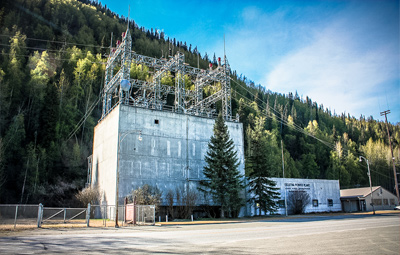
Anchorage Assembly to meet with Eklutna Village leaders to sign mutual goals to destroy hydropower

The Anchorage Assembly Democrat majority has prioritized the removal of the hydro dam and associated Anchorage electricity and drinking water from the Eklutna River and will meet with the leaders of the village of Eklutna on Sept. 5 to advance those goals with a formal joint resolution.

The Democrats controlling the Anchorage Assembly want to delay a decision that Gov. Mike Dunleavy must make soon on whether to remove the dam; members hope to wait until a Democrat governor is in office — one who will take action to dismantle the dam, originally built in 1929, and rebuilt twice after that, which powers more than 24,600 residential homes for an entire year.

Eklutna hydroelectric power is the lowest cost renewable energy in Southcentral Alaska; it also provides power to areas of the MatSu Valley and nearly all of the water or Anchorage.

The governor needs to make a decision by October on the 1991 reauthorization of the dam. There has been a public comment period that now ended, and there is no legal language to delay the process, which is what the Assembly majority wants; it is asking for a two-year delay.

As much as it is trying to assert authority, the Assembly doesn’t have legal standing in the decision-making process, as the municipality has no member or voting rights on the ownership committee, which is made up of Chugach Electric Association and Matanuska Electric Association.

The Assembly has sent up every smoke signal possible to indicate it is likely to sue the governor and other related entities, such as the Regulatory Commission of Alaska, if it doesn’t get its way.

Rick Whitbeck, Alaska state director of Power the Future, said that it’s time for rational voices to prevail.

“Like petulant children crying over a toy at the supermarket, the Anchorage municipality leadership continues to whine over a process they have no legal standing in. Their continued tactics will only lead to taxpayer and ratepayer expenditures on a cause they have no hope of winning legally.”

Whitbeck called for the reauthorization and its five-year process to be approved “and for Eklutna to continue to provide always-on, always available, low-cost power and water to Anchorage”

The village of Eklutna is reported to have around 70 members, although the exact tribal roll is hard to determine. Most, if not all of the members live throughout the municipality and depend on the power and water from the Eklutna project. The municipality has lifted the village to a government-to-government status and now meets with village leaders on a formal basis, which is what the Aug. 5 meeting is scheduled as.

On the agenda for the joint meeting on Sept. 5:

“Resolution AR No. AR 2024-276, a resolution of the Anchorage Municipal Assembly authorizing the Anchorage Assembly Chair to sign a Joint Resolution of the Anchorage Assembly and the Native Village of Eklutna in support of exploration of alternative solutions to attain our shared policy goals for full restoration of the Eklutna River.”

•  Motion from Tribal Council authorizing President Leggett to sign Joint Resolution AR 2024-276

•  Briefing re Gathering Place 

•  Eklutna River Restoration

• Update from Anchorage Hydropower Utility

• Placenames – changing the names of places around Anchorage to Native names

• Property Taxes

• Education

• Public Safety

• Boarding School Investigation

• Use of Alcohol Tax Funds for Culturally Relevant Programming for Youth Prevention Activities – Municipal Employee Training

• FY2025 Budget 

• Cultural Tourism/Moose Loop Increase

• Other items

The tribe has been working “behind the scenes” with Anchorage, it says in a recent newsletter: “The Land and Environment Department has been working hard on the Eklutna River project – doing the behind the scenes work that is needed to work with our partners.”

Thus, it appears the Anchorage Assembly and/or the mayor have been having consultations and possible meetings “behind the scenes” with the tribe that the public has not been made aware of.

Meeting details:

Assembly Chambers

September 5, 2024

Regular Meeting – Loussac Library, 3600 Denali Street, Room 108, 5 p.m. business meeting, 5:30 p.m. appearance requests 

Live Streaming and Archived meetings/Podcasts at http://www.muni.org/watchnow 

Live on Yukon TV streaming service; Rebroadcast Wednesday/Friday at 5 p.m.

Agenda at this link.

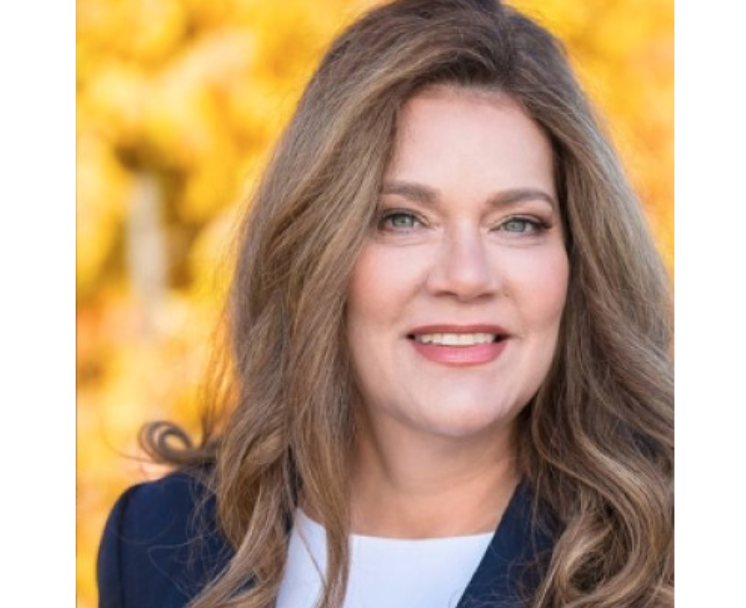
Defeating ranked-choice voting before November, two Republicans drop so Lucy Bauer has a chance in South Anchorage

Republicans again have defeated the ranked-choice ballot. And it’s not even November.

In District 9, two Republicans have dropped, leaving Republican Lucy Bauer alone on the ballot to face Ky Holland, who is endorsed by the Alaska Democratic Party.

Candidates Lee Ellis of Girdwood and Brandy Pennington made it official today. Bauer was the leading Republican out of the primary this month, so they’re making room for her.

Ellis came away with 870 votes, Pennington received 811, and Bauer received 933.

Rather than split the donation and volunteer base, and make Republican voters uncertain or confused about who to support, both Ellis and Pennington cleared the runway for Bauer, who can now also get the endorsement of the Alaska Republican Party later in September. Update: Ellis, who only recently registered as a Republican, has endorsed stealth-Democrat Holland. Evidently Ellis was recruited to run by hardline Democrat Rep. Zack Fields as a plant.

Holland will be tough enough to beat with just one Republican in the race. He received 1,880 votes in the primary.

Lucy Bauer will need the help of Republicans to beat him.

“I dreamed of coming to America when I was a child,” Bauer says on her website. “I immigrated here the first chance I got. I immediately fell in love with the country and never looked back. This country has given me so many opportunities for success and now I’m running for office to give something back. I will work just as hard for you in the State House as I have in building a successful business. I come from humble roots and look forward to serving the community that I have grown so attached to.”

The pattern of Republican self-sacrifice follows what happened earlier in Eagle River, with Republicans Sharon Jackson and Ken McCarty dropping out to clear the path for Republican Jared Goecker to face Sen. Kelly Merrick, who is also a Republican, but who has lost the trust of many due to her allegiance to Democrats. She is not kindly regarded by many in her district, and Goecker got more votes from her in the primary, even though there were two other Republicans to choose from.

In Senate Seat H, Republican Tom McKay dropped, and Republican Liz Vazquez now has a clean shot at taking out Sen. Matt Claman, the Democrat.

That leaves House District 36, where Republicans Dana Mock and Cole Crabgress have both dropped from the November general election to allow Republican Rebecca Schwanke a better chance at defeating Democrat Brandon Kowalski.

There are a handful of Republican-on-Republican races in the MatSu Valley, such as Districts 27, 28, and 30.

In the congressional race, Republican Nancy Dahlstrom dropped out to give Nick Begich a better chance of retiring Rep. Mary Peltola.

Ranked-choice voting was tested first in Alaska in 2022, and Republicans found that it split the donation base, the volunteers, hurt the unity among conservatives, and dragged down the momentum, as people became uncertain about who to trust with their vote, their dollars, and their time.

In 2024, the Alaska Republicans are showing they put their state before their ambitions, pulling together as a team behind one person.

Friday is the last day to in-person drop from the November ballot at the Division of Elections, although some candidates may try to drop electronically over the weekend, with a less-than-certain result. Labor Day is Monday and is also the final day to drop, but the Division of Elections is closed.

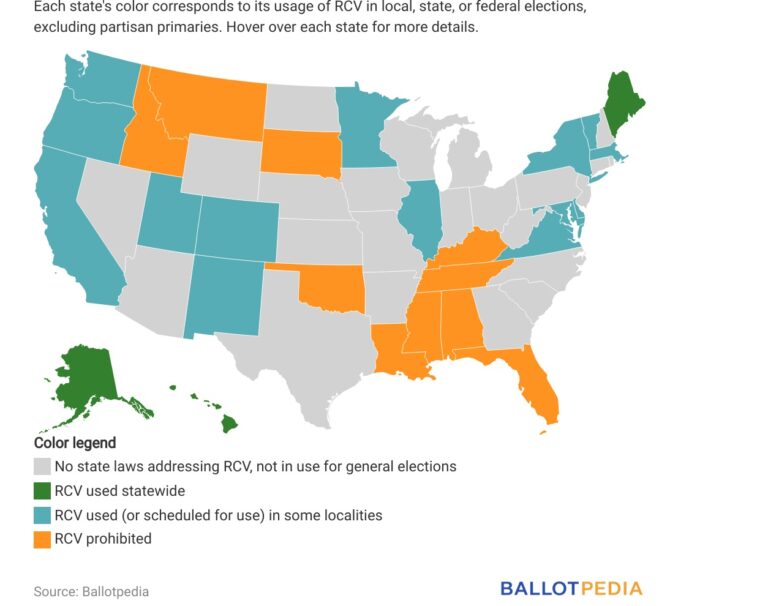
Six states will have measures relating to ranked-choice voting on Nov. 5 ballot

Alaska is not the only state where voters are deciding ranked-choice voting matters on the Nov. 5 ballot.

Colorado confirmed on Thursday that the signatures for Initiative 310, which would create a jungle primary and ranked-choice voting general election — just like Alaska’s — were sufficient to make the Nov. 5 general election ballot.

That means Colorado joins Idaho, Missouri, Nevada, and Oregon in having ballot measures relating to either adopting, repealing, or even pre-empting ranked-choice voting.

“This is the highest number of RCV-related statewide ballot measures on the ballot in any year,” says Ballotpedia, a website that known for high-quality election reporting.

Two more measures — one in Arizona and one in Montana — are also pending, but would require legislative action.

The Colorado, Idaho, Nevada, and Oregon measures would adopt ranked-choice voting. Alaska’s would repeal it, and Missouri’s would repeal or preempt the experimental voting method.

In Nevada, ballot measures go though several stages. Approved by voters in 2022, it now must be approved by voters once again, because it is a constitutional amendment. Then, the Nevada Legislature has to adopt it.

As of now, only Alaska and Maine have adopted ranked-choice voting statewide.

The list of all the measures being considered is at this Ballotpedia link.