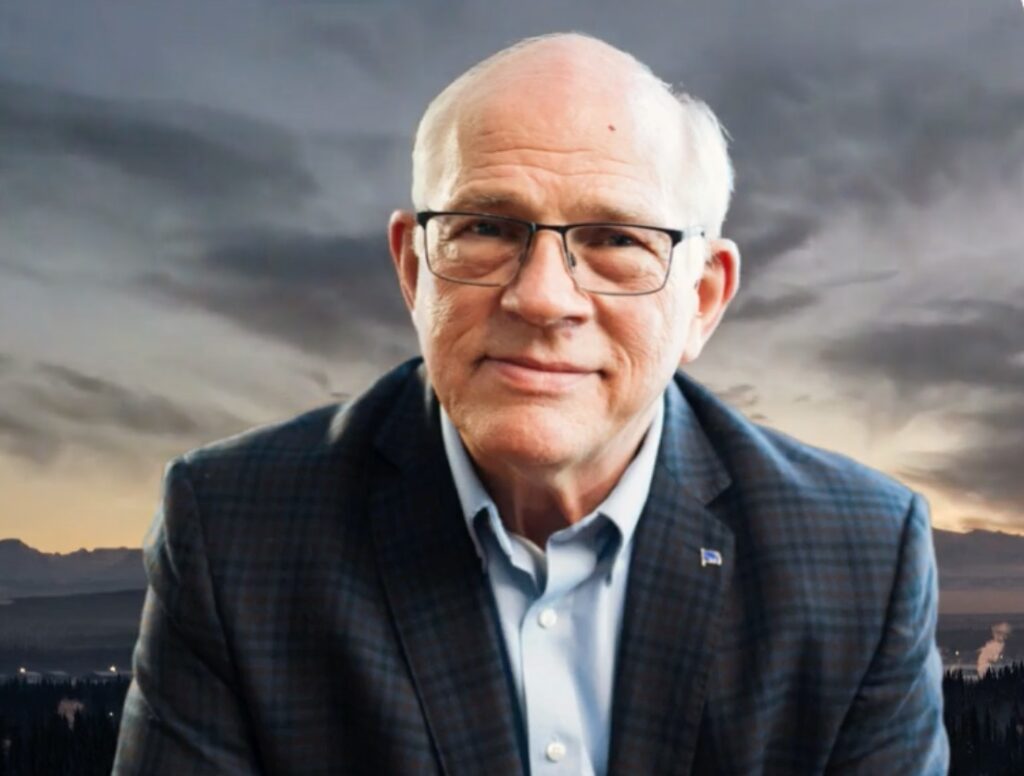
In the race for Assembly Seat G, residents in the Fairbanks North Star Borough have a choice between a tax-pushing public employee — incumbent Kristan Kelly — and a private sector contractor, Jimi Cash.
Both have served on the Assembly but their records are different.
Kristan Kelly is a counselor for the Fairbanks North Star School District. On the Assembly this year, she has served as finance chair, and led to the borough to a budget that was on the brink of busting through the tax revenue cap.
In February, she voted as a member of the Assembly to hold a special election to raise taxes for the school district and never declared a conflict: Her salary comes from the school district.
Even worse, Kelly also participated in the secret “ad hoc” meetings that took place in January over Zoom, a videoconference web tool.
In those meetings, a group of Assembly members and school board employees, organized by School Board President Brandy Harty and Assembly Presiding Officer Savannah Fletcher, worked to draft a set of joint “legislative priorities.”
As the public records request made by Aaron Lojewski revealed, Fletcher was leaving voicemails for members and School Board member Erin Morotti would tell fellow school board members to check their voicemails from Fletcher.
Information among the “formal group,” which included Assembly members Kelly, Scott Crass, and David Guttenberg, among others in a texting chat, was relayed by Morotti in a separate private group Facebook Messenger Chat, which included Assembly member Liz Reeves Ramos. It was a daisy chain meeting, all in violation of the Open Meetings Act.
While the Borough Clerk and attorney Jill Dolan had ruled these meetings were “legal,” and refused to forward to the Ethics Committee, there clearly was a chain of activity that would qualify for violations of the Alaska Open Meetings Act, as well as school board policy in force at the time relating to Ad Hoc Committees and Legislative Committees.
Assemblywoman Kelly was a major proponent of the $33 million animal shelter replacement project, known more widely as the Puppy Palace. In a recent Assembly meeting she discussed how much she loved the current project and voted to give more money to the project, despite the assembly voting earlier to freeze spending on this budget-busting project.
Kelly has a dim view of property rights. She stated in a recent Chamber Forum that if you bought land in the borough, your rights are subject to the needs of the borough, even for recreational trails going through your property. She seems oblivious to the 5th and 14th Amendments that provide assurances to American citizens on their property rights.
Kelly also appears to have violated campaign laws: Her recent ads had to be pulled off the air because certain statements were misleading and involved other campaigns. She has consistently tried to suggest that Jimi Cash was against trails when he actually voted for Trails Plan 2022-47.
Kelly claims she is for economic growth. Her votes show she is for tax growth. Kelly she sees growth of government as the path to growing the economy. She voted against a resolution stating that payment of the Permanent Fund dividend is important to the wellbeing of borough residents and is an important borough priority. She believes having more defined pension benefits for public employees like herself is a borough legislative priority.
In contrast, Jimi Cash has shown himself to be a champion of private property rights and fiscal conservatism in the borough. Cash traveled to Washington D.C. to meet with EPA officials on the subject of air quality to explain to bureaucrats in the nation’s capital that the EPA rules are detrimental to borough residents. Unlike Assemblyman David Guttenberg, who travels on taxpayer dime, Cash used his own funds, not the borough’s. He was successful in getting some of the restrictions on borough residents lifted.
Cash has been a supporter of trails, but wants it done right, respecting the rights of property owners. The original trail plan had some serious flaws that needed to be resolved; Cash voted to support 2022-47 the trails plan after significant changes had been made to protect the rights of property owners.
Cash has been a major supporter of putting property public lands in the hands of private owners. One of the biggest challenges the borough faces is revenue, and yet the borough has kept substantial amounts of land in its possession and not used that land to earn additional property tax revenue.
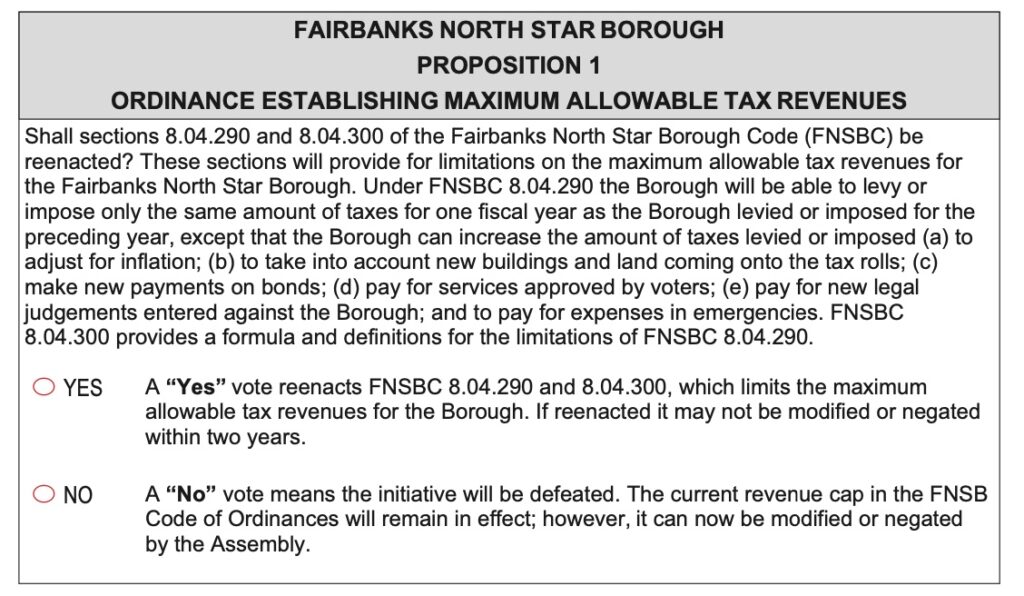
Cash has also supported the tax cap, and favors keeping the government small and efficient. For Cash, the key to economic growth is growth of the private sector, not growth of the government.
All Assembly seats in the Fairbanks North Star Borough are vote on “at large,” which means those who vote can vote on all of the seats. The election ends at 8 p.m. on Tuesday, Oct. 1.
In the Fairbanks North Star Borough, all Assembly seats are elected “at large.” As long as you are registered to vote in the borough, you can vote on a seat. The election ends at 8 p.m. on Tuesday, Oct. 1.
The race for Seat A could determine the balance of the assembly.
Incumbent David Guttenberg, long-time Democrat activist and career politician, argues that the tax cap is broken and needs to be tossed, while in reality he wants government to have an even bigger footprint.
On Feb. 15, he voted with the leftist majority on the Assembly to hold a special election to increase taxes, despite six hours of testimony and hundreds of emails opposing the election.
He was stalwart in his support for enacting “vote by mail” elections in the borough, despite three Assembly meetings filled with testimony opposing it.
Guttenberg then voted for the censure of Assemblywoman Barbara Haney, a conservative, despite the fact that the Ethics Committee had returned a “no punishment” recommendation after a political activist form the left launched a complaint about Haney writing a letter to the editor.
Guttenberg has supported the Marxist Assembly Presiding Officer Savannah Fletcher, a lawyer who fights for radical extremist causes, every step of the way.
Guttenberg uses his position on the Assembly to further his family’s well-known political fortunes. He attempted to use the borough’s attorney to go after the redistricting board to defend his nephew’s district.
Who is that nephew? Mayoral candidate Grier Hopkins, a Democrat who is son of the former mayor Luke Hopkins and who is related by marriage to notorious Alaska election attorney Scott Kendall.
Guttenberg has taken expensive junkets on the taxpayer dime to attend meetings of the Alaska Municipal League. He has been a driving force in keeping the borough involved with other expensive membership organizations, where he uses the platforms to damage conservative elected officials around the state.
Guttenberg, who was in the Alaska House of Representatives from 2003 to 2019, participates in activities that damage the relationship between the borough and the current governor. He was an active in the Recall Dunleavy effort.
He was also an activist with “Friends of Fairbanks Schools for PROP A,” the group that attempted to raise property taxes on local residents and he participated in protest marches to encourage residents to vote to increase their property taxes by $10 million.
Just this month, Guttenberg was on the street corner with a handful of protestors displaying their displeasure with the governor.
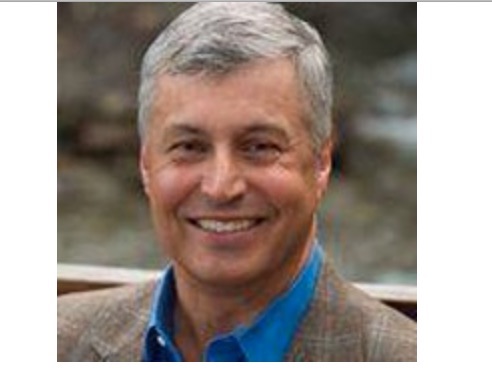
Guttenberg’s opponent is Miguel Ramirez, a retired combat veteran who served with the Marines and the Army with 20 years, including two tours of combat zone in Iraq and Afghanistan.He retired as a logistician, and understands government operations.
Ramirez works for the Department of Defense’s housing office. He has a tremendous knowledge of the needs of military housing in the civilian market. A fiscal conservative and a home owner in West Gate area of Fairbanks, he is new on the political scene. He supports preserving the tax cap and has a reputation for listening to the public.
The voters in the Fairbanks area have a clear choice in this race.
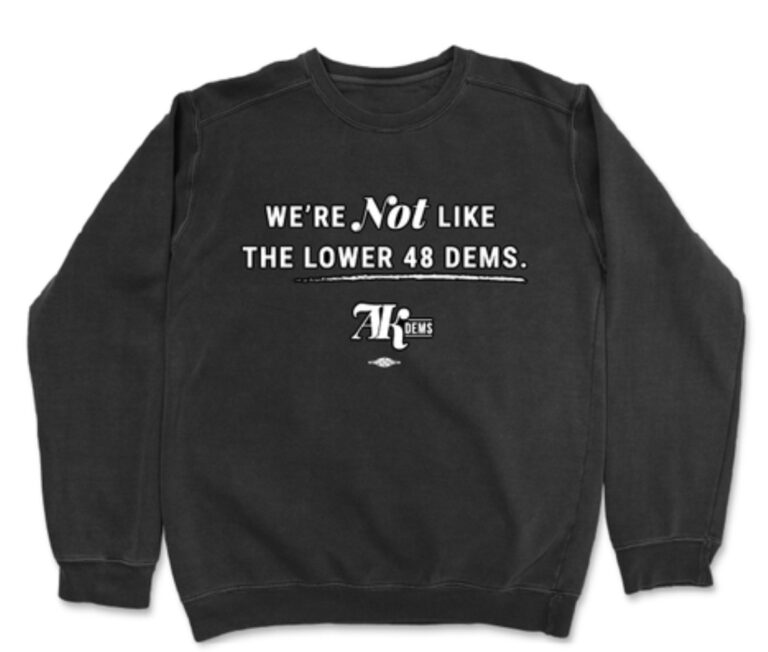
Walter Featherly, running with Alaska Democratic Party support against Republican Rep. Julie Coulombe for House District 11. The Democratic Party hawks shirts with the slogan, “We are NOT like the Lower 48 Dems,” and that’s true, because more and more of their officially backed candidates are like Featherly — not registered with their true party due to its damaged reputation in Alaska.
But Featherly, who claims to be a nonpartisan, has some history of interest to voters who were not in Anchorage in 1992. You won’t find it in his campaign literature or on his official candidate statement filed with the State of Alaska.
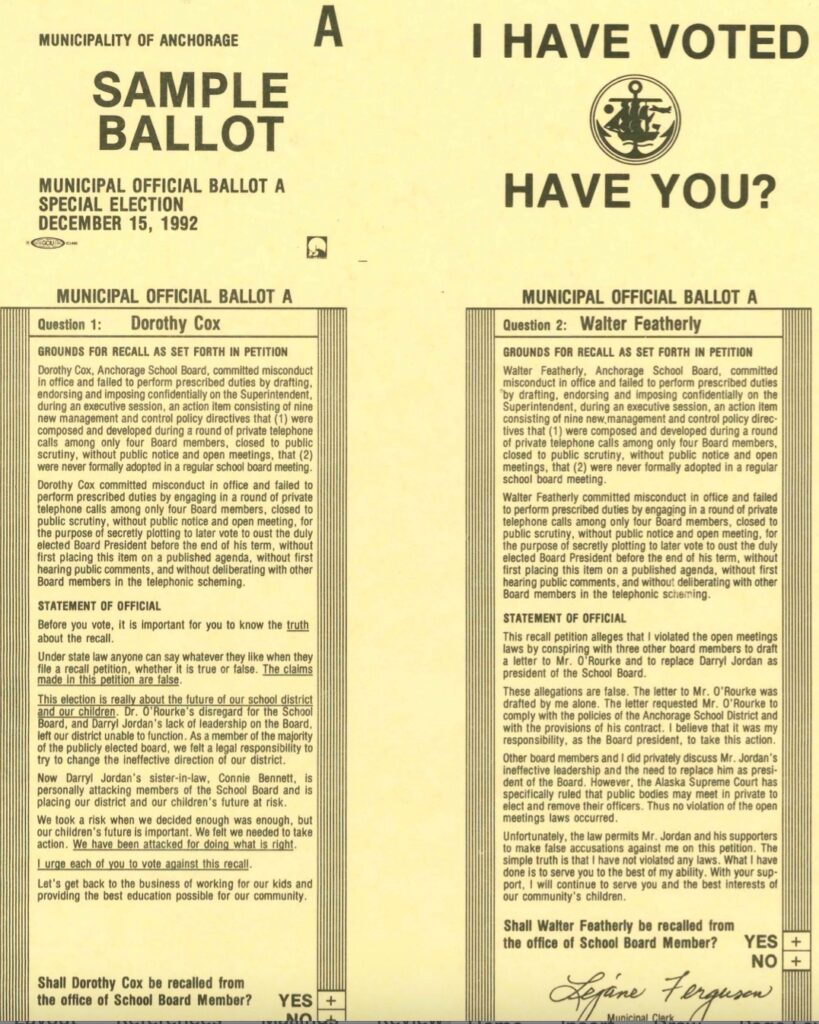
Walter Featherly was recalled by a landslide from the Anchorage School Board for committing misconduct in office through actions that many voters felt were evidence of corruption.
The 1992 ballot question read:
Featherly and two others “misconduct in office and failed to perform prescribed duties by drafting, endorsing and imposing confidentially on the Superintendent, during an executive session, an action item consisting of nine new, management and control policy directives that (1) were composed and developed during a round of private telephone calls among only four Board members, closed to public scrutiny, without public notice and open meetings, that (2) were never formally adopted in a regular school board meeting. Walter Featherly committed misconduct in office and failed to perform prescribed duties by engaging in a round of private telephone calls among only four Board members, closed to public scrutiny, without public notice and open meeting, for the purpose of secretly plotting to later vote to oust the duly elected Board President before the end of his term, without first placing this item on a published agenda, without first hearing public comments, and without deliberating with other Board members in the telephonic scheming.”
It was a landslide of over 70%. Featherly and the two others that year were the only persons ever recalled from the Anchorage School Board.
Featherly challenged the validity of petitions to recall him and lost his case — as well as his elected office. The Superior Court ruled against him in his appeal and the Alaska Supreme Court affirmed the Superior Court’s ruling.
Now, as one of the “poser nonpartisans” who are backed by the Alaska Democratic Party, Featherly wants back in office. He is a lawyer who has worked for Calista Corporation for the past four years and was in private practice for over 35 years before that. His wife, Carol Stolpe, was also one of the school board members who faced recall in 1992 and was bounced from office.
Featherly is among the many rising “nonpartisans” who actually are endorsed by and are working with the help of the Alaska Democratic Party in an effort to fool conservative and moderate voters. Another of the posers is Fairbanks’ Savannah Fletcher, who is running for Senate as a nonpartisan, but is backed by the Democrats.
The “fabulous fakes” like Fletcher and Featherly are revealed in their deceit this earlier Must Read Alaska article:
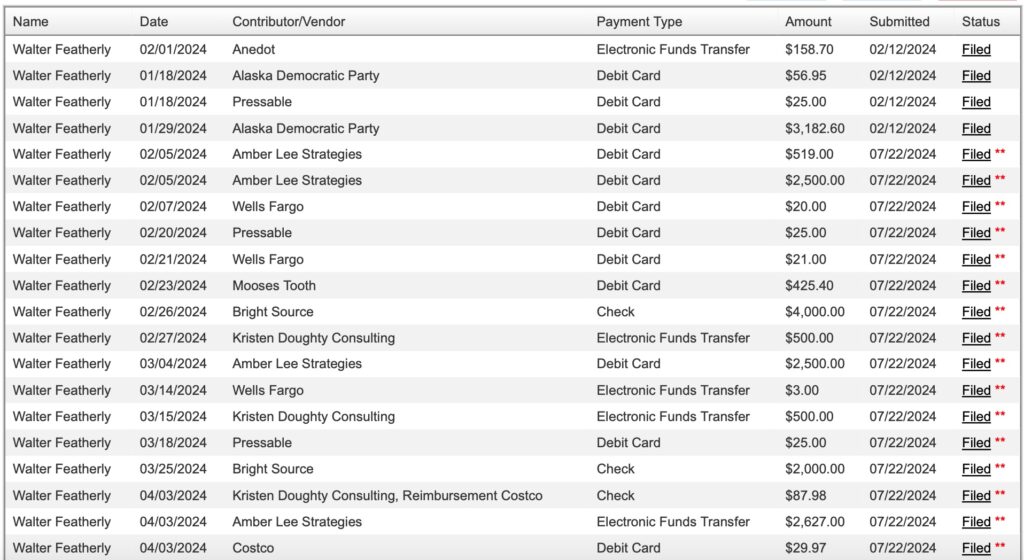
Like Fletcher, Featherlys expenditure report at the Alaska Public Offices Commission shows that he is paying the Alaska Democratic Party for use of the party’s coordinated campaign services:
A snapshot of a portion of Walter Featherly’s campaign expenditure report shows that he is actually a Democrat and using the Alaska Democratic Party infrastructure.
Alaska’s general election takes place starting with early voting in October and ends on Nov. 5. Early voting is Oct. 21 – Nov. 4. All House seats are up for election, as they are every two years. Eight Alaska Senate seats are up for election, as is Alaska’s lone congressional seat.
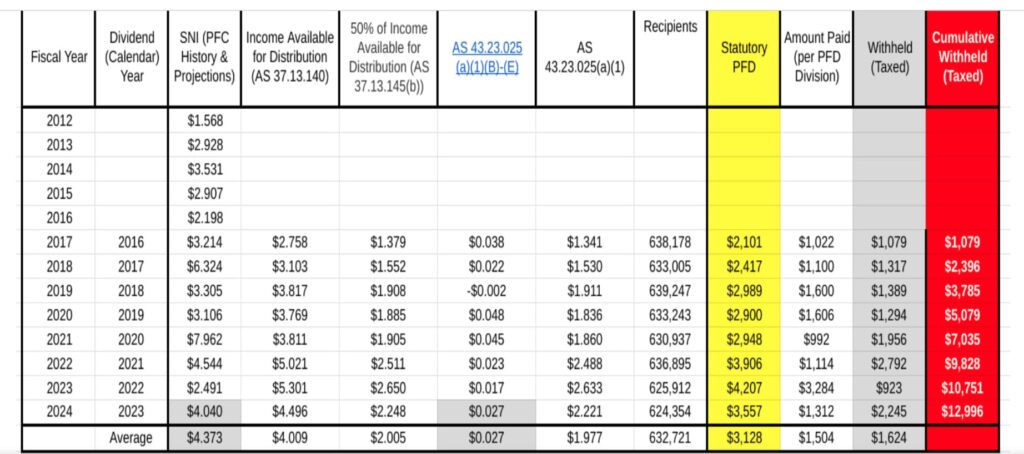
According to the chart below, fully eligible Alaskans are owed $14,619 in Permanent Fund dividend remittances. For a family of four, that’s $58,476.
What’s truly fascinating is that some so-called “conservative” legislators claim the Alaska Permanent Fund Dividend — and the significant loss of revenue to Alaskans—won’t be a big issue in the upcoming election.
Screenshot
Yet, come session time, they’ll spend countless hours wrangling over it, just like they have every year since 2016. So, what’s the real priority? Protecting the bureaucracy, or stopping the Alaska Legislature from reaching into our pockets and snatching what is owed?
The Must Read Alaska column from Sept. 10, written by Rep. Kevin McCabe, reads as a defense of the Legislature’s inaction on the PFD, framing it in a way that echoes statist reasoning.
McCabe’s argument suggests that legislative neglect is justified by broader concerns, harking back to former Gov. Bill Walker’s misleading claims that the state was running out of money and needed to prioritize government functions over fulfilling the full PFD.
The column reflects a familiar pattern of defending cuts to the PFD in favor of protecting the state bureaucracy. And yet since 2016, the state’s operating budget has increased by over 15%.
McCabe defends legislators who vote for budgets that reduce dividends, arguing that these decisions are necessary to address broader state priorities like infrastructure and essential services. His argument highlights the complexity of the budget process and denotes that voting for less than a full PFD should not automatically label a legislator as a “PFD thief.” However, this reasoning downplays the significant financial impact reduced PFD payments have on Alaskans, particularly those in low-income and rural areas. Additionally, the claims of shifting public opinion against full PFD payments lack concrete evidence to support the assertion.
Let’s be frank, the Alaska government has created this struggle to serve its population effectively due to centralization, inefficiencies, and a focus on maintaining the bureaucracy rather than directly addressing constituent needs. This misalignment of values, priorities and ethical disingenuousness undermines the potential for effective governance in a state with unique geographic and economic challenges.
What is startling to me is this is statism — the authoritarian collectivist belief that the state should have substantial control over social and economic affairs, often prioritizing government authority and interests over individual or community benefits. In such arguments, the state’s needs (e.g., infrastructure, bureaucracy, or public programs) are framed as paramount, even when it conflicts with individual benefits, such as the PFD.
The PFD is a cornerstone of Alaska’s political and economic landscape, hailed as a unique model of wealth distribution in the United States. Established in 1980 as a means to share the state’s vast oil wealth with its residents, the PFD has undergone significant changes over the years. The debate surrounding the dividend has evolved from a symbol of Alaska pride and prosperity into a battleground over state spending, with the Alaska Legislature increasingly prioritizing the expansion of the administrative state over providing Alaskans their rightful share of the fund.
Alaska’s vast size and the dispersion of its population — split 66%/34% between urban centers like Anchorage, Fairbanks and Juneau and remote rural communities — make it challenging for a centralized government to effectively address local needs. Centralized decision-making in Juneau fails to understand or prioritize the specific needs of remote areas creating this elitist mentality.
Alaska’s large bureaucracy does not translate to effective service delivery. Alaska’s government faces significant inefficiencies in its allocation of resources, often spending vast amounts on administration rather than directly providing services. This results in high overhead costs and a bloated state apparatus that struggles to effectively manage essential programs like healthcare, education, and transportation across the entire state.
A significant portion of Alaska’s budget comes from federal sources — 56% of its revenue — rather than state-generated revenue. This keeps Alaska in colony status rather than the natural resource juggernaut it rightfully is. Federal revenue reliance on external funding mismanages or mismatches between how money is spent and the actual needs of the population. Additionally, with a bureaucracy dependent on federal grants, much of the focus goes toward securing funds rather than efficiently delivering services to Alaskans.
Instead of streamlining government operations to better serve constituents, Alaska’s government has prioritized growing the administrative state. This includes expanding government jobs, which often benefits urban centers and state workers but doesn’t translate into direct improvements in public services. This growth has been partly funded by reducing the PFD by billions of dollars, frustrating many Alaskans who feel they are being deprived of their rightful share of state oil revenues.
The Alaska Permanent Fund was born out of the Prudhoe Bay oil discovery in 1968, which promised Alaska vast wealth. But there was also a recognition that oil revenues would eventually dry up, leaving the state without a reliable financial foundation.
In 1976, under Gov. Jay Hammond, Alaskans approved an amendment to the state constitution establishing the Permanent Fund. Its purpose was to invest at least 25% of oil revenues for future generations. The fund was designed to act as a savings account, accumulating earnings that would provide a financial buffer when oil production inevitably declined.
In 1980, the Alaska Legislature established the Permanent Fund dividend program, which would pay out a portion of the fund’s earnings directly to Alaskan residents. The program was revolutionary — a government distributing wealth directly to its people rather than filtering it through bureaucratic channels. For decades, the dividend represented a tangible benefit of living in Alaska, a reflection of the state’s unique relationship with its natural resources.
Since its inception, the PFD has faced threats from the Legislature, as lawmakers grapple with imagined growing budget deficits and the spurious pressures of funding government services mostly pontificated by special interests and unions. The tension between using the fund’s earnings to support government programs and paying dividends to Alaskans has become increasingly pronounced in recent years.
In 2016, Gov. Walker made a controversial decision to cut the PFD by nearly half, marking the first time in Alaska’s history that a governor reduced the dividend in response to Chicken Little fiscal shortfalls. This set a dangerous precedent: when the state needs money, lawmakers can tap into the fund at the expense of represented residents.
The Alaska Legislature’s actions since 2016 suggest a preference for growing the state bureaucracy over paying out full dividends. Every year, legislative battles are waged over how much of the fund’s earnings should be allocated to the dividend versus state programs. Due in part to fluctuating oil prices and production, the pressure to divert PFD money into the general budget has intensified. Despite the fact that the dividend was created as a direct benefit to Alaskans, lawmakers have increasingly used the fund as a tool to prop up the state’s growing administrative apparatus rather than directly decrease the size of the bureaucracy.
The Legislature’s decisions on the PFD reflect a broader trend: the prioritization of state spending over individual benefits. The administrative state in Alaska continues to grow, with ever-increasing funding directed toward government departments, salaries, and programs at the expense of the dividend. Meanwhile, the people of Alaska—those whom the fund was originally intended to benefit—are left with a reduced share of the wealth their state generates.
This shift in priorities is particularly striking given the rhetoric of many “conservative” legislators who claim to champion smaller government and fiscal responsibility. While these representatives may speak of reducing government waste and cutting unnecessary spending, their actions regarding the PFD tell a different story.
Year after year, they have allowed the growth of the state bureaucracy while Alaskans watch their dividends shrink. The result is an administrative state that is becoming increasingly entrenched, while the citizens who own the wealth of the state are left with less.
The U.S. Debt Clock, Alaska section, reports the current population at over 730,800, Alaska’s unemployed are 20,899. Alaska’s food stamp (EBT) recipients number over 156,107.
This is over 21% of the state’s population. State revenue amounts to $6.3 Billion, but state spending over $16.6 Billion (remember that monetary heroin injection of 56% federal money) and a debt per citizen of over $13,392. Why do our state legislators choose to ignore the anguish?
The reduction of the PFD has had tangible impacts on Alaskan families, especially in a state with a high cost of living. For many, the dividend represents a significant portion of their annual income, helping to cover basic expenses such as heating, food, and transportation. The decision to prioritize state spending over full dividends disproportionately affects lower-income Alaskans and rural communities, where economic opportunities are fewer, and the cost of goods and services is higher.
It is time for Alaska’s representative government to establish its priorities. Should the state continue to grow its bureaucracy, or should the legislature respect the original intent of the PFD by ensuring Alaskans receive their full share of the wealth generated by the state’s natural resources?
The current trajectory suggests sadly and coldly that, for many lawmakers, the expansion of the administrative state is a more pressing concern than the financial well-being of their constituents.
In the end, the issue is not merely about dollars and cents, but about principles. The legislature must decide whether its role is to serve the people or the state itself.
Michael Tavoliero is a resident of Eagle River and writes for Must Read Alaska.
Elections are about choosing representatives who have the best judgment. On Tuesday, Oct. 1, most boroughs and municipalities around the state hold local elections for city councils, borough assemblies, school boards, and a few ballot measures. Some of these elections have few contested seats. But the Fairbanks North Star Borough is among the more interesting races because the candidates provide a clear choice to voters. And some of the candidates are running on a pro-tax-hike record.
Several candidates running for office in the Fairbanks borough supported the special election held to raise taxes, which was overwhelmingly defeated by voters.
A few of of them also have a history of sticking with Democrat policies and partisan attacks, such as supporting the failed 2019 recall of Gov. Mike Dunleavy.
Past policy positions taken by candidates are often a good indicator of the sort of policies they will support in the future.
The FNSB Assembly majority voted to spend $33 million on an animal shelter (puppy palace), before turning around and asking voters to increase taxes and blow through the tax cap, all in the name of education.
Which candidates voted to fund the palatial animal shelter? Incumbents Kristan Kelly, David Guttenberg, and Garrett Armstrong supported the $33 million animal shelter, as did Savannah Fletcher, who is now running for state Senate.
The cost of living in Fairbanks is already 24% higher than the national average.
To compare the cost of building animal shelters around the Northwest, 10 years ago an animal shelter was built in Bellingham, Washington for the cost of $2.6 million.
In 2017, Boise, Idaho built a 42,000-square-foot animal shelter for $15 million. And in 2022, Kootenai Humane Society in Coeur d’Alene, Idaho built a new $8 million, 20,000-square-foot animal shelter.
The animal shelter authorized by the Assembly majority in Fairbanks is 17,737 square feet for $33 million, something the liberal Assembly members signed off on, with only two members voting against — Barbara Haney and Brett Rotermund.
As for the increased $10 million in taxes sought by the liberals on the Assembly, incumbent Assembly candidates David Guttenberg and Kristan Kelly, and Savannah Fletcher (now running for Senate) fully supported the special tax election and actively campaigned for borough residents to raise their taxes this year.
The ordinance to hold that special election,2024-07, was sponsored by Fletcher, Nick LaJiness, and Scott Crass. Only Fletcher is a candidate this year among those three sponsors.
The measure passed the Assembly, despite nearly six hours of testimony over two Assembly hearings in opposition to the special election ordinance.
Morgan Dulian, who led the tax-raising push, testified before the Assembly in March her desire to raise taxes on tourism and marijuana, and property.
The election, held at a cost to taxpayers of at least $130,000 on May 7, would have allowed the borough to take another $10 million from property owners in the borough, where property owners already pay an average of $3,531 each to the borough every year. Voters delivered a landslide against the Assembly majority’s desire for more money.
Now Dulian is running against April Smith for Fairbanks North Star Borough School Board. Dulian’s lead role in enacting higher taxes suggests she will do all in her power to do so, if elected.
To understand where Morgan Dulian is on the political spectrum, she is a registered nonpartisan but in 2019, she signed the petition to recall Gov. Mike Dunleavy, who Democrats were trying to get rid of within weeks of his election in 2018. The Democrats found fault in how he approached a judicial appointment, when he was given the names on only liberal lawyers by the Alaska Judicial Council.
The list of candidate on the Fairbanks North Star Borough ballot signed the Recall Dunleavy petition in 2019:
State Senate candidate Savannah Fletcher, registered nonpartisan but financially supported by Democratic Party
Fairbanks North Star Borough Assemblywoman Barbara Haney, targeted for legal harassment by leftist Presiding Office Savannah Fletcher, has filed a supplemental court brief to her original appeal with the Superior Court, to further assert her innocence in a case involving ethics.
Haney had been fined $1 for an ethics violation by her fellow Assembly members. Her offense? She had written a letter to the editor without saying “this is my opinion as a private citizen.”
Haney’s supplemental filing said, “Assemblywoman Haney did not violate FNSB 6.12.010(O)(2) as entered by Assembly Presiding Officer Savannah Fletcher on July 26, 2024. This code allows Haney to express a personal opinion through a public statement which she did in a letter to the editor through the Fairbanks Newsminer.”
In the filing, Haney detailed the actual and substantive conflicts of interests of some of the Assembly members and exposed the cavalier disregard to fairness in the way conflicts are treated by the Assembly’s presiding officer.
Haney is a conservative in an Assembly led by radical Savannah Fletcher, who works as an attorney for leftist organizations in Alaska. Fletcher is running for state Senate now.
The Ethics Committee that convened to hear the “no letter to the editor allowed” complaint that had been brought by a financial backer of Fletcher, had deliberated and recommended no punishment for Haney over the letter to the editor.
But the Assembly, in spite of its own conflicts of interest, decided a censure was in order, along with a nominal fine, meant to tar the record of Haney and damage her in the public eye. Haney says the censure is purely political retribution against her conservative stances defending taxpayers in the community.
Fletcher has a financial relationship with the filer of the ethics complaint, Kristen Schupp, the wife of another leftist activist, school board member Bobby Burgess.
According to Haney’s account, during the time the complaint was filed, Fletcher was running for borough mayor and significant donations to Fletcher’s campaign had been made by both Schupp and Burgess, totaling nearly $5,000.
These cash donations for her Senate campaign occurred 10 days before the Ethics Committee hearing. Previous large donations had been made by Schupp to Fletcher’s mayoral campaign.
Haney asserted in her court filing that Fletcher should have recused herself, since she had received significant financial support for her campaign from the very person filing the complaint against Haney, in violation of Alaska Statute 29.20.010. Under state statute, it is incumbent on the person with the conflict to recuse themselves if they have a significant financial conflict.
Haney also detailed conflicts of other members involved.
Mindy O’Neal, the deputy presiding officer, also had conflicts, having written several opinion columns and letters to the editor for the News-Miner herself, and none of them contained the language that stated she was only offering her own opinion not the opinion of others.
Because O’Neal had this conflict — having committed the same “offense” but not ever facing the same sanctions, she should not have been able to rule on Fletcher’s conflict or vote on the matter. Neither Fletcher nor O’Neal should have been able to preside over the meeting, Haney has asserted.
Haney also detailed how two other members had conflicts and should have recused themselves. Those members did declare conflicts, but the Presiding Officer Fletcher, who had the option to drop the entire matter, ruled that they had to vote on the censure.
According to Haney’s filings, if the conflicts of interest been observed as they should have been under state statute and borough code, the outcome would have been quite different.
The advice of Fairbanks Borough Attorney Jill Dolan also fell short. Dolan failed to include other options when she was advising the Assembly. Instead, she kept insisting that a penalty be issued against Haney, even when the Ethics Committee clearly did not recommend one.
The blatant disregard for conflicts on the Assembly has been a serious issue this year. For example, Assemblywoman Kristen Kelly, who is an employee of the school district, was the chair of the finance committee, which determines matters that relate to how the school district is funded through property tax dollars. Assemblyman Scott Crass is a steward for a public employees (ASEA) union, yet was allowed on union contracts of the borough employees.
I was born here in 1960, and have worked at our 79-year-old family business full time since 1978. I have lived through the 1967 flood, the pipeline, and the mid-1980s real estate crash. In other words, I’ve lived the good times and the bad.
I recall my dad telling me in the 1970s, as John Butrovich walked out of our retail business, “that’s the only honest politician I’ve ever met.” I never forgot that, and over the years I put a lot of thought into what it takes to be both honest, and a politician. With all the political pressure, lobbyists, special interest groups, campaign contributions, and the like, I’ve watched people that I’ve supported bend to these pressures, and lose focus on what they stepped into the ring for in the first place.
Fifty years later, I think back to those words my dad said on our showroom, and I put a lot of emphasis in the character of the candidate, and not the promises they make along the campaign trail. So when I get ready to cast my vote, I look at that persons past, his or her values, and most importantly to me, their character.
John Coghill
In 2012, I watched a Republican State Senate candidate run against a Democrat, the head of a local union. It was a highly contested race, with two decent men, both candidates with strong convictions and vastly different positions on state finance, and their priorities if elected.
Just a day or two before the election, I was driving in downtown Fairbanks on the way to a doctor appointment. I hadn’t voted, but had a good idea of who I wanted to vote for.
As I approached a busy intersection, I saw 20-30 union employees holding signs for their union boss, who was also part of that sign-waving party. It was the middle of the day, and in the middle very busy construction season. I wondered where his opponent was, until I got to my doctor appointment. There, in the lobby, was that candidate. He was taking his elderly father, who was in a wheelchair, to his doctor’s appointment. The man in the chair had also been a political figure in Alaska. In fact, he had been a mayor, a state senator, and a lieutenant governor. He was a key player in authoring the Alaska State Constitution in 1955. But now he was ill and needed help from his son.
As I sat there in the lobby watching John Coghill putting the care of his dad, (Jack Coghill), in front of politics, it struck me. I want someone to represent me that cares less about being in the political spotlight than looking after his family.
Fast forward a dozen years later. John Coghill has watched with the rest of us the decline of our borough. From school curriculum, to Taj Mahal animal shelters, to parental rights, and mixed gender sporting events. So John decided to throw his name into the hat for North Star Borough mayor.
He was already a very busy guy, working at the Fairbanks Rescue Mission helping unfortunate Fairbanks folks try to get back on their feet and turn their lives around. But John knew he had the skills, patience, and experience to help the Borough get back on its feet. To turn it around. To get a handle on out of control spending. And to bring a level of calm and competence to a Borough that has made headlines with its childish actions.
Last week I was speaking with John Coghill at a luncheon event, and he was apologizing for not knocking on doors like he would have wanted to during this campaign. No, it wasn’t because of an injury.
“God has recently blessed me with three young children that needed to be fostered”, John told me. “I had to be there for them.”
That reminded me of an old Bear Bryant quote. “Show class, have pride, and display character. If you do, winning takes care of itself.”
Craig Compeau is a 64-year resident of Fairbanks and the owner of Compeau’s, a four generation family marine and powersports business.
A bipartisan Senate report released Wednesday blasts the U.S. Secret Service for several significant failures that led to the near-fatal assassination attempt against former President Donald Trump in Butler County, Pennsylvania, over the summer.
The bipartisan report indicates that security knew the shooter was on the roof minutes before Trump was shot.
Meanwhile, a bill that would increase the Secret Service protection for former President Donald Trump and his running mate, Sen. J.D. Vance, now awaits President Joe Biden’s signature.
The new Senate report lays out a litany of failures from the Secret Service, including failure to delegate responsibilities to agents and officers, failure to keep the key buildings cleared, failure to work will with local law enforcement, who were helping with security, and more.
The report includes a list of failures, including that the Secret Service did not properly respond after the would-be assassin was identified as a suspicious person over an hour before Trump took the stage.
A stunning paragraph from the report lays out the gravity of some of the mistakes:
“Approximately two minutes before shots were fired, the USSS Security Room, located on the rally grounds, was told that there was an individual on the roof of the AGR building,” the report said. “Shortly before shots were fired, a USSS counter sniper observed local officers running towards the AGR building with guns drawn.”
Critics have blasted the agency from its poor planning of the event, its slow and clumsy response and its unwillingness to share details publicly after the incident. The former head of the Secret Service resigned after a disastrous Congressional hearing on the issue where lawmakers from both sides took her to task.
The report also said an inexperienced agent had trouble getting the drone working and spent hours calling a tech support hotline for help. The agents apparently also had problems with their radios, something that is common, according to the repot.
“From planning missteps, to the siloed and flawed communication to the lack of effective coordination between law enforcement, to the breakdowns in technology, the Secret Service’s failures that allowed an assassination attempt on former President Trump at his July 13 rally were shocking, unacceptable, and preventable – and they led to tragic consequences,” said Chairman Sen. Gary Peters, D-Mich.
Ever wonder why your representative voted in opposition to an issue supported by a majority of his constituents? It may be because he is secretly more accountable to illegal donors than he is to his voters.
Recent research by Vote Your Vision, a national election integrity organization, suggests that illegal campaign contributions through identity theft are much more common than is generally known, and are likely the largest factor undermining the quality of democratic representation provided by our politicians.
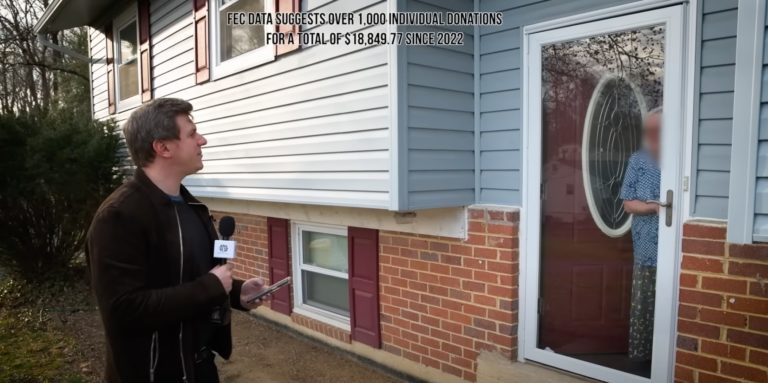
“Smurfing” is a money laundering technique where large sums of illicit money are broken down into smaller, less noticeable transactions to evade detection by regulatory authorities. Recently, there have been numerous reports that smurfing has been used to launder illegal contributions to political campaigns through identity theft.
Criminals do this by identifying someone who made contributions in the past (usually a senior citizen), and then they make hundreds or thousands of small dollar donations in that person’s name to a particular campaign or candidate, thereby evading campaign contribution limits.
Tens of thousands of people across the country are victims of this form of identity fraud in every election cycle, and thousands of candidates (whether knowingly or not) have benefited from these types of illegal contributions.
Read the entire story at Chronicles of American Culture at this link:
Editor’s note: Check the list of high frequency donors in Alaska at this link. Use the tool to drill into Alaska information on those who have made more than 100 donations to campaigns and follow the links to the FEC file on the donations and where they went. Is your name on the list? If so, have you been smurfed?