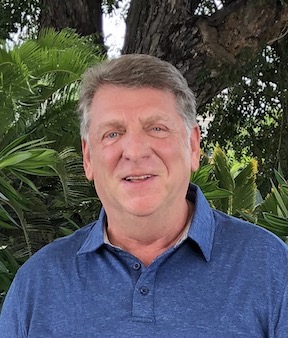
David Rubenstein, former husband of the most recent owner of the Anchorage Daily News, has been chairman of the board of the Kennedy Center for the Performing Arts for 14 years.
President Donald Trump says he’s replacing Rubenstein — with himself.
Trump is also replacing other board members, although it’s unclear which ones. He wants the Kennedy Center to reflect a different vision.
“I have decided to immediately terminate multiple individuals from the Board of Trustees, including the Chairman, who do not share our Vision for a Golden Age in Arts and Culture,” he said. “We will soon announce a new Board, with an amazing Chairman, DONALD J. TRUMP!”
Rubenstein came into prominence in politics as an aide to former President Jimmy Carter.
He devised a way to squeeze money out of Native Corporations after they were created by the Alaska Native Claims Settlement Act. It was a tax loophole — selling net operating losses — and Rubenstein’s method became known as the Great Eskimo Tax Scam.
After making millions of dollars, he started the Carlyle Group, a private equity investment firm, and became one of the wealthiest men in the world.
The Caryle Group is a leader in promoting diversity, equity, and inclusion (DEI) investing. Founder Rubenstein remains one of the most influential men in Washington, D.C., but his ties to Alaska go farther than the Great Eskimo Tax Scam. For a while, the Carlyle Group managed a small portion of the Alaska Permanent Fund.
In 2009, David’s then-wife, Alice Rogoff, purchased the start-up news website the Alaska Dispatch, and later she bought the Anchorage Daily News for $34 million and combined the two publications, before driving the entire enterprise into bankruptcy court in 2017, about the time she and David divorced.
Their daughter, Gabrielle Rubenstein, was appointed by Gov. Mike Dunleavy to serve on the board of the Alaska Permanent Fund. She left the board last year after news got out that she was seen to be meddling in the day-to-day business of the Permanent Fund, reaching her hand into specific decision making by the professional staff — not an appropriate thing for a board member.
Before former President Joe Biden left office, he awarded David Rubenstein the Presidential Medal of Freedom, the nation’s highest civilian honor.
At the Anchorage Assembly meeting on Tuesday, the Assembly will consider a proposed ordinance that would expand liability to parents, foster parents, and guardians of minors who bring deadly weapons to school grounds or to school functions. The law might even be applied to babysitters or friends who are taking care of a child while parents are out of town.
According to the proposed ordinance, in 2023 5.6% of Alaska students and 3.5% of Anchorage students reported having carried a weapon to school on at least one day in the 30 previous 15 days.
The ordinance explains that any deadly weapon that a child has on school grounds will lead to the prosecution of the parent or guardian, if the parent or guardian had the weapon in their possession originally and didn’t secure it or store it properly, but stored the weapon “in a criminally negligent manner.”
This could apply to an elderly grandparent who is raising children due to some type of family dysfunction or tragedy. A knife taken from a kitchen drawer or a nail gun taken from the garage of that grandparent could qualify, and the grandparent or guardian could be charged as though he or she had brought the knife on campus.
The same could hold true for a boxcutter, hatchet, or other item that could be seen as a deadly weapon.
The ordinance raises constitutional and legal questions.
The Alaska Constitution says, “The individual right to keep and bear arms shall not be denied or infringed by the state or political subdivision of the State.” The Bronga ordinance appears to violate the Constitution by infringing on constitutional rights.
There is also state law that says no political subdivision can have a more restrictive law on firearms than the state itself has in law.
AS 29.35.145 Regulation of firearms and knivessays “The authority to regulate firearms and knives is reserved to the state, and, except as specifically provided by statute, a municipality may not enact or enforce an ordinance regulating the possession, ownership, sale, transfer, use, carrying, transportation, licensing, taxation, or registration of firearms or knives, unless explicitly allowed by state law.”
There are very few exceptions to this state statute. Municipalities can enact ordinances that are identical to state law and carry the same penalties as those established by the state, but cannot make the local ordinances more restrictive. Ordinances cannot infringe upon the right to bear arms as guaranteed by the Alaska Constitution.
It’s unclear how Bronga was able to get the Assembly’s legal staff to sign off on an unconstitutional provision that would most certainly draw a legal challenge.
Paying youth members
The Assembly also will vote on making the youth members on the Assembly into paid positions.
Chairman Chris Constant offered the resolution that will pay youth representatives $2,000 each. There are three youth representatives, for a total of $6,000 to be expended.
Youth voter registration drive
The youth members on the Assembly will also ask the Assembly to request that the Anchorage School District hold a voter registration drive to encourage participation in regular municipal elections, which occur in early April. Voter registration drives are uncommon in Alaska since more than 116% of the population is already registered to vote, due to things like automatic registration with Permanent Fund dividend applications and drivers license applications. The effort to register more youth may be seen as yet another distraction from the school district’s core mission of teaching, which it is failing at, by every measure.
The Anchorage Assembly meets on the ground floor of the Loussac Library on 36th Ave., with the meeting starting at 5 p.m. and lasting typically until about 11 p.m.
President Donald Trump on Sunday said that the penny is a waste of government time and … er … money.
“For far too long the United States has minted pennies which literally cost us more than 2 cents. This is so wasteful! I have instructed my Secretary of the US Treasury to stop producing new pennies. Let’s rip the waste out of our great nations budget, even if it’s a penny at a time,” he wrote on his social media account.
It’s estimated that it costs the U.S. Mint 3.07 cents to produce one penny — more than three times its face value. According to JM Bullion, the U.S. Mint lost $179 million in 2023 due to penny production.
The debate over whether to continue minting the penny has gone on for years. In production since 1793, it’s kept in circulation due to its sentimental value, not its actual value.
In January, President Donald Trump signed an executive order restricting “transgender” procedures on youth, including puberty blockers and surgeries such as mastectomies and penile reconstruction. In response, many medical providers including some of the top in the nation for performing them have announced they will comply with the EO.
The EO states that “it is the policy of the United States that it will not fund, sponsor, promote, assist, or support the so-called ‘transition’ of a child from one sex to another, and it will rigorously enforce all laws that prohibit or limit these destructive and life-altering procedures.”
Last year, nonprofit Do No Harm unveiled a database reporting that between 2019-2023, there were 13,000 gender reassignment procedures performed throughout the nation on minors; those procedures included both surgeries and prescriptions. Among the top states in the nation for those procedures was Ohio, which has since enacted legislation banning such procedures.
The Center Square reached out to more than two dozen medical providers throughout the country based on data provided by Do No Harm regarding their total billing, prescriptions, and surgeries performed, asking them how they planned to respond to Trump’s EO.
UW Medicine stated in an email that it was “committed to supporting the clinical care needs and well-being of all our patients, as well as complying with state and federal law. We are currently in compliance and are also continuing to provide our full spectrum of services.”
Seattle Children’s Hospital ranked among the top in the nation for puberty blocker prescriptions; though it did not respond to request for comment, there have been reports that it has suspended those services, and its webpage for gender affirmation surgery has since been removed.
MultiCare Mary Bridge Children’s Hospital located in Tacoma wrote in an email that while it does not perform gender-affirming surgeries, “we are aware of the executive order that calls for an end to gender-affirming medical treatments for children and adolescents under 19 and are continuing to monitor the situation. Executive orders are directives to federal agencies on how they will operate. Much of what’s been issued has not yet become rules for us to evaluate.”
D.C.-based Children’s National Hospital released a statement that it will no longer prescribe puberty blockers or hormone therapy, noting that prior to the EO it did not perform gender affirming surgeries.
Coolie Dickinson Hospital based out of Massachusetts wrote in an email that it “is reviewing to see what, if any, actual impact the executive orders might have and would follow up, if there is any impact. In the meantime, the care we provide to our community continues as normal at this time.”
University of Michigan Health stated that its “teams are assessing the potential impact of this executive order on our healthcare services and the communities we serve. Our priority remains delivering high-quality, accessible care to our patients while ensuring compliance with the law.”
Another medical provider to cease gender transition services for anyone under 19 is VCU Health and Children’s Hospital of Richmond, Virginia, which wrote in a statement that it was “in response to an Executive Order issued by the White House on January 28, 2025, and related state guidance received by VCU on January 30, 2025. Our doors remain open to all patients and their families for screening, counseling, mental health care and all other health care needs.”
UCSF’s Gender Affirming Care in San Francisco has also ended services for patients under 19, a policy also adopted by Children’s Hospital of Los Angeles.
Mount Sinai Medical Center in New York simply wrote in an email that “we will keep you posted once we have an update on this matter.”
Ann & Robert H. Lurie Children’s Hospital of Chicago and the Children’s Hospital of Philadelphia both said they were reviewing their services.
Several hospitals and hospital systems who performed these procedures on minors did not respond to The Center Square’s requests for comment on the executive order. The Center Square will continue to seek clarification on whether they plan to comply with the order.
It’s the Super Bowl of mushing in Western Alaska … and we have a winner.
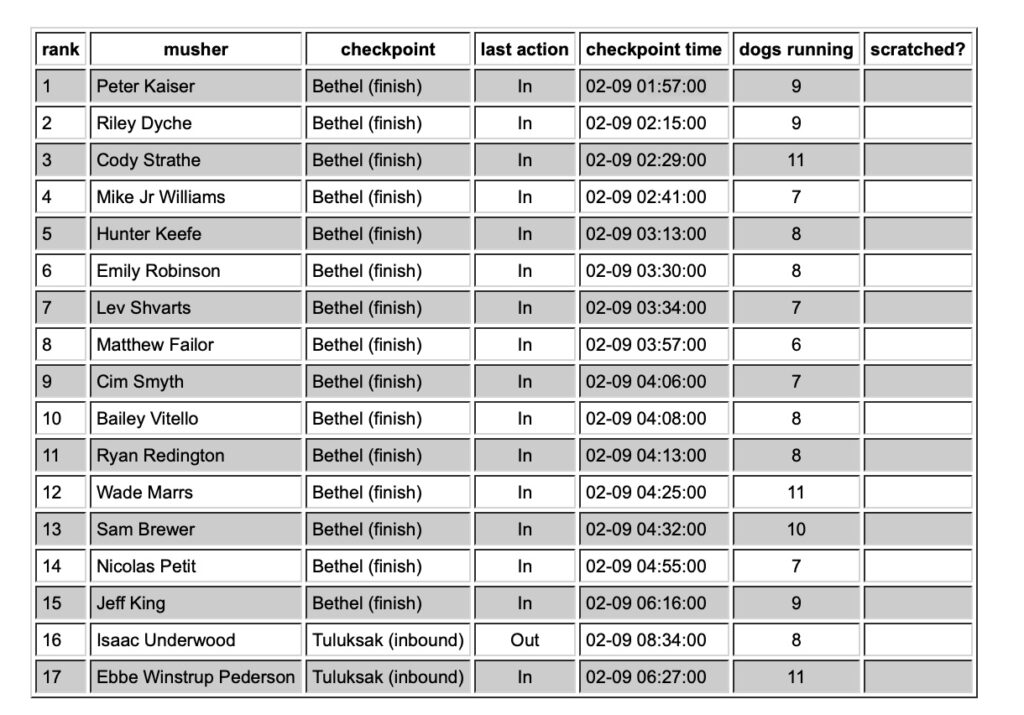
Bethel musher Pete Kaiser has won his ninth Kuskokwim 300 title, sledding into Bethel at 1:57 a.m. on Sunday. Only legendary musher Jeff King has the distinction of that many wins of the K300.
Kaiser was followed in by Big Lake musher Riley Dyche, who crossed the finish line about 18 minutes later.
The race start time was moved up by seven hours to start on Saturday afternoon due to an expected warm front moving in, which could make conditions more challenging as racers went from Bethel to Aniak and back.
Kaiser gets about $30,000 of the $200,000 purse, which is all raised locally through pull-tabs and other donations, as well as merchandise. Because it does not depend as much on national sponsors, like the Iditarod Sled Dog Race does, it is a stable regional race. Many of the race’s sponsors are Alaska businesses.
The K300 is one of the qualifiers for the more internationally known Iditarod Sled Dog Race, which starts in 21 days.
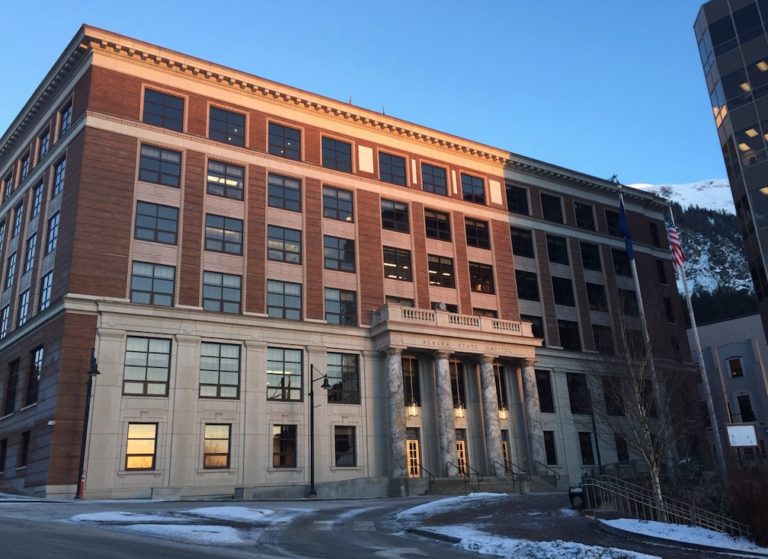
The Alaska Senate has voted unanimously against a proposal from a state commission that would have linked legislative and executive branch salaries to an inflation index. The Senate, by passing Senate Bill 87, will keep salaries stagnant for the political class of state employees.
SB 87rejects recommendations made by the State Officers Compensation Commission. The commission had proposed automatic salary adjustments every two years, tied to the Anchorage Consumer Price Index, beginning after the 2026 state election. Salaries could go up, or even down, depending on the CPI.
SB 87 will be considered in the House, where it is also expected to be passed, putting a knife in the salary proposal for at least another two years.
Currently, Alaska legislators earn an annual salary of $84,000, as well as per diem payments of about $37,000 for most members, except for the three who reside in Juneau. The governor is paid $176,000, the lieutenant governor earns around $140,000, and department commissioners are paid approximately $168,000. Executive branch salaries have remained the same since 2011.
The salary commission was attempting to insulate politically sensitive positions from political winds of the day.
Past commission proposals have met varying fates. In 2009 and 2011, legislative inaction allowed salary increases for legislators, department heads, the governor, and the lieutenant governor to take effect. However, the Legislature rejected executive salary increases recommended in 2014. A 2016 policy permitting deputy commissioners to retain higher salaries upon promotion was implemented, but no changes were proposed in 2020.
In 2021 and 2022, the commission conducted multiple reviews and found that salaries had not kept pace with inflation, emphasizing the need for adjustments. Nonetheless, the Legislature remains hesitant to approve automatic raises, citing concerns over fiscal responsibility and political optics amid ongoing budget challenges.
If the House votes in favor of SB 87, salaries will remain unchanged.
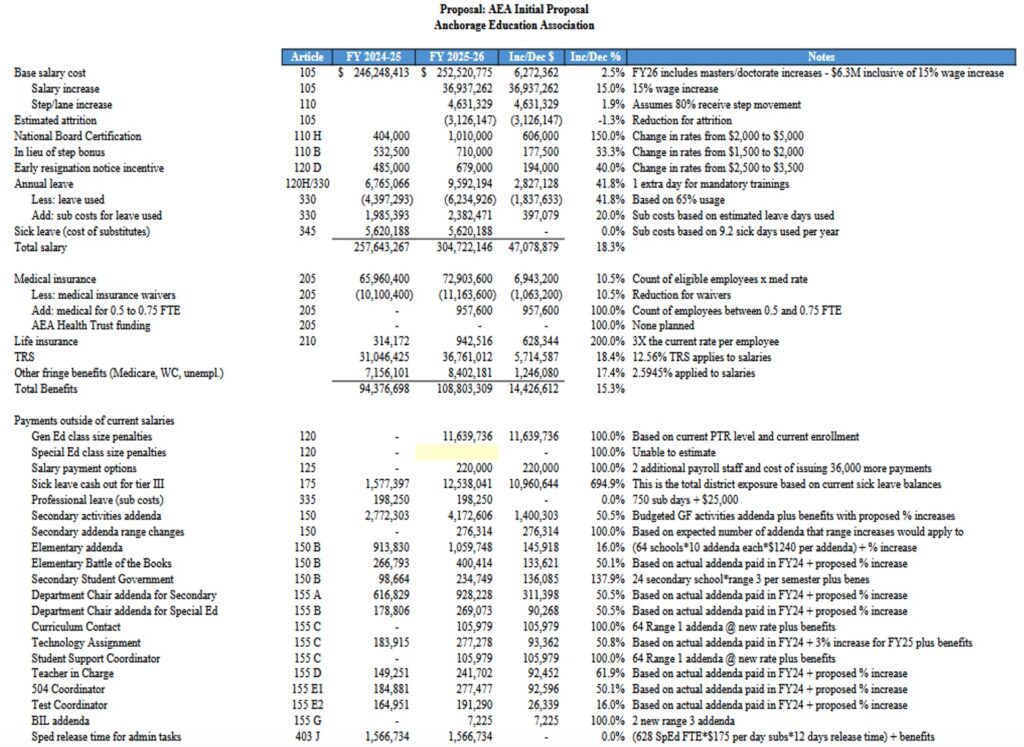
The Anchorage Education Association and the Anchorage School District have been negotiating a new contract since November. An analysis of the going-in position shows that the teachers’ union wants an amazing 15% across-the-board base salary increase for its nearly 3,200 members.
This union, an affiliate of the National Education Association, includes classroom teachers, non-classroom teachers, nurses, librarians, psychologists, librarians, physical therapists, and occupational therapists.
Just the 15% base salary increase would cost the district an additional nearly $37 million.
This salary increase would be for all AEA union members, regardless of their job performance. For example, a mediocre teacher would get the same pay raise as an outstanding and effective classroom teacher. There is no difference in compensation between the good and the not-so-good.
Has anyone else received a 15% salary increase not related to merit in the past year?
But there’s much more in the goody bag for the union members. The union also wants an additional annual 5% of salary for any member that has a doctorate degree. This would be an increase from the previous contract of 3%.
A member that has a master’s degree would get an additional 3% of salary annually. This was 1.25% in the previous contract.
Perhaps the worst part of rewarding a member with advanced degrees is those degrees don’t have to be in the person’s current subject area of teaching. The union wants to delete that requirement from last year’s contract.
One could get an advanced degree in gender studies; puppetry; or diversity, equity and inclusion (DEI) and get a substantial bonus.
This does not help improve student achievement.
There are other factors in the teacher’s union proposal that increase the cost to the district. The total increase in salary type items is $47,078,879.
One of the highest costs to the district is health insurance. This year the district pays nearly $66 million just for the teacher union members’ health insurance. Now the union wants an additional $6.9 million by requiring the district to increase the annual per member premium from $22,800 to $25,200. Health insurance is unsustainable. It would be much more cost-effective for all district employees to be placed on the State’s “Alaska Care” plan.
The AEA wants to increase the number of its members qualifying for health insurance by allowing the part-timers (.50 full-time equivalents) to enroll. This would add another nearly $1 million to the district’s cost.
All these insurance premiums go to the Public Employee Health Trust, managed by, guess who? The teacher’s union!
Notably, in the last Legislature, Rep. Sarah Vance sponsored House Bill 21, and Sen. Shelley Hughes filed Senate Bill 110 that would have allowed school districts to put their employees in the state’s health insurance plan. The Kenai Peninsula Borough School District and the Ketchikan Borough School District both supported this legislation, knowing that health insurance costs were unsustainable.
Similar health insurance legislation that was filed in past legislatures received support from four of the big five school districts. Only the Anchorage School District did not support the bills.
The union also wants to play a role in establishing state law by limiting the pupil/teacher ratio. Because the district is losing so many students the teachers union will probably be losing members. Thus, the union has decided to put limits on the number of students per teacher. This would increase union membership and power.
Here are some of the pupil/teacher classroom ratios the union wants to limit, and the penalties assessed to the district:
GRADE
CLASSROOM SIZE LIMIT
COST TO DISTRICT
PreK
18 students
$250/student/month
Kindergarten
20 students
$250/student/month
Grades 1-3
22 students
$250/student/month
Grades 4-5
25 students
$250/student/month
For example, if a third-grade classroom has 25 students, the teacher would get $750 more per month. That would be an additional cost to the Anchorage School District (taxpayers) of $9,000.
Here are the pupil/teacher classroom ratio limits the union wants on secondary classrooms and the increased cost to the district:
INSTRUCTION TYPE
TEACHER WORKLOAD
COST TO DISTRICT
General Education
140 students
$50/student/month
Physical Education
200 students
$50/student/month
For example, if a high school teacher has more than 150 students in his Algebra classes for five class periods (averaging 30 students per class), that teacher would receive another $500/month, at a cost of $4,500 to the district.
These are just a few of the class size limitations the union wants to force on the district.
The district has done an excellent job of costing out the entire teacher union contract proposal, so taxpayers can see the projected total cost to the district.
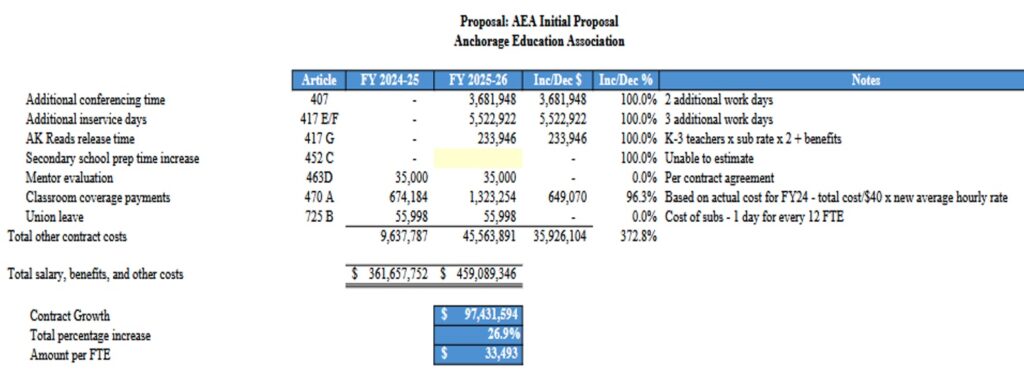
That total cost is more than $97.4 million, an increase of 26.9% over the current contract and at a cost of $33,493 per full time equivalent worker.
That’s roughly 57,245 Permanent Fund dividends.
The total cost by line item of the additional cost by the teacher’s union can be seen here:
You can listen to the contract negotiations online and see the Anchorage School District’s and the teacher’s union going-in proposals here.
It is clear the Anchorage teacher’s union sees the loss of students as a threat to its monopoly over the district. That’s why it supports the massive spending in House Bill 69, with no accountability for increasing student achievement. It needs the spending to maintain its power.
New York Judge Paul Engelmayer on Saturday issued an injunction against the Trump Administration that says no political appointee — including the Secretary of the Treasury — may view or analyze the Department of Treasury data.
The decision by the federal judge throws a monkey wrench into DOGE — the project by the Trump Administration that is known as the Department of Government Efficiency.
Elon Musk is in charge of the project to ferret out waste, fraud, and abuse, and he has Trump’s permission to do so with his DOGE team of analysts.
But he doesn’t have the permission of the judge who agreed with 19 Democratic attorneys general who sued in federal court to keep the Trump Administration from finding out where the taxpayer dollars actually go.
Apparently, it’s not Trump who runs the executive branch. It’s federal judges. According to the Englemayer’s logic, even the president may not look at the Treasury data.
“The judge cites no law or logic to support this unprecedented order, because it defies both. The judge’s ruling is, in essence, that Scott Bessent simply occupies a ceremonial position without real power, like the King of England,” commented Charlie Kirk, a Trump supporter and leader of the Turning Point USA organization. “It forbids the elected government from accessing information about budget and finances. Instead, only the permanent, deep-state government can know what’s being spent. It means Scott Bessent’s subordinates have far more power than Scott Bessent does.”
Engelmayer, appointed by President Barack Obama, wrote in his decision that anyone appointed by Trump who has accessed information from the Treasury Department must immediately destroy all copies immediately.
Bessent on Thursday said, “There’s a lot of misinformation. These are Treasury employees [working with DOGE]. There’s no tinkering with the system, they have read-only access, can make no changes.”
Musk wrote his own explanation on X:
“To be clear, what the @DOGE team and @USTreasury have jointly agreed makes sense is the following:
“- Require that all outgoing government payments have a payment categorization code, which is necessary in order to pass financial audits. This is frequently left blank, making audits almost impossible.
“- All payments must also include a rationale for the payment in the comment field, which is currently left blank. Importantly, we are not yet applying ANY judgment to this rationale, but simply requiring that SOME attempt be made to explain the payment more than NOTHING!
“- The DO-NOT-PAY list of entities known to be fraudulent or people who are dead or are probable fronts for terrorist organizations or do not match Congressional appropriations must actually be implemented and not ignored. Also, it can currently take up to a year to get on this list, which is far too long. This list should be updated at least weekly, if not daily.
“The above super obvious and necessary changes are being implemented by existing, long-time career government employees, not anyone from @DOGE. It is ridiculous that these changes didn’t exist already!
“Yesterday, I was told that there are currently over $100B/year of entitlements payments to individuals with no SSN or even a temporary ID number. If accurate, this is extremely suspicious.
“When I asked if anyone at Treasury had a rough guess for what percentage of that number is unequivocal and obvious fraud, the consensus in the room was about half, so $50B/year or $1B/week!!
“This is utterly insane and must be addressed immediately.”
Far-left activists are relentlessly opposing the present federal administration for imposing and revising economic and trade tariffs with other countries to establish a fair economic practices and balanced reciprocity. Perhaps these radical leftists must be reminded or educated about basic principles of social and economic exchanges of human societies from sociological and anthropological perspectives.
Humans are the only living species involved in social integration through exchange of goods, services and values. Exchange plays a vital part in our daily life, permeating through the social system and holding the society together. Evidently, in every society people are guided by the general rules of reciprocal exchanges: (1) people should help those who have helped them, and (2) people should not injure those who have helped them.
Undoubtedly, in all societies people act within the framework of their social structure and cultural context, maximizing their gains and minimizing their risks, modifying the manner of their performances, and adapting to a given biophysical and socio-economic environment by various means, including exchanges guided by the norms of reciprocity.
These norms of reciprocity regulate human behavior in direct and indirect interactions; it establishes or reinforces social relationships between societies. The norms of reciprocity influence an actor’s behavior rather than determining it. A gift received or services performed create an obligation, unless the recipient does not feel obligated to reciprocate. When reciprocity between two parties break down, it is often replaced by animosity or conflict.
In short, the exchanges of goods and services between parts of a system produces social integration only if both parties to the transaction feel that the values exchanged are roughly equivalent. In other words, rationality in the sense of action based upon prior calculation of expected returns forms one part of a larger subject matter of social and economic exchange.
Exchange (e.g., economic trade—imports and exports of goods and services) is any interaction process that emerges as individuals, corporations or countries seek rewards in social relations; a mutually beneficial exchange requires a reciprocal movement of goods and services.
It is imperative not to confuse economic reciprocal exchanges with a gift (e.g., foreign aid). Gifts are a unidirectional transaction of donated surplus without expectation of equal monetary or value return. Gift exchange, however, is an obligatory act to create social solidarity and collective conscience.
There are several basic forms of reciprocity that our political leaders must understand and apply in their decision making, especially when it is related to international trade, common sense tariffs and national security:
Generalized reciprocity is a predominantly one-way exchange. No return of a gift or value is required to balance any gift; the donor gains prestige and respect in return for his/her generosity. Generalized reciprocity is putatively altruistic, transactions on the line of assistance given, and if possible and necessary, assistance returned—e.g., parent and child relationships. When a parent serves a bowl of soup to a child, he/she does not expect a monetary return of the same value; perhaps a smile and thank you would suffice.
Balanced reciprocity is a form of direct exchange in which goods and services flow two ways. One party gives a gift to another party with expectation of return of a gift of equivalent value within a particular period. These relationships decrease and eventually disappear among peoples that are geographically remote from each other, e.g., Northwest Inupiaq and Tlingit Indians in Southeast Alaska.
Negative reciprocity is the attempt to get something for nothing with impunity. It is an impersonal exchange in which participants confront each other as opposed interests, each looking to maximize utility at the other’s expense. The objective of negative reciprocity is self-interest and profit-making. Negative reciprocity is the kind of economic interaction in which kin and friends are not engaged in an exchange network, e.g., consumer and retailer relationships.
Redistribution refers to a mode of exchange in which goods and services are relocated by authorities, e.g., taxation, tribute, mandatory requirements, and then redistributed throughout the population in the forms of services, social benefits, welfare, police and military protection, etc. Redistribution between societies is a peaceful exchange relationship, like negative reciprocity.
Market exchange is the engagement of societies in trade based on market principles in which exchanges of goods and services are conducted through the medium of a cash economy. In short, it is a form of exchange based on the principle of “supply and demand” of a state system.
Each country bears in mind their own socio-economic interests and national protection. Our country exports to others goods and services that we have in surplus, and we import goods and services that are limited or in demand in our country. Let’s keep this balanced reciprocity always in check—to be constantly under control, monitored, or restrained, so that something doesn’t get out of hand or become excessive.
Alexander B. Dolitsky was born and raised in Kiev in the former Soviet Union. He received an M.A. in history from Kiev Pedagogical Institute, Ukraine, in 1976; an M.A. in anthropology and archaeology from Brown University in 1983; and was enroled in the Ph.D. program in Anthropology at Bryn Mawr College from 1983 to 1985, where he was also a lecturer in the Russian Center. In the U.S.S.R., he was a social studies teacher for three years, and an archaeologist for five years for the Ukranian Academy of Sciences. In 1978, he settled in the United States. Dolitsky visited Alaska for the first time in 1981, while conducting field research for graduate school at Brown. He lived first in Sitka in 1985 and then settled in Juneau in 1986. From 1985 to 1987, he was a U.S. Forest Service archaeologist and social scientist. He was an Adjunct Assistant Professor of Russian Studies at the University of Alaska Southeast from 1985 to 1999; Social Studies Instructor at the Alyeska Central School, Alaska Department of Education from 1988 to 2006; and has been the Director of the Alaska-Siberia Research Center (see www.aksrc.homestead.com) from 1990 to present. He has conducted about 30 field studies in various areas of the former Soviet Union (including Siberia), Central Asia, South America, Eastern Europe and the United States (including Alaska). Dolitsky has been a lecturer on the World Discoverer, Spirit of Oceanus, and Clipper Odyssey vessels in the Arctic and sub-Arctic regions. He was the Project Manager for the WWII Alaska-Siberia Lend Lease Memorial, which was erected in Fairbanks in 2006. He has published extensively in the fields of anthropology, history, archaeology, and ethnography. His more recent publications include Fairy Tales and Myths of the Bering Strait Chukchi, Ancient Tales of Kamchatka; Tales and Legends of the Yupik Eskimos of Siberia; Old Russia in Modern America: Russian Old Believers in Alaska; Allies in Wartime: The Alaska-Siberia Airway During WWII; Spirit of the Siberian Tiger: Folktales of the Russian Far East; Living Wisdom of the Far North: Tales and Legends from Chukotka and Alaska; Pipeline to Russia; The Alaska-Siberia Air Route in WWII; and Old Russia in Modern America: Living Traditions of the Russian Old Believers; Ancient Tales of Chukotka, and Ancient Tales of Kamchatka.