President Donald Trump signed an executive order officially designating English as the official language of the United States. Hir order cites the nation’s historical reliance on English as the language of both governance and unity. The order aims to foster cohesion and streamline government operations.
Many Americans may be surprised to learn that it was not already the official language.
Trump’s executive order emphasizes the role of English in the founding of the Republic, noting that the country’s foundational documents, including the Declaration of Independence and the Constitution, were written in English. It asserts that a shared language is essential for a unified and cohesive society, reinforcing the idea that a common mode of communication strengthens national identity.
“In welcoming new Americans, a policy of encouraging the learning and adoption of our national language will make the United States a shared home and empower new citizens to achieve the American dream,” the order states, as it highlights the economic and social benefits of English proficiency, and asserts that it helps immigrants integrate into their communities, participate in national traditions, and contribute to society.
At the same time, Trump’s directive recognizes the nation’s rich multilingual heritage and praises generations of immigrants who have embraced English while preserving their own native languages. However, it underscores that establishing a single official language will provide clarity in government communication and civic engagement.
The order rescinds President Bill Clinton’s order that required federal agencies to provide assistance for people with limited English proficiency. Agencies may, however, voluntarily provide support.
Alaska has many official languages, including: English, Inupiaq, Siberian Yupik, Central Alaskan Yup’ik, Alutiiq, Unanga/Cx, Dena’ina, Deg Xinag, Holikachuk, Koyukon, Upper Kuskokwim, Gwich’in, Tanana, Upper Tanana, Tanacross, Hän, Ahtna, Eyak, Tlingit, Haida, and Tsimshian, per Alaska statute.
More than 30 other states have laws designating English as their official language. Hawaii has English and Hawaiian as official languages.
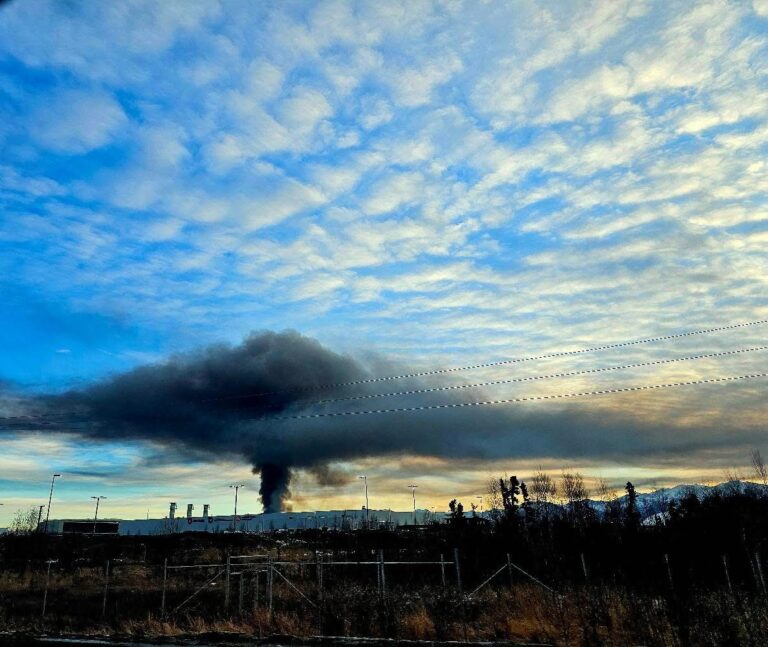
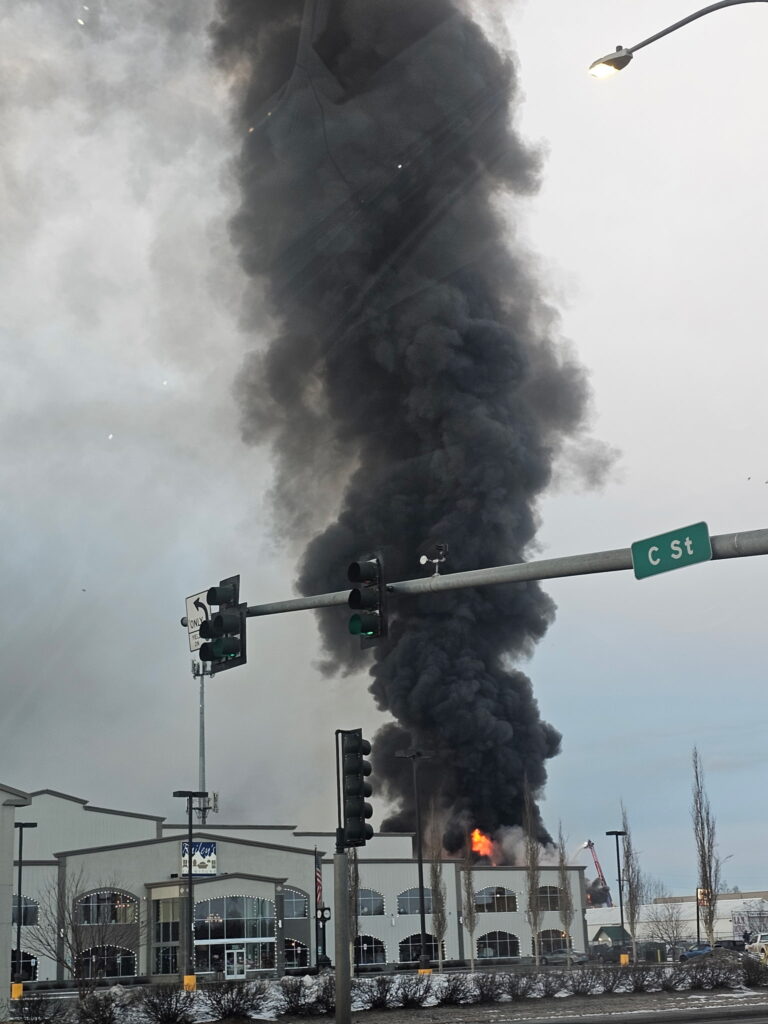
A commercial building in midtown that houses Denali Disposal went up in smoke early Saturday morning. Several other businesses were impacted, including Play Again Sports.
Denali Disposal, which rents space in the building, is owned by GOP political strategist Bernadette Wilson, who started her business nine years ago.
Wilson, age 40, is a leading political figure in Alaska, who is considered by many to be one of the most effective activists in the state. She has hosted both television interview and talk radio talk shows (KFQD) in Anchorage.
Wilson was a strategic advisor to the Nick Begich campaign for Congress and was the Alaska director for Americans for Prosperity and later the Alaska Policy Forum.
She is one of the key principals behind the latest petition effort to remove ranked-choice voting from Alaska’s election system.
Wilson has worked on more than a dozen Republican or conservative political campaigns and led the successful 2010 voter initiative known as “Parental Notification,” which pertained to minors getting abortions without their parents being informed.
Midtown Anchorage fire on March 1, 2025
Wilson arrived on fiery scene about 1/2 hour after the fire department arrived on Saturday morning. As of publication time, there were still fire department units on site. There are several other tenants in the building, which was fully sprinklered.
The news media was on the scene in downtown Anchorage, where a couple of dozen protesters identifying as socialists held signs denouncing Congressman Nick Begich’s vote on a budget resolution that unlocks the budget reconciliation process in the House.
The socialists, wearing expensive North Face jackets and led by leaders of the Party for Socialism and Liberation Anchorage, said that Begich took away their Medicaid.
The Party for Socialism and Liberation is a communist political party in the United States that formed in 2004, when its members split from the Workers World Party. PSL calls itself a revolutionary socialist party, and believes that only a revolution can end capitalism and establish socialism. According to InfluenceWatch.org, PSL has publicly supported Communist dictators such as Vladimir Lenin and Mao Zedong and has been active in anti-police protests since 2020.
KTUU reported the statements made by the Party for Socialism and Liberation during the Friday protest as factual, not acknowledging that they were wholly false.
In fact, the only suggested current change to Medicaid is a work requirement for those who are able to work, which is policy supported by 70% of Americans. The word Medicaid does not appear in the bill that passed.
“Begich serves Trump’s far-right billionaire agenda and not the working people of Alaska. Begich voted to take 100k Alaskans off of Medicaid and 70k Alaskans off of SNAP. Anchorage will continue to fight back against Trump and the billionaires!” the socialists wrote on social media.
The protest was dubbed an “EMERGENCY PROTEST” by the PSL. The protesters chanted and marched to Begich’s office in downtown Anchorage at around 6 p.m.
Meanwhile Anchorage businesses are begging for employees and asking for extension of the “J-1” and related visa programs to supply Alaska’s workforce, because Socialists refuse to show up to work, but do show up to march.
The Party for Socialism and Liberation is not only the far left segment of the Alaska Democratic Party’s voting base, supporting politicians like Anchorage Assemblyman Felix Rivera, the PSL is embrace by the national Democrats’ political action committee, “House Majority PAC,” which posted the news story about protest on their own social media page on X.
The chairman of House Majority PAC is Mike Smith, former senior advisor to former Speaker of the House Nancy Pelosi. The PAC has now officially aligned itself with socialists. He’s in charge of flipping seats to Democrats and the group has targeted Begich for one of its top seats to flip in 2026.
Watch the Anchorage media sympathize with the protesters in this clip posted by the House Majority PAC:
Last week’s Palmer Food Security Workshop was a “smashing success,” according to Sen. Shelley Hughes, who said that the event’s attendance was higher than expected and that the presentations received thousands of views online.
To achieve food security in Alaska, producers must overcome unique challenges due to the region’s climate, production costs, and transportation. Sen. Hughes, chairwoman of the Food Strategy Taskforce, aims to establish a culture of strategic planning, community collaboration, and long-term solutions to increase agricultural productivity. She hosted the Palmer event to connect food production novices with local experts to inspire learning and discovery, promote self-sufficiency, and encourage people to seek food production opportunities.
Hughes expressed optimism that the Palmer Food Security Workshop will become an annual event and that other Alaska communities will also have similar low-cost gatherings to foster networking in support of local agriculture.
The family-friendly event kept children busy with activities while adults listened to presentations and rotated among a range of table topics covering beekeeping, livestock rearing, egg production, gardening, microgreen cultivation, soil health, food processing, freeze drying, canning, and more.
Throughout the event, smiles were seen, thanks in part to Future Farmers of America students Isabelle Ockerman and Tylynn Sturdivant, who shared two irresistible baby goats for everyone to enjoy.
Invited speaker Janet Dinwiddie of Pyrah’s Pioneer Peak Farm addressed the importance of increasing in-state food production, pointing out that existing food production only meets a fraction of the population’s sustenance needs. She backed her claim with data, demonstrating that at current production rates, Alaska would only have a few days’ supply in the case of a food chain disruption.
Pyrah’s Pioneer Peak Farm is producing a variety of fruits and vegetables on the 270-acre farm, as well as offering prepared foods. Dinwiddie intends to expand her operation to establish a processing building on the property so that community growers could utilize the facility to turn their crops into a commodity for redistribution and long-term storage. Dinwiddie stated that her vision is “to create a processing hub for the community,” adding that she is “hoping it will serve as a model for other communities around the state.”
Hughes noted that she received “tremendously positive” feedback from the workshop, which she attributed to the organizational efforts of her aide, Eleilia Preston, who she said excelled at the event’s coordination. However, she stated that putting everything into action was time-consuming, and although she is happy to promote the next event, her office can’t be the one to coordinate it next time.
The Mat-Su Chapter of the Alaska Farm Bureau is interested in hosting the next workshop, according to Ken Hoffman, Executive Director.
Hoffman spoke at the event about his personal experience turning his vegetable-growing hobby into a business and also led a table-topic discussion on cultivating microgreens. Afterward, he said, “The workshop was excellent, with experts presenting on a variety of topics. I’d like to see it become an annual or semiannual event. Based on the attendance, it was clear that the community wants this type of event.”
Hoffman also indicated that a post-harvest workshop, before Thanksgiving, would be ideal timing, allowing the community to celebrate the bounty and plan for the next growing season. If you are interested in learning more about the Palmer food security workshop, contact Ken Hoffman at (907) 841-2593 or via email at [email protected].
For information about Alaska’s Food Strategy Taskforce, contact Sen. Hughes’ office at (907) 465-3743 or via email at [email protected].
Brenda Josephson is a Haines resident. Her writings are featured in Must Read Alaska’s Foodies and Forages column.
History does not repeat. Yesterday will never be today or tomorrow, but historic patterns do repeat. History shows a pattern of the nations’ emergence, growth and decline. It provides facts and allows us to search for underlying causes of historic events.
Elected government officials, policy makers, educators and the society at large must clearly understand that ignorance, irresponsible government mandates and disregard of historic patterns may create irreversible socio–economic consequences.
In this essay I will briefly outline the causes of decline of the major world empires — Rome, Russia, Great Britain –- and point these causes to today’s decline of the socio-economic environment in the United States.
The fall of the Roman Empire was caused by many factors, including economic problems, government corruption, military overspending, never-ending wars and invasions by ferocious nomads and horsemen from the East.
— Economic causes: The government’s corruption and financial mismanagement led to inflation and debased currency; the empire’s economic troubles were made worse by its heavy overreliance on slave labor.
— Military causes: The Roman Empire over-expanded and spent too much on its military; the empire’s military became a drain on its resources, leaving little money for other socio-economic needs.
— Government corruption: Government corruption led to political instability, which weakened the empire; as Rome grew, rulers became more concerned with protecting themselves rather than serving the Empire.
— Invasions: Barbarian tribes invaded the empire, contributing to its decline; the arrival of the Huns in around 370 AD, and the migration of other barbarian tribes contributed to the Empire’s decline.
— Decline in morals: The Roman Empire’s final years were marked by declining morals, including violence, promiscuity, and lavish parties and celebrations.
The Romans established many cities and settlements along the Black Sea coast (today’s Ukraine and part of southern Russia), including Histria and Pompeipolis. The remains of Roman-era settlements along the Black Sea coast have survived centuries of rebuilding and inhabitation.
The Russian Empire declined due to a combination of poor leadership, economic and social unrest, and military defeats in World War I (1914-1918).
— Leadership: Tsar Nicholas II (1868-1918) was a poor leader who repeatedly dissolved the Russian parliament; the government was corrupt and inefficient; the military was mismanaged, with shortages of munitions and wounded soldiers left untended.
— Economy: The Russian economy was backward and suffered from food shortages; WWI substantially impacted Russia’s economy and decline of the prestige as a European power.
— Social unrest: Peasants, workers, professionals and soldiers became increasingly dissatisfied with the central Tsarist government; ethnic minorities in Russia (Jews, Poles, Latvians, Estonians) wanted to escape Russian domination; the military occupations and martial law crippled the civilian functions of the state.
— Military defeats: Russia suffered a series of defeats in the Crimean War (1861-65); Russo-Japanese war (1904-1905); and World War I (1914-1918). The military defeats undermined authority at the local and metropolitan levels. The Russian Socialist Revolution of October 1917 resulted from these causes. The Bolsheviks eventually overthrew the Russian Provisional Government in 1918 and later established the Soviet Union in 1922.
The British Empire declined due to a combination of factors, including devastating economic impacts of World War II (1939-1945), economic strain, and pressure for independence from its colonies.
— World War II: Britain’s defeats in Europe and Asia destroyed its economic and financial independence; Japan’s occupation of British colonies in Southeast and East Asia damaged Britain’s prestige.
— Economic strain: Britain was left with hundreds of billions of dollars in debt after World War II; the cost of maintaining its colonies became an expensive liability.
— Pressure for independence: The British Crown’s heavy-handedness and political missteps fueled nationalist movements; Britain’s colonies increasingly saw themselves as separate peoples.
— Other factors: The British Empire was transformed into the Commonwealth 56 sovereign countries, an association of independent states that still share a British monarch. By the 1970s, little of the British Empire remained.
Clearly, the decline of the major world empires and states, at the different historical eras, have many common causes and characteristics, such as: never-ending wars, social unrest, economic strains, invasion by outsiders (like today’s illegal immigration in the U.S.), military defeats, decline in moral values and traditions, a remarkable government corruption in all socio-economic levels, and spread of the destructive far-left neo-Marxist ideology worldwide.
When I arrived in the United States on February of 1978 as a political refugee from a socialist country, I never thought America would attempt to destroy itself from within with the radical neo-Marxist ideology—critical race theory, white privilege doctrine, systemic racism, Black Lives Matter and Pro-Palestinian antisemitic movement around the world.
Historically, the main reason leftism is radicalized in America today, and accelerating among our youth, is because young people of the post–Vietnam war generation had never experienced economic hardship or oppression by a totalitarian regime; they have been intensely subjected to political correctness, wants, and irrational and wasteful handouts instead of hand–ups.
Today, many radical educators believe themselves to be teaching the “truthful” history of the world, including American history. They aggressively and unwisely inject divisive concepts of “gender identity,” “Project 1619,” “white privilege doctrine,” “critical race theory” and violent and antisemitic pro-Palestinian movement into their teaching curriculums.
This neo-Marxism will only accomplish two main far-left objectives: (1) racial segregation and indoctrination among our youth, and (2) hatred of the historic past of our nation. It is imperative to acknowledge and understand, in contrast, that world events must be interpreted and understood in the historic context of their time, relying on factual truth rather than on subjective “truth” wrapped into neo-Marxist ideology.
In fact, far–left progressives are not as they think of themselves—liberal or open minded. In fact, they are illiberal and intolerant deflationists—i.e., I am going to serve you a bowl of soup once a month at your place, if you don’t crash into my ocean-front home to ask for more.
Far-left progressivism is now a religion for some groups; and they possess the typical zeal and emotional attachment to a far-left dogma—socialism and neo-Marxism—which blinds them to having a rational and open mind. Indeed, they are hypocritical fools, who are literally the main cause for the ideological and economic decline of America.
Alexander B. Dolitsky was born and raised in Kiev in the former Soviet Union. He received an M.A. in history from Kiev Pedagogical Institute, Ukraine, in 1976; an M.A. in anthropology and archaeology from Brown University in 1983; and was enroled in the Ph.D. program in Anthropology at Bryn Mawr College from 1983 to 1985, where he was also a lecturer in the Russian Center. In the U.S.S.R., he was a social studies teacher for three years, and an archaeologist for five years for the Ukranian Academy of Sciences. In 1978, he settled in the United States. Dolitsky visited Alaska for the first time in 1981, while conducting field research for graduate school at Brown. He lived first in Sitka in 1985 and then settled in Juneau in 1986. From 1985 to 1987, he was a U.S. Forest Service archaeologist and social scientist. He was an Adjunct Assistant Professor of Russian Studies at the University of Alaska Southeast from 1985 to 1999; Social Studies Instructor at the Alyeska Central School, Alaska Department of Education from 1988 to 2006; and has been the Director of the Alaska-Siberia Research Center (see www.aksrc.homestead.com) from 1990 to present. He has conducted about 30 field studies in various areas of the former Soviet Union (including Siberia), Central Asia, South America, Eastern Europe and the United States (including Alaska). Dolitsky has been a lecturer on the World Discoverer, Spirit of Oceanus, and Clipper Odyssey vessels in the Arctic and sub-Arctic regions. He was the Project Manager for the WWII Alaska-Siberia Lend Lease Memorial, which was erected in Fairbanks in 2006. He has published extensively in the fields of anthropology, history, archaeology, and ethnography. His more recent publications include Fairy Tales and Myths of the Bering Strait Chukchi, Ancient Tales of Kamchatka; Tales and Legends of the Yupik Eskimos of Siberia; Old Russia in Modern America: Russian Old Believers in Alaska; Allies in Wartime: The Alaska-Siberia Airway During WWII; Spirit of the Siberian Tiger: Folktales of the Russian Far East; Living Wisdom of the Far North: Tales and Legends from Chukotka and Alaska; Pipeline to Russia; The Alaska-Siberia Air Route in WWII; and Old Russia in Modern America: Living Traditions of the Russian Old Believers; Ancient Tales of Chukotka, and Ancient Tales of Kamchatka.
By NICOLE SILVERIO | THE DAILY CALLER NEWS FOUNDATION
President Donald Trump and Vice President J.D. Vance duked it out with Ukrainian President Volodymyr Zelenskyy Friday after he openly criticized the U.S. for not having stopped Russian President Vladimir Putin.
Trump said he is not siding with either Putin or Zelenskyy but is determined to negotiate a deal to end the war, while Vance argued that the current administration is “engaging in diplomacy.” Zelenskyy argued that the U.S. has failed to stop Putin and challenged Vance’s argument that the nation is engaging in “diplomacy.”
“During 2015, nobody stopped [Putin]. He just occupied them too. He killed people,” Zelenskyy said. “[Throughout] 2014 and 2022, the situation [was] the same. People have been dying on the content line, nobody stopped him … He broke this ceasefire. He killed our people and he didn’t exchange prisoners. We signed the exchange of prisoners. But he didn’t do it. What kind of diplomacy, J.D., are you speaking about? What do you mean?”
“I’m talking about the kind of diplomacy that’s going to end the destruction of your country,” Vance said. “Mr. President, Mr. President, with respect, I think it’s disrespectful for you to come into the Oval Office and try to litigate this in front of the American media. Right now, you guys are going around and forcing conscripts to the front lines because you have manpower problems. You should be thanking the president for trying to bring an end to this conflict … I have actually watched and seen the stories and I know what happens, you bring people, you bring them on a propaganda tour, Mr. President, do you disagree that you’ve had problems bringing people into your military? And do you think it’s disrespectful to come to the Oval Office of the United States of America and attack the administration that is trying to prevent the destruction of your country.”
Trump told Zelenskyy point-blank that he was “disrespecting” the U.S. and had “no position” to be critical of the nation given that he is at war.
“We’re trying to solve a problem, don’t tell us what we’re going to feel,” Trump told Zelenskyy. “Because you’re in no position to dictate that, remember that. You’re in no position to dictate what we’re going to feel. We’re going to feel very good and very strong. You’re right now not in a very good position … You don’t have the cards right now. With us, you’ll have the cards. You’re playing cards. You’re gambling with a lot of lives and millions of people. You’re gambling with World War III, you’re gambling with World War III and what you’re doing is very disrespectful to this country. It’s backed you far more than a lot people say it should have.”
“Have you said thank you once?” Vance then asked, prompting Zelenskyy to claim he had. “No, in this entire meeting, have you said thank you? You went to Pennsylvania and campaigned for the opposition in October. Offer some words of appreciation for the United States of America and to the president who’s trying to save your country.”
Zelenskyy accused Vance of “speaking very loudly about the war,” and argued his nation has “stayed strong” throughout the conflict. Trump reminded the Ukrainian president that the Ukrainians have persisted against Russia since 2022 because the U.S. generously sent the nation its military equipment and spent billions of taxpayer dollars to help them fight the war.
Vance told Zelenskyy that they should “litigate [their] disagreements” rather than him traveling to the U.S. to call out the nation’s leaders.
After the explosive exchange, the scheduled joint press conference between Trump and Zelenskyy had been canceled. The White House told the Daily Caller that Trump asked Zelenskyy to leave the White House over the incident.
The president said in a Truth Social post that Zelenskyy “is not ready for peace” because U.S. involvement grants him a “big advantage in negotiations.”
“We had a very meaningful meeting in the White House today,” Trump said. “Much was learned that could never be understood without conversation under such fire and pressure. It’s amazing what comes out through emotion, and I have determined that President Zelenskyy is not ready for Peace if America is involved, because he feels our involvement gives him a big advantage in negotiations. I don’t want advantage, I want PEACE. He disrespected the United States of America in its cherished Oval Office. He can come back when he is ready for Peace.”
The U.S. and Ukraine had finalized a deal for mineral extraction and had planned to sign the agreement at the White House. No deals will be signed as of Friday.
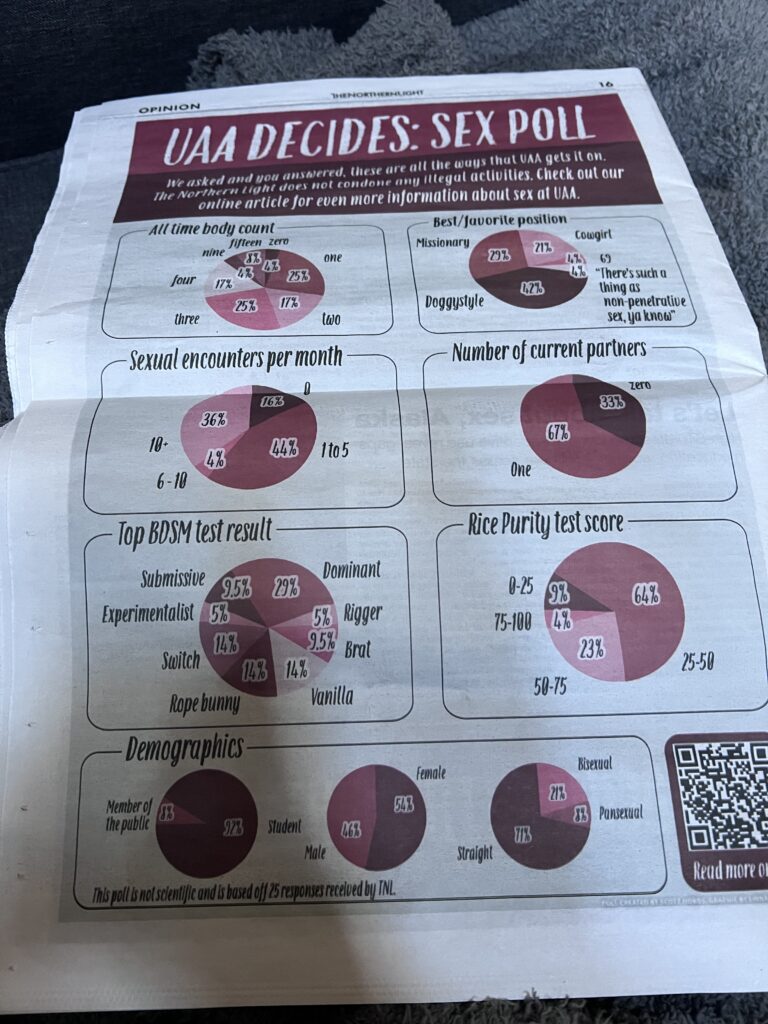
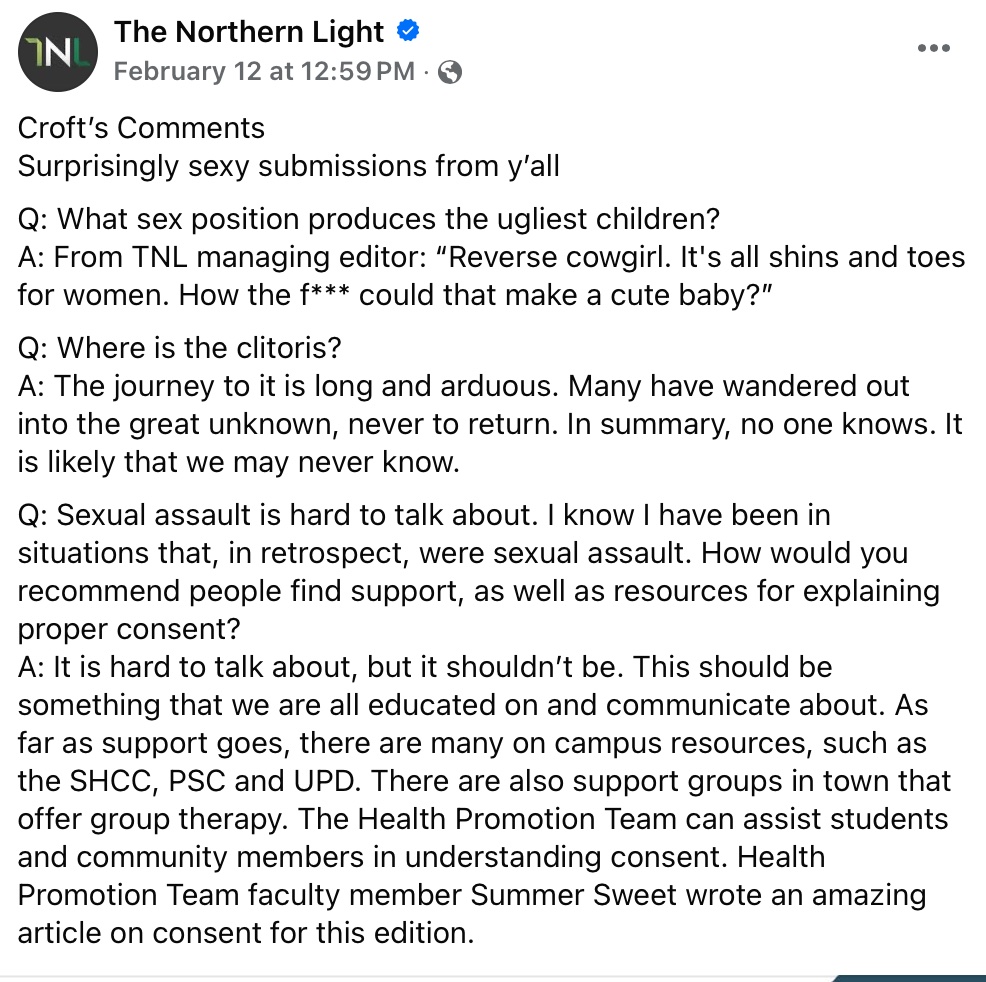
Alaskans who are being told they must give up even more of their Permanent Fund dividends for state spending will be interested in the latest edition of The Northern Light student newspaper at the University of Alaska Anchorage.
It’s the Sex Edition, and it features sex poll results that inform readers about how much sex students are having at the university and just how kinky they like it. Your Permanent Fund dividend may go to paying for the production of this newspaper at a time when print newspapers are not exactly a growth industry and when there are fewer journalism jobs for graduates.
Among topics in the poll conducted by the staff is BDSM (bondage, discipline, dominance, submission, and sadism and masochism as a sexual practice).
Answers include “Submissive, dominant, Rigger (rope tying), Brat (physical force), Vanilla (no BDSM), Rope bunny (being tied up with rope), Switch (dominant or submissive role switching), Experimentalist.
In promoting the edition on Facebook, the newspaper wrote, “A closer look at how UAA gets their freak on | UAA had a lot to say about their sexual preferences — so much to the extent that we couldn’t include it all in the print. The Northern Light is here to share the rest of the results collected by the poll, starting with UAA’s favorite porn stars.”
Many students who are under the age of 18 attend the university, and are exposed to this on campus, sanctioned by the Journalism and Communication Department.
Numerous other posts on the newspaper’s Facebook page focus on sex topics, such as:
The Sex Edition comes at an awkward time for the university, which is facing possible budget cuts during the current 2026 state spending plan now being debated in the Legislature.
The total University of Alaska budget for 2026 includes $589 million from unrestricted sources, including $366 million for the state’s general fund.
The Legislature is grappling with a budget deficit of an estimated $500 million this year, and cuts will have to come from somewhere. The Northern Light may have made the university a target for deeper cuts.
While the student newspaper is funded in part by student fees, the underlying programs are funded by the public.
Staff photo of The Northern Light newspaper at University of Alaska Anchorage from the newspaper’s Facebook page.
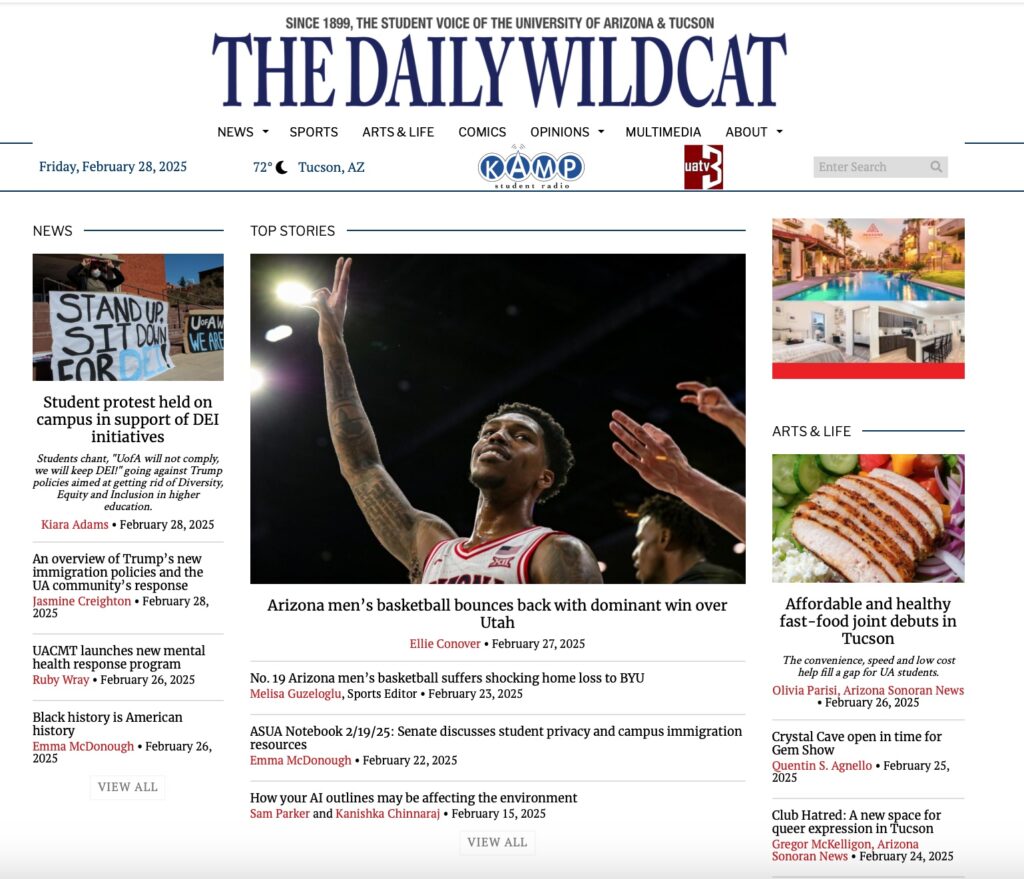
As a comparison, here’s the front page of the most recent edition of the University of Arizona’s The Daily Wildcat:
AT%T internet and phone service is down in Juneau and across Southeast Alaska, due to a damaged undersea cable that sources say is near Whittier.
“Customers in the Juneau area may be experiencing service disruptions due to damage to an undersea cable operated by another provider,” said s a statement from AT&T. The other provider is Alaska Communications Services and that company said the problem started on Thursday night.
At 8:20 a.m., Alaska Communications wrote that a team worked through the night on the network issues impacting Southeast Alaska.
“We have technical teams dispatched to multiple locations to troubleshoot. This is our top priority and we’ll share an update as soon as we have more information,” ACS said.
At 12:30 p.m., the company confirmed the subsea cable damage: “We are dispatching a repair ship. We do not yet have an estimated time for restoral. We are also working to find alternate ways to restore connectivity in Juneau. This is our top priority and we deeply apologize for the inconvenience. We know how important staying connected is to you and we will not rest until this is fixed. We will continue to share updates as we have more information.”
At the Alaska Capitol, all internet and cell phone service is affected and there is no access to the Basis legislation information site. Some employees of the building are working from home with the use of their home internet.
The resident historian to the state’s largest failing newspaper detoured into an online fight with Alaska’s mining trade association this week.
David Reamer, who contributes to the Anchorage Daily News on snippets for state and local stories of the past, took time to spar with the Alaska Miners Association on X, formerly known as Twitter.
In a post, the mining association wrote “Greta Schuerch, Teck Alaska Red Dog Mine, presents to the Alaska House Resources Committee on the mine’s amazing story of benefitting a region, Alaska Native Corporation region, and being responsible stewards of the environment.”
The association was engaged in its annual trade trip to the state capitol building in Juneau. The journey to southeast Alaska’s largest city, where the largest private sector employers are the Greens Creek and Kensington Mines, is a unique opportunity for the large metal mine and placer operators to speak with lawmakers and staff.
It is also a chance for the Resources committees in both the House and Senate to get updated the status of the industry, and to dispel the rumors that this intensive activity generates from entrenched environmental groups.
Reamer followed up on the mining group’s tweet by writing “To learn more about their role as stewards of the environment, just google ‘Red Dog Mine and EPA.’”
The dog whistle employed by Reamer is a catchall the environmental lobby has used for years on mines in Alaska: Invoke the U.S. Environmental Protection Agency and the disputes between operators and bureaucracies who engage in wars of definitions.
The EPA under the Obama and Biden administrations were actively colluding with environmental activists on controversial proposed mines, such as the Pebble Project in southwest Alaska. This collusion included “findings” of environmental unsuitability, and “risk of unmanaged release.” These type of terms served as the impetus for recently Democratic-leaning communities in the Midwest, such as in northern Minnesota, voting for President Donald Trump.
The mining association attempted to clarify the record in the online exchange “Misleading statement. You’re referring to the TRI- a program where permitted facilities report “releases” into contained and permitted sites. What this means is: when a truck hauls a bucketful of mineral rich dirt from one area to another, it’s called a “release” and must be reported.”
Reamer’s response was to link an article from the publicly subsidized state radio network on the dispute between the Red Dog Mine and the EPA, including a settlement.
Anyone who has worked in the resource industry in Alaska has had to experience the eye rolling faux outrage about “spills” on the North Slope (engine oil from a truck leaching onto an absorbent pad which must be classified as a spill) to the release of “toxic material.” What is profoundly enraging to the mining community when confronted with these types of attacks is not just their lack of truth (the Alaska mining sector is one of the safest in the world) but also the willful use of misinformation that was abetted by government and media officials.
The sadness of this exhange is that there is a powerful story of the people in rural, predominantly Alaska Native northwest region, rising up and reducing poverty, child and adult mortality, and providing the dignity of multi-generational jobs. Alaska Gov. Mike Dunleavy’s three daughters, who are Alaska Native, have worked at Red Dog. The environmental record for one of the largest zinc mines on earth has been a model the Alaska Miners Association holds for how to mitigate natural environmental contamination. But that story won’t be told.
The Binkley family, which owns the ADN, are prominent supporters of mining projects. It is ironic that the in-house designated expert on Alaska’s past would use such blatant tactics from partisan opponents to make a snide point.
Readers to that publication should thus be prepared for a forthcoming story or perhaps a series from this individual on “the troubled history of mining in rural Alaska.”
Of course, expect the historic environmental remediation efforts, including making the Red Dog Creek, which was naturally toxic due to latent zinc levels now fit for fish to swim in, will be omitted.
Suzanne Downing is the editor of Must Read Alaska. Her family arrived in Alaska in 1969 thanks to mining opportunities.