The average K-12 student in Alaska costs the state 2.2 times the $5,960 Base Student Allocation after all the multipliers in the funding formula or about $13,100 per year. The funding formula is just one component of the $20,535/student Alaska spent in local, state and federal K-12 funding in 2022-23 according to the NEA.
All correspondence school students in Alaska are currently funded and 0.9 BSA or $5,364/year. With 24,000 Alaskan kids enrolled in correspondence programs, the state is currently saving around $186 million/year in what those students would cost in formula funding if they were enrolled in neighborhood schools.
There is a proposal in Juneau to increase the BSA allotment for these correspondence students to 1.0. It officially has a fiscal note of $14 million a year since it would increase the student allotment about $600 for each student currently in correspondence program. The part that most policy makers are missing is the potential for cost savings if an additional $600 incentivizes more parents to patriciate in the program.
For every student who leaves a neighborhood school and enrolls in a correspondence program at 1.0 BSA, the state will be saving about $7,200 per year per student in formula funding. It would only take an additional 1,900 kids switching (an 8% increase correspondence enrollment) to completely erase the cost of the change in the program. With a 20% increase in enrollment, the state would be saving and additional $21 million per year.
The other benefit that is often overlooked is the fact that the kids in correspondence programs have very little impact on the local, federal and capital funding for neighborhood schools – so there’s significantly higher funding, on a per student basis, for the kids in neighborhood schools who don’t have to share those other funding streams with an additional 24,000 students.
A small increase in the correspondence allotment would allow more families to participate in this program that has become so wildly popular with Alaska parents. It also has the potential for increasing the per student resources that go to kids in our neighborhood schools and additional savings for taxpayers.
Bob Griffin is a former member of the Alaska Board of Education and Early Development and a life-long learner.
The reporting website FiveThirtyEight, which focused on news of opinion polls, polling analysis, politics, economics, and sports, lasted just two years under its new owner, Disney-ABC. The website is now just an ABC political news aggregator, nothing more.
Founder Nate Silver started the company in 2008 and sold the company to Disney in 2023, although he took the rights to his forecasting model with him to his new website, Silver Bulletin, at the Substack newsletter group where Must Read Alaska also publishes a newsletter.
Silver essentially took others’ work and published predictions and averages based off the this party polling work, making a few correct predictions that won him accolades in the media. He didn’t do his own polling. But he lost his leftist base when he wrongly predicted that Donald Trump would lose the presidential race in 2016, and the Left never forgave him.
FiveThirtyEight also rated pollsters, by calculating and analyzing the historical accuracy and methodology of each firm.
Under Disney, G. Elliott Morris, formerly with The Economist, was hired to continue the FiveThirtyEight site; he developed a new prediction model for the website under the name 538.
Morris’s 538 had a rough history. It was the only professional election forecaster that gave President Joe Biden the majority odds of winning the election last July; that was just before Biden withdrew.
This week the FiveThirtyEight website was shut down altogether.
Although FiveThirtyEight.com can still be reached, it takes users to an ABC page devoted to politics, fed by artificial intelligence content generation. The actual human-driven content that made FiveThirtyEight such a powerful and interesting website is not accessible, including all the polling it reported on about Alaska.
On Friday, Monmouth University also announced it is shutting down its polling division, the Monmouth Polling Institute. Over the course of 98 polls, not even a third of them came within the standard margin of error, and the bias was D+4.34. Still, FiveThirtyEight gave Monmouth an A+ rating.
Patrick Murray built the polling institute from scratch in 2005, just before Nate Silver launched FiveThirtyEight.
Alaska-based Dittman Research is still going strong 55 years after being started. In fact, the only polling firm that is older is Gallup. George Gallup invented/discovered modern polling methods in 1935, while Dave Dittman founded Dittman Research 34 years later in 1969.
There were likely some other firms prior to Dave Dittman, but they are long gone now. Dittman is now under the ownership of Matt Larkin, who kept the Dittman name, and has his best year ever in 2024.
“Dave built a great foundation and our Alaska clients have stuck with us. We are very grateful!” said Larkin.
Alaska’s state government has long operated under the false premise that its fiscal problems stem from inadequate revenue rather than reckless, unaccountable spending.
This lie is perpetuated by entrenched bureaucrats, along with histrionic politicians such as Senators Cathy Giessel, Gary Stevens, Jesse Bjorkman, Matt Claman, Forrest Dunbar, Elvi Gray-Jackson, Lyman Hoffman, Scoot Kawasaki, Jesse Kiehl, Kelly Merrick, Donny Olson, Bert Stedman, Loki Tobin, Bill Wielechowski, and Robert Yundt, and their useless counterpart House Representatives that include Chuck Kopp, Bryce Edgmon, Robyn Niayuq Burke, Ashley Carrick, Maxine Dilbert, Ted Eischeid, Zack Fields, Neal Foster, Alyse Galvin, Andrew Gray, Carolyn Hall, Sara Hannah, Rebecca Himschoot, Ky Holland, Nellie Unangiq Jimmie, Andy Josephson, Donna Mears, Genevieve Mina, Calvin Schrage, Andi Story, and Louise Stutes. The lie is not only misleading but an insult to the intelligence of all Alaskans.
As an example of the lies on a national level, the mission statement of the US National Security Agency is a combat support agency within the US Department of Defense. It leads in cryptology, providing signals intelligence (SIGINT) and cybersecurity to support military operations, secure communications, and protect national security.
The American public just discovered that this group of unelected bureaucrats are already anal-eyezed.
If this is what national security looks like, where taxpayer-funded intelligence networks double as a kink forum for government employees, what exactly is the Alaska deep state up to?
If the NSA, tasked with protecting America from cyber threats and foreign adversaries, is instead hosting discussions on “butthole laser treatments” and “sexual pleasure post-castration,” what confidence should Alaskans have that their own bureaucracies are operating with any greater professionalism or competence?
Are state agencies—already bloated with inefficiency—just as preoccupied with indulgent self-exploration under the banner of diversity, equity, and inclusion?
How many hours of taxpayer-funded work are being dedicated to “ally awareness” meetings instead of actually addressing Alaska’s failing education system, crumbling infrastructure, or economic stagnation?
If this level of absurdity can take hold at the highest levels of intelligence nationally, what kind of degeneracy and waste is lurking in Alaska’s government offices?
The reality is clear: Alaska does not have a revenue problem—it has a spending problem managed and operated by entitled elites.
National polling data supports what Alaskans already know: government inefficiency, waste, fraud, and mismanagement are the primary culprits behind our fiscal challenges, not a lack of taxation.
On Feb. 24, 2025, the February Harvard CAPS / Harris poll, a monthly collaboration between the Center for American Political Studies at Harvard and the Harris Poll and HarrisX released the results of 83% of voters favor reducing government expenditures over increasing taxes, and 77% say a full examination of all government expenditures is necessary.
The unelected bureaucratic machine in Juneau — the so-called “deep state” — is not concerned with the well-being of Alaskans. Its primary objective is job security and maintaining its grip on power.
This explains why Alaskan politicians, public unions and Alaska’s government agencies resist meaningful spending cuts while relentlessly pushing for tax increases and PFD reductions. They do not serve Alaskans; they serve themselves. Every attempt to impose an income tax or seize Alaskans’ PFD is nothing more than an effort to preserve their bloated, self-sustaining bureaucracy at the expense of hardworking residents.
Despite receiving some of the highest per-student funding in the nation, Alaska’s public education system ranks near the bottom in student achievement. More money has not, and will not, fix this problem. Instead, it enables an expanding administrative class that diverts funding away from classrooms and into bureaucratic salaries, regulatory compliance, and redundant oversight. It is self-perpetuating at the cost of Alaska’s future.
Rather than addressing this failure, leaders like Giessel want Alaskans to accept even higher taxes to fuel the very system that has already failed their children.
The push for an income tax is a distraction from the real reform Alaska needs: a comprehensive reduction in government spending and an overhaul of the budget process to ensure that every dollar is spent efficiently and with accountability. Bureaucrats and career politicians claim that “there is nothing left to cut,” yet millions of dollars continue to be wasted annually on redundant programs, unnecessary administrative positions, and inefficient service delivery models.
Instead of increasing taxes, Alaska should pursue serious fiscal discipline, including:
Eliminating redundant state agencies and administrative overhead that do not provide direct services to Alaskans.
Ending special-interest subsidies and corporate welfare that offer no clear return on investment.
Enforcing zero-based budgeting, requiring every department to justify its budget from the ground up rather than assuming automatic increases.
Redirecting education funding from bloated bureaucracies directly into classrooms where it can actually impact student outcomes.
Auditing every state agency to root out fraud, waste, and mismanagement.
The people of Alaska have every right to demand a government that works for them, not against them. Instead, they are subjected to an inefficient and self-serving bureaucracy that refuses to be held accountable. Senator Giessel’s call for an income tax is not about fiscal responsibility—it is about protecting the bureaucratic class at the expense of Alaskans. The people of this state deserve a government that respects their hard work, safeguards their earnings, and prioritizes efficient governance over self-preservation.
On his campaign website in March 2024, Sen. Rob Yundt wrote, “Alaska stands at a critical juncture in its economic trajectory.” He was right then, and his statement is true now – Alaska is at a crossroads. Despite the unfriendly policies of the Biden administration, Alaska’s oil and gas industry is finally regaining momentum as the Trump administration reduces restrictions on production.
For example, President Donald Trump is actively promoting Alaskan U.S. liquefied natural gas (LNG), aiming to enhance U.S. energy dominance and strengthen economic ties with East Asian allies. In a recent meeting with Japanese Prime Minister Shigeru Ishiba, the president proposed Japan’s participation in a $44 billion Alaska LNG project.
Unfortunately, Senate Bill 92 threatens to derail this progress by imposing hundreds of millions in new taxes on production in Prudhoe Bay.
Senator Yundt’s proposed tax increase couldn’t come at a worse time. When major oil companies were reducing their Alaska investments due to changing market conditions and pressure from environmental organizations with clear anti-fossil fuel agendas, privately-owned Hilcorp stepped up to invest in the Last Frontier. Their acquisition of BP’s assets ensured the continued operation of critical energy infrastructure, preserved Alaskan jobs, anddemonstrated a long-term commitment to the state when others were pulling back.
Investment from privately-held oil and gas companies, like Hillcorp, means they aren’t beholden to shareholder demands; rather they can make long-term investment decisions. Alaska needs a stable tax structure to attract investment from oil and gas companies, no matter their corporate structure. SB 92 would fundamentally undermine this stability. The hundreds of millions in new taxes represent real money that would otherwise be reinvested in Alaska’s infrastructure, workforce, and communities. Instead of allowing these resources to directly support economic growth, politicians in Juneau would redirect these funds according to their priorities.
The impact of this tax will also be felt by the broader oil and gas industry, including direct jobs, contractors who depend on oil and gas projects, and countless small businesses that service these operations. The ripple effects would touch communities throughout Alaska.
Ironically enough, less than a year ago, Senator Yundt warned that “history teaches us that over taxing residents often yields unintended consequences like stifling economic growth & burdening residents.” He advocated for “nurturing economic expansion through responsible resource development” and “reducing the many bureaucratic hurdles slowing private enterprises.” Senator Yundt alsowrote that, “imposing additional taxes would infringe upon these liberties” and “represent a governmental overreach that contradicts Alaska’s ethos of independence & self-reliance.”
What changed? Why is Senator Yundt now trying to pass a tax increase that would cost hundreds of millions of dollars?
Alaska needs high-density, reliable energy that’s available year-round. Thanks to President Trump, the state also has an enormous opportunity to export its energy around the world. It needs elected officials who understand that unnecessary constraints on resource development only undermine our long-term fiscal health—officials who stand by their campaign promises rather than reversing course once in office.
Senator Yundt was right when he stated that Alaska should focus on “reducing or at the very least capping state spending while at the same time nurturing economic expansion through responsible resource development.” He was right when he noted that “streamlining regulations and reducing bureaucratic red tape are imperative” because “excessive regulations stifle entrepreneurship and deter investment.”
But he couldn’t be more wrong now, with legislation that would increase tax burdens, create economic uncertainty, and deter future investment in the state.
Thomas Pyle is the President of the American Energy Alliance.
Democrats’ push to massively expand Medicaid over the past several years has turned the program into something nearly unrecognizable.
A series of reports have outlined the growing list of problems at the Centers for Medicare and Medicaid Services (CMS), including improper payments, healthcare funds being used for non-medical expenses and able-bodied adults receiving funds meant for Americans who may desperately need it. Former President Joe Biden’s CMS massively expanded Medicaid benefits during his sole term, driving Medicaid spending up from $734 billion at the beginning of his term to $871.7 billion in 2023.
“The big thing that’s sort of missing is [Medicaid’s] role of covering able-bodied adults in this,” Edmund Haislmaier, a health care policy expert at the Heritage Foundation, told the Daily Caller News Foundation. “Medicaid was originally set up to cover what we would call vulnerable enrollees, basically people who could not work and could not expect to have other sources of income or [medical] coverage. So you’re talking about poor children, low-income senior citizens, and disabled people. That is the core focus, and it’s also been expanded to include poor pregnant women over the years. What happened with the Affordable Care Act (ACA) is it was further expanded [Medicaid] to include able-bodied adults below a certain income level.”
A provision under the ACA, which was signed into law by former President Barack Obama in March 2010, called for Medicaid to be expanded to provide coverage for adults under age 65 with incomes up to 138% of the federal poverty level. Roughly 35 million able-bodied adults were enrolled in Medicaid programs while not working as of May 2023, according to estimates from the Foundation for Government Accountability, a conservative think tank.
Similarly, the Obama-Biden administration also oversaw sweeping expansions to Medicare coverage by abolishing a rule in 2014 preventing Medicare from funding sex-change surgeries. Obama’s administration also expanded coverage for sex-change procedures in 2016 through their interpretation of Section 1557, a non-discrimination provision of the ACA, which helped pave the way for Medicaid funds to be used to coversex-change operations in certain states.
From January 2018 to September 2023, 16 states funneled over $165 million toward so-called “gender transition services.”
“The argument that we and others make is ‘look, why is the federal government giving states more money for covering people who have other options, like getting a job and getting coverage privately, and less money for people who need it the most, like disabled people,’” Haislmaier added. “That’s something that should be fixed in reforms.”
Biden also encouraged states to propose waivers to broaden Medicaid coverage during his presidency, resulting in the CMS approving some states’ requests to use Medicaid funds to pay for non-medical expenses for some individuals, such as rent, air conditioning and food. In April 2024, the federal government approved a request from Massachusetts to use Medicaid funds to pay for up to six months of temporary housing for eligible families and pregnant individuals who are MassHealth members residing in the emergency shelter system.
In the waning weeks of Biden’s presidency, his administration’s CMS also granted Vermont approval to use Medicaid funds to cover the cost of rent for some homeless individuals in the state.
For fiscal year 2025, Medicaid programs are projected to cost roughly $656 billion, according to the Congressional Budget Office.
Notably, the U.S. spends more on healthcare per individual than any other similar country, with health expenditures per person costing $12,555 in 2022, which was over $4,000 higher than any other high-income country. The rate of improper Medicaid payments in 2024 was 5.09% — or $31.10 billion — 79.11% of which was the result of insufficient documentation, according to the CMS.
House Republicans on Feb. 25 advanced a budget resolution calling for major reductions to overall federal government spending, but Congress has not yet made any specific proposals involving Medicaid. Many Democrats have repeatedly said that Medicaid funding is at risk of potential cuts by Republican lawmakers, despite President Donald Trump recently emphasizing that he does not want to see any drastic changes to the program.
While Republicans on the House Ways and Means Committee circulated a list of possible cuts to Medicaid funding in recent weeks, the potential cuts were primarily focused on removing illegal migrants from eligibility, which they claimed could save up to $35 billion over the course of a decade.
Trump told Fox News’ Sean Hannity during a Feb. 14 interview that Medicaid will not be “touched” aside from cases of fraud or illegal migrants found to be misusing the program. Still, Democratic lawmakers have continued making claims in recent weeks that Medicaid funding is in peril.
Democratic House Minority Leader Hakeem Jeffries claimed in a Feb. 27 post on X that some Americans would have healthcare “ripped away” from them due to House Republicans’ budgetary agenda. Moreover, during Trump’s address to a joint session of Congress on Tuesday, several Democrats attempted to protest the speech by holding up signs that read “Save Medicaid.”
The Biden-Harris administration presided over enormousgovernmentspending, which some economists have claimed partially contributed to the rapidly-expanding U.S. federal deficit and widespread inflation. Trump has madeweeding out any unnecessary spending and waste at federal agencies a cornerstone of his presidential agenda as part of a wider effort to save American taxpayers money, which has thus far faced massive opposition from Democrats.
In light of Biden’s Medicaid expansions, some Republican lawmakers have called for drastic reforms to CMS in recent weeks, including Republican Texas Rep. Chip Roy, who claimed in a Feb. 26 post on X that Medicaid is being “abused” by able-bodied individuals “gaming the system,” also noting that Congress has the responsibility “reform” the program.
Similarly, Republican Kansas Sen. Roger Marshall wrote in a Feb. 27 social media post that the U.S. “must return Medicaid to its intended purpose of helping those in desperate need,” and North Carolina Republican Rep. Greg Murphy wrote in Thursday social media post that possible reforms to Medicaid are about “prohibiting able-bodied individuals from abusing the program and states like California getting their Medicaid house in order.”
“Republicans have not been as good about reforming [Medicaid] as they should be,” Haislmaier told the DCNF. “They have been more about budget cutting. What you need to do with this is not approach it as a budget issue, you need to approach it as ‘how do we reform this program to better serve people who need it?’ And frankly, to move off of it the people who don’t need it.”
The CMS did not respond to a request for comment from the Daily Caller News Foundation.
The Anchorage School Board decided to repurpose one of its closed schools — Lake Hood Elementary School — and make it into a Alaska Native Cultural Charter School.
The board defied the Administration’s recommendation that the Rilke Schule German Immersion Charter School be transferred to the closed Lake Hood campus.
But the board instead pulled the DEI card and pushed the Rilke Schule kids to the back of the proverbial bus.
More than a hundred Rilke Schule parents and students have testified to the excellent learning occurring at the school. The school has outperformed most of Anchorage’s schools by a significant margin in PEAKS state standardized testing for all grades:
School/District
English Language Arts
Math
Anchorage
36%
36%
Rilke Schule
60%
60%
Alaska Native Cultural Charter School
23%
17%
So much for rewarding outstanding performance.
On the other hand, the Alaska Native Cultural Charter School students are vastly underperforming other average Anchorage students.
Rilke Schule is also more cost-effective to operate than the Alaska Native Cultural Charter School.
As background, here is the per student cost comparison between Rilke Schule and Alaska Native Cultural Charter School:
School
Local, State & Federal
Local & State Only
Rilke Schule
$14,047
$10,224
Alaska Native Cultural Charter School
$19,15
$11,545
(The Alaska Native Cultural Charter School receives more than $5,000 in federal dollars per student.)
The Alaska Native Cultural Charter School has been housed in district buildings for several years. It last shared facilities with Bettye Davis East High School, which was not a good fit for the younger students. Two years ago, it moved into the recently closed Abbott Loop Elementary School for at least five years.
Unlike the Rilke Schule Charter German Immersion Charter School, the Alaska Native Cultural Charter School has not had to pay rent for its facilities, which can be a substantial expense for any charter school. Rilke Schule pays $738,000 in rent, which takes up to 20% of its operating budget. The Alaska Native Cultural Charter School has paid zero rent.
The Alaska Native Cultural Charter School finally came to the discussion at the 11th hour on Feb. 6, when its representative testified that the Lake Hood Elementary School campus was a good fit for its school.
An Alaska Native Cultural Charter School representative stated that because her school was a Title 1 school, it should be able to move into Lake Hood, which was also a Title 1 school. That reasoning makes very little sense in determining which school should move into the closed Lake Hood campus.
The Alaska Native Cultural Charter School Academic Policy Committee president stated that, “Awarding this facility to a school that does not require Title 1 funding would deprive our community of critical resources.”
He further stated, “By not choosing ANCCS, you are reinforcing a system in which our voices and needs are marginalized and our history of trauma minimized. It is one of equity, cultural preservation, and social justice.”
Enter Diversity, Equity, and Inclusion — DEI.
That set off alarm bells for board member Pat Higgins (formerly the board representative from the Marshall Islands) who moved to amend the memo by replacing Rilke Schule with the Alaska Native Cultural Charter School for the move.
“I am not going to abandon the Alaska Native Cultural Charter School,” Higgins said. But he seems to have no problem abandoning Rilke Schule children.
Higgins also has some conflicts of interest, as was recently the senior director of human resources for Tlingit and Haida Indian Tribes of Alaska.
Board member Margo Bellamy wondered why the Alaska Native Cultural Charter School got so concerned at this last minute. She noted that the school had another three years it could stay in the closed Abbott Loop School. And voters approved a bond which has more than $2 million to bring Abbott Loop School up to code. That money is still available.
Remember, the administration recommended that Rilke Schule be housed in the closed Lake Hood School because its current lease was expiring this year. On the other hand, Alaska Native Cultural Charter School just moved into the closed Abbott Loop School and has another three years remaining with a fire code exemption.
Here are some more facts to consider. Rilke Schule has 485 students and Alaska Native Cultural Charter School has 342 students. Thus, the large Lake Hood School is a much better fit for Rilke Schule. Clearly, the Rilke Schule with 143 more students has a greater need for more space than does the ANCCS.
Here are the facts from the most recent Capital Improvement Plan that should be considered in this decision to occupy the closed Lake Hood School:
School
Square Footage
Classrooms
Student Capacity
Student Count
Lake Hood
61,549
29
469
XXX
Alaska Native Cultural Charter School
58,341
16
**
342
Rilke Schule
39,500
23
**
485
(** the CIP gives no student capacity for charter schools)
The Alaska Native Cultural Charter School has more than enough current square footage to accommodate its students. On the other hand, Rilke Schule is squeezing its students into a very small building.
The Alaska Native Cultural Charter School only has 16 classrooms while the Lake Hood School has almost double that number. The Rilke Schule requires almost 50% more classrooms than the Alaska Native Cultural Charter School.
The choice is clear when one considers these facts: Rilke Schule needs much more space than does the Alaska Native Cultural Charter School; Rilke Schule’s lease expires this summer while the Alaska Native Cultural Charter School has three more years in the Abbott Loop facility.
But facts don’t matter when DEI is dominant in the decision-making process.
The rationale for allowing the Alaska Native Cultural Charter School to move into the Abbott Loop School must fall under the Diversity, Equity and Inclusion guardrail the board has established.
The administration was right in choosing Rilke Schule. The board was wrong in choosing ANCCS.
Financially it makes no sense. Logically it makes no sense.
But when DEI enters into the equation, logic and finances are cancelled.
David Boyle is the education writer at Must Read Alaska.
There’s a new wrinkle that could dramatically improve the likelihood Alaska could see a multi-billion dollar liquefied natural gas pipeline built from the North Slope to tidewater in Nikiski.
State leaders have for decades attempted to kickstart the mega project that could bring an economic boom to Alaska.
Republican President Donald Trump’s tariff wars could be the catalyst to developing the $44 billion mega project.
Trump is prioritizing leveling trade deficits with other countries and his weapon of choice is raising tariffs — tariffs that could cripple the economies of other nations that depend on heavy exports to the U.S.
This week, the president announced both Japan and South Korea have renewed interest in importing natural gas from Alaska.
“Japan, South Korea and other nations want to be our partner, with investments of trillions of dollars each,” said Trump, during his address to a joint session of Congress.
Currently, the United States has a $68 billion trade deficit with Japan. America has a $70 billion trade deficit with South Korea. Our trade deficit with South Korea grew by a third in 2024. With Japan, it grew by 13% since 2021.
This does not sit well with the president.
And since Japan’s tariffs on goods imported from the U.S. are typically double of what our country charges, Trump wants to level the playing field.
Trump says South Korea’s tariffs on U.S. imports are on average four times of what we charge.
“Countless other nations charge us tremendously higher tariffs than we charge them. It’s very unfair,” said Trump.
Analysts say Trump’s laser focus on leveling tariffs has motivated countries like Japan and South Korea to find new ways to lower their trade deficit with the US in hopes the president will reconsider making them a victim of his tariff war.
This is where the Alaska gas pipeline comes in.
If South Korea and Japan agree to import natural gas from the Alaska pipeline mega project, it would help lower the two nation’s trade deficits with the US.
Reuters reports Japanese Prime Minister Shigeru Ishiba said on Wednesday expanding American gas imports would meet the national interests of both Japan and the US as it would stabilize Japan’s energy supply while reducing the U.S. trade deficit.
Japan’s trade minister will visit Washington this month seeking exemptions from Trump’s tariffs using the prospect of importing more natural gas from the US as a bargaining tool.
Trump on Tuesday during his address to the nation made it clear he’s bullish on the prospect of the building of Alaska’s gas pipeline.
“My administration is working on a gigantic natural gas pipeline in Alaska, among the largest in the world, where Japan, South Korea and other nations want to be our partner with investments of trillions of dollars each,” said Trump. “There’s never been anything like that one. It will be truly spectacular. It’s all set to go. The permitting is gotten.”
Alaska legacy media outlets like the Anchorage Daily News, Alaska’s News Source, and Alaska Public Media have all downplayed the possibility of Trump kickstarting the state’s gas pipeline.
But Trump has built a consistent record of accomplishing the things he promises, especially during his second term. It’s no secret the default position of Alaska’s legacy media, especially the Anchorage Daily News, is to doubt, demonize, and attack Trump.
But US Sen. Dan Sullivan and Gov. Mike Dunleavy, both Republicans, hold a different view. Sullivan says it was a big deal the president mentioned the Alaska pipeline during his national address on Tuesday.
“People have always been naysayers,” said Sullivan. “Gov. Dunleavy and I worked this really hard to encourage the president and his team to put it in the State of the Union. They did. That was a huge win for us.”
If there’s one thing Trump has a talent for it’s making the most of leverage. And the leverage generated from his threat of the use of tariffs could very well be the final piece of the puzzle that brings about the long dreamed of Alaska natural gas pipeline.
Dan Fagan reports for Must Read Alaska. He’s covered Alaska politics for close to 30 years. He currently hosts a morning drive radio talk show on 1020 am 92.5 and 104.5 fm on KVNT. For news tips, email Dan at [email protected]
It’s amazing to discover that various companies were awarded taxpayer dollars just as former President Joe Biden was going out the door.
One that caught my eye was the $28 million awarded to a start-up company that doesn’t even have a web page. And on its grant application, it listed a Maryland post office box.
The National Institutes of Health provided this grant to a venture-backed company called Vaccine Company Inc. The grant’s purpose was to develop flaviviruses vaccines to combat viruses that include West Nile, dengue, and Zika viruses.
NIH’s Advanced Research Projects Agency for Health selected Vaccine Company along with three university sites (La Jolla Institute for Immunology, University of Washington, Vanderbilt University) to develop a more robust platform for vaccine development. The goal is to target more than one specific virus at a time—develop vaccines for a family of viruses, such as flaviviruses in the case of Vaccine Company, Inc.
The selected company was to “focus on predictive modeling and machine learning tools to design proteins that can act as broadly effective antigens.” The goal of this research was to identify the protein structures of viruses so to be able to create “more broadly effective, safe, and accessible vaccines.” So, if a new virus in that family of viruses emerges, it will be easier to create a vaccine for it.
That certainly is a laudable goal. Research in that area may be good for humanity. It is the kind of research that needs to be done by experts in the field. It is hoped this research could also lead to advancements in the treatment of cancer.
Enter Vaccine Company. This is a new biomedical firm was established in 2022. Its chief financial officer was one of Biden’s top Covid advisors. In researching its location, it gives one P.O. box address in Bethesda Maryland, one in Chicago, and one in California.
There is no company web page to explain how these sites are linked together and even if they are. And there are three different home bases in their business registration filings.
Further intrigue exists. Nowhere can I find exactly who makes up the board of directors. There is a lot of mystery surrounding this organization. I do know it has already spent $2 million of its grant funds—but I can’t tell you on what.
All this information became public when Iowa Sen. Joni Ernst urged Health Secretary Robert F. Kennedy, Jr. to investigate why this startup company with no history of accomplishments but with connections to Biden received this grant. Ernst further suggested RFK Jr. claw back any amount still unspent, if the grant was found to have been given inappropriately.
Ernst told the Free Beacon, “From listing its mailing address as a P.O. box to being run by former Biden staffers, there are alarm bells going off as to how and why Vaccine Company, Inc. was awarded a lucrative government contract. Unfortunately, there are more questions than answers because everything this company does is shrouded in mystery. It should not be this hard to figure out where $28 million in tax dollars are going. The American people deserve to know.”
Ernst has given HHS until 17 March to finish its investigation. It will be interesting to see what comes out. How was VCI vetted? Where is it located? Who is involved? Was it given as a political favor? Where is the truth?
It’s well past time to connect the dots to many of our federal grants and contracts.
Linda Boyle, RN, MSN, DM, was formerly the chief nurse for the 3rd Medical Group, JBER, and was the interim director of the Alaska VA. Most recently, she served as Director for Central Alabama VA Healthcare System. She is the director of the Alaska Covid Alliance/Alaskans 4 Personal Freedom.
The Alaska House Democrats wanted to have a 3-1/2 day week. They planned on being on the midday flight back to Anchorage on Thursday and the Republicans of the House were getting in their way.
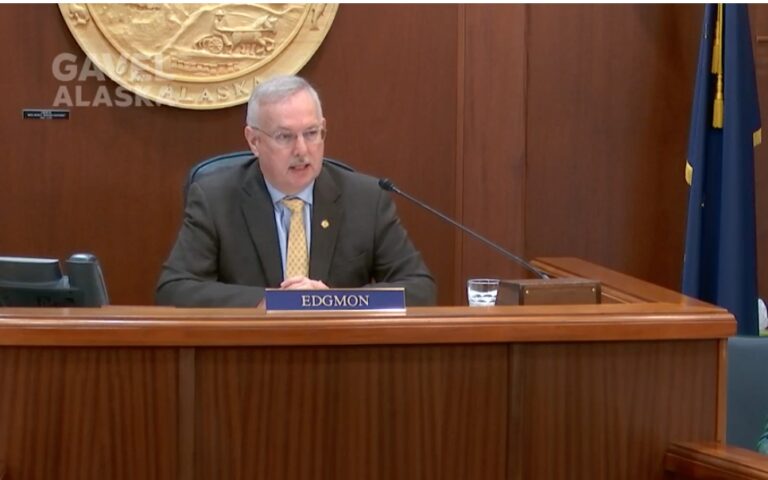
Speaker Bryce Edgmon was clearly having trouble holding together the Democrat-led majority because Rep. Maxine Dibert of Fairbanks was out for an extended period as she recovered from a serious illness. She was present on Thursday, sitting in the back and on an oxygen tank.
Meanwhile, House Republicans went long in their introductions of guests, putting the plans of the Democrats to hightail it out of Juneau at risk.
That finally irritated Speaker Bryce Edgmon who got chippy with the minority, asking sarcastically at one point “how many more staff do we have to introduce?”
Rep. Will Stapp, a colorful member of the Republican minority, then waxed at length about one of his staff members, until he was cut off by the speaker, who became increasingly irritable with the minority members. Watch it here:
This clip from Thursday’s floor session gives a sense of how it went before Speaker Bryce Edgmon pulled the plug.
In the middle of of the multiple “at eases,” Edgmon could be seen raising his voice at Minority Leader Mia Costello, he ordered Rep. Dan Saddler to “stand down, Rep. Saddler.”
Saddler refused, calling a point of order.
“This is not a debatable motion. I asked you to stand down,” Edgmon said sternly. “I am not going to be the presiding officer over a chamber that plays games.”
Watch as Edgmon loses his temper at the Republicans:
The remainder of the session on Thursday ended up being extended “at eases” sprinkled with Edgmon lecturing the minority.
Then, Edgmon turned to Majority Leader Chuck Kopp and said, “in deference to order and decorum on the floor, and not be obfuscating the action that we had hoped to take today, I ask for you to make a motion.”
Kopp motioned that the body adjourn until Monday. The Democrats all made their flights back to Anchorage after having put in only a half week of work.