The debate over school funding in Alaska’s Capitol is intensifying — and it’s not just about the money. With the 2026 governor’s race looming on the horizon, education policy has become a political flashpoint, as lawmakers spar over the suddenly-relevant House Bill 57, which is now funding “turducken” bill (three-bird roast) and what it signals to voters.
At the heart of the debate is the Base Student Allocation, a metric used to determine how much the state spends per student. Some Democratic lawmakers are pushing for a significant increase in the BSA, a move aimed as much at gaining political ground as it is at funding classrooms.
But on Thursday, Gov. Mike Dunleavy took a strategic approach on social media, diffusing partisan tensions with a message of cooperation — and clear expectations.
“Let me be clear,” Dunleavy wrote. “If legislators make a few key edits, including restoring the reading grants, adding open enrollment, ensuring full funding for correspondence students, and including the four charter school reforms, I will sign this bill. I look forward to working with lawmakers to make HB 57 a bill that strengthens outcomes, expands opportunity, and responsibly increases education funding.”
HB 57 is currently stalled in the Senate Finance Committee, where it still lacks some of the provisions Dunleavy is demanding — most notably, language granting additional authorizing authority for new charter schools and full funding for Alaska’s growing number of correspondence students.
In the Senate a coalition of Democrats and left-of-center Republicans must decide whether to meet the governor halfway or challenge him head-on. If they proceed with the current version of the bill, they risk another high-profile veto, just as happened with House Bill 69 earlier last week. That could lead to a showdown that could dominate headlines heading into campaign season.
With education emerging as a defining issue for both sides, Alaskans are likely to see more than just a budget battle play out in Juneau. Alaskans are seeing the early skirmishes of a governor’s race where classrooms, charter schools, and funding formulas are on the ballot, and this governor is trying to get the matter settled before it becomes the battering ram for the Democrats in 2026.
Defense Secretary Pete Hegseth signed a memorandum Wednesday directing the Pentagon to expedite the reinstatement of service members who were discharged for refusing the Covid-19 vaccine during the Biden Administration. This action follows President Donald Trump’s Jan. 27 executive order, which undid the Biden Covid vaccine mandates.
“We’re doing everything we can, as quickly as we can, to reinstate those who were affected by that policy,” Hegseth said.
The Department of Defense’s now has initiated outreach efforts to contact the more than 8,700 former service members affected by the Biden mandate. Defense has sent letters of apology, emails, phone calls, and is providing information through official websites and social media channels to try to reach the men and women who were separated from service and inform them about how they can come back at their previous rank, and the along with the possibility of getting back pay and benefits they would have earned had they been retained in the military.
Under the new policy, those who were involuntarily separated solely due to vaccine refusal are eligible for reinstatement and back pay. The back pay will be calculated based on what the service member would have received had they not been discharged, minus any income or benefits they received during their time away from the military.
“It hasn’t been perfect, and we know that,” Hegseth said. “We’re having an ongoing conversation with you to get it right. [We’re] working with the White House as well. We want anyone impacted by that vaccine mandate back into the military — people of conscience, warriors of conscience — back in our formations.”
The Army has reenlisted at least two dozen soldiers who were discharged for refusing the shot. Other branches, including the Marine Corps, Air Force, and Navy, have initiated outreach to the men and women they discharged during Biden.
“The guidance also will facilitate the removal of adverse actions on service members solely for refusing to take the COVID-19 vaccine, including discharge upgrades and less than fully honorable discharges for individuals separated from refusing to take the COVID-19 vaccine,” Hegseth said. “We’re trying to scrub all that, clean all that up.”
In July 2021, vaccination mandates were issued for federal employees, federal contractors, and military service members.
Despite growing evidence suggesting vaccinated individuals could still transmit Covid-19, these mandates continued to be enforced, significantly affecting the American workforce.
Despite eventual rescission of the mandates due to constitutional, statutory, financial, and other harms inflicted upon citizens, service members, and businesses, the military mandate remained.
An estimated 1.4 million active-duty and reserve service members were subject to the mandate, including members of the National Guard.
The community of Tok, deep in Interior Alaska, became a hub of forestry expertise this week, as professionals from across the state convened for the three-day annual meeting of the Alaska Society of American Foresters.
Organized by the Tanana chapter under Chairman Jeremy Douse, the gathering featured more than a dozen insightful presentations covering the latest updates in forestry management and Alaska Division of Forestry operations.
Attendees praised the line-up of speakers, noting that every presentation was “timely, succinct, and enlightening,” reflecting a growing urgency in addressing the complex issues facing Alaska’s forests and fire suppression strategies.
Two major topics dominated the meeting: Timber carbon credits and fires started in urban encampments
Timber carbon credits and Senate Bill 48
If Alaska sells timber off as carbon credits and the forests burn, does Alaska have to give the money back to the purchaser of the credits? Does this liability stretch to the life of the carbon credits when the cash is paid up front? It’s a question that is being asked as the state moves into the global carbon credit business, and the foresters attending the meeting discussed it at length.
The rapidly evolving field of timber carbon credits and implications of Senate Bill 48, signed into law in Alaska in 2023, which laid the foundation for the state’s entry into the carbon credit market, is an arcane, but important topic. Key updates highlighted the continued significance of Alaska-based sales, including the Chugach Alaska Corporation’s transaction, currently the largest known sale in North America, and Sealaska’s sale, the second largest.
Alaska’s Department of Natural Resources is expected to open a public comment period in early 2026 regarding its carbon credit sales strategy. Meanwhile, Doyon, Limited is emerging as another major player exploring this industry.
However, challenges remain. Who is responsible for fire suppression on carbon credit land? Who is responsible for fire suppression for carbon credit land owned by Native corporations?
If a private company is paid today for promising to not log specific land for 40 years, or 100 years, and that land is now designated as not eligible for fire suppression (called “limited”), does the private company pick up the suppression costs?
The concepts of fire suppression costs on lands enrolled in credit programs are emerging as potentially costly and complicated issues. Notably, there is currently no compliance carbon market — either voluntary or regulatory — for lands north of the Alaska Range.
Only Michigan, to date, has sold carbon credits as a state government entity, placing them into the voluntary market, which has recently softened significantly. While the market has gone flat, Alaska even has not gone through the public comment period.
New fire suppression threats from urban encampments
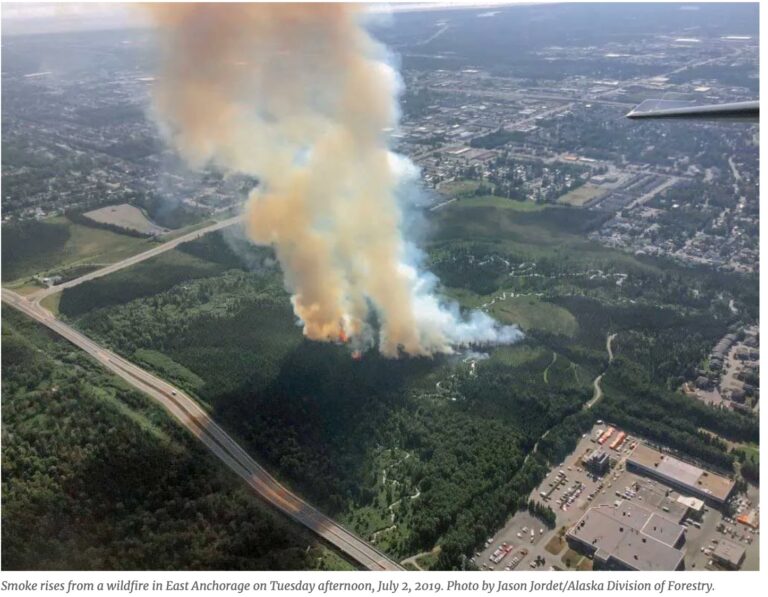
A second pressing issue brought forth during the meeting was the unprecedented wildfire risk posed by homeless encampments, particularly in Anchorage.
Speakers emphasized that such encampments represent a new and unpredictable fire threat that defies the typical patterns of Alaska wildfires.
While it remains impossible to predict the severity of a fire season in advance, experts warned that fires originating in homeless shantytowns could blur the line between urban fires and traditional wildfires. Because these encampments often involve flammable structures, outdoor fires, use of gasoline or other propellents as starter, and because they exist outside standard regulatory frameworks, the threat to surrounding areas during periods of low humidity and high winds is especially serious. This year, the wildfire season in Anchorage started early, due to low snowfall over the winter.
Forest fire managers may need the state to communicate clearly with municipal governments to let them know that local resources would be on the hook for suppression costs when fires start within city limits and then spread outside the city limits.
Current agreements used annually to allocate suppression costs — especially involving federal partners like the Departments of Interior and Agriculture — default to state payment through disaster declarations unless otherwise specified.
Redundancy in having the Alaska Departments of Law, and Natural Resources, and the 34th Alaska Legislature alert at least the Municipality of Anchorage of a potentially costly conflagration is one recommendation. The 1994 Miller’s Reach II Fire, in Big Lake cost about $50 million ($170 million in 2025 dollars) and was likely started by fireworks (as the Miller’s Reach I fire, a few days earlier was). It destroyed 344 structures in addition to the basic suppression costs.
With wildfire suppression costs having risen exponentially since the 1990s, attendees were reminded that suppression costs are just part of the picture. The damage to property and structures adds another layer of financial strain. A single wildfire ignited in a homeless encampment could require at least tens of millions of dollars to extinguish—underscoring the need for proactive planning and clear financial policies. In recent years a $60 million Alaska fire year is a larger year, but the homeless encampment situation might bring Alaska its first $100 million year.
House Bill 57, sponsored by Democrat Rep. Zack Fields, is intended to create policies and mandates to prohibit cell phone use I’m schools in Alaska.
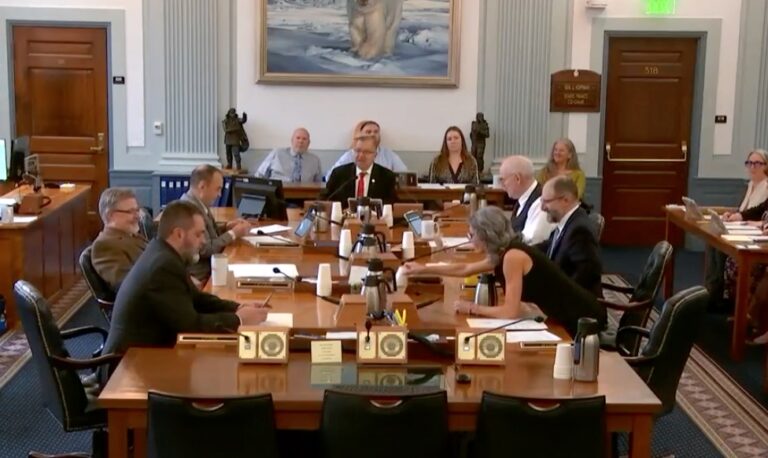
But in Senate Finance Committee on Wednesday, it became so much more — hundreds of millions of dollars more. The committee substitute for the bill stuffed in a $700 per student increase to education in the Base Student Allocation, which is the basis of the state’s contributions to local school districts.
But wait, there’s more: The committee also added in a 10% increase in transportation funding for schools.
The bill, when it was just about curbing student cell phone access in schools, passed the House on April 16 on a vote of 34-6.
The new version, howeve, is a fight with Gov. Mike Dunleavy, who earlier this week offered House Bill 204, which has education policy reforms and a beefy funding increase.
The Senate Democrat-led majority doesn’t appear to want the governor to have a win in education, so they’ve stuffed the funding they want, without Dunleavy’s policies relating to school choice and performance expectation, into a bill that originally had almost no fiscal impact, but was a Democrat policy bill relating to schools.
Notable is that the Senate Finance Committee had scheduled hearing the cell phone bill before it even left the House. The committee asked no questions of presenter Rep. Fields, and immediately brought forth the committee substitute.
But now, the Finance Committee doesn’t seem to be in a hurry to move it to the floor. In fact, the Democrat-led majority had two emergency caucus meetings on Wednesday, which indicates there’s trouble in the caucus.
Just days ago , the governor vetoed House Bill 69, the massive education funding bill from Democrats that would have added $1,000 per student increase to the school districts on a permanent annual basis. Dunleavy then offered a new bill that included a smaller Base Student Allocation increase and his policy proposals.
But in the Senate there seems to be two camps — one camp wants to get things done, and the other camp, led by senators like Sen. Bill Wielechowski, are taking a “burn it down” approach so they can have something to use in the 2026 election cycle to beat up Republicans.
Almost certainly, if HB 57 makes it to the governor’s desk in its current condition, Dunleavy will veto that bill, as he did HB 69.
Meanwhile, Dunleavy’s House Bill 204, with its $560 BSA increase and another $35 million for various programs, has yet to be even scheduled for a hearing. The legislative session ends on May 21, just 27 days away.
We fought, we argued, we disagreed, and we were more blessed to know each other than you can imagine.
Dan Fagan was a hero of mine. Heroes are funny in that most of the time, you are somewhat distant from them. You don’t really know them. That is what helps to make them your hero. Dan was someone I knew very well. Perhaps I didn’t perfectly understand him, but I always knew him. His heart, his courage, his drive. After years and years of doing shows together and having it out on the radio, I can safely say I loved Dan. He was worth my time. He gave me his time, and he cared for me.
Dan was a funny guy in just about every way. What set Dan apart and built the greatest talk show in Alaska’s history was his humor. This was especially true with women (Sharon Leighow and Charisse Millett etc.) Dan found the humor in the uncomfortable and drew us in like moths to a flame.
We listened to Dan because we were always in on the joke, and he knew how to play it for all it was worth.
After KFQD, Dan, Bonnie Voves, and I did a show together for a long time. I haven’t talked to Bonnie about this, but I always thought he asked her to be on the show for both a new and enlightened perspective, but also because he knew he and I would fight, and neither of us knew when to quit fighting.
I remember when we were having some trouble with an issue, Dan would remind me of several things: I was wrong. He was right. And iron sharpens iron. He knew that we were both invested in our positions. That we thought, prayed, and researched them to be ready for battle each day. He liked to test me. My ability to stick to a point was what he liked most about talking to me.
Dan and I were very different in our approach to gathering information. I didn’t trust others as much as myself. I always figured they either had something to hide or something to gain, so I would trust my own research and instincts. There is, however, only so much you can do on your own. Dan cast a wide net. He interviewed people, asked a lot of questions, and had a nose for duplicitousness that rivaled a bloodhound. He loved asking gotcha questions. That’s another reason he rose to the top.
Dan always had a side and a team, and it was his most profound sorrow when members of his team would betray him. This angst was a constant friction between Dan and me. It was also one of the most significant parts of his heart and soul. He wanted the truth more than friends, more than comfort, and he wanted people to live up to his high expectations more than anything.
I could go on for a long time about Dan and everything I remember. All the things he taught me, and how much I miss having more of him in my life. Ultimately, I pray that we remember Dan fondly, with the humor and passion he was so gifted to possess and share with everyone he met.
Dan continues to inspire me to be my best self. For that, I thank him and pray his journey to Our Father’s arms is swift. Thank you for being my closest ally when I needed you most. May God bless you, Dan Fagan, as he blessed me for knowing you.
Glen Biegel is a technology security professional, Catholic father of nine, husband to a saint, and politically active conservative.
As Alaska continues to grapple with fiscal uncertainty, the Alaska Permanent Fund remains at the heart of the conversation. Its performance and structure profoundly affect our state’s budget, the future of the Permanent Fund Dividend (PFD), and the long-term economic health of Alaska. Yet its structure – specifically the division between the Earnings Reserve Account (ERA) and the principal – is no longer serving us well.
In fact, it’s creating a slow bleed of our spendable savings. Proposals to merge the two accounts into a single constitutionally protected fund are not just about simplifying accounting. They are about correcting a dangerous flaw in how we draw money from the Fund and effectively creating a spending limit on the Fund.
To understand why, we need to briefly unpack how the Fund works today.
The Fund is divided into two accounts: the principal, which is constitutionally protected and cannot be spent without a vote of the people, and the Earnings Reserve Account (ERA), which holds realized investment earnings and is fully spendable with a simple majority vote of the Legislature.
Since 2018, Alaska has followed a Percent of Market Value (POMV) draw system to sustainably use Fund earnings. The formula allows for a 5% annual draw based the average total market value of the entire fund – both the principal and the ERA. However, there’s a fundamental problem: while the POMV is calculated using the full value of the Fund, themoney can only be taken from the ERA. The Legislature is legally prohibited from touching the principal, which means the full value of the Fund is theoretical when it comes to actual cash available.
This creates an imbalance that threatens the very sustainability the POMV system was designed to protect. Here’s why: realized gains from investments (like selling a stock at profit) flow into the ERA, where they become available to spend. But unrealized gains – paper increases in asset values – primarily remain in the principal. The problem is that most of the Fund’s growth has been in unrealized gains, which are locked away. Meanwhile, the Legislature continues to draw 5% of the average total fund value every year – but only from the ERA.
This means the ERA is being drawn down faster than in can be replenished. In years of market volatility or lower realized returns, this pressure becomes even more acute. And because the ERA is fully spendable with a simple majority vote, it’s vulnerable to political pressure. The temptation to overdraw is always there.
Merging the ERA with the principal into a single, constitutionally protected fund fixes this flaw. It doesn’t just simplify fund management; it changes how the Fund can be accessed. All earnings – realized and unrealized – would remain in the unified fund. The only way money could be withdrawn would be through a constitutional POMV draw.
This is not a minor shift. It would be the most significant fiscal reform in Alaska in a generation. It creates a hard cap on spending from the Fund, one tied directly to its performance and sustainability. No more treating realized gains as a checking account. Instead, the entire fund is protected, and spending from it is limited to what is sustainable over the long term.
In the end, this reform is about protecting the Fund, the PFD, and Alaska’s fiscal future. The Fund was created to turn a temporary resource boom into a permanent financial legacy. But that legacy only survives if we guard it against political pressure and short-term thinking.
This is more than a fiscal policy debate. It’s about protecting the Fund for future generations, ensuring the PFD survives, and building a system that supports long-term stability. Merging the accounts creates the discipline Alaska needs – and the legacy Alaskans deserve.
Angela Rodell of Juneau is a former executive director of the Alaska Permanent Fund.
Glenfarne, the company that has an agreement with the Alaska Gasline Development Corporation to move a gasline forward for Alaska, will not be needing the $50 million guarantee that the Alaska Industrial Development and Export Authority had offered.
That news was relayed in a House committee today by AGDC President Frank Richards.
Glenfarne, the new majority owner and lead developer of the Alaska LNG project, will proceed without the previously approved $50 million financial backstop, a development that takes that off the table as criticism of the project. Some critics had said that Glenfarne didn’t have enough skin in the game, if that guarantee was in place.
Glenfarne had inherited that $50 million backstop guarantee from an agreement with an earlier pipeline builder, a builder that was only interested in doing the narrower building portion of the project, which had a lot more financial risk associate with it.
Richards told the House Resources Committee that Glenfarne is going to seek private financing for the entire project and won’t need to be reimbursed for the front-end engineering and design portion if the project does not reach a final investment decision.
The Alaska LNG project has received all major federal permits, and may eventually deliver up to 3.3 billion cubic feet of gas per day, some for Alaska and some for export. With Glenfarne’s leadership and financial commitment, the project is moving quickly toward that prized “final investment decision.” That decision is expected later this year.
Time now to discuss “papabili.” Or, Catholic cardinals who might be the next pope.
Pronounced, pa-PA-bee-lee. Please do not offend my sensitive Italian ears by mispronouncing this, like so many do in regards to a favorite pizza cheese. (It is NOT “provolone” with a Long O and Silent E, but pro-vo-LO-nay.)
Alexander Dolitsky, a superb conservative columnist whose essays have regularly appeared here, has revealed his Russian biography to the readers. I will now do so briefly here.
Despite my last name, I am very Italian. My mother Hedda was a spy and scout for the Italian underground, known as partisans. My Uncle Mario, as a teen, blew up a truck of SS troops with a grenade, on its way to slaughter a village that was hiding partisans.
My dad, Robert was an American GI, an Intel & Recon officer. He met Hedda while he was on patrol, in the final six weeks of the war. I have his pocket diary with many details. He became the commander of the CID/Mediterranean Theater and remained in Italy for two years after the war, prosecuting Americans soldiers who were guilty of crimes.
They were married in Pisa. My Mom was quadri-lingual. On my first trip to Italy, I sailed on the ill-fated Andrea Doria in 1955, and remember it well. A year later, the ship was T-boned in fog, and sank. I myself speak Italian quite well. I visited many Catholic shrines in Italy with my wife in 2023. We saw the Shroud of Turin in 2010.
The media will come out with various and contradictory assessments about who the next pope might be. All of us will have to chew and digest them, and think for ourselves. But what difference should it make? This is not something the world gets to vote on, right?
Catholics and non-Catholics might all have similar reactions. “Nothing I can do about it, so whatever happens, happens.” Or perhaps, “Who could care, anyway?” This might be fitting responses for atheists and agnostics, but not for Protestants, Evangelicals, Catholics, Jews and Moslems, all of whom pray to the God of Abraham, our “Father in Faith.”
They might even detest or fear the Catholic Church, misunderstand it or ignore it, but none can deny its importance. It is the world’s largest religion. And despite its apparent loss of influence, that influence is still there, and admitted to be so, even by its open enemies, who have long wanted to destroy it.
And while millions have left it, there is an awareness, backed by solid data, that a new seed is sprouting once again. The Church is ever-ancient, and ever-young. This renewal is visible, and depending on your perspective, it is either a new hope or a new threat.
Only a fool thinks that a man who will claim to be “The Vicar of Christ on Earth” does not possess influence. He does. He will. And another confused and contradictory pope will serve the entire world ill.
My stomach has turned in reading the characterizations in the mainstream media regarding the legacy of Pope Francis.
He was anything but humble. He was crude, impulsive and contradictory. Like so many Catholics, he was poorly instructed in Church dogma, and the long-established limits on his own power. He was a tool of globalists. He gave man-made climate change, anti-Americanism, leftist sympathies and Covid-vaxing his priorities, all of which are propped up by the diminishing influence of the globalists, who controlled him.
His confusion was ignored and his better comments emphasized, by priests and bishops who actually knew better, but they played along, mostly out of fear. He banished the truly humble and tradition-minded priests and bishops to the Church attic, suppressed religious orders and institutions who were founded on the same plane, and appointed those who shared his false compassion that would pander to the sins of adultery and homosexuality.
The smart money is that his intentional packing of the College of Cardinals will ensure that this sort of papacy will continue. But smart money is often wrong.
So, how does the humblest worshipper of the God of Abraham, Catholic or not, vote for pope? Well, all of them understand that you can pray. And prayer is effective. Just how it works is a mystery, but there is an old saying that says, “Prayer is man’s strength, and God’s weakness.”
To keep this column short, here is a list of papabili. The first list would be Cardinals who would continue the Francine Legacy of confusion and destruction.
Pietro Parolin, Vatican Secretary of State.
Mario Grech, from Malta.
Sergio Rocha, from Brazil. An Odds-on favorite.
Luis Tagle, Philippines. Another favorite of the odds-makers.
Carlos Retes, from Mexico.
Next is a list of those who would make the cleansing and corrections needed to reform the Church and its tarnished reputation. They belong to the Pope John Paul II and Benedict XVI school of adherence to timeless truths. None of them are favorites in the sense of the odds, but odds are often wrong.
Pierbattista Pizzabella, Patriarch of Jerusalem.
Peter Erdo, Hungary.
Freddin Besungo, Congo.
Robert Sarah, Guineau.
Gerhard Muller, Germany.
The list is incomplete in both categories, and of the 266 popes, the dark horse has often been selected.
So, whether you are Catholic or not, if you want a good pope, pray for it. There is no Dominion voting machine, or paper ballots. My guess is that the Almighty will be even more impressed with prayer emanating from non-Catholics than from Catholics.
And do something that only cheaters do, and in this case, is perfectly legit:
Vote early, and vote often.
Bob Bird is former chair of the Alaskan Independence Party and the host of a talk show on KSRM radio, Kenai.
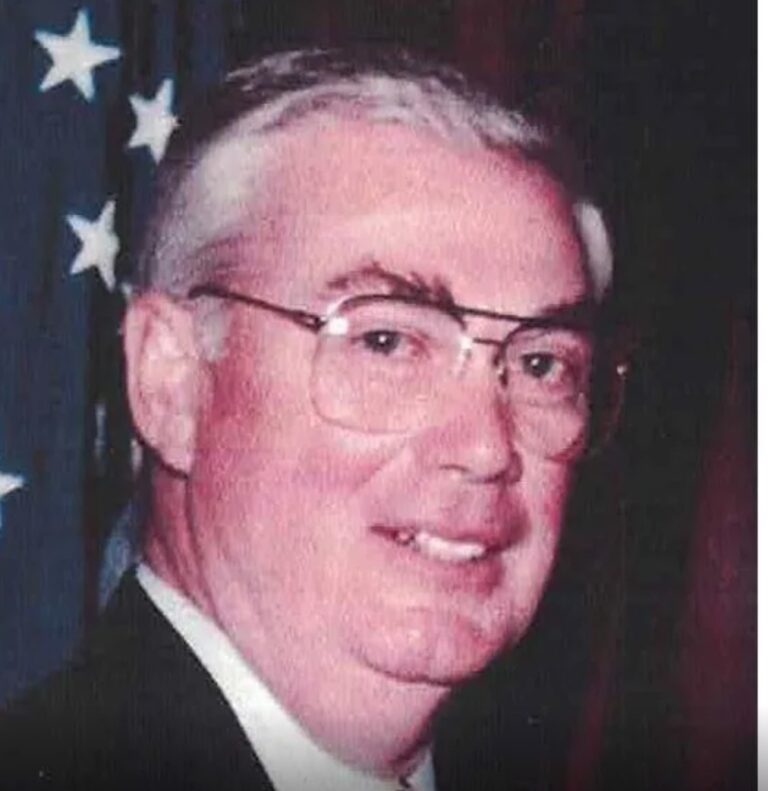
William “Bill” Sharrow, a decorated brigadier general in the Alaska National Guard and the longtime state director for the late Congressman Don Young, died April 11, 2025, with Margaret, his beloved wife of 69 years, by his side. He was 92.
Born Aug. 19, 1932, in the iron mining hamlet of Witherbee, NY, Bill’s life was defined by duty, service, and deep commitment to both his country and community.
After working as a hard-rock driller in an iron mine following high school, he was drafted into the Army during the Korean War and stationed in Anchorage in 1952 with the 867th AAA Battalion. Alaska would capture his heart, and shape his future.
While in Alaska, a sergeant enlisted Bill and three fellow soldiers to help build a log cabin near Palmer. It was there that he met Margaret, who was a nurse at the Palmer Hospital. The connection would define the rest of his life. After his discharge in 1954, he returned briefly to New York and joined an Army Reserve unit, but soon realized Alaska, and Margaret, were where he truly belonged.
He returned to Alaska, joined the Alaska Army National Guard, and was commissioned as an officer in 1956. Over the next two decades, Bill rose through the ranks, serving in an array of vital roles including radio repairman, supply officer, personnel officer, and Command Administrative Assistant to the Adjutant General. His leadership culminated in his appointment as Chief of Staff for the Alaska National Guard in 1972, and later that year, his promotion to Brigadier General.
In 1974, after more than 20 years of distinguished military service, Bill transitioned to a new kind of public service as the state director for Congressman Don Young, a position he would hold for 24 years. He served the state through the heady days of the building of the Trans Alaska Pipeline System, the boom and bust economic turns, and during the Exxon Valdez oil spill, and the signing of the Alaska National Interest Lands Conservation Act (ANILCA) into law by President Jimmy Carter.
In a 2007 Congressional Record tribute, Rep. Young called Bill Sharrow “a truly great American” and praised his unwavering dedication to the people of Alaska. “When I was unable to attend an important function or meeting,” Young said, “it was Bill that I always trusted to represent me.”
Congressman Nick Begich noted that his family played a large role in all of this.
“Bill Sharrow served the state of Alaska for nearly a quarter of a century as Don Young’s trusted right-hand man in the state. It takes a team to be Alaska’s only US representative, but it takes a team at home, as well. Thank you to Bill’s family for allowing him to serve all Alaskans for so much of his life,” Begich said.
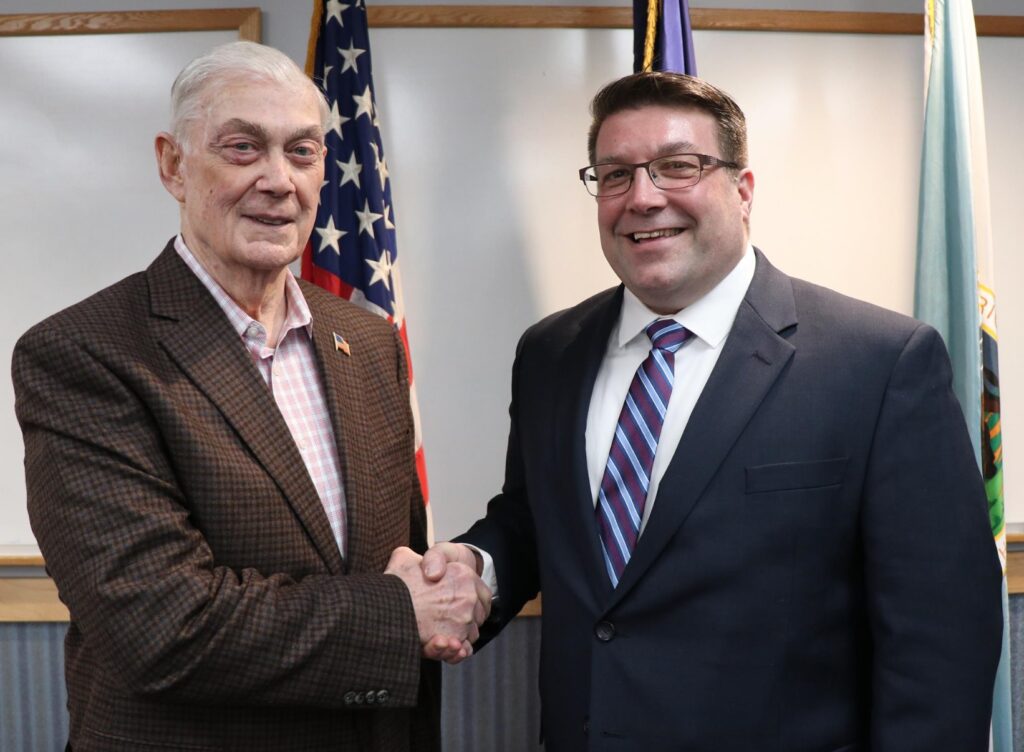
Bill Sharrow and Chad Padgett shake hands in this 2019 photo. Padgett followed Sharrow as state director for Congressman Don Young from 2009 to 2019, when Padgett joined the Bureau of Land Management. Sharrow was attending Padgett’s swearing in ceremony at BLM in Anchorage.
Outside of his professional life, Bill was committed to his community and faith. In 1958, he helped found St. Bartholomew’s Episcopal Church in Palmer, and later became deeply involved at St. Mary’s Episcopal Church in Anchorage after the family relocated there.
Chad Padgett wrote this tribute to him:
“Just before his passing, I had the opportunity to speak with him. I was undergoing cancer treatment in Houston, TX and was feeling a bit down. I heard Bill was having a serious health issue so I called him to say hello. As always, Bill was strong. He knew his fate was sealed but because of his faith in God, he was not sad about passing as he absolutely knew where he was going, to heaven. Once again, as Bill had done many times throughout the 30 years I have known him, he cheered me up, made me laugh, and I forgot all about my woes. So even from his literal deathbed, there was Bill, guiding me and making me stronger in my belief in God and humanity. Since that day, not only do I have an even stronger faith in God, but know that Bill is by his side, likely arguing (in a good way), as he was known to do, with Congressman Young. Now with Bill, Congressman Young and Ted Stevens all in heaven, we have many Titans watching what we do with their legacies.
“Bill Sharrow wasn’t just a boss—he was a mentor, a friend, and a rare kind of leader who left a lasting imprint on everyone lucky enough to know him. He led with quiet strength, unwavering kindness, and an innate sense of humanity that shone in both big decisions and small, unnoticed moments.
“One memory that stays with me is on a cold (subzero) day in January Bill saw a woman who was cold and, without a second thought, took off his own coat and handed it to her. That was Bill: always paying attention, always ready to help, no matter the circumstance. It wasn’t for show—it was just who he was.
“And then there was his laugh—deep, warm, and unmistakable. You could hear it from down the hall or across a crowded room, and it had a way of making everything feel a little lighter. His presence brought comfort; his humor brought joy.
“Not many people know that Bill played a quiet but pivotal role in helping bring the Alaska Military Youth Academy to life. He believed deeply in the potential of young people and was always looking for ways to help them build full, productive lives. Whether it was creating new opportunities or encouraging service to the community, he understood the power of investing in the next generation.
“Bill’s legacy lives on in the people he believed in, the lives he touched, and the way he made all of us feel seen, heard, and valued. He will be deeply missed—but never forgotten.”
A devoted husband, father, and grandfather, Bill took immense pride in his family. He and Margaret raised three sons — David, Philip, and Steven — and delighted in their six grandchildren and two great-grandchildren. After retirement, Bill and Margaret cherished their time together traveling, particularly enjoying river cruises and warm holidays in New Zealand with family.
A celebration of Bill’s life will be held at 4 pm on April 24, at St. Mary’s Episcopal Church in Anchorage.
Bill Sharrow served with honor, humility, and heart, and he leaves behind a legacy of leadership and familial love that will be remembered by all who knew him.