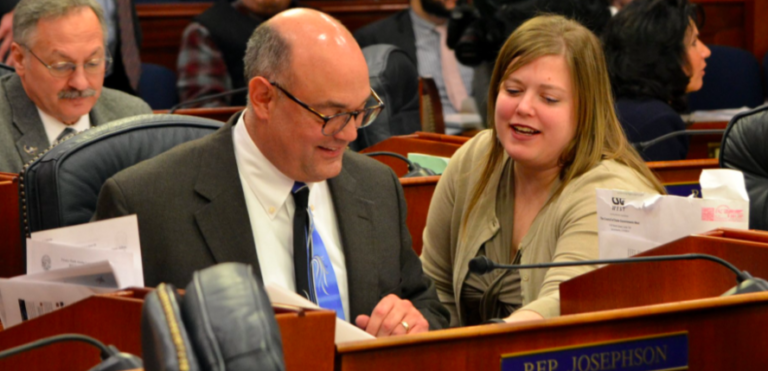
Senator Berta Gardner, D-Anchorage argues against allowing Uber and Lyft companies to operate in Alaska, while members of her Democrat caucus, Tom Begich, Bill Wielechowski, and Dennis Egan, listen.
Ride-sharing companies such as Uber and Lyft got the green light by the Alaska Senate, which voted to pass Senate Bill 14, allowing Alaskans to use their cell phones to connect themselves with for-hire drivers in what’s known as the “access economy.”
The Senate vote was along party lines: Republicans favored it and Democrats voted against it, 14-5. Sen. Bert Stedman, R-Sitka, was the only Republican senator who voted against it.
Sponsored by Sen. Mia Costello, R-Anchorage, the bill endured lengthy floor objections by Sens. Bill Wielechowski, Dennis Egan, Berta Gardner, and Tom Begich. Wielechowski, Begich and Gardner are all part of a newly formed “Innovation Caucus” that was announced earlier in the week.
“Personally I like transportation network services,” argued Sen. Dennis Egan. “The problem is they don’t fit here. I’ve used them Outside. And I hope they come to Alaska someday.” And then he went on to say why they were a bad idea because local municipalities should have control.
Most of the amendments were “poison pill” amendments, and the majority of those were offered and argued by Wielechowski, a union lawyer for IBEW 1547. But two amendments passed, preventing drivers who have been convicted of a felony or some moving vehicle violations, as well as those on the national sex offender registry. Both required amendments to amendments to make them work, due to a drafting error by Legislative Legal Affairs.
Unions have made their displeasure known in Juneau on the ride-sharing bill. The Teamsters flew a union representative in from Seattle to testify during the House hearings on the companion bill, HB 132, which was heard in House Labor and Commerce Committee last week.
Vince Beltrami and Joelle Hall, president and director of operations for the Alaska AFL-CIO have been spotted in the Capitol this week, to talk with lawmakers, and Teamsters are hosting an invitation only birthday party for a key legislator this weekend.
The House version was heard and held in House Labor and Commerce Committee and will be taken up today at 3:15 pm., where poison pill amendments by Rep. Andy Josephson, D-Anchorage will be heard.
Rep. Paul Seaton’s aide, Taneeka Hansen, explains the new version of the income tax bill, HB 115.
The governor has spoken on the need for a state income tax — again.
Only this time it’s a whopper of an income tax bill. It covers S corporations, limited liability corporations (LLCs), trusts, and estates. It creates tax brackets, like the federal government, rather than taxing people a percentage of their federal tax liability. It has taxes in it that the governor never dreamed of last year.
HB 115 is, in fact, a whole new bill.
At the beginning of today’s House Finance Committee meeting, Rep. Tammie Wilson asked Rep. Paul Seaton’s staff, Taneeka Hansen, where the new tax language came for the new version of HB 115.
The answer is a lot of it came from the administration of Gov. Bill Walker. The Department of Revenue, which has been rumored to have an income tax plan in its back pocket, introduced it through Seaton’s staff, and Seaton’s original HB 115.
“We were working with the Department of Revenue to get the type of language they would need in order to implement an effective tax,” said aide Taneeka Hansen. She also referenced people who had testified that an Alaska income tax on a federal tax liability might make it volatile, should the federal tax rates change.
Hansen said others had testified that deductions and credits that people use to reduce their federal tax liability aren’t “necessarily the best tax system.”
With the new version, things like mortgage interest, charitable donations, or itemized deductions would not be allowed as deductions against your state tax, a clear shot across the bow of Alaska’s working middle class.
The new version of HB 115 is complicated. In addition to increasing taxes in numerous ways, it restructures how the Permanent Fund Earning Reserve Account works, and we’ll save that analysis for another day.
But it does all of this — setting forth various taxes and fiscal restructuring — without a fiscal note so far, which is the piece that tells Alaskans how much it will cost to implement, and what all the new taxes are expected to generate.
This new version is so complex that the bill is likely to require a new set of public hearings. Rep. Tammy Wilson of North Pole forced the hand of Chairman Paul Seaton of Homer, by detailing how many aspects that were new in this bill.
“There are so many moving parts to this that right now it’s hard to know what extent it will hit the individual,” said Wilson in an interview Thursday, as she and her staff were combing over the bill to understand how much Alaskans will be asked to give State government, should it pass both the House and Senate.
Knowing that much of the new version originates with the Department of Revenue, if it did pass both houses, it would likely be signed by the governor.
But passage in the Senate is unlikely. Senate President Pete Kelly issued a statement on a Facebook video saying that the Senate Republican majority is not interested in an income tax, but that they have sent the House a plan that would solve the state’s fiscal crisis with budget cuts, a spending cap, and revenue limits, along with a set Permanent Fund dividend and use of Earnings Reserve Account of the Alaska Permanent Fund.
“We believe people should be able to keep the fruits of their labor,” he said. “We just don’t think you should be taxing people at the same time you’re handing out [Permanent Fund] checks.”
Must Read Alaska will follow this story, so check back for updates.
In a week when the Trump Administration has released a list of sanctuary cities that refuse to cooperate with national immigration officials, a group of Homer, Alaska residents is well on its way to booting three city council members who tried to declare the town a sanctuary for illegal immigrants.
The group is halfway to its goal of 800 signatures on a petition they are circulating for a recall election.
They have until April 11 to submit the signatures to City Clerk Jo Johnson, who will then decide if they can hold a special election.
The recall relates to an effort by council members Donna Aderhold, David Lewis and Catriona Reynolds to pass a resolution opposing the administration of President Donald Trump and creating “sanctuary city” status for Homer, Alaska.
The final draft resolution that was presented to the council removed references to the president directly and was titled: A Resolution of the City Council of Homer, Alaska, Stating That the City of Homer Adheres to the Principle of Inclusion and Herein Committing This City to Resisting Efforts to Divide This Community With Regard to Race, Religion, Ethnicity, Gender, National Origin, Physical Capabilities, or Sexual Orientation Regardless of the Origin of Those Efforts, Including From Local, State or Federal Agencies. Aderhold/Reynolds/Lewis. It was voted down by all but Reynolds.
Other cities that have flirted with “sanctuary” status include Anchorage, where immediately following the presidential election in November, Mayor Ethan Berkowitz penned an opinion that was published in the Alaska Dispatch News. He and his wife wrote of Anchorage as a “Welcoming City,” where everyone should feel safe, secure and strong.
Welcoming cities are a notch back from sanctuary cities, “sanctuary-lite” in practice, and are part of a softened national movement toward the more militant, more lawless aspects of sanctuary cities.
Welcoming cities have plans for integrating and welcoming immigrants into their communities, and they generally adhere to the principles set forth by the nonprofit Welcoming America network. While there is no legal definition for sanctuary city, a welcoming city resists requiring local law enforcement agencies to “do the federal government’s job of enforcing immigration laws. Many do this by preventing local officials from asking people about their immigration status. Other cities refuse to use local resources to detain immigrants. The main purpose for these types of policies is to comply with constitutional requirements and to protect public safety by maintaining positive relationships between local law enforcement and immigrant communities,” according to the group’s web site.
In Fairbanks, Mayor Matherly was asked to propose a sanctuary resolution in February by a dozen Fairbanksians, but he decided against it: “After researching the definition and implications of sanctuary cities, the mayor does not plan on supporting a resolution to designate Fairbanks as such,” he said in a statement. The calls and emails from residents were overwhelmingly against the proposal.
President Trump has threatened to withdraw federal funds from cities that refuse to cooperate with federal immigration authorities. This week his administration published a list of the municipalities and counties that are refusing to work with federal immigration officials. [See Table 3]
No Alaska communities are yet listed on the Immigration and Customs Enforcement document as sanctuary cities.
Can your truck be considered a place of business if you’re an independent truck driver? Is your truck cab your office? Maybe or maybe not, says Gov. Walker.
If you don’t shell out cash to advertise for new customers, will the State decide you’re not really a contractor? Probably. At the very least, you’re going to have to prove you are an independent contractor to the Alaska Department of Labor. If Walker’s legislation passes, they’ll fine you first, ask questions later.
“Investigators will investigate as they always do and they will assess a penalty,” said Department of Labor Director of the Division of Workers Compensation Marie Marx to the House Labor and Commerce Committee on Wednesday. And if you don’t like the assessment, you can ask for a hearing, she said, calling it a more efficient way of doing business.
“We anticipate that fewer assessments will go toward hearings,” said Marx. She may be right — after all, independent contractors are awfully busy just trying to make a living.
Independent contractors in Alaska would be defined so narrowly by the Walker Administration that many would be relabeled as employees of other contractors, and would be required to be covered by the prime contractor’s workers compensation insurance. This is a move that is hostile to small businesses.
It’s all part of HB 79, a job-killing bill that passed out of House Labor and Commerce Committee yesterday over the objections of pro-business Republicans.
The bill, offered up by the Department of Labor Commissioner Heidi Drygas, impacts tens of thousands of Alaska workers who are trying to make a living in a state that has a rapidly shrinking economy. Over 7,500 jobs are forecasted to be lost this year in a state that already has the highest unemployment rate in the nation.
HB 79 says that if you are a contractor who uses independent subcontractors in your business, in all-too-many cases you would be forced to consider them employees and cover them by your insurance. But, that is not the half of it. Other benefits and payroll taxes would also be due, once the employer-employee relationship is established.
It’s a move that will sharply increase the cost of doing business and limit the free market.
In small Alaska communities, which is most of them, people work at various jobs to patch together a living. They may have a contractor’s license, but may do frequent work for a larger contractor who comes into town to do a job. They may have various contract arrangements. This is how Alaskans manage to keep going in small economies from Tok to Togiak, from Ketchikan to Kaktovik. It’s the way it’s been done in Alaska since, well, forever. And it favors the worker and the entrepreneur.
TRUCKERS HIT, BUT CONSULTANTS TOO
In House Labor and Commerce Committee, Aves Thompson, who represents the Alaska Truckers Association, explained to the committee that many truckers in Alaska get work by word of mouth. When they need a job, they don’t advertise, which is one of the check-box requirements of the Department of Labor as it evaluates whether you are truly a contractor.
“We dealt with this issue last year in a piece of legislation that was in fact introduced by Rep. [Gabrielle] LeDoux,” said Thompson. “We think this bill in principle is good — we just have a few difficulties with it in this independent contractor paragraph.”
Thompson said the bill was sprung on the business community this year. “We didn’t hear anything about it from anybody until the bill popped up in February, and they said ‘Here it is and here are the definitions.’
“We made contact with the department and started talking about it, and we give them credit, they made significant progress from original bill to the committee substitute.
“We felt that was progress,” he continued. “We again said we supported the bill in principle and there was some misunderstanding about what our level of support by our association was for this bill. I believe I tried to express my apology for that last Monday, for whatever part I played in making that error.”
Thompson was apologizing to the committee for the second time in a week.
Rep. Sam Kito, D-Juneau, lectures Alaska Trucking Association President Aves Thompson, and accuses him of trying to delay a bill that makes it harder to be an independent contractor. Thompson is shown in the box in the lower corner of this screen shot from 360north.org
But his apology wasn’t enough for Committee Chairman Sam Kito, a Juneau Democrat, who took after Thompson in front of the entire committee and dressed him down at length.
“I do think the department [of Labor] has done an admirable job of putting together and trying to accommodate the situation with the independent contractors. And I do think that efforts to try to delay the bill really are not appreciated,” Kito lectured Thompson.
Kito has been romantically linked to Commissioner Drygas, but sources in Juneau say that liaison is not current. He has never acknowledged the conflict of interest.
“So I would encourage you to work productively and constructively and provide statements that don’t misstate the position of the truckers, because on March 9 it seemed to be everything was OK, and now it’s not,” Kito said, jabbing at the air toward Thompson, who maintained a diplomatic silence during the rather unusual dressing-down.
The truckers aren’t the only ones who have trouble with the bill.
“It’s part of the broad theme of the Dept. of Labor being punitive toward employers,” said Rebecca Logan, president of the Alaska Support Industry Alliance.
“They are impacting wage payers. Instead of growing the pie of jobs, they’re trying to shrink the pie. They’re being punitive to employers by creating more policies so they can catch employers doing something wrong and fine them.” she said.
The business community — especially small business owners — use independent contractors and consultants (including professional consultants) to allow them to compete for jobs that are limited in time or that are very specific in scope. Many sole proprietors can only stay in business with the plug-and–play help of professional consultants who allow them to scale up their businesses as needed. This is especially the case in rural areas, but also relates to the North Slope oil patch. The independent subcontractors that these prime contractors use have their own business licenses and are fully accounted for in their transactions.
Colleen Sullivan-Leonard, a Republican from Wasilla, said she wanted the bill to be held until the identified problems were addressed.
But Chairman Kito refused: “I am interested in moving the bill today,” he said.
Rep. Louise Stutes, a Kodiak Republican who has thrown in her lot with the Democrat majority, agreed with Kito and said she was fine with the bill going forward, even though the business community objects: “This is year number three for me,” she said, of her years of experience. “And I’ve yet to see a perfect bill.”
Democrats Kito, Andy Josephson of Anchorage, Adam Wool of Fairbanks, and Democrat caucus member Stutes voted for HB 79, which now heads to the House Judiciary Committee, chaired by Democrat Matt Claman of Anchorage.
Rep. Chris Birch, R-Anchorage, Rep. Gary Knopp, R-Kenai, and Rep. Sullivan-Leonard, R-Wasilla were in the minority, voting against it. Their objections related to the punitive effect on small businesses and restricting economic freedoms.
The Alaska House of Representatives, having passed its no-more-cuts budget along caucus lines, turns its attention to other pressing matters this week — hiking oil taxes with HB 111, and taking down the Electoral College with HB 175.
HB 175, which has received scant attention to date, would have Alaska join an interstate compact to award all of its electoral votes to the winner of the national popular vote in a presidential election. The bill is sponsored by Democrat Zach Fansler, with cosponsors Les Gara, Justin Parish, Harriet Drummond, Scott Kawasaki, and Geran Tarr, all Democrats.
It will be heard in House State Affairs Committee on Thursday. It has no fiscal impact on the state budget, except as the presidency can impact the state budget.
The interstate compact among participating states would go into effect after there are enough states to represent an absolute majority of votes, which is currently enough states to equal 270 Electoral College votes.
If passed, in the next presidential election, the joining states would award all of their electoral votes to the electors associated with the candidate winning the popular vote across all 50 states and the District of Columbia. In other words, if Hillary Clinton won the popular vote across all states, the compact members would award all their electoral votes to her.
In this way, the winner of the popular vote nationally would always win the presidency, because he or she would gain the majority of the Electoral College votes.
The “mob rule states” would be breaking-and-entering through the backdoor of the U.S. Constitution, Article II, Section 1, Clause 2, which lines out the rules by which the Electoral College operates.
The Constitution allows legislatures to choose how their states allocate electors. Currently, Alaska awards all of its votes to the candidate who wins the most votes statewide. This is how it is done in every state but Maine and Nebraska, which award them in a split fashion.
Today, Alaska has a House majority run by Democrats, and they are using it to their advantage to push through legislation that they feel will be favorable to Democrats in the next election — 2020.
Current signatories to the compact are the heavily Democrat majority states of California, District of Columbia, Hawaii, Illinois, Maryland, Massachusetts, New Jersey, New York, Rhode Island, Vermont, and Washington.
Unsurprisingly, Hillary Clinton won all those states’ popular votes:
California: 61.6 percent
District of Columbia: 92.8 percent
Hawaii: 62.3 percent
Illinois: 54.3 percent
Maryland: 60.5 percent
Massachusetts: 60.8 percent
New Jersey: 55 percent
New York: 58.8 percent
Rhode Island: 55.4 percent
Vermont: 61.1 percent
Washington: 54.4 percent
In Alaska, Donald Trump won 51.3 [corrected 03.24.17] percent of the vote. With HB 175, our votes would be awarded to Hillary Clinton.
WHY THE ELECTORAL COLLEGE MATTERS
The authors of the U.S. Constitution invented a system of Electoral College voting, in order to protect the rights of minority states like, for instance, Alaska, which has a small population. They rejected the simple majority vote because they are prone toward dictatorships and mob rule.
The system was designed by James Madison to protect citizens from the tyranny of direct democracy, where citizens could band together to form an absolute majority, and then strip the rights from the minority.
In Federalist Paper Number 10, Madison describes how, “By a faction, I understand a number of citizens, whether amounting to a majority or a minority of the whole, who are united and actuated by some common impulse of passion, or of interest, adverse to the rights of other citizens, or to the permanent and aggregate interests of the community.”
Madison wrote that “a well-constructed Union” must “break and control … the superior force of an…overbearing majority.”
Protecting smaller, less populous states from being overpowered by larger states was an equally strong concern at the time, which led to the Connecticut Compromise at the Founding Fathers’ Constitutional Convention of 1787. It established a bicameral — or two-body — Congress that allocated members of the House of Representatives according to population but allocated Senators in equal numbers (two per state).
Madison’s electoral college simply extended the Connecticut Compromise to the election of presidents. Electoral votes are awarded by total House and Senate seats combined, thus guaranteeing small states like Alaska a meaningful say in presidential elections. This stroke of remarkable statesmanship has protected small states from the tyranny of large states since the birth of the nation.
There are 538 electoral votes available, and it takes 270 to win the presidency. Some liken the process to the World Series: It’s not the overall number of runs that wins the series, but the team that wins the most games. A team could technically score more runs throughout a series and still lose the series.
(We are not an accomplished student of baseball, but that happened in the 1960 World Series, where the Pittsburgh Pirates won over the New York Yankees. The Yankees won three blowout games (16–3, 10–0, and 12–0), but the Pirates won four games (6–4, 3–2, 5–2, and 10–9).
In U.S. election history, five presidents have won the Electoral College without winning the popular vote:
John Quincy Adams, 1824
Rutherford B. Hayes, 1876
Benjamin Harrison, 1888
George W. Bush, 2000
2016, Donald Trump
Today, with our nation’s cities heavily populated by racial minorities, the Electoral College makes sense as never before, as it actually gives minorities a bit of an edge. They influence the entire electoral vote of their states.
House State Affairs will hear HB 175 during its March 23 meeting at 3 pm in Room 120 of the Capitol. The meeting will be teleconferenced. Four Democrat majority caucus members dominate the committee — Chairman Jonathan Kreiss-Tomkins, Gabrielle LeDoux, Chris Tuck, and Adam Wool. Republicans Chris Birch, DeLena Johnson, and Gary Knopp round out the committee.
As a clear case of “elections have consequences,” Alaska students of the Constitution should watch this legislation carefully.
JUNEAU – Rep. Les Gara, the unwavering leftist anchor of the Alaska House of Representatives, has a favorite saying:
“I guess if you say something enough times, and convince people enough times with an inaccurate statement that you’re right, maybe they start to believe you.”
At least Gara walks that talk.
On Feb. 17, Gara, D-Anchorage, told reporters that State budget cuts would put Alaska into a “10-year recession.”
It was a round number, and it may have sounded good to him as a sound bite, one that he’s been repeating nearly daily for the past month without a challenge from the media.
No one in Alaska economic circles has repeated the theme, but Gara recycles it with confidence.
Cuts will “also get you one of the worst recessions in Alaska history, and a state where your children can’t find a job. You deserve real information instead of soundbites, so you can tell your legislators the path you prefer,” he wrote back in February in the Alaska Dispatch News.
“No solution will be as popular as those irresponsible political soundbites you hear. I’d rather hear from you than those who peddle false soundbites,” he concluded.
Monday, he said the House Democrats had cut $81 million from the $6.5 billion budget, which passed along caucus lines, 22-17.
But House Republicans said the budget is actually $14 million bigger — two-tenths of one percent more than the governor asked for. Most Republicans voted against it, but three key Republicans joined with Democrats to pass a larger budget and enact new revenues to pay for it.
It depends on how you slice the numbers, whether the budget is smaller or larger than before.
Walker has proposed a gasoline tax that would raise $81 million a year, which masks the fact that significant cuts were not made. But the gas tax alone leaves a $2.78 billion gap.
The gas tax, one of several being considered, would cost average Alaskans about $150 a year, but would hit commuters from the Mat-Su Valley particularly hard, since many commute 50 miles or more per day.
“You’re taxing people who are driving to work, then taxing the work they do,” said Rep. David Eastman, a freshman from Wasilla, referring to the double whammy gasoline and income taxes that Democrats are also proposing.
A draw from the Permanent Fund Earnings Reserve Account is in the mix as well. The various taxes and Permanent Fund restructuring are included in HB 115, which was heard by the House Finance Committee today and held until Thursday for a hearing.
Gara went on to say that Alaska spends less than it did in 1975 in real dollars, but that is not borne out by the governor’s own slide deck from last year, which shows:
TAXES DRAG ECONOMY
The problem with trying to tax Alaska’s way out of a recession is that taxes do not inject new money into the economy. Taxation only keeps the same amount of money circulating, but only after a portion of it is siphoned off by government, and is put back into the economy via government jobs.
In Alaska, with its limited economic diversity, the only way out of recession is by bringing in a lot more tourists, catching a lot more fish, mining a lot more gold, and putting a lot more oil in the pipeline.
There is also another penalty. When money is siphoned off by government, the main agent of economic growth is neutered — innovation and new ways of doing old jobs more efficiently. The economy suffers in the long haul. As in, over the next 10 years.
Or, the state can simply hope that price-per-barrel reaches above $70. Many economists believe prices that high are as much as a decade away. If so, Alaska will simply need to increase production.
As the statements from the House members were heard one-by-one just before they voted Monday on the biggie-sized budget, Gara brought out his favorite saying — the same one he has used whenever he’s had the microphone in front of him and a camera rolling during the past month: He argued again that cuts to government would put the state into a “10 year recession.”
There’s nary a data point to back that up. But at least he inadvertently admits it with his other favorite saying, “I guess if you say something enough times, and convince people enough times with an inaccurate statement that you’re right, maybe they start to believe you.”
A group of citizens in Homer, Alaska has had quite enough of three city council members who tried to make Homer a “sanctuary city ” — a place where illegal immigrants could find safe haven from the law.
The citizens want the three recalled. The reason? The city council members’ actions have harmed the economic health of Homer and constituted “improper behavior.”
As of this afternoon, the recall petition blew past 300 signatures in less than four days’ effort. That is 80 percent of the minimum total signatures that will be required.
HAL SPENCE TAKES CREDIT
In January, shortly after the swearing in of President Donald Trump, Homer City Council members Donna Aderhold, David Lewis, and Catriona Reynolds worked quietly on a resolution that rebuked Trump and declared Homer in resistance to everything about his administration, including his entire cabinet.
The draft resolution was a blistering “Whereas” document that contained the wordsmithing of former Homer News and Peninsula Clarion reporter Hal Spence.
Spence is the former president of the Alaska Press Club and, since early 2009, he has been on contract with a number of environmental organizations, such as Cook Inletkeeper, Alaska Marine Conservation Council, and World Wildlife Fund, according to his profile at the Hospice of Homer, where he serves on the board. He calls himself an independent environmental services professional on his LinkedIn social media profile.
Spence has written a letter to the editor taking credit for the original draft.
TOO LITTLE SOFTENING, TOO LATE
Later, the draft anti-Trump language was softened by Aderhold, Lewis, and Reynolds, and the resolution was introduced as a milder, “inclusivity” statement.
But the cat was out of the bag on the original intent of the resolution. It failed to pass after more than 100 citizens came to a hearing to testify on it. Many felt the entire exercise was divisive and disrespectful of the views of the 56 percent of Homer voters who cast a ballot for Trump.
Now, the recall petition is the talk of the town. The group has until April 11 to obtain 373 valid signatures needed for a vote.
Even if it fails, facing a recall election is a heavy price to pay for Aderhold, Lewis, and Reynolds. Lewis and Reynolds are facing reelection on Oct. 3, so regardless of whether they are removed early, this will be a campaign issue and they are likely to face stiff political headwinds.
Donna Aderhold, Catriona Reynolds, David Lewis, all city council members in Homer, Alaska, face recall after they collaborated on a santuary city resolution.
The last recall effort in Homer happened in August, 1965 to Mayor Ralph Cowles, who survived the vote. The petitioners said that Cowles, the city’s first mayor, was “discourteous and rude to Homer citizens who approach him on city matters.”
The recallers have established a storefront location to gather signatures from 11 am to 7 pm at 1104 Ocean Drive in Homer. Most of the people coming into the storefront just ask, “Where do I sign?”
But the group has also had to remove interlopers: A man started taking photographs of the process. A woman, who identified herself as a government employee, became argumentative with the petition sponsors, saying they were hurting the feelings of the three council members. She was asked to leave.
The petition sponsors have since set up better door security protocols.
PETITION CERTIFICATION NO SURE THING
Corbin Arno signs the recall petition in Homer, Alaska. (Photographer Barrett Moe)
The petitioners say the actions of the three council members constitute a dereliction of duty and “improper behavior.” Further, they say, the three council members have caused economic harm to the city. They cite cancellations of hotel rooms and fishing trips as evidence of that harm.
“[I]mproper behavior’ is a very subjective standard,” City Attorney Holly Wells said in a memo. Whether the city had declined the petition for recall or approved it, it would likely have been subject to legal challenge.
The city clerk is the decider, however. Once the signatures are turned in, Clerk Jo Johnson will judge the merits of the allegations and either refuse the petitioners or call a special election.
Because they are under the shadow of a recall election, the three council members have been advised by the city attorney to not speak of the matter either publicly or in discussions.
Grounds for recall include misconduct in office, incompetence, or failure to perform prescribed duties. Alaska laws governing municipal recall processes are summarized at Ballotopedia.
I was surprised to read the recent Juneau Empire news story headlined “Why is Uber Wrong for Juneau?” It reported on proposed legislation, HB 132, SB 14, authorizing “on-demand” ride-sharing services in Alaska.
The headline is somewhat misleading since it’s obvious many residents and visitors wish it were available.
20,000 Alaskan residents have downloaded the Uber smart phone application (presumably to use when traveling) and over 60,000 people have opened the Uber app in Alaska. Despite this, Alaska is the only remaining state in the country that has not allowed such services.
Uber and Lyft, the two most visible ride-sharing companies, have experienced phenomenal growth. Uber is available in 500 cities worldwide and, together with other ride-sharing enterprises, have revolutionized the concept of local transportation by providing a platform for independent drivers to “share their ride” with others.
Service requests are handled through smart phone apps pairing potential riders with the nearest independent driver at pre-negotiated rates (including tip) that are well below standard cab fares. No money changes hands as the rider’s secure credit card number is on file.
The initial comments by some city leaders were puzzling. Juneau is a “connected” town with lots of bandwidth. Despite that and the many advantages services like Uber and Lyft offer, their reaction was unduly negative.
City Manager Rorie Watt referred to the “peculiar needs” of Juneau and stated “I don’t think we’re ready for Uber.” Assemblyman Jesse Kiehl expressed safety concerns about ridesharing services.
Yet these ride-sharing services now operate successfully in many cities across the country with similar characteristics as Juneau — with high seasonal visitor volumes and downtown parking issues, for example.
The misconception many people may have about ridesharing is thinking it’s just another cab service. However, statistics in states where Uber and Lyft are operating reflect a different story.
Initially, conventional cab rides decrease after ride-sharing services are introduced but overall total rides increase considerably more.
In other words, while some cab trips will be replaced by ridesharing, the overall increase is attributable to unmet demand that will take private vehicles off the road. Many Uber and Lyft drivers are driving their private vehicles on a route they would be driving anyway (such as to and from work). They aren’t adding to traffic but instead are allowing someone else the opportunity to ride with them — thereby taking that person’s carbon footprint off the street.
Other part-time drivers without regular jobs or retired, for instance, would be at home or running errands and available to share rides during the day and evenings — the point being they’re not burning gasoline cruising for fares or idling downtown or at the airport. This added capacity and convenience makes it easier for people looking for a “night out on the town” to avoid parking hassles and even a potential DUI on their way home.
The concerns regarding safety seem unfounded. While cab drivers are fingerprinted and Uber drivers are not, both undergo a background check before they are allowed to operate. Even without the fingerprinting, a standard background check for all drivers would reveal any disqualifying criminal convictions.
Besides, there are safety features built into the smart phone app. When confirming an Uber ride, the rider is provided the driver’s name, license plate number, photo and rating — so you know who’s picking you up. The app allows the rider to track the vehicle in real time on a map to monitor its arrival time. The rider can stay indoors in a secure location until the vehicle arrives. Contrast that with calling a taxi dispatcher and waiting outside in the weather without a good idea when and if it will arrive.
Another important issue our capital city struggles with is the lack of transportation options at our airport, ferry terminal and harbors. How many times have you arrived in Juneau and found a line of people needing transportation and no taxis were available? This reflects poorly on us as a capital city and continues to be a real sore point with legislators and staffers. During the summer, the problem is magnified when many taxicabs prefer to host sightseeing tours rather than pick up a cab fare.
The self-regulating feature that ridesharing services like Uber provide is also a major advantage. Drivers receiving unsatisfactory ratings by riders are not permitted to continue in the program. Unlike cab companies, vehicles must meet certain standards and the driver is graded on such things as cleanliness, friendliness, correct routing, safe driving, etc.
It’s a good thing when new technology creates opportunities for environmentally friendly efficiencies, lower costs and greater convenience. Our readiness to embrace these new ideas and the realization our community can adapt and benefit from them is what progressive thinking should mean.
Competition in commerce is always healthy. How can it be wrong to allow people to make their own choice?
Win Gruening retired as the senior vice president for business banking for Key Bank. He was born and raised in Juneau and graduated from the U.S. Air Force Academy.
Reps. Andy Josephson and Geran Tarr, co-chairs of House Resources, confer during floor session.
An aggressive oil tax bill crafted by the co-chairs of the House Resources Committee was voted out of committee this week and is headed for its next stop, House Finance. It will be heard at 1:30 pm Monday.
Republicans on the Resources Committee had criticized HB 111 since its introduction as a committee bill, distancing themselves from it throughout the hearing process that began Feb. 8.
The vote to move the bill forward was along party lines, with Democrats Justin Parish, Geran Tarr, Andy Josephson, Harriet Drummond, and Dean Westlake favoring it, and Republicans George Rauscher, Dave Talerico, Chris Birch and DeLena Johnson saying no. Leaders from the oil and gas industry expressed dismay at the seventh tax change on their industry in the past 11 years.
The bill was crafted by co-chairs Andy Josephson and Geran Tarr, two Anchorage Democrats who have strong anti-oil beliefs. The two were recent presenters at the Alaska Center for the Environment, where they were caught on tape talking about their commitment to moving the state away from oil and into renewable resources.
Reps. Geran Tarr and Andy Josephson talk about their commitment to ending oil production during a meeting at the Alaska Center for the Environment last fall, as Lt. Gov. Byron Mallott, another oil industry critic, listens.
SNATCHING DECLINE FROM THE JAWS OF GROWTH
The Department of Revenue issued a fiscal note for HB 111 that predicts the State would capture an additional $45 million in taxes in 2018, $140 million for 2019, and up to $265 million per year by 2026.
Republicans on the committee said the existing oil tax system, adopted in 2013 as SB 21, is responsible for bringing more oil into production this past year, and that more volume is the goal. Oil flowing through the Trans Alaska Pipeline System is where the State of Alaska gets the majority of its revenue, but the pipeline is running at only about 25 percent of capacity.
The production boosting benefits of SB 21 became clear very quickly after adoption. In 2015, average pipeline throughput was 508,446 barrels per day. That rose to 517,868 in 2016, ending 15 years of consecutive annual declines. The trend so far this year is higher still, with a year-to-date average of 554,816 per day.
Even more encouraging are the several new discoveries recently announced by Caelus and Armstrong that may boost Alaska’s pipeline throughput substantially. But, in today’s low oil price environment, there’s no guarantee those finds would be produced under a markedly less favorable tax regime.
HB 111 increases the state government’s take by rolling back tax credits that companies get when they make new investments in the oil patch. It also raises the minimum tax on the gross value of production. These changes can ratchet up taxes 25-100 percent, depending on the producer, at a time when they are lucky to be breaking even.
The bill eliminates net operating loss credits that companies can subtract from their tax bills for North Slope oil. It changes how they can carry those credits forward into future years when they can use them to their advantage.
Kara Moriarty, president of the Alaska Oil and Gas Association, called the bill an ill-conceived policy “which would further damage Alaska’s economy by increasing taxes on the state’s largest private sector industry, and creating one of the largest regulatory processes in state history.”
She was especially critical of the portion of the bill that requires the pre-approval of oil company expenditures before the company could qualify for a potential net operating loss deduction. That would put state bureaucrats in charge of guiding oilfield investment decisions.
FISCAL NOTE FROM REVENUE, BUT NOT FROM DNR
How the state would handle such a pre-approval process was not accounted for in the bill. And, there was no fiscal note from the Department of Natural Resources detailing the cost of standing up such an approval process, what state personnel might need to be hired to analyze and adjudicate the pre-approval process, or what the appeal mechanism might look like. That bothered Rep. George Rauscher, District 9. The problem with it was explained by AOGA in a statement:
“Due to a variety of factors, such as oil price, the industry does not know at the time of the expenditure if they will suffer a net operating loss. So essentially, the new regulations will mean almost every penny of every proposed investment in the state’s largest private-sector industry would need to be pre-approved by the State of Alaska before the expenditure could happen.
“This also means that expenditures will have to be pre-approved by DNR before they happen to qualify for a net operating loss deduction, and the same expenditures will be audited after they occur by the Department of Revenue in their auditing process to actually receive the net operating loss deduction.”
“This new process, yet to be defined or truly vetted, will add tremendous burden and uncertainty. It is unreasonable to expect every expenditure to be preapproved.” — Kara Moriarty.
During committee discussion on March 14, Rep. Dean Westlake of District 40, voiced his own concerns that, “What I’m seeing here is a little disturbing because we’re going to be micromanaging basically their leases. We want accounting and yet we are five years behind on our accounting.”
Rep. Tarr responded that all of the details of the legislation, which is a broad document, can be spelled out in the regulations that will be developed. “The statute should be less prescriptive in nature because the regulations spell out the details,” she said. “Really let it be dictated by the folks who know best, the folks who manage it” at DNR.
However, with no fiscal note from DNR, legislators have no idea how much time and money it will take to develop the regulations around HB 111 and then administer them.
More importantly, there is no way to accurately estimate the chilling effect this will have on Alaska’s most important industry, the one that pays the majority of the State’s bills.
But it is safe to say that, if this legislation were to somehow become law, the pipeline throughput growth Alaska is currently enjoying would quickly revert to a more familiar pattern of annual declines.










 City Manager Rorie Watt referred to the “peculiar needs” of Juneau and stated “I don’t think we’re ready for Uber.” Assemblyman Jesse Kiehl expressed safety concerns about ridesharing services.