(1-minute read) MURKOWSKI, SULLIVAN VOTE YES, BUT THE TALLY CAME UP SHORT
The U.S. Senate voted down President Donald Trump’s $5.7 billion border wall today. The compromise would have given additional leniency to DACA — young, illegal immigrants also known as “dreamers.” Importantly, it would have reopened the portions of the government that are currently in shutdown mode.
HR 268 was expected to fail, as it needed 60 votes to pass and went down 50-47, but with yes votes from Sens. Lisa Murkowski and Dan Sullivan. (The vote was incorrectly announced on the Senate floor as 51-47).
One Democrat voted for the funding: Sen. Joe Manchin of West Virginia. Two Republicans voted no: Tom Cotton of Arkansas, and Mike Lee of Utah.
The Senate also voted down a Democrat-backed bill to keep the government open through Feb. 8. That bill excluded money for the border wall. That measure failed 52-44. Sullivan voted no and Murkowski voted yes.
Today is the 34th day of the partial government shutdown. The Democrats are blocking the president on his promise to secure the southern border with Mexico, and are blocking legislation that includes funding for his proposed wall. They also want permanent status for the “dreamer” immigrants, and a pathway to citizenship.
This bill would have provided $12.1 billion in FY2019 supplemental appropriations to several federal departments and agencies for expenses related to the consequences of recent wildfires, hurricanes, volcanos, earthquakes, typhoons, and other natural disasters. It was designated as emergency spending, which is exempt from discretionary spending limits and other budget enforcement rules.
JOHN CROWTHER NOW WITH SEN. MURKOWSKI’S ENERGY COMMITTEE
The former chief of Alaska’s Washington, D.C. Office of the Governor is returning to that post, Must Read Alaska has learned.
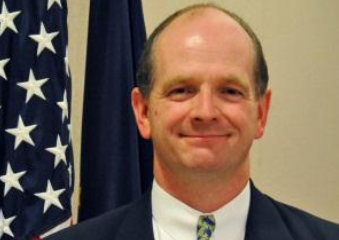
Kip Knudson had served in the same role, titled “director of state and federal relations,” under former Gov. Sean Parnell beginning in 2011, upon the retirement of the long-time director John Katz, who had served Alaska in that role for 32 years.
The director of the DC office is the point person for federal and state relations and keeps the Administration apprised of anticipated actions in Congress.
Knudson served for more than four years as the director, but was eventually replaced by former Gov. Bill Walker, who assigned Craig Fleener to the prestigious post.
Later, Walker assigned John Crowther to head up the D.C. office.
Knudson, meanwhile, stayed in the nation’s capital and was on Sen. Murkowski’s Energy Committee staff for a period, before being hired as the director of federal affairs for Marathon Oil Company and Andeavor. His wife works in the DC office of Congressman Don Young.
Alaskans also know Knudson as the former board chair of the Alaska Chamber of Commerce, board chair of the Alaska Air Carriers Association, board chair of Hospice of Anchorage, and board member of the Alaska Resource Development Council, among other charitable and civic roles.
As for Crowther, he has officially accepted a position as counsel to Sen. Lisa Murkowski’s Energy and Natural Resources Committee.
Crowther, born and raised in Anchorage and a graduate of Grace Christian School, was a special assistant at the Alaska Department of Natural Resources under Gov. Parnell, before being shifted to Alaska’s DC office under Walker. He has a bachelor’s degree in economics from Dartmouth College and a law degree from Georgetown University Law Center. Crowther is considered an expert on oil and gas issues.
ON ANNIVERSARY OF LEGALIZED ABORTION, TWO DISTINCT REACTIONS
While New York Gov. Andrew Cuomo was signing an act that allows non-doctors to conduct abortions and allows the procedure up until the mother’s due date in some instances, Alaska Gov. Michael Dunleavy had a different reaction to the anniversary of Roe v. Wade.
On the day marking legalized abortion, Dunleavy signed a resolution supporting the right to life of the unborn.
CUOMO’S ‘REPRODUCTIVE HEALTH ACT’
Cuomo, who leads a progressive state, signed what he called the Reproductive Health Act, which allows abortions at any time if the mother’s health is endangered or if the unborn child is not viable. Prior to the act, abortions were only allowed until the 24th week of pregnancy if a woman’s life was at risk.
Cuomo called the act “a historic victory for New Yorkers and for our progressive values.” Then, he directed the 408-foot spire on the One World Trade Center, the Governor Mario M. Cuomo Bridge, the Kosciuszko Bridge, and the Alfred E. Smith Building in Albany to be lit with pink lights, to celebrate the “achievement and shine a bright light forward for the rest of the nation to follow.”
Cuomo’s law effectively eliminates all sideboards on abortion, according to Christina Fadden, who chairs the New York State Right to Life. “RHA has made abortion a ‘fundamental right’ and prohibits all limits on abortion, which not even Roe v. Wade did.” He said he plans to attempt to enshrine abortion rights into the New York State Constitution.
DUNLEAVY: ‘MOURN THE MILLIONS OF LIVES CUT SHORT’
On the other coast, in the far upper corner, Alaska Gov. Mike Dunleavy had penned an eloquent ode to life itself on the anniversary of Roe vs. Wade. He encouraged Alaskans to consider the “loss of laughter, of tears, and of life itself of the generations lost through abortion.”
His proclamation says, in part:
“…to mark the 46th year since the United States Supreme Court’s decision in Roe v. Wade, we join with the President of the United States, Donald J. Trump, and mourn the millions of lives cut short, and the tremendous promise lost as a result of abortion on demand; and
… as a state, we must resolve to protect innocent human life at every stage. As Governor, I am committed to the promise made in our Declaration of Independence to protect Life, Liberty and the Pursuit of Happiness. I recognize that without Life, there is no Liberty. Without Liberty, there is no freedom for the individual Pursuit of Happiness. My policy will always be to defend human life at all stages; and
… we must do everything we can to protect the sanctity of life for the most vulnerable and defenseless among us, including people with disabilities. Americans with disabilities like Down Syndrome are an inspiration and their example of joy and perseverance enriches our lives – they should never be targets for abortion; and
…our Constitution and our laws contain many protections for innocent life, and I will work with the Alaska Judicial Council to encourage the nomination of Judges who believe the Constitution is a fundamental contract between the People and their government; and
…as Governor, I commend the pro-life Alaskans who have volunteered to help prevent the deaths of innocent unborn children. For more than 46 years, courageous and faithful citizens, many from college campuses and high schools across Alaska, from all walks of life, have extended a helping hand to all those expectant parents experiencing an unexpected pregnancy; and
…as your Governor, I am committed to protecting innocent life every day and at every stage. We must stand tall as a state, and show respect and love for the dignity and worth of every person, at every stage of life – the unborn, the aged, the disabled, the mentally ill – all our most vulnerable neighbors; and
…I respectfully encourage all Alaskans to care for women with unexpected or unwanted pregnancies, to support adoption and foster care, and to ensure that every child can be raised to live the life they choose.”
Dunleavy’s proclamation left no doubt about where he stands on the question of abortion.
(1-minute read) REP. GERAN TARR SPENT THREE DAYS CALLING SCHOOL
Rep. Geran Tarr was busy on social media this week, tarnishing the reputation of Covington Catholic High School of Kentucky, and the student who politely stood his ground while being verbally harassed during a March for Life rally.
The Alaska House of Representatives has not yet gotten to work because there is no leadership caucus in charge, but Tarr kept herself busy writing her opinion on the incident, which falsely portrayed the students as racists. The video clip went viral on social media and news organizations picked it up as gospel, without having seen sections of the video that led up to the part that appeared to make the students look like the aggressors.
The Catholic high school reopened today under heavy police protection after being closed for two days due to the hundreds of death threats against the students. Today, the school was evacuated after a suspicious package was sent to the school.
But Tarr was having none of it, writing out her frustration over not being able to talk with someone at the school to register her complaint from Alaska.
Later in the social media exchange, Tarr says that the student targeted by leftists for vilification “scares” her.
“I look at that young man and he scares me,” Tarr wrote on Facebook.
A chaperone for the students who attended the rally with them had a different perspective than Rep. Tarr.
Jill Hamlin told reporters that she believes they were targeted “for what they stood for.” She said boys from the school were attending the rally, as the students do annually, when a group known as the Black Hebrew Israelites began hurling abusive language at them.
“I think they were targeted for what they stood for… which is Christianity, the right for life,” Hamlin told Fox News. “And they were singled out, and I believe, partially because of the color of their skin they were targeted.”
The Native American protester at the center of the storm led a group of his supporters as they attempted to enter the Basilica of the National Shrine of the Immaculate Conception in Washington, D.C. during evening Mass on Saturday.
The demonstrators were stopped by shrine security they attempted to gain entry into the church during worship and the doors had to be locked to keep them out. They maintained their drumming and chanting outside the church.
“It was really upsetting,” the guard told Catholic News Service. “There were about 20 people trying to get in, we had to lock the doors and everything.”
The guard said the incident was a disappointment during a busy and joyful weekend for the shrine.
“We had hundreds and hundreds of people from all over the country come here to celebrate life, to celebrate each other together. That a protest tried to come inside during Mass was really the worst.”
(3-minute read) CLOSES ‘JUSTIN SCHNEIDER LOOPHOLE,’ GIVES DISCRETION TO JUDGES
Gov. Michael Dunleavy rolled out his “repeal and replace” legislation on Wednesday, making good on his promise to get tough on crime and close the more egregious loopholes still present in Alaska criminal justice law.
His bills will come with fiscal notes — that means State money — and may require more prisons to be built and more prison beds, he said. How he will pay for it while reducing the overall state budget remains to be seen, as his budget is not due until Feb. 13.
“We will be expending resources in these areas to have the outcomes that we need,” said Dunleavy. “When people ask the question, ‘Are folks going go to jail?’ Yes, they’re going go to jail.”
“And will we need to increase the number of beds in jails? Probably yes,” he said. “Will we need to increase jails? Maybe. We’ll see.”
SB 32:Classification and Sentencing. SB 32 increases the range of sentencing for those convicted of drug trafficking. Possession of certain illegal drugs would once again become a felony. It also increases sentencing ranges for felonies and misdemeanors that were reduced by SB 91.
It would make terroristic threatening a new criminal offense, so that law law enforcement officers can act on threats, even if those threats are not carried out.
And if criminals remove an electronic ankle monitor, they’ll face a felony charge, whether they are in pretrial monitoring or if they cut their monitors after they are sentenced.
SB 33: Pretrial (Bail). This bill builds on some improvements started with HB 312 in 2018, by returning to judges the discretion they had before SB 91.
It ends the practice of allowing defendants to receive credit for their future sentence by being on an electronic monitor in the community or under house arrest (third-party supervision). This loophole is how Justin Schneider escaped a prison sentence — he had worn an electronic monitor while awaiting trial, and that leash time counted toward his eventual prison sentence.
Further, SB 33 also would do away with the risk assessment tool that was implemented under SB 91, and would end the pretrial enforcement division operating as an independent department. The division is the unit that has implemented the risk assessment tool, which has allowed criminals to rotate in and out of jail repeatedly.
“The governor intends to end the ‘catch and release’ cycle in Alaska,” said Attorney General Kevin Clarkson, during today’s press conference.
SB 34: Probation and Parole. SB 34 strengthens judges’ discretion when weighing probation violations. It would change the “earned compliance credit,” given for good behavior, from a day-for-day credit to a three-for-one credit, and if offenders violate their conditions, they would be stripped of their earned compliance credit.
SB 34 also restricts some offenders, such as sex offenders, from being eligible for discretionary parole. It returns the parole system to its previous structure to ensure the parole board is not overwhelmed and those that are released on parole are good candidates for release.
Parole eligibility will once again be restricted to certain crimes to ensure those released on parole are safe to be released.
SB 35: Sex Offenses. SB 35 updates statutes by closing a loophole in the law that allowed Justin Schneider to walk free. SB 35 makes non-consensual contact with semen a felony sex offense. It increases penalties for third-degree sexual abuse of a minor, if the age difference between the offender and victim is six years or more. Viewing or production of child pornography would be a felony, and solicitation of a minor a felony in all cases.
SB 35 also updates laws on “sexting,” making it illegal to repeatedly transmit unsolicited images depicting genitalia.
While the changes do not repeal SB 91 entirely, the problematic law also has been changed significantly in legislation in 2017 and 2018 that came in response to public outcry over the “soft on crime” approach that had welcomed criminals to the state and made judges helpless in cracking down with sentences.
Dunleavy’s approach is a comprehensive approach to complete the job started in those two years to repair the trust in Alaska’s judicial system.
“There are parts of SB 91 that are worth keeping,” Attorney General Clarkson said. “For example, the increase of the penalty for murder.”
The Alaska Senate Majority has sent out its annual poll, asking Alaskans’ views on myriad topics, starting with the State’s earthquake response and ending with whether you support the president’s tariffs on Chinese-made goods.
Gov. Michael J. Dunleavy will unveil a package of crime-fighting bills to repeal and replace SB 91 on Wednesday, January 23 at an 11:30 am press conference.
Crime was one of the major thrusts of his State of the State Address on Tuesday night, and he reiterated a promise he made during his campaign for governor that he would introduce legislation to repeal the bill that many Alaskans believe led to a surge in crime.
Along with Dunleavy, Attorney General Kevin Clarkson, and Corrections Commissioner Nancy Dahlstrom will attend, as well as other members of his public safety team, his office said.
Although the Legislature has rolled back some of the more egregious aspects of SB 91, public perception is that the bill has created a soft-on-crime cultural norm.
‘IF YOU’RE A CRIMINAL … I STRONGLY SUGGEST YOU GET OUT WHILE YOU CAN’
Gov. Michael Dunleavy gave a big-picture speech as his first State of the State Address on Tuesday night. The theme was that he plans to keep the promises he made in the campaign: No change to the Permanent Fund dividend calculation without a vote of the people, turning the economy around and growing jobs, and having a budget that reflects what actual revenues are.
But most of all, he focused on crime. It was clear there’s a new sheriff in town, and in that section of his speech, he delivered his most powerful lines of the evening:
“To law-abiding Alaskans, I say this to you: I care if your house is burglarized. I care if your car is stolen. And I care if your loved ones are threatened.
“But to the criminals, and to the rapists and molesters who see women and children as nothing more than opportunities, I say this to you: We will do everything in our power to stop you, apprehend you, and put you in prison for a very long time.”
Dunleavy showed compassion for those Alaskans who have gotten mixed up with opioids or other addictive substances and want help.
“We are a compassionate people as well. Therefore, as part of our public safety approach we will provide ways for you to break this habit and get back into society and be productive individuals.”
But let me be perfectly clear. If you are a criminal, this is going to be a very dangerous place for you, starting now. I strongly suggest you get out while you can. No more coddling, no more excuses. Your days are over. – Gov. Michael Dunleavy
Dunleavy went on to reiterate his pledge to repeal and replace SB 91, the criminal justice reform bill that is widely blamed for the increase in crime across Alaska.
With SB 91, we broke the People’s trust and now is the time to restore it. By doing the right things, we can fix what is broken and restore the trust that was lost.
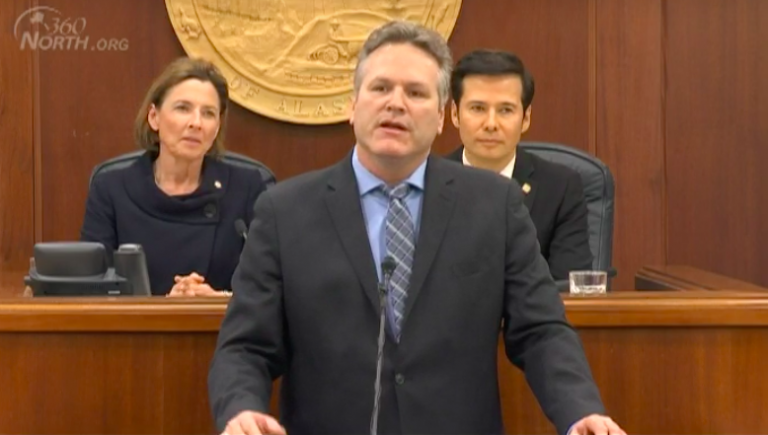
Gov. Michael Dunleavy enters the House Chambers before giving his first State of the State Address.
The speech went for about 23 minutes and it was his first address to the Alaska Legislature. The State of the State address is a tradition, but not a requirement. The governor must give a report on the state of the state every year to the Legislature, and by custom, it is a speech that is televised, as this one was at 360North.org. It was streamed live on KTUU.com and KTVA.com.
During the speech, he introduced the families of victims of crime: Scotty and Aaliya Barr of Kotzebue, who lost Ashley Johnson-Barr in a gruesome killing, and Edie and Ben Grunwald of Palmer, who lost their son David to an execution-style murder. The Grunwalds were not able to make it into Juneau because of fog at the airport.
“Unfortunately, we all know their tragic stories too well — two beautiful young Alaskans taken from their families by individuals who have no regard for human life.”
KEEPING PROMISES – THREE CONSTITUTIONAL AMENDMENTS
Dunleavy didn’t dive into specifics on his plans for the budget, but he reiterated that the budget he will present will be far smaller than the one that was handed to him by Gov. Bill Walker.
For growing the economy, he said he had assembled a top team of experts that will focus on bringing businesses to Alaska. He highlighted two small businesses in Alaska that have been successful at manufacturing in the 49th state: TriJet Manufacturing Systems in Palmer and Bambino’s Baby Food in Anchorage, which now employs 25 people.
He said that he’d offer three constitutional amendments for the Legislature’s consideration: No change in the way the Permanent Fund dividend is calculated without a vote of the people, no change in taxes without a vote of the people. The third constitutional amendment would relate to a spending limit and savings plan to keep politicians from spending “every penny we have.”
MEMORABLE QUOTES FROM THE SPEECH
“I’m Governor today because of the campaign promises I made to the people of Alaska on the issues most of us believe in. I’m here to do exactly what I promised to do. What I told Alaskans I would do.”
“We’re going to declare war on criminals. We’re going to get our spending in line with our revenue. We’re going to protect Alaskans’ PFDs. We’re going to grow our economy and put Alaskans to work. And we must restore public trust in government and elected officials.”
“…that together we can overcome anything; that together we will make our streets safe again; that together we will build a permanent fiscal plan; that together, we will protect the Permanent Fund dividend for generations to come. That together, we will restore the trust of the Alaska People in their government and their elected officials.”
“We are now preparing a budget that for the first time all Alaskans will be able to understand and trust. No more games, no more shuffling numbers. Just an honest, straightforward look at where we are.”
“In order to address the fiscal issues that have plagued our state for years, we need a permanent fiscal plan. A plan that will put our state on solid footing for decades to come.”
“Politicians often talk about policies and laws, but what Alaskans really care about, are jobs, opportunities and individual freedoms.”
“Alaska doesn’t have to be just a resource state. We have so much more to offer.”
“I promise you now, what I promised during the campaign. Things will be different, things will be very different. Together we are tasked with righting the wrongs that have broken the trust of the Alaskan people.”
“As for me, that in part means this: That all the special interests, all the political insiders, all those used to manipulating government and policy for their own benefit — this is just not your time.”
“Together we are tasked with righting the wrongs that have broken the trust of the Alaska People. And I’ll work with all my energy, dedication, and ability to do exactly what I promised you I would do.”
(2-minute read) BOARD NAMES HIM DURING MEETING TODAY
Curtis Thayer, who announced recently that he was stepping down from the head of the Alaska Chamber of Commerce, has been named the executive director of the Alaska Energy Authority. He takes the place of Janet Reiser, who left last month.
The Alaska Energy Authority is an independent corporation governed by a board of directors with the mission to “reduce the cost of energy in Alaska.” AEA is the state’s energy office and lead agency for statewide energy policy and program development.
Whether building modern and code-compliant bulk fuel tank farms, upgrading to high-efficiency generators in rural powerhouse systems or integrating renewable energy projects, AEA emphasizes community-based project management. AEA’s core programs work to diversify Alaska’s energy portfolio, lead energy planning and policy, invest in Alaska’s energy infrastructure and provide rural Alaska with technical and community assistance.
AEA also manages the Renewable Energy Fund, the Emerging Energy Technology Fund, the Power Cost Equalization Program and various Energy Efficiency and Conservation Programs. AEA provides grants and loans for qualified energy infrastructure projects and also owns energy infrastructure for the benefit of Alaskans.
Thayer was commissioner of the Department of Administration under Gov. Sean Parnell and has deep political ties throughout the state. He was also deputy commissioner of the Department of Commerce, Community and Economic Development, worked for the Alaska Gas Producers Pipeline Team, and ENSTAR natural gas company.
Thayer was born and raised in Anchorage and graduated from the University of Alaska Fairbanks.