Friday, October 16, 2026
Home Blog Page 1565

In Fairbanks, gender is disappearing from the books

15

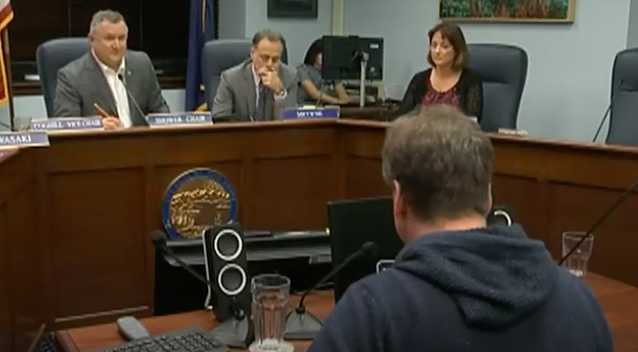
The men and women of the Fairbanks North Star Borough Assembly on Thursday night adopted an ordinance that removes gender-specific pronouns and replaces them with grammatically incorrect pronouns in city code.

They’re going to use pronouns they hope won’t offend.

  • “He” and “She” is now called a “They.”
  • “His” and “Hers” possessive is now to be known as “Their.”
  • “Him” and “Her” would now be a “Them.”

The Assembly voted unanimously to make the change to lessen the chance that someone might not feel included because of the use of a binary gender pronoun.

The ordinance No. 2019-09 amends the borough’s code of ordinances to “modify any and all masculine and/or feminine language to gender neutral pronounces; and to amend FNSBC 1.04.080 regarding gender.”

The change to using singular gender pronouns like “They” is, of course, grammatically incorrect. It also creates yet another grammar problem:

Do you follow the now-singular word “They” with “is,” as in “They is”? Or do you write “They are,” when referring to a singular person?

None of it is clear, but in 2017, the Associated Press added “They” as a singular pronoun to its AP Style Book, while advising people to try to write around the awkwardness.

But it likely will lead to confusion and misunderstanding, even in city code.

AN EXAMPLE OF THE GRAMMAR NIGHTMARE

Consider, for a moment, this sentence found in a story in today’s Boston Globe about a murder:

“Jassy Correia loved to get her toddler daughter all dressed up and take her to Flames restaurant in Grove Hall to sit and eat oxtails together. They zoomed down slides at the playground, lay in bed and goofed around taking videos, and watched “Enchanted” and “Baby Shark.”

“When Correia’s friends called her on FaceTime, sometimes they would see her sweet little lookalike Gabriella, and Correia laughing nearby. She was a good mother, family and friends said — it was the most important thing to her. Correia, 23, had built her life around her child, who just turned 2. She had their future planned out.

“On Friday, the day after her body was found in a man’s car trunk in Delaware, authorities disclosed that Correia had been mutilated after leaving a Boston nightclub early Sunday morning. They announced that a Providence engineer had been charged with “kidnapping, failure to report death, and mutilation of a dead body.’’

Now, to put the story in the new Fairbanks North Star Borough gender-neutral style:

“Jassy Correia loved to get their toddler daughter all dressed up and take them to Flames restaurant in Grove Hall to sit and eat oxtails together. They zoomed down slides at the playground, lay in bed and goofed around taking videos, and watched “Enchanted” and “Baby Shark.”

“When Correia’s friends called them on FaceTime, sometimes they would see their sweet little lookalike Gabriella, and Correia laughing nearby. They was a good mother, family and friends said — it was the most important thing to them. Correia, 23, had built them life around them’s child, who just turned 2. They had their future planned out.

“On Friday, the day after their body was found in a man’s car trunk in Delaware, authorities disclosed that Correia had been mutilated after leaving a Boston nightclub early Sunday morning. They announced that a Providence engineer had been charged with “kidnapping, failure to report death, and mutilation of a dead body.’’

There are just too many “they” references, forcing readers to slow down, piece together the meaning, and and take apart the sentences. In the end, there’s no making sense of the gender-neutral story.

Perhaps the good men and women of Fairbanks will reconsider before they commit further grammatical mutilations.
The surge was at the voting booth

ANCHORAGE DAILY PLANET

The Anchorage Daily News headline made us chuckle: “In public testimony, a surge of support for cuts — to the Permanent Fund dividend.”

The story was that during an Alaska Senate State Affairs Committee meeting, Alaskans, by a 2-1 margin, urged lawmakers to block plans to return Permanent Fund dividends impounded by the state. Instead, they wanted more spending for education and other state services.

That’s right. Sixty-five of Alaska’s 730,000 residents testified against Gov. Mike Dunleavy’s proposal to restore the Permanent Fund dividends vetoed by former Gov. Bill Walker in 2016 and cut by the Legislature in 2017 and last year. Only 33 testified for restoration of the purloined dividends, the newspaper said. What the rest said apparently was unclear. It is Alaska, after all.

Mind you, the vote was taken after exhortations from the governor, lawmakers and unions to get more people to testify before the committee. It seems to us – as in too many land-use, water-use hearings – the left managed to pack the testimony.

The tally was, indeed, strange. Dunleavy ran for office promising, among other things, to restore the purloined dividends. In response, 145,631 Alaskans – 51.4 percent of those who went to the polls last year – voted for him.

Do 65 people represent a “surge” in Alaskans’ support for giving up dividends held by the state?

http://www.anchoragedailyplanet.com


Why did Murkowski skip ‘born alive’ bill vote?

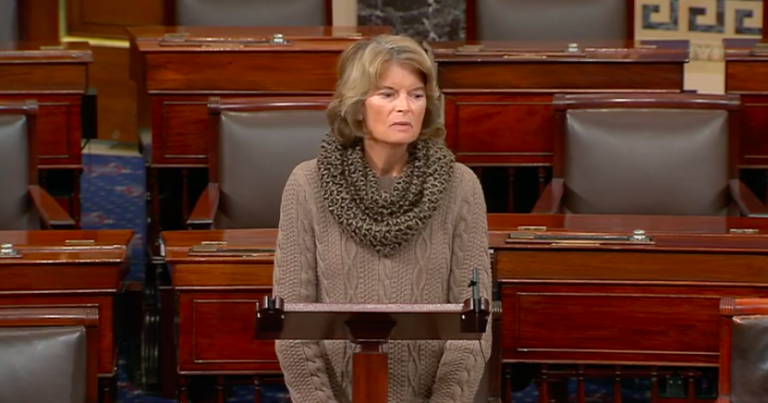
This week, Sen. Lisa Murkowski skipped an important vote on the Senate floor on a bill that made the front page of every newspaper in America.

The Born Alive bill, sponsored by Sens. Ben Sasse and Pat Toomey was simple: If a baby is delivered alive during an abortion, it is entitled to protection like any other human. Doctors who failed to provide the newborn support after a botched abortion would face charges.

Three Democrat senators — Bob Casey,  Doug Jones, and Joe Manchin — voted in favor of the bill, which failed 53 to 44. It needed 60 votes to pass.

Although Murkowski’s vote would not have changed the outcome, she was absent for the vote on infanticide, a vote that could have shored up her conservative credentials.

Murkowski, long struggling as a Catholic with her feelings about abortion and women’s right to choose, was tending to personal family matters, her staff said.

The vote occurred on the heels of a Marist Poll, sponsored by the Knights of Columbus, that shows Americans are less supportive of liberal abortion laws. Three in four Americans say abortion should be limited to – at most – the first three months of pregnancy.

“This includes most of those who identify as Republicans (92 percent), independents (78 percent) and Democrats (60 percent). It also includes more than six in 10 (61 percent) who identify as pro-choice,” the group said.

“There has been a significant increase in the proportion of Americans who see themselves as pro-life and an equally notable decline in those who describe themselves as pro-choice,” said Barbara Carvalho, director of Marist Polling.

All six Democrat senators who are running for president in 2020 voted against the bill: Kamala Harris, Elizabeth Warren, Cory Booker, Amy Klobuchar, Sherrod Brown, Kirsten Gillibrand and Indie-Democrat Bernie Sanders.

Dermot alleging SB 21 has failed stretches truth to breaking point

Dermot Cole, whose anti-oil position has been his journalistic super power for decades, took another stab at oil when he wrote “SB 21 was oversold as a miracle cure for Alaska oil production.” 

Cole has waged a tireless but threadbare tirade against the oil tax policy known as Senate Bill 21, which gave stability to our oil tax system in Alaska.

Historically, the accuracy of some of Cole allegations have proven to have been incorrect. For example, he recently, falsely implied that we should measure SB 21’s success starting in 2013. And yet, SB 21 wasn’t even the law in 2013.

In 2013, SB 21 was still being debated.  The law didn’t actually take effect until Jan. 1, 2014. Noteworthy is that Jan. 1 is in the middle of the North Slope winter work season. The tax changes would be felt later than that date.

Even then, the industry had to survive the uncertainty of a referendum. The referendum was voted on by the people of Alaska in August, 2014.

Ultimately, SB 21 was upheld, 99,855 to 89,608. Realistically, any measure of success from SB 21 should not even begin before the referendum was challenged and then safely approved by the voters.

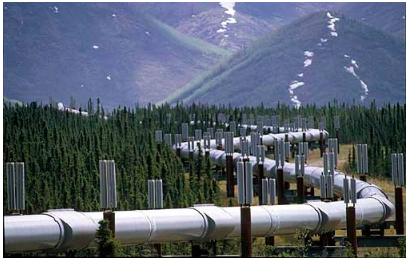
While it is true that there has been a slight decrease in barrels through the Trans-Alaska Pipeline System from 2014 to 2018, there were increases in 2016 (517,868 barrels per day) and 2017 (527,323 barrels per day).

Before SB 21, the tax policy known as ACES — Alaska’s Clear and Equitable Share — resulted in no anticipated increases. There was no hope on the horizon for more production, only steady annual declines.

In fact, a look at the Fall 2012 Production Forecast  shows where the State thought it would be in 2019. to understand how much of a difference SB 21 has made.

In the fall of 2012 (under ACES), the state predicted that by 2019, Alaskan North Slope oil production would decrease to 421,600 barrels per day.

Think about that:  Only 421,600 barrels a day.

Contrast with what is actually being produced today:  In 2018, the average was 509,315 barrels.  According to Alyeska, as of Feb. 28, 2019 TAPS is averaging 525,826 BPD.

That’s a beefy increase over the barrels forecasted under the failing policy of ACES.

That’s good news, although some may allege otherwise.

Alaska is getting more oil than forecast. That oil is keeping TAPS throughput fairly constant. Much of the “more oil” is coming from investments made possible under SB 21 that decrease the decline rate in our mature fields.

Take Prudhoe Bay, where most of the oil comes from. Without investment, the field could decline around 12-15 percent per year.

With basic investment, the field would decline about 6-7 percent per year – and that’s what Alaska was experiencing before SB 21 took effect.

With SB 21 and its focus on new production, BP and its partners increased investment in Prudhoe, drilling new wells and funding other in-field work. They have, remarkably, held production flat (just shy of flat in 2018) from this mature field. In other words: instead of 12 or 6 percent declines, the field has held flat.

Once a field reaches its maximum rate of production – in the case of Prudhoe, around 1988 – a field starts a natural decline. From that point on, it will take more investment in more wells, more in-field work, and more tune-ups to get a barrel of oil out.

Production declines, even as the costs-per-barrel keep going up.

Industry said that a competitive regime under SB21 would increase investment that would in turn boost production – and it has. Production can increase without a commensurate increase in TAPS volumes as other older oil fields naturally decline over time (i.e. more steeply without significant new investment).

But to allege that SB 21 has failed Alaska is simply trafficking in falsehoods.

Daniel George is new Don Young state director

1

Daniel George is the new state director for Congressman Don Young, replacing Chad Padgett, who has moved to the Bureau of Land Management.

George worked for Sen. Lisa Murkowski, State Sen. Bill Stoltze, and Sen. Mike Dunleavy. He graduated from Lumen Christi High School in Anchorage and Gonzaga University and has been working as a Realtor for the past two years.

Teachers turn out to oppose PFD payback

PROPONENTS OF FULL DIVIDENDS DIDN’T SHOW

The teachers were organized and they dominated public comment Thursday night during the first public hearing for SB 23 and SB 24.

SB 23 and 24 are the bills proposed by Gov. Michael Dunleavy that would fund full Permanent Fund dividends, and also pay back the amounts that State government kept over the past three years.

The Senate State Affairs Committee heard from 65 Alaskans opposed to the governor’s bills.

The other 33 callers said they support SB 23 and 24. A handful of people were on the fence about it.

Must Read Alaska researched the voter registrations of those testifying. (Not all were found on voter rolls. Some likely are registered to vote under other names than given to the committee, or the names were spelled wrong).

The breakdown was clear: Democrats want to keep the current configuration where the State of Alaska keeps about half of everyone’s dividend and uses it to run state programs and fund education. Most of the Democrats who testified also urged income taxes.

Must Read Alaska counted 25 Democrats among those testifying, all opposed to the legislation.

16 Republicans testified. Just two of them opposed SB 23 and 24, and the rest supported.

The two registered members of the Alaskan Independence Party also supported the PFD bills.

The 22 undeclared voters testifying split between supporting and opposing the legislation.

Of the nine nonpartisan voters, only one of them supported the legislation, with the other eight opposed.

There were at least two students who testified from Sitka and both opposed the bills, saying they preferred to spend the money on education.

Sitka was the community most represented, with 25 testifiers, all of them opposed to the legislation.

Next Tuesday and Thursday the public hearing process will continue at 6 pm. Due to the volume of people calling in, the committee will limit testimony to one minute.

Anchorage callers: 907-563-9085

Juneau Callers: 907-586-9085

All other communities: 1-844-586-9085

Written testimony can be sent to [email protected].

Federal agency delays impact statement for gasline project

4

The Federal Energy Regulatory Commission added three months to the deadline for the draft environmental impact statement that was due today for the Alaska LNG Project.

The draft EIS is now expected to be released in June, with the final document due one year from now, and a final commission decision by June, 2020.

Its likely the federal government shutdown was likely a factor in the revised schedule, which puts the entire process back four months. Also, the chairman of FERC passed away recently and the agency is searching for a new chairman; meanwhile it has a 2-2 partisan split that makes decisionmaking harder.

“The revised schedule for the EIS is based upon AGDC meeting its commitment to provide complete responses to outstanding data requests on the dates it has identified,” FERC wrote, ignoring its own internal difficulties.

But the timeline delay is good news for AGDC, which has not yet provided information on numerous topics requested by FERC. AGDC is working to get third party’s engaged with the process, particularly with permitting and other expertise need. The delay does not impact the project’s viability, sources say.

It is not the first revision on the environmental impact statement schedule. Last year, under Gov. Bill Walker, FERC had issued a plan to have the final EIS completed by December, 2019.

Joe Dubler, the president of AGDC issued a statement: “FERC’s comprehensive analysis of Alaska LNG now includes more than 150,000 pages of environmental and engineering data, including responses to more than 1,700 FERC queries submitted since AGDC initiated this permitting process 22 months ago. Previous FERC scheduling changes accelerated the permitting calendar, and we believe that today’s revision does not affect the prospects for Alaska LNG. We look forward to working with FERC to complete this process and obtain the permits required to bring Alaska’s North Slope natural gas to market.”

The $43-60 billion project includes an 800-mile gasline, bookended by a gas treatment plant on the North Slope and a liquefaction plant at Nikiski, with an adjacent export facility to take the product to Asian markets.

This process has been underway for 22 months, but the state has been pursuing a natural gasline since 2006.

House bipartisan majority hires Walker press secretary

12

Austin Baird, the former press secretary to Gov. Bill Walker, is the new press secretary for the Democrat-led, bipartisan House majority.

Baird is a former news reporter who signed onto the Walker Administration midstream and was in the unenviable position of trying to explain why Lt. Gov. Byron Mallott was resigning, without actually explaining it.

In response to candidate Alyse Galvin’s infamous and dramatic response to Congressman Don Young’s firm handshake, and a social media post from Amy Demboski criticizing Baird’s limp handshake, he posted the following response to Demboski:

Baird worked for KTUU as a political reporter covering the Legislature for several years. He left the station in December of 2017 to join the Walker Administration, where he earned $110,000 a year plus benefits, for a total compensation package of over $130,000 per year.

Walker’s former communications director, Grace Jang, had also worked as a reporter, but left immediately after Walker was elected to join his team. She has started her own consultancy, focusing on crisis communications.

Wielechowski peddles false oil profit narrative

0

TRYING TO GET MORE OIL TAXES AGAIN

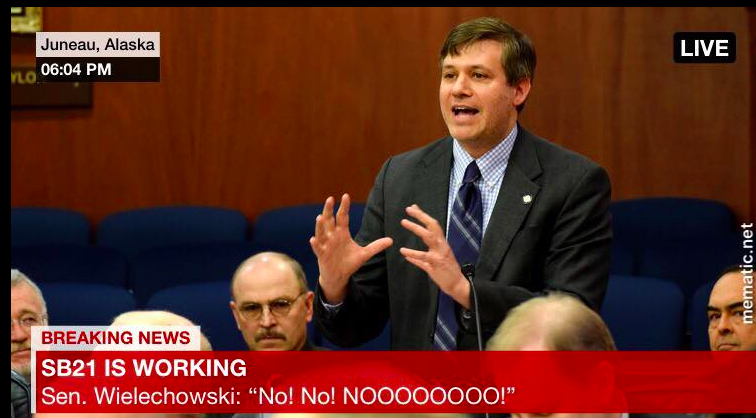
Sen. Bill Wielechowski, who has long been a foe of the oil industry, is peddling around the Capitol Building a memo written for him by Legislative Research Services that says ConocoPhillips makes more money in Alaska than anywhere in the world.

Wielechowski, Sen. Tom Begich and other Democrats have drawn the conclusion from that memo that ConocoPhillips should pay more taxes, using the old “our fair share” argument.

The problem with Wielechowski is that he didn’t read the footnote of the memo, which states:

“Please note the barrel of oil equivalent measure is primarily useful as a means of comparing total hydrocarbon energy produced between geographic locations. Because it does not capture widely varying economic factors underlying that production, drawing conclusions on profitability based solely on this measure is problematic. Further, please note that the amount of energy provided by a given volume of crude oil (or any fuel) varies by production location or, more precisely, by the grade of oil produced and the results of its ultimate refinement.”

What that means is that oil producers in the Lower 48, such as ConocoPhillips, are selling barrels of energy that are made up of oil and gas. The gas is a cheap product that lowers the total value of the “barrel of energy equivalent.” But producers have to sell it off so they can get to more of the high-value oil.

With “barrel of energy,” it makes it look more profitable to drill in Alaska, but the per-barrel comparison is false. In certain parts of West Texas, gas is so plentiful that producers are actually paying for it to be hauled away. So comparing the profits on barrels of energy is simply not valid.

In Alaska, each barrel is all oil, at a much higher value. It’s not true that ConocoPhillips makes more per barrel of oil in Alaska, because it costs the company more to produce the oil in the highly technical world of Arctic oil development.

But it’s the same argument Wielechowski has been peddling over the years as he tries to ratchet up taxes on oil companies.

Alaska is such a big portion of the ConocoPhillips portfolio that the SEC requires it to report Alaska separately. None of the other companies doing business in Alaska are required to do so. This is why the Legislative Research Services report focuses only on ConocoPhillips.

[Read the Legislative Research Services report here]