Monday, December 22, 2025
Home Blog Page 1496

State, Pharmacy Board tell pharmacies: ‘Fill legitimate opioid prescriptions’

(8-minute read) BUT PROBLEM IS DEEPER — WHOLESALERS ARE CUTTING SUPPLY

In what has emerged as a crisis within a crisis, patients with chronic pain in Alaska are having a harder time getting legitimate pain medication.  They are being turned away by pharmacies for the opioids or other controlled substances that keep their pain manageable.

News accounts across the country report that patients who have had their pain medication cut off or drastically reduced are killing themselves because they can’t live with their chronic pain. Those in chronic pain understand this growing  health crisis, which is a personal crisis to them.

[Read: Man, 58, kills himself because pain too much to bear without needed drugs]

This problem grew when recent federal legislation attempted to reduce the amount of illegal opioids hitting the streets through pill mills — unscrupulous doctors who flood the market with classified drugs through misuse of the prescription pad.

But in Alaska, it’s been a painful transition for those who rely on controlled pain medication. Pharmacies have been turning them away, to the point where the patients have reached out to the State Pharmacy Board for relief.

In response to these complaints, a letter went out to Alaska’s pharmacists from the Pharmacy Board last week, telling them to follow the law, which is to fill legitimate prescriptions.

The trend toward “refusal to fill” prompted the board to issue specific guidelines and reminders to pharmacists:

  1. Pharmacists must use reasonable knowledge, skill, and professional judgment when evaluating whether to fill a prescription. Extreme caution should be used when deciding not to fill a prescription. A patient who suddenly discontinues a chronic medication may experience negative health consequences;
  2. Part of being a licensed healthcare professional is that you put the patient first. This means that if a pharmacist has any concern regarding a prescription, they should attempt to have a professional conversation with the practitioner to resolve those concerns and not simply refuse the prescription. Being a healthcare professional also means that you use your medication expertise during that dialogue in offering advice on potential alternatives, changes in the prescription strength, directions etc. Simply refusing to fill a prescription without trying to resolve the concern may call into question the knowledge, skill or judgment of the pharmacist and may be deemed unprofessional conduct;
  3. Controlled substance prescriptions are not a “bartering” mechanism. In other words, a pharmacist should not tell a patient that they have refused to fill a prescription and then explain that if they go to a pain specialist to get the same prescription then they will reconsider filling it. Again, this may call into question the knowledge, skill or judgment of the pharmacist;
  4. Yes, there is an opioid crisis. However, this should in no way alter our professional approach to treatment of patients in end-of-life or palliative care situations. Again, the fundamentals of using our professional judgment, skill and knowledge of treatments plays an integral role in who we are as professionals. Refusing to fill prescriptions for these patients without a solid medical reason may call into question whether the pharmacist is informed of current professional practice in the treatment of these medical cases.
  5. If a prescription is refused, there should be sound professional reasons for doing so. Each patient is a unique medical case and should be treated independently as such. Making blanket decisions regarding dispensing of controlled substances may call into question the motivation of the pharmacist and how they are using their knowledge, skill or judgment to best serve the public.

The Pharmacy Board further warned that failing to practice pharmacy using reasonable knowledge, skill, competence, and safety for the public could result in disciplinary actions.

Read: Pharmacy Board Letter to Pharmacies

The State’s Division of Corporations also sent a similar letter, ordering pharmacies to consult physicians before refusing their patient’s opioid prescriptions.

“Recent federal legislation (21 CFR §1306.04(a)) provides more tools to strike this balance; it does not inhibit practitioners’ ability to prescribe controlled substances to patients,” the letter stated

“State law places the treatment of pain in the prescriber’s hands,” said Sara Chambers, director of the Division of Corporations, Business and Professional Licensing. “The prescribing practitioner has full authority to make a diagnosis and determine the appropriate course of treatment, including dosage and quantity of a controlled substance. The patient’s best interests must come first, and pharmacists are valued partners in the healthcare team; however, they are not prescribers and should not refuse to fill a valid prescription without first consulting the prescribing practitioner.”

PHARMACIES CAUGHT IN THE MIDDLE

After the federal legislation to crack down on the opioid epidemic, wholesalers have begun cutting off the supply to pharmacists.

In Alaska and elsewhere, that has meant that if a wholesaler notices an increase in orders, they can refuse to send them. Alaska pharmacies are finding it increasingly hard to even get the drugs being prescribed by doctors.

But that leads to another problem: If a patient is turned away from one pharmacy, he or she will try another. Those pharmacies may not know the patient or feel comfortable with a new prescription showing up out of the blue. In addition, that new opioid prescription increases the number of opioids that pharmacy is filling, and then the pharmacy could find that it has exceeded the percentage of opioids-to-other-prescriptions, and find itself on the black list with the opioid wholesalers.

This has led some pharmacists to refuse to fill an opioid prescription unless the patient brings all of his or her prescriptions to that pharmacy, in order to balance the ratio required by wholesalers.

The burden, then, is shifted downward to the patient.

(Do you have a story about not being able to get your needed pain medication? Send it to [email protected]. Your name and identifiers will be kept confidential)

After Medicaid expansion: Alaskans are failing the health test

(3-minute read) HUNDREDS OF MILLIONS OF DOLLARS, NOT MUCH YET TO SHOW

Alaskans are surviving cancer better, are slapping each other less, and are quitting smoking.

But according to the Healthy Alaska Scorecard update from the Alaska Department of Health and Social Services, there’s a lot of work ahead to get Alaskans’ health on track.

We’re still too fat, we drink too much, and we’re couch potatoes. Plus, too many of us kill ourselves.

Those are just a few of the findings released last week by the department. Commissioner Adam Crum said that while there are some improvements, there are plenty of health indicators not worthy of bragging rights.

The data compares baseline information in over 25 health indicator categories from 2010 to the years 2017 and 2018. There are a couple of indicators only updated as far as 2016.

Only one of the categories is considered “on track” — meaning it’s meeting the expectation of the department for progress. That is the increase in the percentage of rural community housing units with water and sewer services. In Alaskan terms, this means running water and no honey buckets.

But as for accessing a doctor, progress has been slight, in spite of the billions of dollars spent to expand Medicaid to working adults without children.

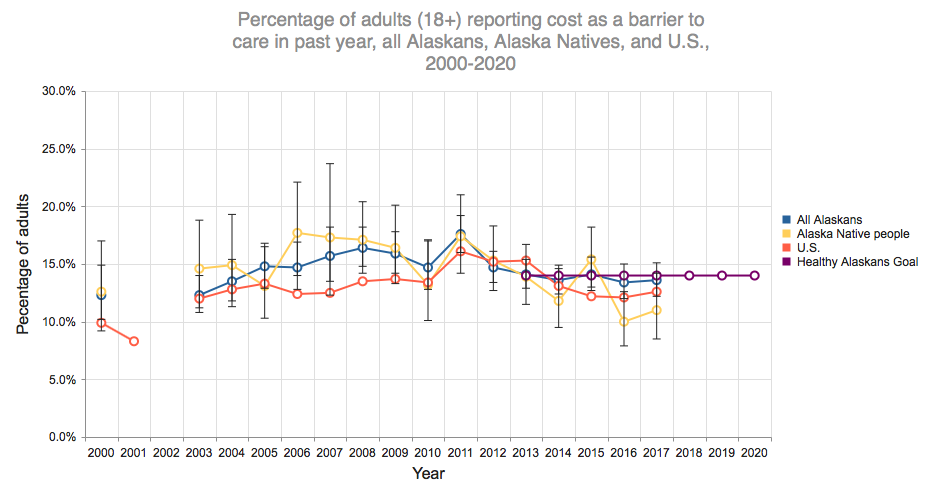
In 2017, 13.6 percent said they could not afford to see a doctor, compared with the baseline rate of 14.7 percent from years earlier. DHSS claims progress in this area — progress of 1 percent.

For Alaska Natives, there’s been more progress in access to doctors. The percentage of that population who could not afford to see a doctor went from 13.2 in 2010 down to 11 percent in 2017.

The number of Alaskans admitted to hospitals for cases that could have been prevented with high-quality preventative care (based on industry definitions) was also lackluster. It was 7.1 percent in 2010, but rose to 7.3 percent in 2017. Medicaid was supposed to fix the problem of hospital emergency admissions due to lack of access to a doctor.

Alcohol mortality rates have also increased at an alarming rate since 2010. For every 100,000 Alaskans, there were 16.3 deaths in 2010, but it creeped up to 19 deaths per 100,000 in 2017.

On the other hand, binge drinking is down in both underage drinkers and those of legal age.

View the chart with all 25 health measurement scores here.

NATIVE HEALTH OUTCOMES STILL A CONCERN

A population subset that has benefited most from Medicaid expansion is Alaska Natives. Some improvements in health care access are noted in a separate report, such as access to prenatal care during the first trimester of pregnancy, which saw a 4 percent improvement.

Cigarette use is also down among Natives, as it is in the general population. The percentage of high schoolers who don’t smoke went from 59.2 percent to over 70.9 percent in the time between 2010 and 2017.

Cancer mortality is down.

But other concerns, such as suicide among Alaska Native adults, has skyrocketed since 2010, from 36.4 per 100,000 to 57.3 per 100,000.

The “Native only” chart shows no data at all for the number of rapes among that population. Neither does it show the reported rate of child maltreatment.

But in the overall population report for Natives and non-Natives, these numbers have worsened. (Note: this can be skewed because of a reduction in stigma in telling someone what happened leads to more reporting of these crimes.)

View the scorecard with the Alaska Native health outcomes here.

COSTS EXPLODING

The state’s Medicaid program is an open checkbook. Those enrolled will have their health care paid for by the state and federal governments without a cap, which allows the program to continue to expand, and always come back for supplemental funding.

During last year’s Senate Finance Committee hearings, both Sens. Anna MacKinnon and Peter Micciche expressed grave concern that the costs were exploding after they received a supplemental request from the Walker Administration of $170 million for the 2019 budget.

“When Medicaid was expanded, it was expanded with a set of assumptions that were simply incorrect,” Micciche said at the time. “There has to be a point where we have a bottom line of understanding what the end result is going to be. I mean, it is literally an open checkbook.”

Gov. Michael Dunleavy’s 2020 budget, due on Feb. 13, will likely have a different approach to what his administration has inherited, a health care system with not enough effective limits in spending and a substantial amount of fraud.

Most of traditional Medicaid enrollment — pre-expansion — is funded in a 50-50 split between the State and the Federal government. The expansion population has the Federal government paying about 90 percent of the cost, with the State picking up the remainder, at least for now.

Some costs for Medicaid have started to flatten since SB 74 was passed in 2016. To read the most recent report to the Legislature on cost-avoidance measures that have resulted from the recent Medicaid reform bill, check this link.

Who’s doing the vetting?

THE ANCHORAGE DAILY PLANET

Two recent flubs are beginning to make us wonder: Who is doing the vetting of Gov. Mike Dunleavy’s political appointments for jobs in his administration?

A member of Dunleavy’s Cabinet, Department of Administration Commissioner Jonathan Quick, resigned Thursday amid accusations he lied about his business background.

Then, Art Chance, a tough labor negotiator who came under fire for Facebook comments described as racially charged and misogynistic, declined a job with the Department of Administration.

These kinds of things must be embarrassing for a new administration and easily could be avoided – and kept out of the headlines – by serious vetting. The Left and its pals in the media, it must be remembered, will pull out the stops to give this administration, any Republican administration, a black eye.

Just sayin’.

The Anchorage Daily Planet

Franklin Graham to headline Governors Prayer Breakfast

0
(2-minute read)
The president of Samaritan’s Purse, Franklin Graham, will be the keynote speaker at the Governors Prayer Breakfast on March 23 in Anchorage. The event takes place at the Dena’ina Center.  Doors open at 7 am with breakfast beginning at 8 am.
The Alaska Governors Prayer Breakfast began in 1983 to give Christians a venue to pray together for the leaders of Alaska. It became an annual event and hosts some of the major Christian speakers in America for an inspirational message on a Saturday morning.
Graham is the son of the late Rev. Billy Graham and Ruth Bell Graham. By the time Franklin was born, Billy Graham was already the most famous Christian pastor of his generation. Franklin rebelled and traveled the world as a young man, but eventually committed himself to Christ. He was invited by Dr. Bob Pierce, the founder of Samaritan’s Purse, to join him on a mission to Asia. During the trip, Franklin answered the call to work with hurting people in areas of the world affected by war, famine, disease, and natural disasters.
Samaritan’s Purse has a presence in Alaska, including a lodge where the organization hosts military husbands and wives whose marriages need renewal after one of them has been deployed to a war zone or has been exposed to trauma. The group was also instrumental in rebuilding many homes after the 2009 Yukon River flood.
The group responded to hurricanes, tornadoes, and floods across the South, fires in the West, and recently provided free lunches to all furloughed Federal employees near the group’s headquarters in Boone, N.C.
It is active in several countries overseas, providing medical response to the Ebola crisis in the Democratic Republic of Congo, and bringing presents to children all over the world through Operation Christmas Child.
Tickets and more information:

Uber, Lyft fees to soar at Anchorage airport

10

(2-minute read) COMMENT PERIOD ENDS JAN 31

Independent ride-sharing drivers may have to charge their riders $2.50 more to be picked up and dropped off at the Anchorage and Fairbanks international airports.

The $5 roundtrip fee the State seeks to charge riders who ride in an Uber or Lyft to the airport, rather than a cab, is the subject of a comment period that ends on Jan. 31 at 4:30 pm.

Transportation Network Companies, or TNCs as they are called, don’t pay a fee to drive people to and from the airports. They were only approved to operate in Alaska in 2017 after passage of a bill sponsored by Sen. Mia Costello and Rep. Adam Wool.

But cab companies pay $75 per year in Anchorage and $150 a year in Fairbanks, per cab. Limos in Anchorage pay $150 a year to access the airport.

IS IT FAIR?

Uber and Lyft are two TNCs that operate in Anchorage.

In 2018, about half of the active drivers made 95 percent of the trips to the airport. Those trips averaged out to 187 trips per driver. A $2.50 fee for those drivers would mean $467 a year in fees, meaning that Uber and Lyft users would pay more than four times the fees that cabs are paying — and passing along to their customers.

Last year’s TNC driver with the most number of trips to the airport would have paid $4,993 to the Ted Stevens International Airport, if the fee structure applied in 2018.

The public hasn’t heard much about the proposed fees, and information on it is buried in the State of Alaska website.

Sending in a public comment on it will require some effort, as there is no email address provided by the State to submit messages electronically. You’ll need to do it the old-fashioned way by writing to:

Keith Day, Controller
Alaska International Airports System
P.O. Box 196960
Anchorage, AK 99519-6960

Comments may also be hand-delivered to Room C-3588, South Terminal, Ted Stevens Anchorage International Airport during business hours.

Should this murderer go free? Help Parole Board decide

7

(1-minute read) DEADLINE APPROACHES FOR COMMENT

The Alaska Parole Board has heard from more than 220 Alaskans about the pending parole hearing for killer Jonathan Norton, since news of his upcoming parole hearing was covered earlier this month in MustReadAlaska.

The parole board will meet on Feb. 4 to hear Norton’s request to be set free after serving just one third of his sentence for the horrific murder of Duane Samuels in 1989.

Jonathan Norton rang the doorbell of Duane Samuel’s house one October morning, demanding his car keys and then shooting him three times. It was one of the most notorious murders of the era because it was both premeditated and a stranger murder.

Friends of the Samuels family have since created a website about Duane to give people more information, should they want to help the family keep Norton off the streets.

The parole board must receive letters of support for his release or continued incarceration by noon, Feb. 1. So far, most letters are opposing his release, MustReadAlaska has learned.

Write to the Parole Board here:

Parole Board: [email protected]

The Office for Victims Rights: [email protected]

The MustReadAlaska story about Duane Samuels’ murder is linked below. Caution: details are gruesome:

‘He fell to his knees and I shot him again’


Don Young is ‘in’ for 2020

2

(2-minute read) LONGTIME CAMPAIGN MANAGER RETIRES, NEW TEAM FORMING

Congressman Don Young will be a candidate for U.S. House again in 2020.

His State Director Chad Padgett said this morning that Young’s long-time campaign manager has retired and a new campaign team is in the early stages of organizing. Jerry Hood had run Young’s campaign since 2012.

On March 8, 2019, Young will become the longest serving Republican in the history of the House and Senate. He is serving his 24th term in the House as Alaska’s congressman since 1973. He is the last remaining member of Congress who has been in office since the Nixon Administration. He became the Dean of the House of Representatives on Dec. 5, 2017, after the resignation of John Conyers from Michigan.

Rep. Joseph Gurney Cannon of Illinois served in the House for 46 years to the day, but his service was not continuous. Don Young has served for 45 years, 325 days, as of Jan. 26, 2019.

In the Senate, Sen. Strom Thurmond of South Carolina served 47 years, 5 months and 8 days, but he started his Senate tenure as a Democrat, for his first 10 years in office.

Young moved to Alaska in 1959 and settled in Fort Yukon, above the Arctic Circle. He worked in gold mining, trapping, and construction.  He also captained a tugboat, running a barge operation on the Yukon River. In the winters, he taught at the local Bureau of Indian Affairs elementary school.

Jerry Hood

Hood came to Alaska in 1970 and worked in the broadcast industry before joining the Teamsters Union in 1973, where he was a shop steward, editor of the union’s newsletter, business representative, and executive director of the Teamster’s political action committee, among other roles.

No replacement for Hood has been named, Padgett said.

Dunleavy announces dozens of board, commission appointments

(2-minute read) CHANGES 5 OF 7 ON BOARD OF NURSING

Gov. Michael Dunleavy announced 44 appointments to State boards and commissions. He replaced five of seven members of the Board of Nursing, and replaced all three members of the Clemency Board.

The Nursing Board regulates and approves applications for licenses and permits, and discipline of nurses.

The Clemency Board makes recommendations to the Governor to grant a pardon, commutation, reprieve or remission of fines and forfeitures concerning state crimes. Dunleavy removed Bruce Botelho, Jim Cantor and Nancy Shaw. He named Ralph Samuels, Carol Fraser and Scotty Barr to the board.

The state has over 140 boards and commissions. Many citizens get their start in politics by serving on one.

Alaska Commission on Aging

  • Nona Safra of Anchor Point
  • Mike Coons of Palmer

Alaska Commission on Judicial Conduct

  • Trevor Shaw of Ketchikan

Alaska Judicial Council

  • David Parker of Wasilla (reappointment)

Alaska Police Standards Council

  • Jennifer Winkelman of Juneau (Correctional Administrative Officer)
  • Rebecca Hamon of King Salmon (reappointment)
  • Chief Stephen Dutra of North Pole (reappointment)
  • Chief Burke Waldron of Bethel (reappointment)

Alaska Workers’ Compensation Board

  • Bob Doyle of Wasilla
  • Bradley Austin of Juneau (reappointment)
  • Sarah LeFebvre of Fairbanks (reappointment)
  • Dr. Christopher Twiford of Kodiak
  • Albert Haynes of Wasilla
  • Sara Faulkner of Homer
  • Randy Beltz of Anchorage
  • Julie Duquette of Fairbanks

Big Game Commercial Services Board

  • Tom Harris of Anchorage
  • Jason Bunch of Kodiak (reappointment)
  • Cash Joyce of Wasilla (reappointment)

Board of Direct-Entry Midwives

  • Cathy Mosher of Willow

 Board of Governors of Alaska Bar Association

  • Jedediah Cox of Anchorage

Board of Marine Pilots

  • Edward Sinclair of Juneau

Board of Massage Therapy

  • Julie Endle of Palmer

Board of Nursing

  • Julie Tisdale of Anchorage
  • Danette Schloeder of Anchorage
  • Marisha Dieters of Eagle River
  • Wendy Monrad of Anchorage
  • Shannon Connelly of Palmer

Board of Social Work Examiners

  • Geoffry McCormick of North Pole (reappointment)
  • Colleen Vague of Wasilla

Board of Psychologists and Psychological Associate Examiners

  • Dr. Erin Johnson of Anchorage
  • Dr. Matthew Dammeyer of Soldotna

Board of Veterinary Examiners

  • Scott Flamme of Fairbanks

Executive Clemency Advisory Committee

  • Ralph Samuels of Anchorage (Chair)
  • Carol Fraser of Anchorage
  • Scotty Barr of Kotzebue

Fishermen’s Fund Advisory and Appeals Council

  • Moses Toyukak Sr of Manokotak

Marijuana Control Board

  • Vivian Stiver of Fairbanks
  • Lt. Christopher Jaime of Soldotna

Personnel Board

  • Craig Johnson of Anchorage

Professional Teaching Practices Commission

  • Todd Smoldon of Wasilla

State Commission for Human Rights

  • Marcus Sanders (Anchorage)

Violent Crimes Compensation Board

  • John Francis of Wasilla 

Workers Compensation Appeals Commission

  • Charles Collins, Jr of Juneau

Are Juneau officials misleading public about cruise industry lawsuit?

0

By WIN GRUENING
SENIOR CONTRIBUTOR

There was a great deal of speculation about how City and Borough of Juneau officials would react to Federal Judge H. Russell Holland’s recent ruling on the cruise industry (CLIA) lawsuit.  CLIA lodged the lawsuit in 2016 in an attempt to clarify the legal and permissible uses of Juneau’s marine passenger fees and port development fees.

The suspense is over.

Win Gruening

In two public presentations last week, Juneau City Manager Rorie Watt laid out the city’s case.

Watt described issues surrounding the lawsuit as “a ball of spaghetti”.  While the city has chosen “not to litigate these issues publicly in the past,” Watt explained that now it’s time to take their case to the public.

The timing seems odd since Judge Holland ruled that many of the proposed projects and services to be funded by passenger fees would be considered unconstitutional under the U. S. Constitution’s Tonnage Clause because they do not provide a service to cruise ship vessels.

Has the city chosen to abandon legal arguments in favor of a public relations campaign thereby hoping to gain negotiating advantage?

Perhaps.  But is that the best way to encourage a mutually agreeable settlement or does it foment further acrimony between the community and the industry?

Watt claims that not much will change as a result of the ruling because the city “won” the lawsuit on two major points:

  • The ruling reaffirmed the collection of marine passenger fees and port development fees is constitutional.
  • The ruling didn’t say the use of past fees was illegal.

Both points, while technically true, ignore that they were not issues CLIA contested.

CLIA has acknowledged the collection of these fees is not necessarily unconstitutional but contend many of Juneau’s uses of revenue generated by the fees are unconstitutional.

Moreover, Judge Holland’s decision concerned prospective uses of the fees and therefore did not address the issue of past fees.

Here’s what relevant portions of Judge Holland’s 35-page order did say:

  • “Expenditure of marine passenger fees and port development fees for services to passengers only, such as crossing guards, repair and maintenance of sidewalks” are unconstitutional “because they do not constitute a service to a vessel.”
  • Furthermore, the order states, “…the question… is not whether Juneau’s use of marine passenger fees and port development funds benefits passengers. Passenger benefits are not relevant. The proper question as to each category of expenditure by defendants is: Does the expenditure provide a service to a vessel? If the answer is yes, the expenditure is constitutional. If the answer is no, the expenditure is unconstitutional….”
  • And finally, “Expenditures or fees imposed upon vessels which enhance the tourist experience of passengers brought to Juneau by plaintiffs’ members’ vessels do not qualify as a service to a vessel, even though the enhancement of passengers’ experience at Juneau may benefit plaintiffs’ members financially.”

Despite the decision’s clear wording, City Manager Watt maintains that expenditures solely serving cruise passengers also benefit the vessel.

Questioned on this point, Watt posits the proposed Archipelago project on the Juneau wharf and debt service funding for the new Juneau cruise ship docks as expenditures that could be jeopardized under CLIA’s interpretation.  Yet, the docks clearly benefit the vessel and would be certainly constitutional.  The Archipelago project is one that could be a subject of negotiation due to its proximity and connection to the cruise dock.

I have no personal knowledge of the legal strategy of Juneau or the cruise industry.  Nor is it my intention to defend the cruise industry.  They have plenty of people capable of doing that.  My concern is getting the fairest deal for all concerned.

Everyone needs to consider, what are the risks of prolonging this litigation?

With city legal costs approaching $1 million, the longer this lawsuit drags on, the costlier it will be.

Further judicial pronouncements could be more specific and may enforce compliance.  How would this affect potential negotiations with CLIA?

With this latest ruling already setting a precedent, further rulings may further cement precedent limiting the uses of similar fees imposed by other ports in Alaska.

How can legitimate concerns about the funding of infrastructure to support the growing numbers of cruise ship visitors be addressed while embroiled in a legal battle with the industry?

Public assertions by city officials that don’t square with the facts of the case or Judge Holland’s order complicate opportunities for negotiation.

Mischaracterizing the possible consequences of the judge’s decision do not help encourage elected assembly members to work cooperatively with the cruise industry or to resolve any ambiguities.

It can be a fine line between “spin” and misleading the public.

No one is well served by the latter.

Win Gruening retired as the senior vice president in charge of business banking for Key Bank in 2012. He was born and raised in Juneau and graduated from the U.S. Air Force Academy in 1970. He is active in community affairs as a 30-plus year member of Juneau Downtown Rotary Club and has been involved in various local and statewide organizations.