The Anchorage School District reviewed the Sept. 6 disqualification of a Dimond High School swimmer whose swim suit revealed perhaps too much for one referee who was officiating the swim meet last week.
The district interviewed several people who were at the swim meet between Dimond and Chugiak High Schools last week, and concluded that the swimmer was discriminated against because of the shape of her body. According to one account, the swimmer is very shapely, not willowy, and she was wearing a suit issued to her by the school. It showed a lot of buttocks, more than what the rules may allow.
“The Anchorage School District has concluded that our swimmer was targeted based solely on how a standard, school-issued uniform happened to fit the shape of her body. We cannot tolerate discrimination of any kind, and certainly not based on body shape. This disqualification was heavy-handed and unnecessary,” the district announced in a press release.
The Dimond High School coach forwarded his appeal of the swimmer’s disqualification to the District which presented the appeal to the Alaska School Activities Association on behalf of the team.
The District seeks to:
Reverse the swimmer disqualification
Return all points to the team
Decertify the official
Suspend, with the intent to revise, the NFHS suit coverage rule, as it is ambiguous and allows the potential for bias to influence officials’ decisions.
“We owe it to our student athletes to provide a fair and consistent atmosphere in which they can train and compete to their fullest potential. ASD will not tolerate any actions that discriminate, target, or otherwise create an unsafe or inequitable environment for its student athletes,” the district wrote.
“These young athletes are phenomenal competitors and their hard work, determination and grit in the pool should be an inspiration to us all. We wish our Dimond Lynx the best of luck in their meet this weekend.”
The case drew national attention, including a brief report on NBC News with Lester Holt on Tuesday.
The disqualification appears to have stemmed from an official’s interpretation of rules governing high school swim uniforms.
Immediately after the disqualification, the Dimond HS swim coach filed a protest with the official to contest the decision.
The coach’s protest was quickly denied at the meet, and he appealed it to the district.
“Because swimming and diving suit coverage rules and regulations have been an ongoing national discussion, the Dimond High School Swim Program has made deliberate efforts over the last year to ensure athletes’ uniforms meet the regulations prescribed by the National Federation of State High School Associations (NFHS) to avoid any confusion or misinterpretation,” the district wrote.
“This year, the Dimond swim team has purchased approved, team suits for every swimmer that meet the requirements put forth by the NFHS. The disqualified athlete was wearing the approved, school-issued suit during the race. In the first three meets this year, the Dimond swim team has had no disqualifications related to the wear of the swim uniform.”
The district explained that the NFHS sets the rules and regulations by which athletic competitions are conducted, and officials make decisions guided by those rules.
“However, we expect all referees and officials to conduct themselves in a manner that respects the dignity and rights of every student athlete regardless of the young person’s gender, body shape, race, ethnicity, religion, national origin, or disability,” the district wrote.
“We owe it to our student athletes to provide a fair and consistent atmosphere in which they can train and compete to their fullest potential. ASD will not tolerate actions by its coaches, students, staff, or community members that discriminate, target, or otherwise create an unsafe or inequitable environment for its student athletes.”
When Congresswoman Alexandria Ocasio-Cortez and others rolled out the “Green New Deal” to America on Feb. 7, they hailed their resolution as a comprehensive plan to address climate change and economic inequality.
The responses I heard upon its release ranged from exuberance to disdain, as my friends and family read, watched and digested the sheer magnitude of the social and economic programs included in the Green New Deal.
The one topic that almost everyone came back to was the sheer cost of implementing the goals laid out in the legislation. How were we supposed to pay for it? What was it really going to cost?
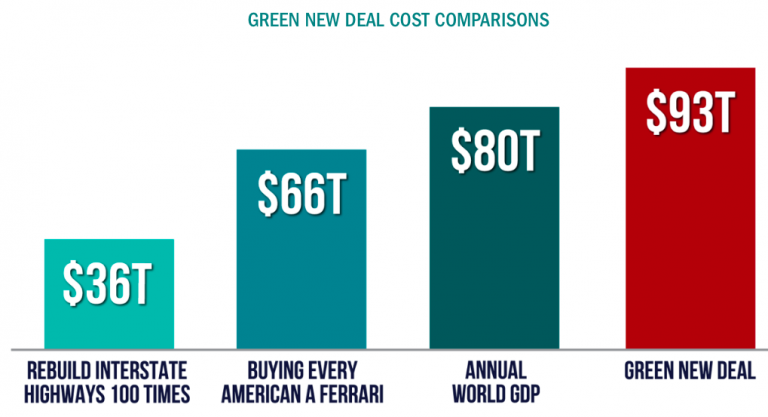
Experts and policy groups were quick to supply some numbers. Over $1 trillion in regulatory and administrative costs. Between $51 and $93 trillion over the first 10 years for full implementation.
But those numbers were crunched and reported on within the first three weeks of the Green New Deal’s launch. What if a group spent some time and studied a portion of the plan in-depth?
That’s exactly what my organization, Power The Future, did. In collaboration with the Competitive Enterprise Institute, we undertook a months-long deep dive into the prospective costs of implementing only the energy and climate-related facets of the Green New Deal for a typical household in five representative states (Alaska, Florida, New Mexico, New Hampshire and Pennsylvania).
Using readily-available and public statistics as starting points, we focused our research on four categories:
Additional electricity demand;
Costs associated with shipping and logistics;
New vehicles; and
Building retrofits.
The results are staggering. We found that a typical household in Alaska would pay more than $100,000 the first year, more than $73,000 for years two through five, and over $67,000 annually after that to implement the Green New Deal’s goals in energy and climate-related changes.
With the median Alaskan household annual income sitting at $66,251, who, if anyone, could afford the Green New Deal?
Before any readers start shouting, “Show me the math!”, we’ve done exactly that. The costs associated with the Green New Deal’s implementation are actually understated. The study excluded the costs to bring air cargo into compliance, for lack of available data.
Alaskans know all-too-well that this is a major pathway for delivery of so many of our goods and would be costly to change. The study also excluded a myriad of other Green New Deal program costs, such as a government takeover of healthcare and a guaranteed jobs program.
There was also no publicly available data on the costs to replace combustion engine-driven snow machines, ATVs, boats or private airplanes, so those weren’t included in the study.
For Alaskans, these are highly-used secondary sources of transportation to/from business, recreational and subsistence activities. Think of the costs associated with replacing each of them with electric capacity-driven alternatives.
Adding those numbers to the equation would likely make the Green New Deal even more gut-wrenching to the average Alaskan household.
The takeaway from all of this is that the Green New Deal sounds great to some on the far left of the political spectrum, but a closer look reveals the Green New Deal to be a smorgasbord of programs that would decimate Alaskan families, who simply cannot afford a $100,000 plus bill.
It’s time for Alexandria Ocasio-Cortez and her far left allies to go back to the drawing board, because Americans will not, nor should not, accept a plan that will bankrupt our country.
Rick Whitbeck is the Alaska State Director for Power The Future, a national non-profit advocating for energy workers and development opportunities, while pushing back on radical green groups and the ideologues who fund them. Contact him at [email protected].
A bold new entrant into the journalism scene in Alaska is led by the former editor of the Catholic Anchor, who in partnership with the president of Crystal Clear Creative, has launched the Alaska Watchman, a news organization that will be covering mainly social issues from a Judeo-Christian perspective.
Joel Davidson had been with the Catholic Anchor for 13 years, but had long dreamed of starting the Alaska Watchman, he told Must Read Alaska. He wants to cover issues that are hot-button items for people of faith, and issues that pertain to the attack on family values.
With video and web, the Alaska Watchman will explore social issues including free speech, religious freedom, marriage, abortion, LGBTQ controversies, and more.
Davidson and Jake Libbey are raising money for the project with this video, released today:
Davidson is a life-long Alaska who lives in Palmer with his wife and children. Besides his longtime experience at the Catholic Anchor, he was a reporter for the Frontiersman from 2004-2006.
The website for the news organization is already launched and populated with several stories, including a story on Drag Queen Story Hour, Planned Parenthood sex-ed materials, Alaska Bar Association freedom of speech issues, and more.
Davidson will appear on Wednesday at 5 pm with Jim Minnery on the Family Mattersradio show on KVNT 92.5FM or 1020AM to discuss the project and its unique niche in the Alaska news landscape.
A letter sent by 19 Democratic legislators and one Republican, criticizing Gov. Michael Dunleavy for supporting due process in the Pebble Project, lacked the signatures of the vast majority of Republicans, with the exception of Sen. Gary Stevens of Kodiak.
The letter was in response to a letter written by Dunleavy to the chief executive officer of Wheaton Precious Metals Corporation, which stated the state would defend the mine against unfair interference and “frivolous and scurrilous attacks.” Dunleavy has said often that he supports due process,
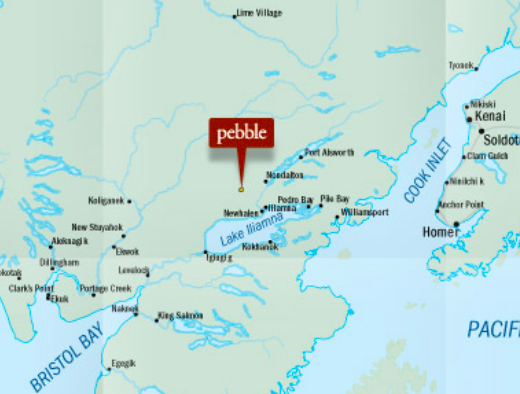
According to the Democrats’ letter, which was also sent to the CEO of Wheaton, the mining project is on the “edge of Bristol Bay.” In fact, the Pebble Project is 230 miles by river from Bristol Bay, or about the same distance by air as Anchorage is from Homer.
“Opposition to this project is both local and statewide, and is not frivolous, slanderous or interference. As individual Alaskans, our opposition to this project arises from the potentially severe social, economic, and cultural risks that the Pebble Mine represents,” according to the lawmakers who signed the letter that was released on Monday.
“Alaskans will vigorously defend their existing cultural and economic interests, and assuming that permitting will be pro forma carries substantial risk. As Alaskans, we refuse to jeopardize an existing, sustainable resource for the sake of an economically dubious project,” they wrote.
A few days earlier, Rep. Chuck Kopp, a Republican, penned an op-ed that ran in Alaska newspapers in which he supported mining as a way to end the despair that has led to lawlessness throughout rural Alaska and he called for an end to divisive and “caustic rhetoric, inaccurate information, and a false dichotomy that says it’s either mining jobs and infrastructure or protection of the environment.”
Suffice it to say, Kopp did not sign the letter to the Wheaton company CEO but stayed on the side of the fair permitting process of a State of Alaska asset.
Mining projects across Alaska.
Alaska’s mining industry breathes new life into our communities
By REP. CHUCK KOPP
A lot of news lately has focused on the very real concerns we have about our future here in Alaska. Lack of public safety, job opportunities, education funding and a weak economy all present challenges that are bringing people together in unprecedented ways to realize a more secure future for our state.
For the first time since statehood, we are seeing year-over-year declines in our population as working-age adults and their families leave Alaska in search of work, taking their expertise with them. The Anchorage Economic Development Corp. reports a loss of 900 jobs just in Anchorage in 2018, and projects another 700 in 2019, as well as 1,000 in 2020. The statewide job loss numbers are much bleaker.
This situation underscores the importance of taking seriously every opportunity to turn this around. A recent announcement of a major oil producer leaving Alaska is a poignant reminder of how critical it is for us to have a stable investment climate, and that the oil and gas sector alone can no longer carry the freight for us. More diversity to our revenue stream is needed, and we do not have the luxury we once had to dismiss viable prospects right in front of us.
The economic strain has a direct nexus to our public safety crisis in rural Alaska. The Anchorage Daily News and ProPublica special report ‘Lawless’ is an astounding observation of just how many of our rural communities are desperate for public safety and other resources necessary to thrive. Numerous cash-poor villages and towns are in terrible predicaments without any public safety presence and few options.
Is there any good news? Yes. Alaska’s mining industry. It continues to weather severe and often unwarranted criticism, while providing almost 15,000 jobs in communities around our state. Just six producing mines, two development projects and several advanced exploration projects are each the single largest property taxpayers in their regions, pumping hundreds of millions of dollars into local economies and providing critically needed infrastructure and high-paying jobs that are breathing new life into rural communities long deprived of hope to improve their economic condition.
It has been said that labor rids us of three great evils — idleness, vice and poverty. Strong and vibrant communities, healthy families and good mining industry jobs are all inextricably linked together, opening paths to freedom, opportunity and a thriving self-sufficiency. The only losers are suicide, crime and substance abuse.
It’s important to remember the abundance of our natural resources and our commitment to market them was key to our gaining statehood 60 years ago. Congress feared that Alaska would be unable to raise enough taxes due to its small population and end up as a welfare state. The tide finally began to turn in favor of statehood with the discovery of gold and other natural resources. We were able to prove we could “pay our own way” and that our value to the U.S. was significant.
Alaska has been a natural resource extraction state for well more than 150 years, with the mining industry as the bedrock of our economy for nearly a century. Most of our population centers, from Juneau to Fairbanks to Nome, were founded by miners. Oil and gas are relative newcomers, and while the energy sector has a bright future, so does our mining industry. Today more than ever, Alaska needs this industry to realize its potential to help stabilize our economy, strengthen our communities and move Alaska forward into a more secure and prosperous future.
The simple truth is, we are no less desperate today for the hope, opportunity and economic freedom brought to us by the mining industry than we were 150 years ago. If a development project is awarded a permit because it has incorporated significant public input and met the necessary and stringent permit process requirements, then we should enthusiastically welcome the jobs, economic freedom, and family stability that flows from a well-developed, well-planned, community supported project that breathes new life into absolutely desperate areas of our state.
What does such a project look like? As recently reported by KTOO, the Donlin Gold project is currently busier renovating a century-old church in Chuathbaluk than building a mine because caring for their neighbor is a high priority. Eric Morgan Sr., subdeacon of the Russian Orthodox church said, “we can’t express our thanks (to Donlin) … like thanks from the heart from the whole village.” Donlin spokesperson Kristina Woolston simply stated, “It was the right thing to do.” Friends, this is generous, peaceful and life-renewing service in cooperation with the community.
Alaska’s mining industry employs Alaskans, whose concerns and burdens for the environment and a better life are the same as our own. Our mining industry routinely works with their neighbors to help alleviate suffering and improve the lives of their region.
I think it is fair to say most Alaskans want a well-regulated mining industry to flourish in our state, and desire to encourage more of this type of investment. But it will be necessary to stop the polarization and divisiveness that comes from caustic rhetoric, inaccurate information, and a false dichotomy that says it’s either mining jobs and infrastructure or protection of the environment. Our modern-day mines in Alaska have repeatedly shown that both needs can be well accommodated. The future of our state depends on the effort of multiple industries and entrepreneurs working together to move us forward into a more secure future.
Every successful mine is an exciting story of new life being breathed into Alaska. We need more of these stories today.
Rep. Chuck Kopp, R-Anchorage, was elected to the state House of Representatives in 2016. This commentary is dedicated to the memory of his friend, the late Alaska Sen. Chris Birch, a mining engineer and a strong champion of responsible natural resource development.
From the Alaska Support Industry Alliance: TheWillow Master Development Plan Draft EIS public meeting will be held on Thursday, Sept. 12, 2019, 6-8 PM at the Crown Plaza Midtown in Anchorage.
FERC sticks to strict guidelines about public comment, so you should have time to give verbal input, should you choose.
You may submit a personal statement via online comment form, emailor mail by October 29, 2019. Letters may be sent to Willow MDP DEIS Comments, Bureau of Land Management, 222 West 7th Ave., Stop #13, Anchorage, AK 99513.
The Willow Project provides for up to five drill sites, a central processing facility, an operations center, gravel roads, ice roads, ice pads, one airstrip, a nearshore staging area for module transfer, pipelines, and a gravel mine site. Construction activities could span more than seven years and at its peak, construction and design activities could employ as many as 2,000 people. Long-term, the project will create more than 300 jobs for operation of the field. Of the various development alternatives discussed in the EIS, ConocoPhillips prefers development Alternative B and module transfer Option 1. The BLM also prefers Alternative B and Option 1. Public comments in support of the selection of Alternative B and Option 1 will be helpful in ensuring these are selected in the Final EIS.
Willow will be the first development in the Bear Tooth Unit in the Northeast NPR-A (National Petroleum Reserve-Alaska) on Alaska’s North Slope. Willow is approximately 30 miles west of the Alpine Central Processing Facility. Willow could be under construction in 2021 with first oil in the 2025-2026 time frame. Willow will be a stand-alone development capable of producing in excess of 100,000 barrels of oil per day (BOPD). The project is estimated to cost $4 billion to $6 billion.
The attached sheet from ConocoPhillips outlines 10 Key Facts which can be helpful in your drafting of a public comment.
DEBATE WATCHING PARTY IN JUNEAU, ANCHORAGE, FAIRBANKS
The top polling candidates in the Democratic 2020 presidential primary will face off on Thursday, Sept. 12, on the debate stage in Houston, Texas, at an event hosted by ABC News and Univision.
Since there are only 10 top candidates who met the threshold, that means only half of the Democratic field is invited, and the debate will last just one night, for three hours, rather than two nights.
The players in the Sept. 12 Democratic Presidential Debate.
The Democratic Party is hosting a Bingo event. If you text 43367 with the word BINGO you’ll receive an electronic Bingo card in advance of the debate. The Democratic Party will also then have your phone number, so only do this if you want your information mined by Democrats and their associated causes.
In Alaska, debate parties will be held by Democrats starting at 3:30 pm:
Peanut Farm, 5227 Old Seward Highway, Anchorage
Roundup Steakhouse, 2701 S Cushman St, Fairbanks
TK Maguire, 375 Whittier Street (Prospector), Juneau, starts at 4 pm
The frontrunners to be on stage are:
Minnesota Sen. Amy Klobuchar
New Jersey Sen. Cory Booker
South Bend, Indiana, Mayor Pete Buttigieg
Vermont Sen. Bernie Sanders
Former Vice President Joe Biden
Massachusetts Sen. Elizabeth Warren
California Sen. Kamala Harris
Entrepreneur Andrew Yang
Former Texas Rep. Beto O’Rourke
Former Housing and Urban Development Secretary Julián Castro
Biden and Warren, vying for the top spot, will be on stage at the same time for the first time.
Warren is polling well in Alaska with Democrats. She, Sanders, and Harris have all said they will end natural gas “fracking” if elected president.
“On my first day as president, I will sign an executive order that puts a total moratorium on all new fossil fuel leases for drilling offshore and on public lands. And I will ban fracking—everywhere,” Warren proclaimed on Twitter on Sept. 6.
“If you think Alaska’s budget woes are tough now, think about the Alaska situation under a Warren presidency, shutting down our entire resource-based economy” said Glenn Clary, chairman of the the Alaska Republican Party.
Striking back, the National Rifle Association has sued San Francisco over the city and county’s declaration that the Second Amendment organization is a “domestic terrorist organization.”
The lawsuit was filed in U.S. District Court for the Northern District of California on Monday, after last week the city and county of San Francisco and its Board of Supervisors designated the NRA a domestic terrorist organization.
The NRA lawsuit says the city is discriminating against people “based on the viewpoint of their political speech.”
This, according to the lawsuit, is an attempt to curb the NRA’s free speech rights, and is a way to blacklist anyone in the city who is associated with the NRA through membership. The resolution also encourages other city and county governments and the federal government to also blacklist the NRA as a terrorist organization.
The lawsuit asks the court to “to instruct elected officials that freedom of speech means you cannot silence or punish those with whom you disagree.”
San Francisco Mayor London Breed has not signed yet signed the resolution, but it would take effect within 10 days if she doesn’t sign it or veto it.
Wayne LaPierre, the executive vice president of the NRA, said that the organization’s 5 million members are not terrorists. After gun rights are attacked, the NRA usually sees a spike in membership.
The NRA annual report distributed earlier this year showed that dues went from $128,209,303 in 2017 to $170,391,374 in 2018, a 33 percent increase year over year. During the same period contributions rose from $132,879,299 to $165,075,288 for an increase of 24 percent.
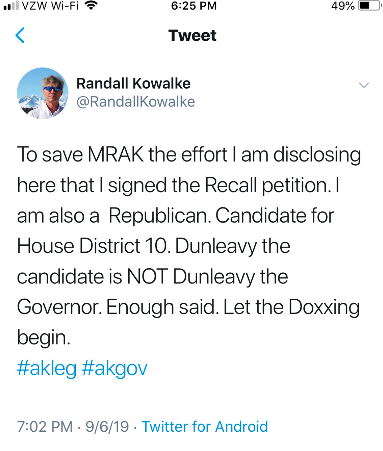
Former Mat-Su Borough Assemblyman Randall Kowalke, a Republican challenger for Rep. David Eastman, says he’s in favor of recalling Gov. Michael Dunleavy, because the candidate Dunleavy is not the same as the governor Dunleavy.
Kowalke, who lives in Willow, took to social media to disclose his opinion (and to save Must Read Alaska some time, evidently). He’s taking on Eastman in House District 10 likely because he sees himself as an anti-Dunleavy Republican, while Eastman is more in line with the governor on issues such as spending and the Constitution.
Kowalke wrote, “Let the doxxing begin.” Doxxing is publishing private or identifying information about a person on the Internet, typically with malicious intent, according to Wikipedia.
Anyone who has been through a divorce knows this: It’s a death in the family. It’s a painful death, and when children are involved, it’s a death for them, too.
When there are children, the death just keeps happening throughout their lives as they try to navigate the birthdays, the holidays, and the other big moments, creating an emotional state of grieving that seems to last a lifetime. Because kids want their parents together — they just do.
But in politics, divorce is fair game. It’s a moral flaw. It’s fodder, and there is no escaping it. Especially if your last name is Palin; there’s nothing like Palin to sell clicks on a website, and try as we may, even Must Read Alaska cannot avert its eyes from the news of this pending divorce.
What Todd and Sarah Palin have been through in their marriage, no one really knows. They’ve had good times, rocky times, and tragedy, much played out in the public eye and some of it of their own making. As with almost all couples, what the world sees and what the world thinks it knows is not the whole story. Not even close.
Craig Medred broke the story on his news site CraigMedred.news. He updated it hours later with information that indicated a court clerk may have fudged a bit by allowing the Palin divorce to be filed by their initials only, while the rest of the divorcing public must file using their full names. That is a small sin, perhaps, but annoying to everyday Alaskans who tsk at such privilege. Rules should be applied evenly and Alaska royalty should not get special treatment. Their lawyer should have advised them better.
Todd filed on a Friday, hoping perhaps to stay out of the limelight. No such luck. Sarah Palin is the favorite punching bag for the liberal media, and she gives it back in spades, typically. She seems to have thrived on the battle with the “lame stream media,” as she has been known to call it.
Living in the spotlight is hard on a marriage, and harder on a divorce. If they get it right, they’ll remain friends, and they are the type of people who can get it right, even while breaking up the camp and going separate ways.
For now, the real sin committed is by those who throw stones at a marriage that has fascinated the world, a marriage that has simply ended sadly. The sin is committed by those who drag the children into it and use them as a battering ram against their parents.
In the beginning, the two were high school sweethearts who eloped in August of 1988 after Sarah finished college and had started a career in sports reporting. The first of their five children was born the following April. She ran for city council of Wasilla, and started a political career that eventually led to a nomination for the vice presidency of the United States. Todd was seemingly always Todd, the sportsman, the businessman, the steady husband coping with the churn of fame and fortune of his wife, who was governor, television star, author, and icon.
In the end, the years and the realities of All Things Palin wore down the love.
The end of the marriage isn’t the end, however. The couple has children and grandchildren, nieces and nephews, parents, sisters, and brothers. These are ties that bind forever, especially around holidays, birthdays, and those big life events, such as birth and death.
You never know … Todd and Sarah could get back together someday. Couples do. But for now, there’s been a death in the family, and plenty of heartache to go around, and some voyeuristic handwringing: Even the beautiful people, it turns out, don’t really live charmed lives.
As for the news cycle, there’s the 24 hours when this is grist for the mill, and then we’ll all be off to another piece of salacious fascination — until the Palins do something else that captures us once again. Because we cannot get enough of them, can we?