By ART CHANCE
SENIOR CONTRIBUTOR
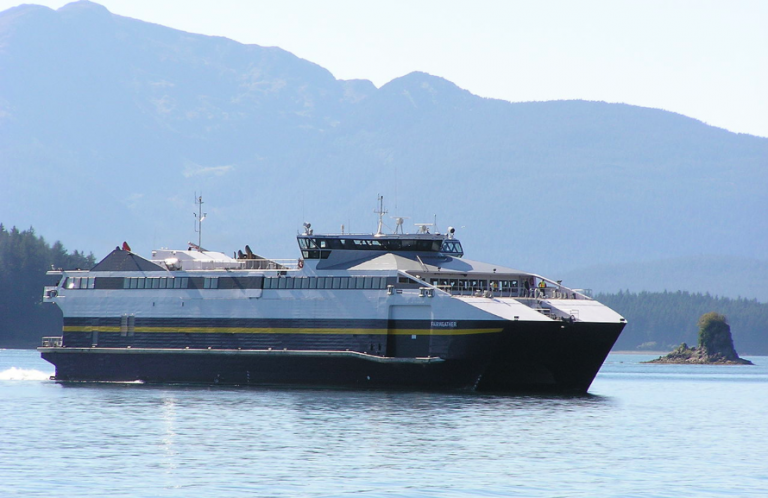
Breathless coverage about the Department of Transportation’s plan to sell off the two Fairweather Class fast ferries reminds me of how we acquired these two ill-fated ferries in the first place.
If you’re a lefty/greenie, it is a tragedy because they were a lefty/greenie wet dream, an antidote to the push for a Juneau road.
I was there when the Tony Knowles Administration threw an arbitration and gave the Marine Engineers union (MEBA) a quarter million bucks, which Joe Geldhof used for walking-around money to narrowly defeat the initiative to build a Juneau road.
After I became director of labor relations in the Murkowski Administration I found the MEBA positions that the criminals at DOT had hidden in doubled up Position Control Numbers.

If I were in charge, I’d reopen a wing in Palmer Correctional Center just for DOT employees. One of my formative experiences with the State was on sunny Fridays watching a Range 20 procurement officer for the AMHS sail his 40-foot trawler majestically down Gastineau Channel on his way to Taku Harbor. I spent most of my career as a range 20-something in State government with a range 20-something wife. Sorry, you don’t have 40-foot boats even on two range 20-something salaries.
I inherited the fast boats when I became head of State labor relations in early 2003. We had a couple hundred million bucks worth of boats coming in the spring of 2003 and nobody at DOT or the Alaska Marine Highway System had a clue how we were going to run them.
We kept the Knowles Administration’s parasites Bob Doll and George Capacci on the payroll through April so they could get another year of PERS credit and maybe help us with planning how we were going to run these white elephants. They were both useless and I finally used labor relations money to hire a Canadian consultant to give us some clue how you ran a high-speed craft code vessel under U.S. maritime and labor laws.
The only beef I have with Gov. Frank Murkowski is that he was loyal to old friends even when he shouldn’t have been. He was buddies with lobbyist Don Kubley’s dad in their Ketchikan days, and Donnie was lobbying for the licensed marine unions; he could get to the governor when nobody else could.
I don’t think he ever got to the governor without the commissioner of Administration or me in the room, but it wasn’t for lack of trying.
The only upset I ever had with Murkowski and his Chief of Staff Jim Clark was when I made a deal to go to Seattle to meet with the licensed unions to see if we could make a deal. I told them I’d give them 20 percent if they’d let me write the work rules. They remembered the 20 percent, but forgot the part about my writing the work rules; we argued about that a lot.
The unions joined the Greenies in support of the fast boats, but once the fast boats came on line, they wanted nothing to do with them. The fast boats were meant to run like airplanes; the unions wanted to run them like 19th Century sailing vessels.
We argued with the unions, we tied up the boats, and we never could get a deal with them that didn’t risk shutting down the whole system. Somewhere in this computer is an email I wrote to Jim Clark when I was facing meeting with the marine unions the next morning. I had no airspeed, altitude, or ideas. I told Jim that the price of oil had been over $50 for a month or so, so why didn’t we just throw some money at the “fine gentlemen” and get off the front page of every paper in coastal Alaska. Jim told me not to ask, but if I could get a deal, do it.
We never got a deal with the marine unions that would allow economic operation of the fast boats. The Fairweather Class was too small for summer traffic in Northern Lynn Canal, so it required a traditional vessel on the route as well. Neither ran full and both lost money. There were routes that might have been successful, Sitka to Juneau might have worked and some of the Southern Southeast routes might have worked. But fundamentally, they were just an ideological proposition that was never intended to solve a transportation problem. I wager we’ll give them away on eBay.
Art Chance is a retired Director of Labor Relations for the State of Alaska, formerly of Juneau and now living in Anchorage. He is the author of the book, “Red on Blue, Establishing a Republican Governance,” available at Amazon.