Thursday, October 8, 2026
Home Blog Page 1409

Kabuki court in session: Judge sets fake hearing on issuing recall petitions

JUDGE PURPOSEFULLY DRAINING DUNLEAVY DEFENSE FUNDS?

Judge Eric Aarseth is scraping egg off of his face this week. Trying to repair damage to his reputation of impartiality, he has called for another court hearing that involves one of his Jan. 10 decisions on whether the Recall Dunleavy petition can move forward to the signature-gathering stage.

Those oral arguments he says will be made on Jan. 29 in Anchorage.

BACKGROUND – A SERIES OF JUDICIAL MISSTEPS

The case involves a quest to unseat Gov. Mike Dunleavy via recall election. The State of Alaska and Stand Tall for Mike say there are no legitimate grounds for recall.

When the original oral arguments were made Jan. 10, observers noted that Aarseth had scheduled two hours for the court hearing. But when he arrived in court, the judge suddenly cut it to one hour — one half hour for each side.

That change left the Recall Dunleavy defense team scrambling without time to coordinate and cut their two presentations down by half. By the time Stand Tall for Mike’s attorney Brewster Jamieson stood to give his presentation, the judge quickly cut him off and told him to conclude.

As he began that hearing on Jan. 10, Aarseth announced he would have a decision at the end of it. This was an unmistakable signal he’d already determined the outcome.

And he had. After a 10-minute break after the hour of arguments, Aarseth returned with a 15-minute explanation of why the Recall Dunleavy petition was legal, and he then announced he would not be granting a “stay” on the petitions, while the matter was appealed to the Alaska Supreme Court by the Stand Tall for Mike group, defending the governor.

Don’t bother asking for a stay, he said, as he was ordering the petitions to be issued by Feb. 10.

Jamieson, arguing for Stand Tall for Mike, asked if he might ask for that stay anyway. Might he be permitted by the court to get that in writing, as this would allow the Stand Tall group to then appeal the “no stay” ruling to the Supreme Court as well as appealing the Aarseth ruling on the merits of the case? The judge begrudgingly agreed.

On Jan. 16, Aarseth had received the Stand Tall argument for a “stay” on the petition booklets, and he reversed his original ruling, and granted the stay, pending the decision by the Alaska Supreme Court.
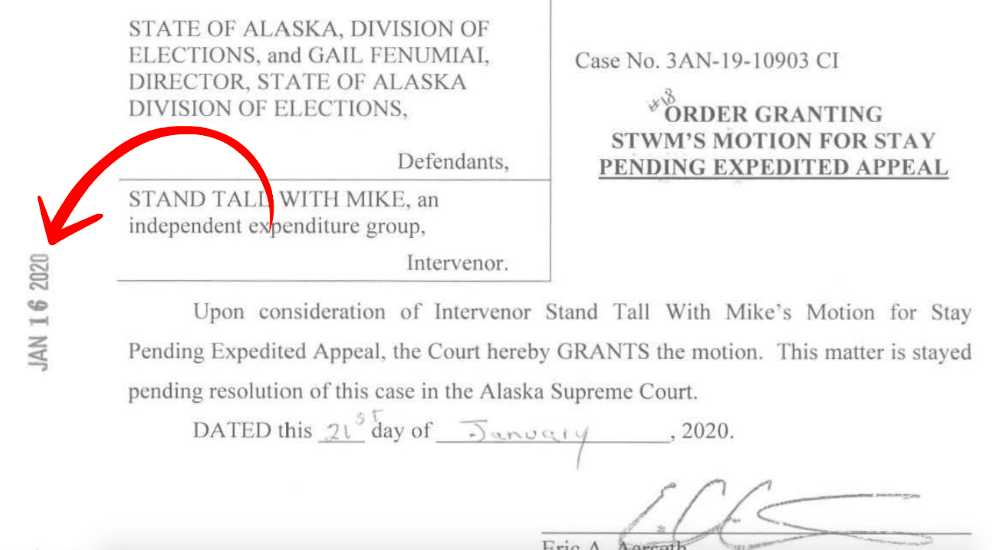
Six days later, on Jan. 22, Aarseth reversed that ruling and said he had made an error.

The court system issued an explanation on Twitter on Jan. 22:

“On January 21, Judge Aarseth reviewed the Unopposed Motion for Expedited Consideration of Motion for Stay Pending Appeal and the Motion for Stay Pending Expedited Appeal filed by STWM while out of town on a urgent family issue.”

“He telephonically authorized granting the Motion for Expedited Consideration only. The Motion for Stay Pending Expedited Appeal was inadvertently granted as well.”

Now, the hapless judge has scheduled oral arguments on the decision about whether the petition booklets can be issued while the case is still under consideration.

That court date, Jan. 29, is only 12 days from the date Aarseth had said the Division of Elections must have the petition booklets printed and available for the Recall Dunleavy group.

Each error and reversal runs up the bills for the Stand Tall group — writing motions, writing reply briefs — all in pursuit of appearing in a Kabuki courtroom, where both sides and the judge already know what the outcome will be: Judge Aarseth is going to rule against the governor and for the Recall Dunleavy group. That you can take to the bank.

Breaking: Senate Majority ‘death sentence’ in works

38

Update – The Senate Republican caucus appears to have backed away from the signed budget pledge referred to in this story. It will be updated if other developments occur.

Republican senators are being asked to sign a pledge to support every budget item approved by Senate President Cathy Giessel and her leadership team, or lose their membership in the Majority Caucus.

Must Read Alaska has learned that the pledge has been signed by most senators and covers the operating, capital, supplemental, “reverse sweep” and Permanent Fund dividend appropriation. It means that halfway through the two-year session, the rules of the Majority caucus are different, and the leadership wants it in writing from all members.

The majority caucus meets at 2 pm and the remaining senators who have not signed the pledge will be confronted with their final decision about whether to be included with the rest of the Republicans.

The move follows a complete reorganization of the Senate on Tuesday, where the most conservative members were stripped of their committee chairmanships and committee memberships. Sen. Mike Shower, Senate Seat E, lost membership in five committees and three subcommittees, and lost two chairmanships. Sen. Lora Reinbold, Sen. Mia Costello, Sen. Peter Micciche, and Sen. Shelley Hughes were also put in the corner.

The move would mean the Senate would likely change to a bipartisan majority with Sen. Tom Begich, a Democrat, as one of its more influential members.

Losing membership in the Republican Majority would mean anyone who does not sign the pledge will lose staff and will likely be relegated to a small office.

Judicial thumb on scale?

THE ANCHORAGE DAILY PLANET

What we first thought was a return to common sense in the misguided recall effort aimed at Gov. Mike Dunleavy turns out to only be a reaffirmation of earlier silliness.

For reasons only he knows, Superior Court Judge Eric Aarseth on Jan. 10 ordered the Division of Elections to issue signature booklets to the Recall Dunleavy group – even as its case against the state pends in court. The state had rejected the group’s recall petition as having insufficient grounds.

The order allowed the group to begin another round of signature-gathering to force a special election to replace Dunleavy.

Tuesday, the judge signed an order, at the request of the Stand Tall with Mike group, that halted that booklet distribution until the Alaska Supreme Court gets a chance to look at the case. From where we sit, that only makes eminent good sense. In the end, it could save the state money and time.

All that was out the window Wednesday when Aarseth said “the court inadvertently issued an order” on Tuesday that paused his ruling ordering the Alaska Division of Elections to distribute signature booklets to Recall Dunleavy. He vacated his Tuesday ruling. Turns out, the judge was out of town, and says he approved the wrong order by telephone.

Stand Tall with Mike gets another chance to argue its case for suspension of the booklet distribution, but who knows how that will turn out?

Aarseth’s ruling that the booklets must be distributed seems to us no less than a judicial thumb on the scale of justice. The Recall Dunleavy group saves precious time by Aarseth’s decision allowing it – despite its case being unresolved in the court system – to proceed as if everything is copacetic.

It would seem to us that holding up the booklets until the all judicial remedies are exhausted would only make good sense.

Whatever the eventual outcome, this bit of on-again, off-again judicial dither is enough to make Alaskans begin to wonder about their court system.

If the Recall Dunleavy group’s ridiculously low bar for recall, if the same level of mis-, mal- and non-feasance it applied to Dunleavy were applied to Aarseth’s handling of his booklet order, he might well find himself looking for a new job.

Read more at the Anchorage Daily Planet.

Nadler attacks Senate GOP, and Murkowski slaps back

33

Sen. Lisa Murkowski had a few choice words for Rep. Jerrold Nadler, the Chair of the House Judiciary Committee leading the charge on impeachment.

Nadler had been arguing in favor of having former national security adviser John Bolton testify during the Senate trial.

But Nadler could not resist his impulses — he had take it a step further and accuse all Senate Republicans of conducting a “cover up.”

Nadler had said, “I see a lot of senators voting for a cover-up, voting to deny witnesses, an absolutely indefensible vote, obviously a treacherous vote,” essentially putting Republicans on trial for corruption.

Even Sen. Chuck Schumer accused Republicans of taking part in a cover up.

That didn’t go over so well with Murkowski.

“As one who is listening attentively and working hard to get to a fair process, I was offended,” Murkowski told reporters who asked her to comment on Nadler’s needling.

Murkowski, considered a moderate Republican by most political observers, plays a key role in the proceedings because she is never in lock-step on any issue. People on the far right are often frustrated by her unwillingness to state her position on impeachment.

And now, she is starting to frustrate Democrats, as they continue to put pressure on her to vote to convict the president.

But Murkowski is process-oriented lawmaker, a trait that sometimes drives her conservative critics to distraction.

Murkowski was voting with McConnell and the rest of Republicans, except Sen. Susan Collins of Maine, in favor of taking things in steps. Witnesses could come later and Murkowski wasn’t going to be bullied into pre-judging whether witnesses are warranted.

The pressure is on, however. Murkowski’s office has received thousands of phone calls from around the country from Democrats encouraging her to vote with Democrats in favor of guaranteeing appearances by the Democrats’ witnesses.

Her siding with McConnell has the Left uneasy, so now they have taken to Twitter, a platform dominated by leftwing voices:

“Murkowski can take her righteous indignation and shove it,” one woman wrote.

“I find it ironic that Lisa Murkowski is outraged at Nadler for calling it a cover up! Well, Lisa what would YOU call it when every single republican voted down 3 different amendments to allow witnesses and documents? A COVERUP! Spare the outrage! The House deserves to be outraged,” wrote another.

“Mitt Romney, Susan Collins, Lisa Murkowski, and the other ‘very serious’ GOP phonies can feel free to go to hell. All these bastards are dragging us closer to totalitarianism, vote by vote,” wrote another angry leftist.

It’s new territory for Murkowski to be criticized by the Left for being too thoughtful and deliberative. These are usually the sentiments of the right wing.

The trial schedule has the issue of witnesses coming up six days after the opening arguments by the House Democrats and the Trump defense lawyers. For Murkowski, it seems to make sense, and appeals to her process-oriented nature.

“I went on to explain more fully what it is that we’re dealing with. And what has been proposed, at that point in time, was the same thing that we have in front of us right now, which is that we should follow this Clinton model …” Murkowski told reporters.

The Left is now as mad at Murkowski as the far right appears to be much of the time.

The “process-oriented senator” who works across the aisle to get bills passed, is not giving the Left the assurances they want, and their talons have come out. The entire scene is reminiscent of the criticism she faced when she refused to be a “yea” vote for Supreme Court Justice Brett Kavanaugh, only back then, the rebuke was coming from the other side.

It’s a reminder that in politics, “there are no permanent enemies, and no permanent friends, only permanent interests.”


Gasline agency has enough cash to continue a few years

9

The Alaska Gasline Development Corporation has $20 million left in its funded account, enough to continue at its current level of activity for several years.

Last year, the agency laid off several members of the staff to conserve funds and curtail the rampant spending that occurred under the reign of Gov. Bill Walker, who had taken over the project when he became governor in 2014, and had developed it in such a way that the private sector stepped out of it.

The agency, now operating with a more modest ambition, is asking the Legislature for “receipt authority” for $20 million more in Fiscal Year 2021, so that it can continue to solicit investors. Receipt authority is not an appropriation but the permission to bring in investment money.

The agency anticipates it will have $15 million in the bank at the end of the year.

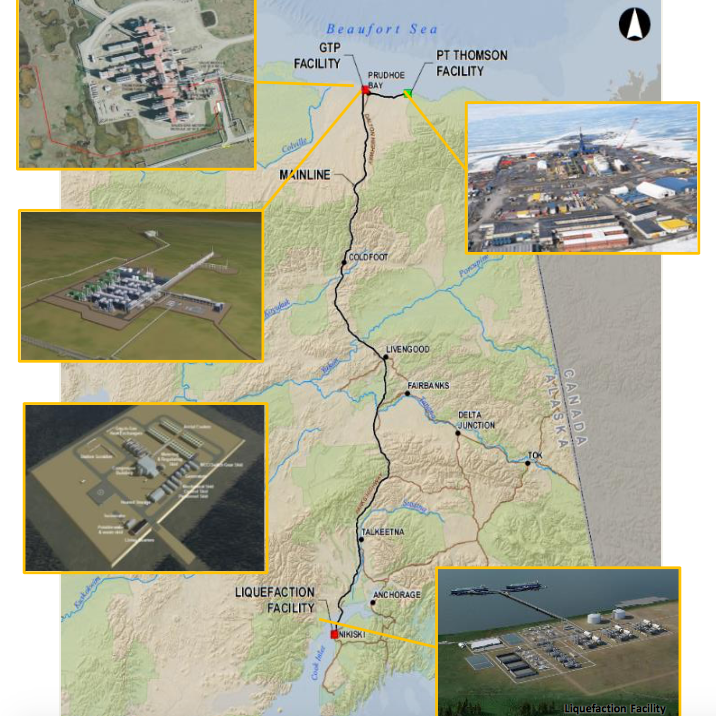
AGDC is trying to find a way to to develop a gasline from the North Slope to tidewater at Nikiski, on the Kenai Peninsula. It’s a challenge because the world is awash in natural gas, which is now selling at a record low amount, at times trading at below $2.

[Read: Has natural gas hit rock bottom?]

Natural gas prices are so bleak for industry that Chevron took a $11 billion write down in the fourth quarter of 2019, a reflection of devalued natural gas assets.

Agency leaders gave the House Resources Committee an overview of the project during the committee’s first hearing of the year.

The original appropriation for the agency was through appropriation to a fund, and AGDC can spend money out of the fund to progress the project. The agency does have to come to the Legislature for its operating budget, but capital expenditures come out of the fund, without additional appropriations.

The history of the project was outlined by AGDC President Joe Dubler today, without mentioning the hundreds of millions of dollars that had been drained off during the Walker Administration. Those details are explained in a story by Craig Medred, published this week.

The sanitized history outlined today, however, gave just the legislative turning points and a few other pivotal details. It did not talk about the $800,000 in annual compensation that the former head of the agency, Keith Meyer, was earning, nor the $120,000 a month contract that Walker awarded to Rigdon Boykin, his old colleague from the failed Alaska Gasline Development Authority.

Under Walker and Meyer, the Administration promised Alaskans the gasline construction would begin in 2019.

[Must Read Alaska’s story from 2016 about the direction the gasline was going in midway through the Walker Administration.]

In 2013 HB 4 created the Alaska Gasline Development Corporation (AGDC) in A.S. 31.25, giving broad powers and funding to advance the Alaska Stand Alone Pipeline Project (“ASAP”)

In 2014 SB 138 gave AGDC authority to represent the State of Alaska in the LNG terminal of the Alaska Liquefied Natural Gas Project (“AKLNG”)

In 2016 DNR bought out Trans Canada and AGDC was granted the entire 25 percent State share in AKLNG

In 2016 the Pre-Front End Engineering and Design was completed and the producers, based upon the economics resulting from that work, stepped aside to allow AGDC to continue working the project.

In 2019 AGDC focused its efforts on the AKLNG Project.

The agency then shelved the Alaska Stand Alone Pipeline Project (“ASAP”) after receiving the Joint Record of Decision and the right of way on federal land. The agency re-initiated the “stage-gate process” for the Alaska Liquefied Natural Gas Project (“AKLNG”).

Stage-gating is an industry standard for managing any large project or innovation rollout.

AGDC focused its activities on getting authorization to construct from the Federal Energy Regulatory Commission (“FERC”).

AGDC committed to evaluating the competitiveness of the AKLNG project by reviewing costs and updating the economic analysis.

The agency committed to bringing back the private sector soliciting companies to build, own and operate AKLNG.

The complete presentation by AGDC President Joe Dubler and his staff is at this link:

Breaking: Can Dunleavy get a fair shake from this court?

JUDGE REVERSES RULING AGAIN: PETITION ON RECALL CAN PROCEED

The judge who issued a “stay” to prevent petition booklets from being issued for the Recall Dunleavy effort, has now reversed his ruling — again. This is his second reversal on the same question.

He vacated his order that went out Tuesday. The Tuesday order was a reversal from his earlier order.

Judge Eric Aarseth originally said on Jan. 10 that he would allow the petition booklets to be issued to the Recall Dunleavy Committee.

On Tuesday, he changed his mind after the Stand Tall for Mike group asked for a “stay” in writing.

And today, he has reversed his ruling once again, saying he erred on Tuesday in an order that was stamped Friday, Jan. 16 and that was not made public until Tuesday.

The question is: While the legitimacy of the recall effort is being appealed to the Alaska Supreme Court, should the Recall Dunleavy group be allowed to collect signatures. Judge Aarseth, during the hearing on the case on Jan. 10, recessed for 10 minutes and then returned to issue a verbal ruling, allowing the petition to be distributed — a ruling that all in the courtroom could see he had decided before the hearing even started.

This is a developing story and will be updated.

Tuesday’s story:

Bloody Tuesday: New org. chart leaves Senate conservatives out in cold

The more conservative members of the Senate’s Republican Majority lost some of their influence today, as Senate President Cathy Giessel and her leadership team reorganized the Senate, putting three Democrats into key committees.

The Senate went through a bruising shuffle, with conservatives being punished for either voting against the budget last year, being absent for the budget vote, or voting against overriding some of the governor’s budget vetoes.

The reorganization exercise came to a head after a several-hour negotiation, when at times the conservative Republicans were being dared to walk out of the Republican caucus altogether, or vote for their own “death sentence” on committees. They didn’t however, and won back some of the seats they were on the verge of losing.

In the end, Democrats had gained influence, while five most conservative Republicans lost positions.

The vote for the reorganization, called the “Report on Committees,” passed the Senate 13-7, with all five Democrats voting for it.

But the Republicans fractured on the vote. Less than a majority of Republicans voted for it, while most opposed the punishing of the conservatives; the vote was six Republicans in favor, and seven opposed to the reorganization.

That’s a dangerous signal for the Senate Republicans, to have the Senate Republican Majority surviving what could have been a leadership meltdown; Sen. President Giessel retained her gavel thanks to 100 percent cooperation from Senate Democrats.

Sen. Mike Shower of District E Wasilla was hit especially hard by the reorganization, being removed from five committees and one chairmanship and being added to just one committee.

Later however, at least some Democrats felt they left too much on the table and grumbled into the night about wanting a vote on Wednesday to rescind the action taken today and negotiate a better deal, now that they’ve seen the split in the Republicans.

Here are some of the highlights:

COMMUNITY AND REGIONAL AFFAIRS

  • Sen. Mia Costello was removed from the committee. Sen. Mike Shower was named to the committee, while Sen. Peter Micciche named vice chair. Sen. Click Bishop remains chair.

EDUCATION

  • Sen. John Coghill, who is Rules chair, was appointed to the committee. Sen. Shelley Hughes was named vice-chair.

FINANCE

  • Sen. Mike Shower and Peter Micciche were both removed from the Finance Committee. The committee, which started out last year with nine members, is now the traditional seven. Without those two extra Republican seats, there are just four Republicans on the committee, and three Democrats. Republicans Natasha Von Imhof and Bert Stedman, remain co-chairs.

JUDICIARY

  • Sen. Hughes removed as chair. Sen. Coghill, who is Rules Chair, named new chair. Sen. Micciche named vice chair.

LABOR AND COMMERCE

  • Sen. Lora Reinbold was removed from committee. She was the chair. Sen. Click Bishop is the new chair. Sen. Josh Revak was appointed to committee. Sen. Gary Stevens was added as vice chair.

RESOURCES

  • Sen. Micciche is the new chair, (replacing the late Sen. Chris Birch, who was the chair.) Sen Reinbold was removed from the committee.

STATE AFFAIRS

  • Sen. Shower was stripped of his chairmanship. Sen. Revak is added and is the new chair. Kicked off the committee were Sen. Micciche, Sen. Reinbold. Sen. David Wilson was added.

TRANSPORTATION

  • Sen. Shower and Sen. Hughes were kicked off the committee, and Sen Costello was added and is the new chair. Sen. Wilson is vice chair.

JOINT ARMED SERVICES

  • Sen. Shower and Sen. Hughes were removed from the committee. Sen. Josh Revak and Sen. Donny Olson, a Democrat, were appointed, with Revak becoming chair.

LEGISLATIVE BUDGET AND AUDIT

  • Alternate member Sen. Micciche was removed, while Democrat Sen. Bill Wielechowski was added to the committee.

LEGISLATIVE COUNCIL

  • Sen. Costello was removed, and Democrat Sen. Tom Begich replaced her on the committee.

Elvi Gray-Jackson and the raft of virtue signaling bills

24

Among important bills read across today on the opening day of the Legislature the Senate are a handful of bills offered by Sen. Elvi Gray-Jackson:

SB 139: Establishing the month of March as Women’s History Month.

SB 140: Establishing the month of September as Hispanic Heritage Month.

SB 141: Establishing the month of October as Filipino American History Month.

SB 147: Establishing the month of June as LGBTQ Pride Month.

SB 148: Establishing May of each year as Asian American and Pacific Islander Heritage Month.

Of the 14 pre-filed bills, more than one-third of them were specially designated months offered by Gray-Jackson recognizing one or another group.

Last year, Gray-Jackson sponsored Black History Month legislation, which was signed into law by Gov. Michael Dunleavy.

Gray-Jackson’s virtue-signaling bills, if they pass both Senate and House, will force Gov. Mike Dunleavy to choose whether to continue making these several special months permanent fixtures in Alaska by signing them into law, or to allow one or more of them to simply go into law without his signature, (or, as some social conservatives would have it, veto the LGBTQ Pride Month legislation.)

LeDoux gets deal from House majority, gets committees

8

DEM-LED MAJORITY REFUSES TO SEAT AFRICAN-AMERICAN VET ON ARMED SERVICES COMMITTEE

Rep. Gabrielle LeDoux has rejoined the Democrat-led House Majority, and was given a seat on the Joint Armed Services Committee and Judiciary Committee. She also was restored “points” allowing her to hire an extra staff.

LeDoux says she did not, in fact, rejoin the majority.

With a 24-member Majority that has seven Republicans in it, that leaves the Minority with 16 members in the Republican-only caucus.

The deal LeDoux made to be allowed to return to the Majority caucus was not made public.

LeDoux left the combined Democrat-Republican caucus last May when it came down to voting for the Permanent Fund dividend, which was cut in half by the majority.

LeDoux was the only member of the House at the time to accept the first version of the budget from the Senate, saying she saw it as her only chance to get on record as voting for the full Permanent Fund dividend. Ultimately, the Senate cut the dividend in half.

LeDoux’s appointment to the Armed Services Committee came over the objection of the 15 members voting members of the minority, (Rep. Mel Gillis was absent).

Rep. Ben Carpenter of Nikiski pointed out on the record that there are six members of the House who are actual veterans, and he recommended that Rep. Sharon Jackson of Eagle River be given that appointment. She is an Army veteran and handled military issues for U.S. Sen. Dan Sullivan when she was on his staff.

Carpenter’s remarks were backed up by Rep. Laddie Shaw of Anchorage, and Rep. David Eastman of Wasilla. All are veterans. Rep. Tammie Wilson also spoke in favor of putting another veteran on the committee; she is married to a Vietnam veteran.

Only two members — 20 percent — of the Joint Armed Services Committee are veterans.

But Rep. Louise Stutes of Kodiak objected to the notion that one must be a veteran in order to care about veterans.

“To suggest you need to be a veteran to support veterans is foreign to me. I’m not a veteran, but trust me, I support our veterans wholly,” she said.

Over in the Senate, chaos in the Senate Republican majority consumed much of the day. It appeared that Sen. President Cathy Giessel was preparing to remove Sen. Mike Shower from the joint military committee as punishment for his vote for a full Permanent Fund dividend. Shower is an Air Force fighter pilot veteran.