The Alaska Supreme Court oral arguments for State Division of Elections vs. Recall Dunleavy Committee are scheduled for March 25 at 1:30 pm, and will be broadcast on KTOO’s Gavel Alaska, the Alaska Court System has confirmed.
Alaskans interested in following the proceedings are advised that the arguments will be made telephonically, but there will be a camera in the courtroom, live-streamed by KTOO/Gavel Alaska/360North. The justices will be visible, but the lawyers will not be visible.
The Supreme Court has limited access to the courtroom in Anchorage and is requiring the two parties participate by telephone due to the coronavirus outbreak.
This updates a story from last week on MRAK that indicated there was uncertainty about whether there would be a broadcast of the proceedings.
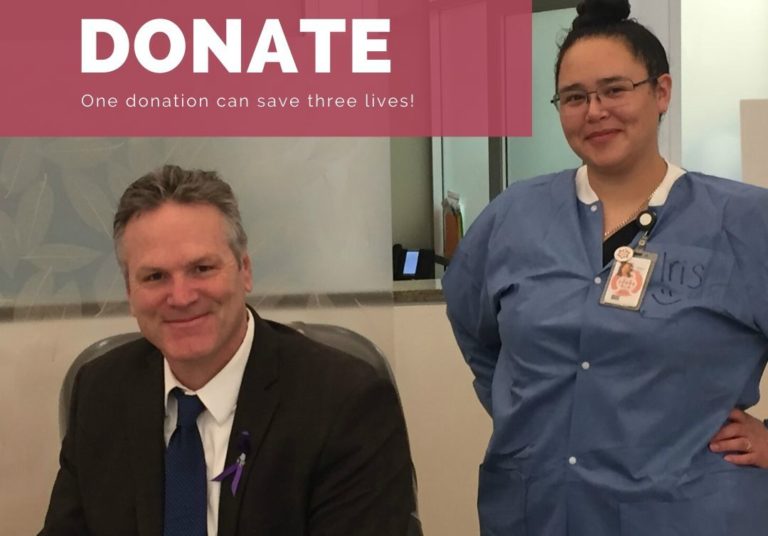
Gov. Mike Dunleavy stopped by and gave a pint of blood at Blood Bank of Alaska this morning. The blood bank was getting low on certain blood types and has put out the word for donors. 700 donors are needed each week to keep the blood supply in Alaska, providing it to to 21 hospitals across Alaska and to the military.
If interested in donating, call to schedule an appointment to ensure a limited wait time. 907-222-5630
I once taught labor relations to State supervisors and managers. After the movie, “Saving Private Ryan” was released, I started my class with taking my attendees to the scene in which the Tom Hanks character reports to headquarters behind Omaha Beach to get the order to save Private Ryan.
The scene is from the bluffs above Omaha Beach and looks out to sea. The beach is crawling with men, vehicles, and materiel. The ocean has ships and aircraft from horizon to horizon.
Art Chance
What is important about that scene is that it’s a realistic reenactment of an actual photograph, and that the only things in the scene that existed in 1941, were a WWI battleship in the invasion bombardment fleet, and the men themselves, who were mostly in high school.
Everything else had been produced by the War Production Board and the War Labor Board between the Declaration of War and June 6, 1944.
My professional career stems from the actions of the War Labor Board, which allocated labor to industries and determined draft deferments for those skills that should be deferred from the almost universal draft in WWII for those skills and trades which were necessary to national defense.
With all respect to my “true conservative” and libertarian friends, sometimes brute, authoritarian government power is the only thing that will do.
For my Juneau friends, the A-J Mine, perhaps the richest in the world, didn’t close because it ran out of gold; it closed because the US determined that in 1944 gold was no longer a strategic material, and the War Labor Board took away the draft deferments of A-J miners.
When the War ended, the price of gold was fixed at $35/oz. and A-J was not economic to re-open. It might well be a productive mine today, but the Juneau greenies and NIMBYs would have a fit of apoplexy.
In WWI, President Woodrow Wilson essentially nationalized certain major industries for war production. We had a command economy that Soviet Russia, Hitler’s Germany, and Mussolini’s Italy would have envied.
Since we had a Constitution and still understood and believed in it, we abandoned the war measures at the end of the war. There ensued the astounding boom of “The Roaring Twenties.”
For reasons that would make this a thousand words too long, that boom collapsed in 1929. I’m not as negative about The New Deal as some of my conservative friends, but it wasn’t an unalloyed good. There is a solid argument that President Franklin Delano Roosevelt didn’t end the Great Depression, but rather Hideki Tojo and Adolf Hitler did.
The FDR scheme wasn’t full nationalization of industry; the government left the control of industry in the hands of the executives and boards of the industries and left the profits to the shareholders. Interestingly, it is much like what the Nazis did with their Gleichshalstung, or co-ordination strategy.
The War Production Board basically ordered American industries to all but cease civilian production of goods. They offered contracts to produce war materiel to government specifications and sold to the government at low-bid prices.
The War Labor Board imposed the requirement that the contracts would be under what we would call today a union “project labor agreement.” This was before the Taft-Hartley Amendments so there were no “right to work” states. Almost all war production was done under a union contract. The condition of the union contract was that the contract had a “no-strike” provision and that labor disputes would be settled by arbitration rather than strikes. The imperative was that nothing could stop production.
I never practiced before any of the War Labor Board arbitrators, but I did practice before quite a few of their understudies; they were learned and practical men, and, yes, almost all men. By the end of my career, most of the people at the head of the table were barely literate.
To get back to what this is really about: President Trump has invoked the Defense Production Act, which is a Korean War era restatement of the War Production Act and the War Labor Act. It gives the President pretty much dictatorial authority over American industry. He has invoked it, but it is clear he really doesn’t want to use it.
President Trump, as am I, is a positional bargainer; he takes a position and tells you to talk him out of it or knock him off of it. He’s saying to American industry, “Don’t make me do it.” He knows that he can commandeer their company and make them do what the government tells them to do. It wasn’t that Ford Motor Company wanted to stop making 1941 Fords at their state-of-the-art Willow Run Plant or that the company wanted to start making B-24 Liberator bombers, but they made about 20,000 of them and bombed Germany to rubble.
I’ve played this game; union reps have come to me and I to them with the message: “Don’t make me do this to you.” President Trump has taken that message to US industry, which hasn’t served us well in the last 30 years or so: “You do it, or we will; your choice.”
So far, they seem to be getting the message.
Art Chance is a retired Director of Labor Relations for the State of Alaska, formerly of Juneau and now living in Anchorage. He is the author of the book, “Red on Blue, Establishing a Republican Governance,” available at Amazon.
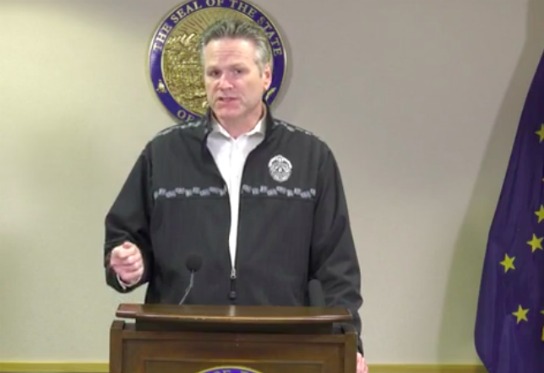
In a press conference that was brutally honest with Alaskans, the Dunleavy Administration today announced the most stringent mandates yet, similar to those imposed in Hawaii:
All travelers coming into Alaska must quarantine for 14 days upon arrival. They’ll need to go directly from their airport to the place where they’ll be quarantined, and that information will be collected from them as they arrive. The order takes effect March 25 and the State will reevaluate this mandate on April 21.
The Administration has not determined yet how it will collect that information from people arriving by boat or road, but most are arriving by air, said Health and Social Services Commissioner Adam Crum.
There are now 36 known cases of coronavirus in Alaska, four more since yesterday.
Chief Medical Officer Dr. Anne Zink said that the state now believes that four of the 36 cases are of “community spread,” which means they have no known connection to travel, although the four new cases today are travel related and are in Anchorage.
In another health mandate, the strong advisory to remain six feet apart from people outside one’s direct family unit is now a mandate. No gatherings of 10 persons or more are permitted, and any gatherings must maintain the six-foot rule.
In addition, all personal care businesses, such as salons, massage services, tattoo businesses and tanning salons are being temporarily closed across the state, said Commissioner Adam Crum. In some communities, this order has already been in effect because of the number of cases of the virus.
The governor said that the state is trying to focus on what can be done in the next couple of weeks, and he acknowledged that the economy won’t work if people can’t get to work. He thanked health care providers, public safety officers, and State workers who continue to work through the crisis, although many State workers are now working from home.
Dunleavy acknowledged that many Alaskans will end up getting the virus, many will get sick, some will get very sick, and he said some Alaskans may even die from it.
“This will be a challenge, but I don’t want Alaskans being afraid,” he said. “We shouldn’t be afraid, but we should be concerned. We should change our behaviors. It will help slow this virus down.”
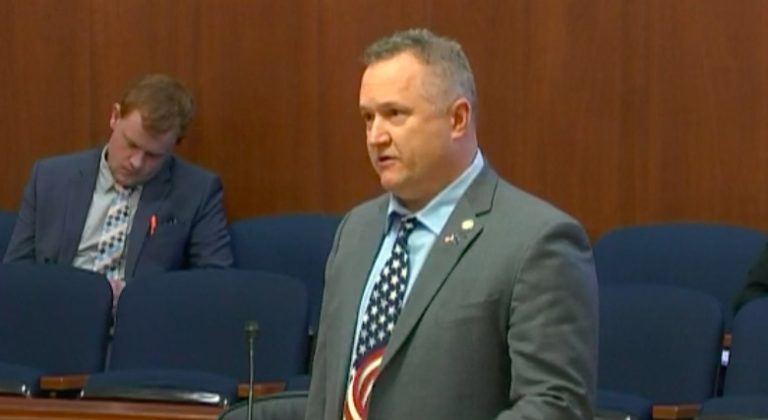
The Alaska Senate today passed an amendment to the operating budget that would issue a $1,000 emergency payment to most Alaskans in the next few weeks.
The amendment was offered by Sen. Mike Shower of Wasilla, and came after a similar amendment offered by Sen. David Wilson failed to pass; the Wilson amendment would have repaid Alaskans their $1,300 still due to them from last year’s Permanent Fund dividend, had it been issued according to the statutory formula.
Shower’s amendment did not refer to the PFD at all. It is a purely economic stimulus check that Alaskans would get in April, if the House goes along with it.
Whether the House will agree remains to be worked out between the two in conference committee. The conference committee process could see that payment reduced.
Voting for the cash payment to Alaskans were Senators Shower and fellow Republicans Shelley Hughes, Peter Micciche, Lora Reinbold, Josh Revak, Natasha von Imhof, and David Wilson; also Democrat Senators Tom Begich, Elvi Gray-Jackson, Scott Kawasaki, Donny Olson, and Bill Wielechowski.
Voting against the emergency allocation were Republican Senators Click Bishop, John Coghill, Cathy Giessel, Bert Stedman, and Gary Stevens; and Democrats Sen. Lyman Hoffman and Jesse Kiehl,.
Amendment 6 is not paying back the Permanent Fund dividend that was cut in half last year, but is about getting cash into families in Alaska at a time of year when they need it most — the end of winter.
In fact, if Sen. Shower had tied his amendment to the dividend, it probably would not have passed, since a majority of senators do not want to be caught in a position of voting in favor of restoring an already decided-upon dividend from last year. That might put them in a legal quandary of admitting that there’s money due.
“We just need to get money into people’s hands before we rule over ashes,” Shower said. “It’s not perfect, but this would put $4,000 into a family of four right now.”
If the measure gets conference committee approval, Alaskans might also see a $1,000 dividend in the fall, as that is the amount that is currently being discussed for this year’s dividend. That decision is also not final.
Although Mayor Ethan Berkowitz did not exempt gun shops from his Emergency Order 03 business closure list in last week’s emergency order, they remain open for business on Monday throughout the city.
Must Read Alaska scouted several gun shops and all were doing normal business. Cabela’s is open, with workers stationed near the entry to direct people to where they need to go, and is limiting the number of people allowed in the store at once. The only portion of the store closed is the cafe and the sunglasses counter.
One independent store owner said the emergency order was unclear, because it listed several types of necessary businesses that did not include firearms, but that he intends to stay open regardless.
“I don’t think this mayor wants to come and deal with closing us down,” he said, asking to remain anonymous.
Target, Walmart, Fred Meyer, Carrs, and other chain stores remain open in Anchorage, while mom-and-pop stores are generally closed unless they are on the list issued by the Mayor’s Office.
According to Mayor Ethan Berkowitz’ emergency order, the following businesses may remain open, but all others must close in Anchorage:
“Healthcare Operations” including hospitals, clinics, dentists, pharmacies, other healthcare facilities, home healthcare services providers, mental health providers, companies and institutions involved in the research and development, manufacture, distribution, warehousing, and supplying ofpharmaceuticals, biotechnology therapies, consumer health products, medical devices, diagnostics, equipment, services, or any related and/or ancillary healthcare services. “Healthcare Operations” also includes veterinary care and healthcare services provided to animals. “Healthcare Operations” does not include fitness and exercise gyms and similar facilities. Healthcare operations remain subject to the restrictions in the Mayor’s Emergency Order EO-02. To expand the capacity and supply of Healthcare Operations necessary for th~ response to the COVID-19 pandemic, all Healthcare Operators shall postpone appointments that are non-urgent or non-emergency whenever possible, and consider alternatives to face-to-face visits, in accordance with CDC guidance for Healthcare Facilities.
Businesses providing any services or performing any work necessary to the operations and maintenance of”Critical Infrastructure,” including, but not limited to, the Port of Alaska, public works construction, construction of housing, airport operations, water, sewer, gas, electrical, oil production, roads and highways, trucking and shipping companies, public transportation, solid waste collection and removal, internet, and telecommunications systems;
First responders, emergency management personnel, emergency dispatchers, court personnel, and law enforcement personnel;
Critical Government Functions, meaning all services needed to ensure the continuing operation ofthe government agencies and provide for the health, safety, and welfare of the public. Federal and State of Alaska employees should follow direction of their employer regarding whether and where to report to work;
Defense and national security-related operations supporting the U.S. Government or a contractor to the U.S. government;
Grocery stores, supermarkets, food banks, marijuana dispensaries, convenience stores, and other establishments engaged in the retail sale of food, beverages, or other household consumer products (such as cleaning and personal care products, pet food and pet supplies). This includes stores that sell groceries and also sell other non-grocery products, as well as stores that sell products necessary to maintaining the safety, sanitation, and operation of residences;
Food cultivation, including fishing, hunting, farming, and livestock;
Businesses that provide food, shelter, and social services, and other necessities of life foreconomically disadvantaged, unsheltered, or otherwise vulnerable individuals;
Newspapers, television, radio, and other media services;
Gas stations and auto-supply, auto-repair, towing companies, and related facilities;
Banks, mortgage companies, insurance companies, and related financial institutions;
Hardware stores;
Plumbers, electricians, exterminators, and other service providers who provide services that are necessary to maintaining the safety, sanitation, and operation ofresidences and critical businesses;
Businesses providing mailing and shipping services;
Educational institutions for purposes o f facilitating distance learning;
Laundromats, dry cleaners, and laundry service providers;
Restaurants, bars, and breweries and other facilities that prepare and serve food and beverages, but only for delivery or carry out under the restrictions laid out in the Mayor’s Emergency Order E0-01;
Businesses that supply products needed for people to work from home;
Businesses that supply other critical businesses with the support or supplies necessary to operate; l
Businesses that ship or deliver groceries, food, goods or services directly to residences;
Businesses that provide transportation services of passengers or goods, including the Alaska Railroad;
Home-based care for seniors, adults, or children;
Hotels, residential facilities and shelters for seniors, adults, and children;
Professional services, such as legal or accounting services, when necessary to assist in compliance with legally mandated activities;
Childcare facilities, subject to new recommendations for increased hygiene and social distancing. Childcare facilities should be used only by those who need childcare to work at a critical job.
A group of 50 doctors in Fairbanks have sent a letter to Gov. Mike Dunleavy, on Sunday asking that he enact a shelter-in-place policy for the entire state as well as a mandated travel ban.
“We are physicians from Fairbanks, Alaska, contacting you out of concern for our patients, our community and our fellow healthcare workers. We work in different medical specialties and clinical settings across Interior Alaska but we are unified in our expert medical advice:
“1. Alaska must have a shelter in place order immediately; and 2. Alaska needs a mandated travel ban.
“We are seeing a rise in laboratory confirmed COVID19 cases as well as a dramatic increase in patients presenting with symptoms that are clinically consistent with COVID19 infection here in Fairbanks.
“New data suggests that COVID19 infection appears to be predominantly spread by people who are minimally sick or asymptomatic. It is these very citizens who feel well and are not adopting the necessary social distancing measures that are spreading COVID19 in our community. We appreciate the steps that you have already taken to restrict travel and encourage Alaskans to stay home but it is becoming clear that the voluntary recommendations on travel and social distancing are proving inadequate. Many Alaskans have not adopted these necessary measures and continue to move around our community and the state without regard for the consequences.
“We implore you to take immediate action to help slow the spread of COVID19 so that our limited healthcare resources will not be overwhelmed. Acting today will save Alaskan lives.”
The letter was signed from a range of practitioners, including family medicine to specialists in the Fairbanks area.
Dr. Zink issued a public response to the doctors’ public letter:
We appreciate and understand the concern of these physicians from Fairbanks. The Alaska Department of Health and Social Services’ epidemiology team is working around the clock on the response to this pandemic. Next steps are constantly evaluated and discussed several times a day. What all Alaskans need to do right now is make sure they are washing their hands, properly covering their cough or sneezes, practicing social distancing and staying home when they are sick. These steps will help everyone stay healthy. Every Alaskan who makes these changes helps mitigate the spread of this virus across our state, which could save the lives of our fellow Alaskans.”
COVERAGE IN A TIME OF COVID-19 IS TURNED OVER TO ROBOTS
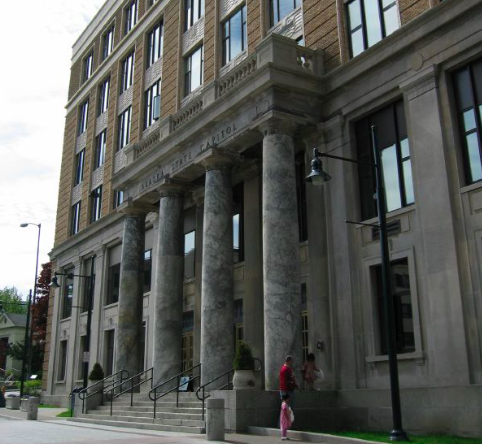
During what is expected to be the last week of the Legislature this year, KTOO will no longer have a physical presence in the Capitol Building with camera operators for Gavel to Gavel coverage on 360North.org. and public television.
That coverage will be provided by the Legislative Affairs Agency Media Services for committees. Gavel Alaska has developed a way to send those grainy video feeds to the KTOO control room for broadcast on television.
For floor sessions in the House and Senate, the public broadcasting station will use robotic cameras starting Monday.
Gavel Alaska provides live coverage of the Alaska Legislature, including committee meetings, floor sessions, press conferences, and other legislative events.
AND NINE OTHERS STATEWIDE, INCLUDING MAT-SU, ANCHORAGE
The Alaska Department of Health and Social Services confirmed Juneau’s first positive case of COVID-19. The case is an adult, and the person has not been hospitalized and is isolating at home. At this time, it is not known if this is a travel-related case. The total number of cases in Alaska that are confirmed rose to 32.
The Alaska Department of Health and Social Services announced 9 other new cases of COVID-19 in two Alaska communities – Anchorage (7), the Matanuska-Susitna Borough (2).
All cases were in adults; none were hospitalized. All of these persons are isolating themselves at home and their close contacts are being asked to self-quarantine for 14 days and monitor for symptoms.
One of the Anchorage cases had recent travel outside of Alaska. The remaining cases are not known to be travel-related at this time.
The Section of Epidemiology is continuing to investigate these cases in cooperation with Joint Base Elmendorf Richardson, the Anchorage Health Department and local public health nurses.
“At least two of the new Anchorage cases that we are investigating have no clearly identified contact with a confirmed case,” said Dr. Joe McLaughlin, Alaska’s State Epidemiologist. “This indicates that community transmission of COVID-19 appears to be occurring in the Anchorage area.”
Travelers arriving from anywhere outside of Alaska should self-quarantine for 14 days, per the March 20th Alaska Health Alert. Find more information about how to keep yourself and your family healthy at coronavirus.alaska.gov.
Additional current information on COVID-19 is available through DHSS at coronavirus.alaska.gov.